
Glowing Flowers
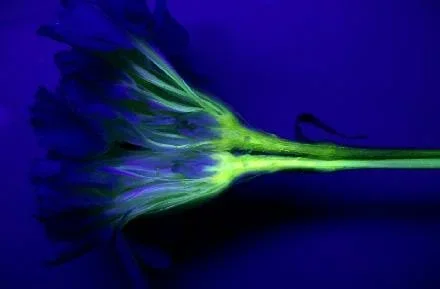 Figure 1. A flower injected with fluorescent dye under ultraviolet light.
Student teams learn about engineering design of green fluorescent proteins (GFPs) and their use in medical research, including stem cell research. They simulate the use of GFPs by adding fluorescent dye to water and letting a flower or plant to transport the dye throughout its structure. Students apply their knowledge of GFPs to engineering applications in the medical, environmental and space exploration fields. Due to the fluorescing nature of the dye, plant life of any color, light or dark, can be used — unlike dyes that can only be seen in visible light.
Engineers develop technologies to advance the possibilities of scientific research. From microscopes designed to see extremely small things, to spacecraft that can peer into far-away galaxies, to a special dye that make stem cells glow, we learn about how things work in our world with the help of engineers.
Engineers play a large supporting role in recent advances in medicine, including research on the treatment of cancer. Research on using stem cells for management of diseases and injuries are among these treatments. Engineering developments in this area allow researchers to study the behavior of stem cells and how they replicate, travel and react in our bodies.
After this activity, students should be able to:
- Describe why fluorescence is useful to observe cells in living organisms.
- Describe engineering designs that are advancing stem cell research.
- Gather, analyze, and interpret data and models on the different types of cells, their structures, components and functions
Grade 7
Do you agree with this alignment?
- Advances and innovations in medical technologies are used to improve healthcare.
Grades 6-8
Do you agree with this alignment?
- MS-LS4-5 Gather and synthesize information about the technologies that have changed the way humans influence the inheritance of desired traits in organisms.
Grades 6-8
This resource focuses on the following Three Dimensional Learning aspects of NGSS:
Science & Engineering Practices- Conduct an investigation to produce data to serve as the basis for evidence that meet the goals of an investigation.Do you agree with this alignment?
Disciplinary Core Ideas- In artificial selection, humans have the capacity to influence certain characteristics of organisms by selective breeding. One can choose desired parental traits determined by genes, which are then passed on to offspring.Do you agree with this alignment?
Crosscutting Concepts- Engineering advances have led to important discoveries in virtually every field of science, and scientific discoveries have led to the development of entire industries and engineered systems.Do you agree with this alignment?
Do you agree with this alignment? - Conduct an investigation to produce data to serve as the basis for evidence that meet the goals of an investigation.
Each group needs:
- 3 flowers or leaves of their choice (Note: Choose flowers/leaves from a pile collected by the teacher or have the class go outside and find samples from school grounds. Be sure to advise students how to take clippings without damaging the tree, plant or surroundings. Note: Carnations work well.)
- 1 plastic cup
- 4 latex gloves (2 per person)
- 1 pair tweezers or tongs
- 1 razor blade or other cutting tool to "dissect" the plants. (Note: Advise students on proper cutting techniques or have a "cutting station" where they can bring their specimen to be cut by an adult.)
- 1 square brown or black (darker colored) cardboard, ~ 1 ft x 1 ft
- Dyeing Plants Worksheet (PDF)
To share with the entire class:
- fluorescent blacklight (~15W) (Note: A fluorescent blacklight may be purchased for ~$20. Incandescent lights are less expensive, but do not provide enough energy for this activity.)
- radiator leak detection dye (available at NAPA or other auto parts store for ~$3)
- (optional) microscope (to take a closer look at the dye in the veins of the plant)
Students should have know the parts of a cell and cell function. It is helpful to complete the associated lesson, The Cloning of Cells, to introduce students to the engineering applications in stem cells research.
Student Scientist Roger: I just put stem cells into this mouse, but I have no idea where they went! To its feet? Its heart? How do I see them?
Master Scientist Ebert: You should talk to the engineer down the hall. I heard he created a dye that you can add to the stem cells and see them as they move through the mouse!
Student Scientist Roger: Wow! That's amazing! Engineers are so helpful.
Cancer is a type of disease in which a cell or group of cells shows uncontrollable growth, invasion or displacement of surrounding cells or tissues, and sometimes spread to other areas of the body through blood or lymph fluids. Many cancers form a tumor; however, some cancers, such as leukemia, do not. Cancers can be found in other animals besides humans, as well as plants. Cancer treatment currently involves surgery, radiation therapy, and/or chemotherapy. Another treatment option for cancer that is being researched involves the use of stem cells. Does anyone know what a stem cell is? Stem cells are specific cells that have the ability to replicate by mitosis and can be grown and differentiated into the many cells in our bodies, including different types of muscle and brain cells. The two classes of stem cells are: embryonic stems cells found in a developing human embryo, and adult stem cells, found in umbilical cord blood and bone marrow. Stem cell research includes the study of using these specialized cells to replace cancerous cells in the body and treat other injuries like spinal cord injuries.
Engineers are involved in the advancement of stem cell research. One example of an engineering innovation that is helping with stem cell research is the development of green fluorescent proteins (GFPs) (see Figure 2). Chemical and bioengineers develop these proteins in a lab based upon a naturally-occurring protein in jellyfish that makes them glow. This particular engineered protein glows bright green under a blue light which helps the observer determine where the protein is located in a Petri dish or in an organism. Engineers have developed modified forms of this protein that can be genetically linked to specific naturally-occurring proteins within the cells of an organism. Basically, the GFP protein is joined to a specific naturally-occurring protein in a laboratory. The GFP protein is small and does not damage the natural protein's function. The modified protein is placed back into the organism. When the GFP-linked natural proteins and cells replicate, the attached GFPs replicate along with it. This way, the observer can really see how and where a specific protein replicates within the body of an organism.
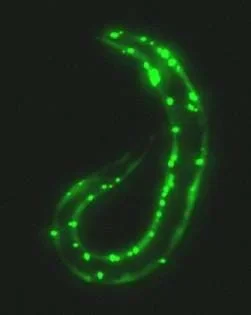 Figure 2. A worm injected with green fluorescent dye.Copyright National Institutes of Health, National Institute of Neurological Disorders and Strokes http://www.ninds.nih.gov/news_and_events/news_articles/news_article_torsion_dystonia.htm
For example, donor mice can be injected with a GFP-linked protein which functions just like a regular protein in the mouse. The GFP-linked proteins replicate within the different cells in that mouse, creating a donor mouse in which the cells glow bright green under a blue light. Target cells from the donor mouse (such as stem cells) can then be removed and injected into another mouse to see (under a fluorescent blue light) where the injected GFP-linked cells go in the new body, as shown in Figure 3. This is especially important for stem cell research since stem cells can differentiate into a number of different cells when injected into a body. This engineered fluorescing protein helps researchers answer critical questions, such as, "What kind of cells are generated from stem cells?" and "Can these cells replace damaged cells and help cure diseases?"
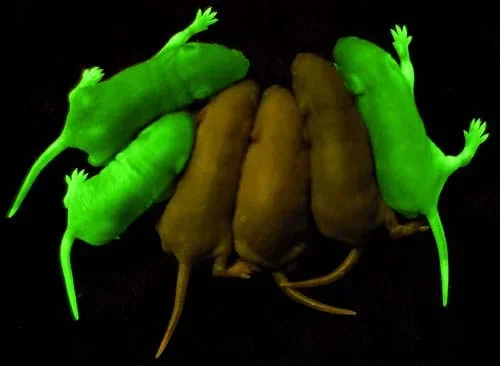 Figure 3. Mice born with green fluorescent protein (GFP) stain, inherited from a father who received a donation of spermatogonial stem cells.Copyright National Institutes of Health, National Institute of Child Health and Human Development http://www.nichd.nih.gov/news/releases/green_brown_mice.cfm
Before the Activity
- Gather materials and make copies of the Dyeing Plants Worksheet (PDF).
- Mix the fluorescent solution by adding 1 part of the radiator detection dye to 50 parts water. The water should look medium to dark orange. (Note: This should be done carefully by the teacher, with gloves, and the students should be careful handling it as it may easily dye/discolor anything with which it comes in contact.)
- Fill plastic cups to about 1-½ inches with dye solution
- Cut flowers, leaves and any other plant specimens that you want to study to about 6 -7 inches long so that stems fit in the cup without the flower/leaf resting directly in the dye solution.
With the Students
Day 1: Setting up the activity (30 minutes)
- Review stem cell and cell biology background with the students.
- Ask students what they think will happen when the plants are placed in the dye. Will we be able to see the dye even in dark-colored leaves? (Ask them to write their hypotheses on their worksheets.)
- Divide the class into groups of two students ieach. Have each pair choose their three plant/flower specimens (from either the teacher's collection or from outside).
- Have students place all three specimens in one cup with dye solution, making sure that the end of the stem is in the liquid by at least one inch and the leaf or flower is not touching the solution.
- Leave the specimens in the dye overnight in an undisturbed location.
Day 2: (60 minutes)
- Set up a blacklight station/area in the classroom where all students can see.
- Ask all students to gather their materials, collect their specimens, put on their gloves and ready their tweezers or tongs.
- Have students pull each specimen from the cup with the tweezers/tongs and lay them on cardboard. (Tip: Hold the cup over the cardboard to prevent dripping during the moving process. The dye is very strong.)
- Once every group has specimens arranged on the cardboard, turn off the lights and have each group bring their specimens to the blacklight station one at a time.
- Shine the blacklight on the plants/flowers so the class can observe the samples from each group (see Figure 1).
- Have the students draw pictures on their worksheets of what their specimens look like when under the blacklight. Have them include written descriptions of their pictures to clarify.
- If time permits, have students cut into the veins or stem of the plant and take a closer look.
- Again, have students bring their cut samples to the blacklight station one at a time.
- Ask each group to share their discoveries with the class and discuss any changes from their hypotheses to their observed results.
- Ask the students to finish their worksheets.
- Engage the class in a group discussion based on the worksheet questions, including which plants/flowers were brighter from the dye and where the dye was carried throughout the flower.
- Engineers design fluorescing proteins that can be replicated within animals and plants for many different purposes. Have students imagine the variety of ways that fluorescing proteins could advance our knowledge of the world around us, including, but not limited to, medical, environmental and space exploration applications.
- fluorescent
- A glowing effect caused by the energy difference between an absorbed and emitted photon (light)
- gfp
- (green fluorescent protein) A protein naturally found in jellyfish that fluoresces green when exposed to a blacklight.
- donor
- A person or animal providing blood, an organ, cells, or other biological tissue for another person or animal
Pre-Activity Assessment
Prediction: Have students predict the outcome of the activity before it is performed. What will happen to the dye solution when the plant is placed in the dye overnight?
Activity Embedded Assessment
Dyeing Plants Worksheet: Have students record their observations using the activity worksheet; review their answers to gauge their mastery of the subject. Which plant fluoresces the most? Where did the dye move to within the plant?
Post-Activity Assessment
Engineering Applications: Engineers have developed different GFPs that can be linked to various proteins in a plant or animal. Not only have they developed GFPs that glow green, but engineers have developed fluorescing proteins that glow in other colors including reds, blues and yellows. One application of this is attaching different colored proteins to different cells within one organism. For example, neurons in the brain of mice have been linked with the different colored fluorescing proteins to follow the wiring of the brain. This may help researchers understand how to treat life-altering diseases such as Alzheimer's. With a partner, think about one or more ways that multicolored fluorescent proteins could be used to find out something about an organism.
The dye is toxic if ingested and easily dyes anything in which it comes in contact. Always use gloves when handling the dye and dyed plants; only the teacher should handle the concentrated dye.
To be able to best see the fluorescent dye, use a fluorescent bulb of ~15W. (Note: Do not use an incandescent light; it will not work in this experiment.)
If possible, use a microscope to get a closer look inside the plant's veins.
Have students research other uses for GFPs. Some of these include identifying organisms based on individual differences (for example, two types of compound eyes are found in fruit flies and house flies), detection of carbon dioxide by mice, and cloning of organisms.
U.S. National Institutes of Health, National Institute of Child Health and Human Development, July 18, 2006, accessed October 3, 2008. http://www.nichd.nih.gov/news/releases/green_brown_mice.cfm
National Institutes of Health, National Institute of Neurological Disorders and Strokes, News & Articles, "Dystonia Protein Linked to Problem Common in Other Neurological Disorders," August 6, 2008, accessed October 4, 2008. http://www.ninds.nih.gov/news_and_events/news_articles/news_article_torsion_dystonia.htm
Contributors
Christie Chatterley; Malinda Schaefer Zarske; Janet Yowell
Supporting Program
Integrated Teaching and Learning Program, College of Engineering, University of Colorado Boulder
Acknowledgements
The contents of this digital library curriculum were developed under a grant from the Fund for the Improvement of Postsecondary Education (FIPSE), U.S. Department of Education and National Science Foundation GK-12 grant no. 0338326. However, these contents do not necessarily represent the policies of the Department of Education or National Science Foundation, and you should not assume endorsement by the federal government.
Copyright
2008 by Regents of the University of Colorado.