
High Arches, Low Arches
A main concern of shoe engineers is creating shoes that provide the right amount of arch support to prevent (or fix) common gait misalignments that lead to injury. During this activity, students look at their own footprints and determine whether they have either of the two most prominent gait misalignments: overpronation (collapsing arches) or supination (high arches). Knowing the shape of a person's foot, and their natural arch movement is necessary to design shoes to fix these gain alignments.
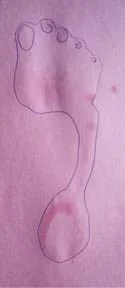 The average person's footprint has a distinct forefoot, midfoot and heel.
The first step of the engineering design process is to recognize a need and identify a problem, which in this case, is to address overpronation and supination. These gait misalignments can cause a variety of hip, knee and foot injuries. Determining the shape of a person's foot and their natural arch movement helps identify the gait misalignment, the first step in designing a shoe or orthotic to fix it so a person can walk or run pain-free.
After this activity, students should be able to:
- Explain how engineers are involved in shoe design and how they help people walk and run pain-free.
- Explain the difference between overpronation and supination.
- Explain the health consequences of gait misalignments.
- Identify overpronation and supination by looking at a footprint, and determine the type of orthotic that would compensate for it.
- Identify the design problem to solve and decide whether or not to address it.
Grades 9-12
Do you agree with this alignment?
Each student needs:
- 2 sheets of construction paper
For the entire class to share:
- tub, big enough for a foot to step into
- water, enough to fill ½ inch (1-2 cm) in the bottom of the tub
- paper or cloth towels
- markers
Has anyone ever noticed what happens to the arch of your foot as you walk? (It collapses to act like a shock absorber and then stiffens to act as a lever to initiate the next step.) Why do you think it does that? Does anyone wear orthotics or custom footbeds in their shoes? Can you explain what are they for?
Most people have an average walking and running stride that does not cause foot, knee or hip pain. Some people have misalignments between their feet, knees and hips that are often caused by their foot arches collapsing too much or too little. During each step, the arch of the foot collapses to act as a shock absorber when the foot first hits the ground and then stiffens to make the foot act like a lever to initiate the next step. Engineers can design shoes to fix misalignments or can retrofit shoes with new foot beds, or orthotics, to create the correct alignment and reduce the chance of injury or pain.
The two most common misalignments are overpronation, which is also referred to as having flat feet, or having a collapsing arch. What would a person's footprint look like if s/he suffered from overpronation? (The arch would not be defined and the foot would taper from the narrowest at the heel to the widest at the toes with no gap for an arch in the middle.)
The other common misalignment is supination, or high arches. Look at the soles of your shoes. Does anyone wear down the soles of your shoes on the outer edge more rapidly than the rest of the shoe? This is a sign of supination, which occurs when the foot does not rotate inwards enough during the stride. What would a footprint from a supinator look like? (A very narrow arch and a clearly-defined heel and forefoot.)
The first step in designing an orthotic or a shoe for a person with a gait misalignment is finding out from which misalignment s/he suffers. While looking at a footprint does not tell a doctor or engineer everything about a person's stride, it provides a good starting point for designing the footbed of a custom shoe.
Before the Activity
- Gather materials.
- Fill the tub with about a half inch of water.
With the Students
- Have each student remove the shoe and sock from one foot.
- Lay a sheet of construction paper by the tub.
- One by one, have students dip his/her foot into the tub of water and take a normal step with the wet foot, stepping onto the paper.
- Have the student run across a second sheet of paper after re-wetting his/her foot.
- While still damp, have each student use a marker to outline his/her footprints on the papers, for analysis once the water has dried. Have students write their names on the papers and identify which is the walking vs. running print.
- Place the outlined footprints at the front of the room and, as a group, classify them as overpronators, supinators, or neither (average). In an overpronator's footprint, the arch would not be defined and the foot would taper from the narrowest at the heel to the widest at the toes with no gap for an arch in the middle. A supinator's footprint would show a very narrow arch and a clearly-defined heel and forefoot.
- Look at each person's running footprint. Forefoot runners have smaller impact areas compared to their walking stride since they land mostly on the midfoot and forefoot. Heel strikers have larger footprints compared to their walking footprints since they are impacting the ground with their entire foot with a higher speed than if walking. This causes the foot to pronate more and have a higher surface area in contact with the ground.
- Conduct a class discussion about how the extremes of misalignment can contribute to the overall misalignment between ankles, knees and hips, potentially leading to pain.
- Have students approximate the areas of their feet by dividing their feet into four rectangles: toes, forefoot, arch and heel. Measure and calculate the area of each of the rectangles and add up the four pieces to find the total impact area.
- Conclude with a class discussion about how total impact area changes depending on whether a person is running or walking. Point out that when running, a person hits the ground at a higher speed, and thus has a higher impact force. Explain the relationship of various gait misalignments to the shape of person's foot. If the arch collapses, a shoe must be designed with more arch support and if the arch does not collapse enough, the shoe must be designed with more padding underfoot. To design shoes to fix these gait alignments, the shape of a person's foot, and their natural arch movement must be known. So now you know both of these factors for your own feet.
- orthotic
- An insert placed inside a shoe to correct either overpronation or supination.
- overpronation
- Excessive rolling inward movement of the foot when walking or running. Predisposes lower extremity injuries (such as knee injuries). Causes heavier wear on shoes on the inner margin. Collapsing arches while walking.
- supination
- A rotation of the foot and leg in which the foot rolls outward with an elevated arch so that in walking the foot tends to come down on its outer edge. Leads to shoes wearing on the outer edge, and knee injuries. High arches. The opposite of pronation. Same as underpronation.
Pre-Activity Assessment
Exploratory Discussion: As a class, lead a discussion using the following questions. Then step outside so everyone can walk and run around a nearby open area, paying closer attention to these issues.
- Where on the soles of your shoes does it wear out first?
- Do you think you have high arches or low arches? Do you have flat feet? Do you have collapsing arches? Are you an overpronator, supinator, or neither? Can you tell?
- Have you noticed the stages of your walking gait and running gait? (While running outside, let students look for when their feet are on the ground or airborne.)
- What happens to the arch of your foot as you walk? Why do you think it does that? (Let students watch each other run before clarifying this answer: The arch collapses to act like a shock absorber and then stiffens to act as a lever to initiate the next step.)
- Do you (or someone you know) wear orthotics (custom footbeds)? What are they for?
Embedded Activity Assessment
Class Discussion: Put all of the outlined footprints at the front of the classroom and have students determine which ones are indicative of overpronation, supination, and which are fairly average. Discuss how each misalignment can contribute to the overall misalignment between ankles, knees and hips (which is covered in more detail in the associated Shoes Under Pressure lesson).
Post-Activity Assessment
Wrap-Up Discussion: With what students have learned from their own footprint analysis about their gait alignment and foot shape, make the points that each footprint is different and has a different impact area with the ground. Depending on the flexibility of a foot's arch, a person can be classified as an overpronator or supinator, and shoes can be designed to fix each misalignment. The area of a person's foot that comes into contact with the ground also changes the pressure that the foot is under during each impact. While running, the impact force is greater than walking because the impact speed is greater and a smaller foot experiences a greater impact pressure than a larger one.
- Watch for slippery floors.
Future Shoe Design: Have students investigate the latest science and engineering research on humans running without shoes. How are the impact forces different without shoes? To start, look at Science Daily's article, "Barefoot Running: How Humans Ran Comfortably and Safely Before the Invention of Shoes" (February 2010), and The Guardian's article, "The Barefoot Professor: Running Without Shoes May Mean Fewer Injuries" (January 2010). Have students report to the class how these findings are impacting the design of footwear (to simulate barefoot running). For example, see Vibram's Five Fingers.
- Shoes Under Pressure
- Convertible Shoes: Function, Fashion and Design
- High Arches, Low Arches
Contributors
Eszter Horanyi
Supporting Program
Integrated Teaching and Learning Program, College of Engineering, University of Colorado Boulder
Acknowledgements
The contents of this digital library curriculum were developed under a grant from the Fund for the Improvement of Postsecondary Education (FIPSE), U.S. Department of Education and National Science Foundation GK-12 grant no. 0338326. However, these contents do not necessarily represent the policies of the Department of Education or National Science Foundation, and you should not assume endorsement by the federal government.
Copyright
2010 by Regents of the University of Colorado.