
Shoes Under Pressure
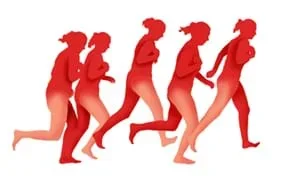 The running gait has different parts, including the take-off, midstride and heel strike.Copyright Zina Deretsky, National Science Foundation http://www.nsf.gov/news/news_summ.jsp?cntn_id=104454
Students explore the basic physics behind walking, and the design and engineering of shoes to accommodate different gaits. They are introduced to pressure, force and impulse as they relate to shoes, walking and running. Students learn about the mechanics of walking, shoe design and common gait misalignments that often lead to injury.
Of the many different types of engineers, some design shoes! Since walking and running are both complex series of movements, shoes are designed to provide support to specific foot areas to prevent injury. Shoes must withstand a multitude of forces, pressures and impacts on a daily basis and for the life of the shoe. Designing a heeled shoe produces a different set of challenges from an athletic shoe, both for the designer and the wearer. Several high-heeled designs feature a storable heel to help alleviate the problems associated with high heels, including driving and long-term discomfort leading to injury.
After this lesson, students should be able to:
- Describe how force and pressure are related.
- Calculate force, pressure, impact force and impulse.
- Identify the different parts of the walking gait.
- Explain how pressures on different parts of the foot increase and decrease while walking or running.
- Explain the difference between overpronation and underpronation, and how to fix the misalignments with orthotics.
- HS.2.4.a.iv Rearrange formulas to highlight a quantity of interest, using the same reasoning as in solving equations.
Grades 9-12
Do you agree with this alignment? - HS.2.4.c Solve equations and inequalities in one variable.
Grades 9-12
Do you agree with this alignment? - HS.2.4.c.i Solve linear equations and inequalities in one variable, including equations with coefficients represented by letters.
Grades 9-12
Do you agree with this alignment?
- Develop, communicate and justify an evidence-based analysis of the forces acting on an object and the resultant acceleration produced by a net force
Grades 9-12
Do you agree with this alignment?
- CCSS.Math.Content.HSA-CED.A.4 Rearrange formulas to highlight a quantity of interest, using the same reasoning as in solving equations.
Grades 9-12
Do you agree with this alignment? - CCSS.Math.Content.HSA-REI.B.3 Solve linear equations and inequalities in one variable, including equations with coefficients represented by letters.
Grades 9-12
Do you agree with this alignment? - CCSS.Math.Content.HSA-REI.B.4 Solve quadratic equations in one variable.
Grades 9-12
Do you agree with this alignment?
- Students will develop an understanding of and be able to select and use medical technologies.
Grades K-12
Do you agree with this alignment?
- DCI.PS2.A.9-12.1 Newton's second law accurately predicts changes in the motion of macroscopic objects.
Grades 9-12
Do you agree with this alignment? - SEP.11.5 Laws are statements or descriptions of the relationships among observable phenomena.
Grades 9-12
Do you agree with this alignment?
- Force and Pressure Quiz (doc)
- Force and Pressure Quiz (pdf)
- Force and Pressure Quiz Example Answers (doc)
- Force and Pressure Quiz Example Answers (pdf)
- Static Forces Worksheet (docx)
- Static Forces Worksheet (pdf)
- Static Forces Worksheet Example Answers (docx)
- Static Forces Worksheet Example Answers (pdf)
- Kinetic Movement Worksheet (docx)
- Kinetic Movement Worksheet (pdf)
- Kinetic Movement Worksheet Example Answers (docx)
- Kinetic Movement Worksheet Example Answers (pdf)
A basic knowledge of forces is required. A familiarity with pressure, impact and impulse is also useful, but not required.
Force
A force is anything that causes an object to undergo acceleration. As applies to this lesson, gravity exerts a downwards force on a shoe and the ground exerts an upwards force on a shoe. When a person is standing, these forces are equal and opposite, causing the person not to move.
A scale measures a person's weight. The force s/he exerts on the ground can be calculated using Newton's second law.
F = m * a
F = force (Newtons)
m = mass (kilograms)
a = acceleration (meters/second2) [gravity, in our case]
When a person pushes off from the ground while walking, s/he exerts a force upwards on the shoe that is greater than the downward force of gravity so the shoe (and foot) accelerate upwards to start the step. When the foot hits the ground, the ground exerts an upward force on the foot, causing it to decelerate to a stop as the foot hits the ground. The faster the foot comes to a stop, the larger the deceleration and the larger the impact force. When running on a surface such as sand, the deceleration is significantly less than when running on concrete, so the impact force that the foot feels every step is less for sand than for concrete.
Pressure
Pressure is the force per area applied to an object.
P = F/A
P = pressure (Pascals)
F = force perpendicular to the area (Newtons)
A = area (square meters)
The same force applied over a small area creates a higher pressure than if it were applied over a large area. For example, the pressure caused by the force of a person applied over the sole of an entire shoe is much less than the pressure due to the force of a person applied over the area of a stiletto heel. In fact, the pressure under a stiletto heel caused by an average-sized woman is greater than that under an elephant's foot while it is walking!
If a large force is applied to an area, it creates a greater pressure than if a small force is applied over the same area. Thus, when a heavier person walks, s/he exerts a greater pressure on the ground than a smaller person with the same shoe size and shape.
Impulse
Impulse is defined as change in momentum of an object or the integral of force with respect to time.
I = m Δv = F Δt
I = impulse (Newton x second)
m = mass (kilograms)
dv = change in velocity (meters per second)
F = force (Newton)
dt = change in time (seconds)
Impulse is the common physical measure of how hard the foot hits the ground. Using the above set of equations, the force felt by the foot can be calculated by knowing how fast the foot hits the ground and making an estimation of how long it takes the foot to decelerate from that velocity. A softer surface causes the deceleration to take longer than a hard surface, meaning that a foot feels a greater force landing on a hard surface than a soft one.
Basic Foot Anatomy
The human foot is made of 26 bones and 100 muscles and tendons. It is divided into three different parts: the forefoot, which is compromised of the toes and the ball of the foot, the midfoot, which is made up of the arch, and the rearfoot, which consists of the heel. The major tendon in the foot is the plantar fascia, which stretches from the ball of the foot to the heel. When the foot first impacts the ground during the stride, the plantar fascia acts as a shock absorber and then tightens during the take-off phase of the stride, causing the foot to act as a lever.
Walking Mechanics
The walking gait is divided into two parts: when the foot is on the ground, called the stance phase, and when the foot is in the air. During an average stride, the foot spends 60% of the time in the stance phase with each full cycle of a step taking approximately one second. The stance phase is further divided into three distinct sections: heel strike, midstance and heel lift. During the heel strike, the outside of the heel hits the ground first and the foot begins to pronate inwards. During pronation, the arch of the foot drops and the ankle turns inward. Because the outside of the heel impacts first, the outer edge of the heel of a shoe tends to wear faster than the rest of the shoe. Generally, this is the part of the gait when the foot experiences the highest impact forces and pressures. During the midstance, weight is evenly distributed over the foot, and the plantar fascia acts as a shock absorber. The foot is maximally pronated during this phase and the pressures experienced by the sole of the foot are at a minimum. During the heel lift phase, weight is shifted to the ball of the foot and the foot supinates (rotates outwards) as the toes bend, and the plantar fascia is elongated. This causes the foot to transition from a soft, shock absorber to a rigid lever necessary for propulsion. The pressure under the ball of the foot increases again, but the force is still less than what the heel experiences during the heel strike phase.
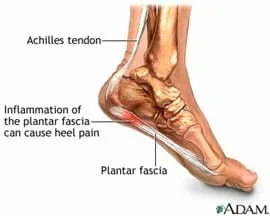 The plantar fascia and Achilles tendon are responsible for forward propulsion.Copyright US National Library of Medicine and the National Institutes of Health http://www.nlm.nih.gov/medlineplus/ency/imagepages/19568.htm
Walking Energetics
The walking stride can be approximated as a swinging pendulum with both legs straight, like a wheel. In this approximation, the energy used to lift the body each stride is not recovered, leading to the low efficiencies found in walking. Using the natural period of a pendulum, the walking cadence can be approximated as:
T = 2* π [2L / 3g]1/2
T = period (seconds)
L = length of leg (meters)
g = gravity (9.8 meters per second squared)
Further calculations determine that the power needed to walk can be approximated as:
Pw = (mg / p) [3gL / 2]1/2{1 - [1 – π*2v2 / 6gL]1/2}
P = power (joules)
m = mass (kilograms)
g = gravity (9.8 meters per second squared)
L = length of leg (meters)
v = velocity (meters per second)
Running Mechanics
Similar to the walking gait, running is divided into the stance phase and the airborne phase. For the average person, 40% of the time is spent in the stance phase and each full cycle takes approximately 0.6 seconds. While most people's walking gaits are similar, two distinct types of runners exist: heel strikers, and midfoot strikers. More than 80% of the population are heel strikers, meaning that the heel is the first part of the foot to impact the ground during the running gait. The other 20% of the population are midfood strikers; either landing on their midfoot, or even their forefoot, while running. Most top runners fall into the midfoot strikers category.
Unlike walking, the maximum forces felt by the foot are during the lift-off phase rather than the heelstrike phase. This distribution is true regardless of the running surface, but the absolute value of the force varies depending on whether the surface is hard or soft. Because of this, running on a hard surface, such as concrete, creates higher stresses on the foot than running on a soft surface, such as sand or grass.
Running Energetics
By making similar assumptions to the walking pendulum approximation, the energetics of running can be calculated. Once again, the legs are considered straight and treated like a wheel, the energy used to flex the leg through the airborne phase is negligible, and the energy used to raise and lower the body each step is not recovered. In addition, the body is propelled forward at a 45° angle each step to maximize the stride length. Using this, the power needed to run can be approximated as:
P = mgv / 4
P = power (joules)
m = mass (kilograms)
g = gravity (9.8 meters per second squared)
v = velocity (meters per second)
Heels
Human use of high-heeled shoes can be traced back to the ancient Egyptians, with the precursor to the stiletto heel found in tombs dating to 1000 BC. It is believed that they were considered a symbol of social status. Since then, they have become a prominent form of footwear.
High-heeled shoes cause a variety of injuries because they alter the natural alignment of the ankle, knee and hip. Wearing a high heel shifts a person's center of gravity forward, causing a shortening of the airborne phase of the stride and increasing his/her cadence. A three-inch heel increases the pressure on the forefoot three to six times, leading to a variety of foot injuries, such as bunions, shortened Achilles tendons, trapped nerves and toe deformities. Women receive more than 90% of the 800,000 foot surgeries performed each year, many due to their use of high heels.
Athletic Shoes
Modern athletic shoes are most commonly constructed with the 22-12 padding paradigm, meaning that they are designed with 22 mm of padding under the heel, and 12 mm under the forefoot. This configuration favors heel-to-toe runners. Recently, some shoe manufacturers have moved away from heavily-padded shoes, following the trend of barefoot running, which is believed to promote forefoot striking running and prevent many common running injuries.
Gait Misalignments
Over pronation, or flat feet, is one of the most common gait misalignments, and occurs when the foot pronates too far inwards during the midstride of the stance phase. It is due to the arches of the foot collapsing too far. It can be caused by genetic factors that lead to flexible feet, overuse, or improperly fit shoes. Overpronation can lead to knee, ankle and hip problems, as well as plantar fascitis, bunions, tendonitis, and heel spurs. It can be corrected by orthotics that provide additional support under the arch.
Underpronation, or supination, is the other common gait misalignment. It occurs when the arches do not collapse enough during the midstride, causing the foot to roll outwards. Supination is easily diagnosed by observing excessive wear on the outer edge of a shoe. Supination can cause all of the problems associated with over pronation and is fixed by adding extra padding to the sole of the shoe.
(Hand out the attached Force and Pressure Quiz for students to individually complete before beginning the lesson. Also make copies of the Static Forces Worksheet and Kinetic Movement Worksheet, enough for one per group of three to four students. Supplies needed: a scale to measure students' weight when walking or jogging, worksheets, pencils, calculators.)
Designing a shoe is a complex process in which several factors must be considered. Engineers design shoes and spend countless hours testing them so that they perform a variety of required functions while conforming to current styles and trends. Shoes are subjected to a range of forces during walking and running. The entire shoe must be able to withstand these forces for their lifetime, without failure. Some of these forces and pressures are enormous. For example, the pressure that a stiletto heel exerts on the ground midstride is substantially greater than that of an elephant walking. A high heeled shoe must be designed to withstand these forces while also providing foot support.
A running shoe, on the other hand, must be able to withstand the impact of hitting the ground every time the runner takes a stride, decrease the impulse felt by the foot, and do so without slipping, enabling a runner to propel himself forward. Running shoes must provide enough support to pad the foot and prevent injuries to the runner while being flexible enough to allow the foot to flex through the stride.
(Deliver content material as provided in the Background Concepts for Teachers section.)
(Divide the class into teams of two to four students and have each team complete the Static Forces Worksheet and Kinetic Movement Worksheet. Supplies needed: a scale to measure students' weight, worksheets, pencils, calculators. Then proceed to conduct the two associated activities for this lesson Convertible Shoes: Function, Fashion and Design and High Arches, Low Arches.)
- force
- Pushes or pulls; anything that causes an object to accelerate or change direction.
- impulse
- Average force x change in time or change in momentum. A measure of how "hard" a shoe hits the ground.
- orthotic
- An insert placed inside a shoe to correct either overpronation or supination.
- overpronation
- Excessive rolling inward movement of the foot when walking or running. Predisposes lower extremity injuries (such as knee injuries). Causes heavier wear on shoes on the inner margin. Collapsing arches while walking.
- pressure
- Force per area.
- stiletto heel
- A very high heel on a woman's shoe, tapering to a very narrow tip. Also called a spike heel.
- supination
- A rotation of the foot and leg in which the foot rolls outward with an elevated arch so that in walking the foot tends to come down on its outer edge. Leads to shoes wearing on the outer edge, and knee injuries. High arches. The opposite of pronation. Same as underpronation.
Pre-Lesson Assessment
Quiz: Before beginning the lesson, have students individually complete the attached Force and Pressure Quiz (PDF), which is a three-question assessment of their understanding of the relationship between force, pressure and area. Review their answers to gauge their initial level of understanding of the lesson subject matter.
Post-Introduction Assessment
Worksheet: Have students complete the attached Static Forces Worksheet (PDF), an exploration of the relationship between force and pressure. Review their answers to gauge their mastery of the subject.
Worksheet: Have students complete the attached Kinetic Movement Worksheet (PDF), an exploration of force, pressure, impulse and impact forces. Review their answers to gauge their mastery of the subject.
Lesson Summary Assessment
Quiz Revisited: As a class, review students' answers to the Force and Pressure Quiz (PDF). Use this opportunity to gauge students' understanding of the concepts and correct any confusion.
Christensen, Kim. High-Heeled Shoes and Musculoskeletal Problems. August 18, 2000. Dynamic Chiropractic. Vol. 18, Issue 18. Accessed August 10, 2010. http://www.dynamicchiropractic.com/mpacms/dc/article.php?id=31847
Dictionary.com. Lexico Publishing Group, LLC. Accessed August 10, 2010. (Source of some vocabulary definitions, with some modifications) http://www.dictionary.com
Pribut, Stephen M. Gait Biomechanics. Last updated February 8, 2009. Dr. Stephen M. Pribut's Sport Pages. Accessed August 10, 2010. (Topics: anatomy, phases of gait, stance phase [contact subphase, midstance subphase, propulsion subphase], pronation, MTJ double axes, force flow, energetic of locomotion, gait evaluation, running gait) http://www.drpribut.com/sports/spgait.html
Sprott, J.C. Energetics of Walking and Running. Sprott's Technical Notes, Sprott's Gateway, Physics Department, University of Wisconsin. Accessed August 10, 2010. http://sprott.physics.wisc.edu/technote/walkrun.htm
Swierzewski, John J. Originally published January 01, 2000. Last reviewed May 30, 2007. Foot and Ankle. Anatomy, Podiatry Channel. Accessed August 10, 2010. http://www.podiatrychannel.com/anatomy/index.shtml
Trimble, Tyghe. The Running Shoe Debate: How Barefoot Runners are Shaping the Shoe Industry. Published December 18, 2009. Popular Mechanics. Accessed August 10, 2010. http://www.popularmechanics.com/outdoors/sports/technology/4314401
Wearing High Heels - Effects on the Body. Last updated February 2009. Personal Health Zone. Accessed August 10, 2010. http://www.personalhealthzone.com/high_heels.html
- Shoes Under Pressure
Contributors
Eszter Horanyi
Supporting Program
Integrated Teaching and Learning Program, of Engineering, University of Colorado Boulder
Acknowledgements
The contents of this digital library curriculum were developed under a grant from the Fund for the Improvement of Postsecondary Education (FIPSE), U.S. Department of Education and National Science Foundation GK-12 grant no. 0338326. However, these contents do not necessarily represent the policies of the Department of Education or National Science Foundation, and you should not assume endorsement by the federal government.
Copyright
2010 by Regents of the University of Colorado.