
Stop Heat from Escaping: Testing Insulation Materials
One way to conserve energy in a building is to use adequate insulation to help keep hot or cool air inside or outside of the structure. Inefficient heating and cooling of buildings is a leading residential and industrial source of wasteful energy use. In this activity, student groups conduct a scientific experiment to help an engineering team determine which type of insulation conserves the most energy—a comparison of newspaper, wool, aluminum foil and thin plastic. They learn about different kinds of insulation materials and that insulation prevents the transfer of heat, electricity or sound. Student teams collect data and make calculations, then compare and discuss their results. A student worksheet is provided.
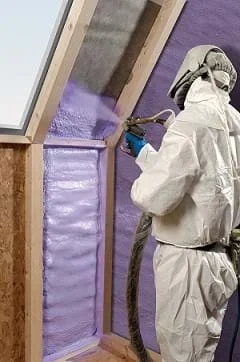 Students learn how insulation works and its importance.Copyright 2009 Cdpweb161, Wikimedia Commons https://commons.wikimedia.org/wiki/File:WALLTITE_spray_foam_insulation_being_applied.jpg
The heating and cooling of buildings uses a lot of energy, so engineers continually look for creative ways to reduce the heating and cooling demands, and thus the total amount of energy required. One way to do this is by using insulation. Engineers have developed many types of insulation such as fiberglass, rock wool, mineral wool, natural wool, cotton, straw, cellulose, paper, polyurethane foam, polystyrene foam, polyester and soy foam. Some insulating materials are also suitable for sound proofing.
After this activity, students should be able to:
- Describe how insulation works.
- Demonstrate how some materials insulate better than others.
- Relate effective insulation with energy conservation.
- Describe how energy engineers use insulation in product design.
- 4.1.3.a.i Fluently add and subtract multi-digit whole numbers using standard algorithms.
Grade 4
Do you agree with this alignment?
- Identify and describe the variety of energy sources
Grade 4
Do you agree with this alignment?
- CCSS.Math.Content.4.NBT.B.4 Fluently add and subtract multi-digit whole numbers using the standard algorithm.
Grade 4
Do you agree with this alignment? - CCSS.Math.Practice.MP2 Reason abstractly and quantitatively.
Grades K-12
Do you agree with this alignment?
- Energy comes in different forms.
Grades 3-5
Do you agree with this alignment?
- 5-PS1-3 Make observations and measurements to identify materials based on their properties.
Grade 5
This resource focuses on the following Three Dimensional Learning aspects of NGSS:
Science & Engineering Practices- Make observations and measurements to produce data to serve as the basis for evidence for an explanation of a phenomenon.Do you agree with this alignment?
Disciplinary Core Ideas- Measurements of a variety of properties can be used to identify materials. (Boundary: At this grade level, mass and weight are not distinguished, and no attempt is made to define the unseen particles or explain the atomic-scale mechanism of evaporation and condensation.)Do you agree with this alignment?
Crosscutting Concepts- Standard units are used to measure and describe physical quantities such as weight, time, temperature, and volume.Do you agree with this alignment?
Do you agree with this alignment? - Make observations and measurements to produce data to serve as the basis for evidence for an explanation of a phenomenon.
Each group needs:
- 4 plastic water or soda bottles, 20-ounce (~590-ml) size
- hot tap water
- thermometer with a Fahrenheit scale
- sheets of newspaper
- wool sock
- large piece of aluminum foil (enough to wrap around a bottle)
- large piece of thick, black plastic bag (enough to wrap around a bottle)
- tape
- Stop Heat from Escaping Worksheet (PDF)
Students should be familiar with the steps of the scientific investigation process.
What does it mean to conserve energy? (Answer: It means using energy wisely and efficiently.) Sometimes people waste energy by not using it wisely. Buildings can often waste great amounts of energy. Most of a building's energy use is for heating or cooling. One way engineers reduce the amount of energy required to heat or cool a building is by using good insulation.
Insulation is a material or substance that is used to prevent the transfer of heat, electricity or sound. In a building, insulation is placed in the walls and roof. When insulating a building, the quality (performance) of an insulation material is measured by how well it keeps heat out or in. Heat flows from warm areas to cool areas. When you touch something that is cold, heat is actually leaving your body to try and warm the cool surface, creating a balance of energy. Insulation helps to prevent that transfer of heat.
Many different materials are used for insulation. Engineers often use fiberglass, wool, cotton, paper (wood cellulose), straw and various types of foams to insulate buildings. A layer of trapped air can serve as insulation, too! Some insulating materials are also suitable for sound proofing.
In this activity, a homeowner has heard about all the different types of insulation that are available to use in a new house and requests your help to decide between wool, newspaper, aluminum foil and plastic to insulate the house. Let's conduct a scientific experiment so we have good information to help the engineering team decide which material would be best.
Before the Activity
Gather materials and make copies of the Stop Heat from Escaping Worksheet (PDF).
With the Students
- Divide the class into teams of two to four students each. Hand out a worksheet to each team.
- Remind the students that today we are conducting an engineering investigation. Review the steps of a scientific investigation (see the Vocabulary/Definitions section). Engineers need to understand energy conservation concepts to design more effective home energy systems.
- On the board, write the problem question that will be addressed today. (Example: Which type of insulation would keep my house warmest in the winter?)
- Show the students the four insulation materials to be tested. Ask them to hypothesize which they think is the best insulating material. Have them circle their predictions on their worksheets.
- Wrap the four plastic bottles with equivalent amounts of each material—newspaper, wool sock, aluminum foil and plastic bag—to serve as insulators. (You may want to discuss and determine as a group what this means for your experiment, for example, same material area, weight, thickness; covers same amount of bottle surface; tight or loose plastic on the bottle, etc.)
- Pour equal amounts of hot tap water into each bottle.
- Immediately after the hot water is poured in the bottle, measure its temperature. Record these beginning temperatures on the worksheets. Set aside the water-filled bottles in areas with the same ambient conditions (such as all in shade on the same surface material).
- For 15 minutes, have students sketch their setups on their worksheets.
- After 15 minutes, again measure and record the (ending) temperature of the water in each bottle.
- To calculate the change in temperature for each bottle, subtract the ending temperature from the beginning temperature.
- Ask the students to determine which material was the best insulator based on their data. Which had the smallest change of temperature? What material(s) do you recommend? How do your findings compare to your predictions?
- As a class, agree on a concluding statement for the experiment based on everyone's research findings. Have the students suggest ideas for potential future insulation tests they may want to conduct.
- energy conservation
- The wise and efficient use of energy resources, resulting in reduced energy usage.
- insulation
- A non-conductive material or substance used to prevent the transfer of heat, electricity or sound.
- scientific method
- 1) Form a hypothesis, 2) make predictions for that hypothesis, 3) test the predictions, and 4) reject or revise the hypothesis based on the research findings.
Pre-Activity Assessment
Drawing: Have students draw pictures of a typical summer clothing outfit and a typical winter clothing outfit. As a class, discuss the differences and why.
Discussion: How do clothes serve as insulation for the human body? Ask students what types of clothes they wear in the summer and what they wear in the winter? What is the difference between the clothing? (Possible answers: Summer clothes allow the heat created by our bodies to dissipate into the surrounding air. Winter clothes, such as heavy winter jackets, sweaters, mittens and hats, trap our body's heat to keep us warm.)
Activity Embedded Assessment
Worksheet: Have student teams work together to use the Stop Heat from Escaping Worksheet (PDF) to guide them through the activity as they record data, make sketches and calculations, and answer questions. Review their answers to gauge their mastery of the concepts.
Post-Activity Assessment
Discussion: Which material provides the best insulation? Which would you wear to keep warm in the winter? We all use a great amount of energy in our daily lives. If we were to reduce the amount of energy we use each day, then we would pollute the environment less and our fossil fuel supplies would last longer. Engineers find many ways to conserve energy in our homes, schools and offices. If we built houses with better insulation, less heat would escape through the walls, roof and windows (or less energy would be required to cool our homes). Engineers also must consider the energy cost required to make insulation. Light bulbs with lower energy demand also help conserve energy.
Insulation Applications: Insulation prevents the transfer of heat, electricity or sound. Have students design a new product using insulation. How many "things" can they think of that involve the idea of insulation? Possible example objects and functions include swimming pool covers, exterior walls and roofs of house in extreme environments, clothing for warmth, ear plugs to block sound, coffee mugs to hold hot liquids, electrical cords to convey electricity and auditoriums
Remind the students that glass thermometers are breakable.
If hot water is not available, use water chilled with ice.
Have a digital thermometer handy in case the change in temperature is not large enough to be read from a regular thermometer.
Follow the same experimental procedure using ice-cold water.
Have students measure the temperature on the inside and outside of the bottle and examine the transfer of heat through the insulating material. Does it make a difference where temperature is measured on the outside of the bottle? (At the insulation surface vs. an inch away from the surface?)
Have students research the types of materials used in the construction of buildings and houses, coffee mugs and winter jackets.
Using the information learned from this activity, have students create small model homes using the insulation materials, and test the temperature readings on the inside and outside of the structures.
- To add a math component, have students measure the water temperature every five minutes and create a graph showing temperature vs. time.
- To add a math component, have students report/plot temperature in degrees Celsius or Kelvin, instead of Fahrenheit.
EERE Consumer's Guide: Your Home: Insulation and Air Sealing. Last updated September 12, 2005. Energy Savers, Office of Energy Efficiency and Renewable Energy, U.S. Department of Energy. Accessed September 18, 2006. http://www.eere.energy.gov/consumer/your_home/insulation_airsealing/index.cfm/mytopic=11220
Energy Conservation: Yesterday and Today, Chapter 5. Renewable Energy Curriculum, TVA Kids for Teachers, Tennessee Valley Authority. Accessed September 21, 2005. http://www.tvakids.com/teachers/pdf/elementary_ch5.pdf
- Thermal Energy
- How Hot Is It?
- Make Your Own Temperature Scale
- How Much Heat Will It Hold?
- Stop Heat from Escaping: Testing Insulation Materials
- How Hot Is It?
Contributors
Sharon D. Perez-Suarez; Natalie Mach; Malinda Schaefer Zarske; Denise W. Carlson
Supporting Program
Integrated Teaching and Learning Program, College of Engineering, University of Colorado Boulder
Acknowledgements
The contents of this digital library curriculum were developed under grants from the Fund for the Improvement of Postsecondary Education (FIPSE), U.S. Department of Education and National Science Foundation (GK-12 grant no. 0338326). However, these contents do not necessarily represent the policies of the Department of Education or National Science Foundation, and you should not assume endorsement by the federal government.
Copyright
2005 by Regents of the University of Colorado