
Energy in Collisions: Rolling Ramp and Review
In this hands-on activity—rolling a ball down an incline and having it collide into a cup—the concepts of mechanical energy, work and power, momentum, and friction are all demonstrated. During the activity, students take measurements and use equations that describe these energy of motion concepts to calculate unknown variables, and review the relationships between these concepts.
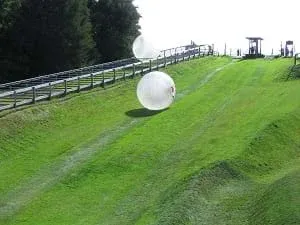 Students explore the concepts of mechanical energy, work and power, momentum, and friction by rolling a ball down an inclineCopyright Wikimedia Commons http://commons.wikimedia.org/wiki/File:Zorbing.jpg
Light rail trains are a modern form of public transportation powered by overhead electrical lines that travel along dedicated pathway of steel rails. To design these trains to be quiet, efficient and safe, engineers consider all of the energy of motion concepts: the work required to convert the mechanical energy when the train goes from a stopped position to forward/backward motion, how much momentum the train acquires between stations, and the power required to overcome the friction between the train's wheels and the effects of drag.
After this activity, students should be able to:
- Identify components of mechanical energy, work and power, momentum, and friction and how they interrelate.
- Construct a model to demonstrate potential and kinetic energy, work, power, momentum and friction.
- Use multiple equations to solve for unknown variables.
- Explain how the concepts of mechanical energy, work, power, momentum, and friction play an important role in everyday life
- 6.1.2.b Fluently add, subtract, multiply, and divide multidigit decimals using standard algorithms for each operation.
Grade 6
Do you agree with this alignment? - 6.2.2 Variables are used to represent unknown quantities within equations and inequalities.
Grade 6
Do you agree with this alignment? - 7.2.2 Equations and expressions model quantitative relationships and phenomena.
Grade 7
Do you agree with this alignment? - 8.2.2.a Solve linear equations in one variable.
Grade 8
Do you agree with this alignment?
- Predict and evaluate the movement of an object by examining the forces applied to it
Grade 8
Do you agree with this alignment? - Gather, analyze, and interpret data to describe the different forms of energy and energy transfer
Grade 8
Do you agree with this alignment?
- CCSS.Math.Content.6.NS.B.3 Fluently add, subtract, multiply, and divide multi-digit decimals using the standard algorithm for each operation.
Grade 6
Do you agree with this alignment? - CCSS.Math.Content.7.EE.B Solve real-life and mathematical problems using numerical and algebraic expressions and equations.
Grade 7
Do you agree with this alignment? - CCSS.Math.Content.7.EE.B.4 Use variables to represent quantities in a real-world or mathematical problem, and construct simple equations and inequalities to solve problems by reasoning about the quantities.
Grade 7
Do you agree with this alignment? - CCSS.Math.Content.8.EE.C.7 Solve linear equations in one variable.
Grade 8
Do you agree with this alignment? - CCSS.Math.Practice.MP2 Reason abstractly and quantitatively.
Grades K-12
Do you agree with this alignment? - CCSS.Math.Practice.MP4 Model with mathematics.
Grades K-12
Do you agree with this alignment?
- Energy is the capacity to do work.
Grades 6-8
Do you agree with this alignment?
- MS-PS3-5 Construct, use, and present arguments to support the claim that when the kinetic energy of an object changes, energy is transferred to or from the object.
Grades 6-8
This resource focuses on the following Three Dimensional Learning aspects of NGSS:
Science & Engineering Practices- Construct, use, and present oral and written arguments supported by empirical evidence and scientific reasoning to support or refute an explanation or a model for a phenomenon.Do you agree with this alignment?
- Science knowledge is based upon logical and conceptual connections between evidence and explanations.Do you agree with this alignment?
Disciplinary Core Ideas- When the motion energy of an object changes, there is inevitably some other change in energy at the same time.Do you agree with this alignment?
Crosscutting Concepts- Energy may take different forms (e.g. energy in fields, thermal energy, energy of motion).Do you agree with this alignment?
Do you agree with this alignment? - Construct, use, and present oral and written arguments supported by empirical evidence and scientific reasoning to support or refute an explanation or a model for a phenomenon.
Each group needs:
- yardstick (for the activity setup)
- metric ruler (for measuring distance)
- 4 dowel rods, 3 ft long, ¼-inch thick
- golf ball (or similar sized ball)
- plastic or Styrofoam cup (must be lightweight, not heavy)
- scale (to weigh the golf ball)
- tape
- paper towels or tissues
- Ramp and Review Worksheet (PDF)
Picture yourself atop a big hill with a scooter. Do you know how much potential energy you have? How fast will you be going when you reach the bottom? How much momentum will you have at the bottom? If you press hard on your brakes and slide to a stop, how much work will friction have done? Today's activity models this scenario and helps you answer these questions.
Before the Activity
- Gather materials and make copies of the Ramp and Review Worksheet (PDF), one per group.
- (optional) Set up a demo test station to help students visualize how the pieces go together.
With the Students
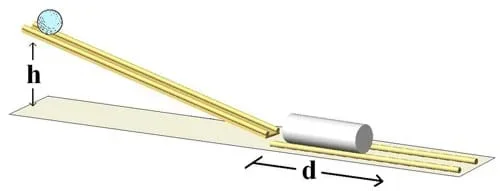 Activity set-up. The height, h, is the vertical distance from the ground to the top of the angled yardstick. The distance, d, is the horizontal distance from the bottom of the ramp to the point where the cup with the ball comes to a rest.Copyright 2004 Chris Yakacki, ITL Program, University of Colorado Boulder, using Microsoft Corporation clipart
- Divide the class into teams of two to four students each. Hand out the materials.
- Tape a dowel rod to each side of a yardstick, approximately 1-inch apart from each other. This serves as a track for the golf ball to roll down.
- Prop the yardstick against a wall or desk to create a slope for the ball to roll down.
- Place a small amount of crushed paper towels or tissues inside the cup to absorb the impact of the ball and keep the ball in the cup.
- Place the cup at the end of the yardstick ramp to catch the ball at the end of the incline.
- Tape the other two dowel rods a few inches apart to create a track for the cup to slide along.
- On the worksheet, complete questions 1 and 2 (measure the height of yardstick and weight of golf ball).
- Place the ball at the top of the ramp and let it go.
- Measure the distance the cup travels at the end of the ramp and record that for question 3 on the worksheet.
- Complete the calculations on the worksheet.
- Conclude with a class discussion. See the Assessment section for details.
Pre-Activity Assessment
Brainstorming: Have students engage in open discussion. Remind them that no idea or suggestion is "silly." All ideas should be respectfully heard. Ask students to think of situations that involve a combination of mechanical energy, momentum and collisions, work and power, and friction. (Example answer: Going down a slide. Potential energy turns into kinetic energy. Friction from sliding. As you gain velocity, you gain momentum.)
Activity Embedded Assessment
Worksheet: Have students use the Ramp and Review Worksheet (PDF) to record measurements and follow along with the activity. After teams have finished their worksheets, have them compare answers with their peers.
Hypothesize: Ask each group what would happen if a heavier glass cup was used instead of a lightweight cup. (Answer: The heavier cup would slow the overall speed of the ball and cup to conserve momentum. Since the lightweight cup is used, the ball and cup will barely slow down to conserve momentum.)
Post-Activity Assessment
Worksheet Discussion: As a class, review and discuss the worksheet answers. Student answers reveal their level of mastery of the concepts.
Discussion Questions: As a class, solicit, integrate and summarize student responses to the following wrap-up questions, which refer to question 8 on the worksheet:
- Why is work expressed as a negative value? (Answer: Work is defined as "force acting over a distance." When the force and distance traveled are in the same direction, the value of work is positive. However, in this case of friction, the force is acting in the opposite direction of the sliding cup, hence a negative value of work.)
- How did the friction, momentum, kinetic and potential energy, and work and power all come together to make the cup move? How does this relate to activities you do every day? (Answer: To make the cup move, first we built up momentum by giving the ball potential energy and converting it into kinetic energy. When the ball reached the bottom of the track, it collided with the cup and conserved momentum. Once the cup started sliding, friction came into play to bring the cup to a stop. The power of friction was related to how fast the cup stopped. This is very similar to riding down a hill with a bicycle, skateboard or scooter and braking to come to a stop.)
If the ball falls out of the cup,
- A small amount of wadded tissues or paper towels in the bottom of the cup helps to catch the ball and keep it in the cup
- Adjust the slide rails so that the cup does not turn around while sliding.
- Make sure the cup is placed on a smooth surface and not on carpet.
- If the yardstick is angled too high or too low, the cup will not slide as well as it could. Adjust the yardstick to approximately a 30˚ – 40˚ angle.
Another form of mechanical energy is rotational energy, which has not been discussed in this unit. In actuality, as the ball rolls down the incline, some of the potential energy is turned into rotational energy, while the rest is turned into kinetic energy. This decreases the ball's velocity as it rolls down the incline and makes our calculated value of velocity slightly higher than it really is. Have students search the Internet to find out more about rotational energy and why it causes certain objects to roll slower down inclines. Start with the rotational energy article at Wikipedia: https://en.wikipedia.org/wiki/Rotational_energy.
- For lower grades, have students complete at least one trial of how far the cup slides and record that on the worksheet as their distance (question 3). Also, you may want to run through the equations (on the bottom of the worksheet) as a class. Worksheet question 6 may be difficult, so solve it together.
- For upper grades, have students solve for velocity using the kinetic energy equation on their own. (Conduct the high school version of this activity.) For example,
K.E. = ½ ∙ m ∙ V2 →
Contributors
Chris Yakacki; Malinda Schaefer Zarske; Denise W. Carlson
Supporting Program
Integrated Teaching and Learning Program, College of Engineering, University of Colorado Boulder
Acknowledgements
The contents of this digital library curriculum were developed under grants from the Fund for the Improvement of Postsecondary Education (FIPSE), U.S. Department of Education and National Science Foundation (GK-12 grant no. 0338326). However, these contents do not necessarily represent the policies of the Department of Education or National Science Foundation, and you should not assume endorsement by the federal government.
Copyright
2004 by Regents of the University of Colorado