
Kinetic and Potential Energy of Motion
In this lesson, students are introduced to both potential energy and kinetic energy as forms of mechanical energy. A hands-on activity demonstrates how potential energy can change into kinetic energy by swinging a pendulum, illustrating the concept of conservation of energy. Students calculate the potential energy of the pendulum and predict how fast it will travel knowing that the potential energy will convert into kinetic energy. They verify their predictions by measuring the speed of the pendulum.
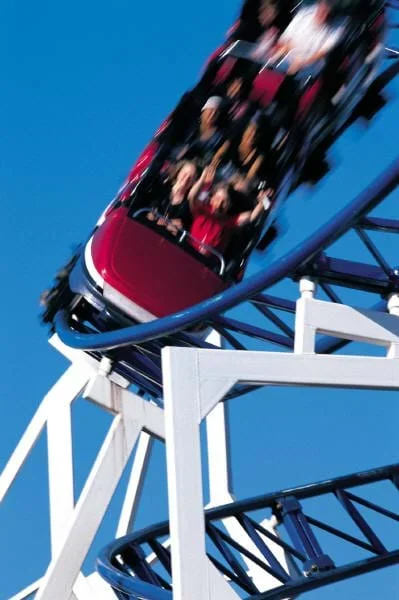 A roller coaster exhibits both kinetic and potential energyCopyright Microsoft Corporation 1983-2001.
Mechanical engineers are concerned about the mechanics of energy — how it is generated, stored and moved. Product design engineers apply the principles of potential and kinetic energy when they design consumer products. For example, a pencil sharpener employs mechanical energy and electrical energy. When designing a roller coaster, mechanical and civil engineers ensure that there is sufficient potential energy (which is converted to kinetic energy) to move the cars through the entire roller coaster ride.
After this lesson, students should be able to:
- Recognize that engineers need to understand the many different forms of energy in order to design useful products.
- Explain the concepts of kinetic and potential energy.
- Understand that energy can change from one form into another.
- Understand that energy can be described by equations.
- 6.1.2.b Fluently add, subtract, multiply, and divide multidigit decimals using standard algorithms for each operation.
Grade 6
Do you agree with this alignment? - HS.1.2.a Reason quantitatively and use units to solve problems.
Grades 9-12
Do you agree with this alignment? - HS.2.4.c.i Solve linear equations and inequalities in one variable, including equations with coefficients represented by letters.
Grades 9-12
Do you agree with this alignment?
- There are different forms of energy, and those forms of energy can be changed from one form to another – but total energy is conserved
Grade 8
Do you agree with this alignment? - Use mathematical expressions to describe the movement of an object
Grade 8
Do you agree with this alignment?
- CCSS.Math.Content.6.NS.B.3 Fluently add, subtract, multiply, and divide multi-digit decimals using the standard algorithm for each operation.
Grade 6
Do you agree with this alignment? - CCSS.Math.Content.HSA-CED.A.4 Rearrange formulas to highlight a quantity of interest, using the same reasoning as in solving equations.
Grades 9-12
Do you agree with this alignment? - CCSS.Math.Content.HSA-REI.B.3 Solve linear equations and inequalities in one variable, including equations with coefficients represented by letters.
Grades 9-12
Do you agree with this alignment?
- Energy is the capacity to do work.
Grades 6-8
Do you agree with this alignment?
- MS-PS3-5 Construct, use, and present arguments to support the claim that when the kinetic energy of an object changes, energy is transferred to or from the object.
Grades 6-8
This resource focuses on the following Three Dimensional Learning aspects of NGSS:
Science & Engineering Practices- Science knowledge is based upon logical and conceptual connections between evidence and explanations.Do you agree with this alignment?
Disciplinary Core Ideas- When the motion energy of an object changes, there is inevitably some other change in energy at the same time.Do you agree with this alignment?
Crosscutting Concepts- Energy may take different forms (e.g. energy in fields, thermal energy, energy of motion).Do you agree with this alignment?
Do you agree with this alignment? - Science knowledge is based upon logical and conceptual connections between evidence and explanations.
Whenever something moves, you can see the change in energy of that system. Energy can make things move or cause a change in the position or state of an object. Energy can be defined as the capacity for doing work. Work is done when a force moves an object over a given distance. The capacity for work, or energy, can come in many different forms. Examples of such forms are mechanical, electrical, chemical or nuclear energy.
This lesson introduces mechanical energy, the form of energy that is easiest to observe on a daily basis. All moving objects have mechanical energy. There are two types of mechanical energy: potential energy and kinetic energy. Potential energy is the energy that an object has because of its position and is measured in Joules (J). Potential energy can also be thought of as stored energy. Kinetic energy is the energy an object has because of its motion and is also measured in Joules (J). Due to the principle of conservation of energy, energy can change its form (potential, kinetic, heat/thermal, electrical, light, sound, etc.) but it is never created or destroyed.
Within the context of mechanical energy, potential energy is a result of an object's position, mass and the acceleration of gravity. A book resting on the edge of a table has potential energy; if you were to nudge it off the edge, the book would fall. It is sometimes called gravitational potential energy (PE). It can be expressed mathematically as follows:
PE = mass x g x height or PE = weight x height
where PE is the potential energy, and g is the acceleration due to gravity. At sea level, g = 9.81 meters/sec2 or 32.2 feet/sec2. In the metric system, we would commonly use mass in kilograms or grams with the first equation. With English units it is common to use weight in pounds with the second equation.
Kinetic energy (KE) is energy of motion. Any object that is moving has kinetic energy. An example is a baseball that has been thrown. The kinetic energy depends on both mass and velocity and can be expressed mathematically as follows:
KE = 1/2 m x v2
Here KE stands for kinetic energy. Note that a change in the velocity will have a much greater effect on the amount of kinetic energy because that term is squared. The total amount of mechanical energy in a system is the sum of both potential and kinetic energy, also measured in Joules (J).
Total Mechanical Energy = Potential Energy + Kinetic Energy
Engineers must understand both potential and kinetic energy. A simple example would be the design of a roller coaster — a project that involves both mechanical and civil engineers. At the beginning of the roller coaster, the cars must have enough potential energy to power them for the rest of the ride. This can be done by raising the cars to a great height. Then, the increased potential energy of the cars is converted into enough kinetic energy to keep them in motion for the length of the track. This is why roller coaters usually start with a big hill. As the cars start down the first hill, potential energy is changed into kinetic energy and the cars pick up speed. Engineers design the roller coaster to have enough energy to complete the course and to overcome the energy-draining effect of friction.
Begin by showing the class three items: 1) an item of food (such as a bagel, banana or can of soda water), 2) a battery, and 3) you, standing on a stool or chair. Ask the class what these three things have in common. The answer is energy. The food contains chemical energy that is used by the body as fuel. The battery contains electrical energy (in the form of electrical, potential or stored energy), which can be used by a flashlight or a portable CD player. A person standing on a stool has potential energy (sometimes called gravitational potential energy) that could be used to crush a can, smash the banana, or really hurt the foot of someone standing under you. Do a dramatic demonstration of jumping down on the banana or an empty soda can. (Be careful! Banana peels are slippery!) Explain the ideas of potential energy and kinetic energy as two different kinds of mechanical energy. Give definitions of each and present the equations, carefully explaining each variable, as discussed in the next section,
PE = mass x g x height
and
KE = 1/2 m x v2
Explain how energy can be converted from one form to another. Refer to the associated activities, Swinging Pendulum and Swinging Pendulum (for High School) to illustrate the transition of potential to kinetic energy. This should be clear from the jumping demonstration. You had potential energy (stored energy) when standing on the stool, which completely changed into kinetic energy (energy of motion) right before you landed on the ground. As a side note, the ground absorbed your energy when you landed and turned it into heat.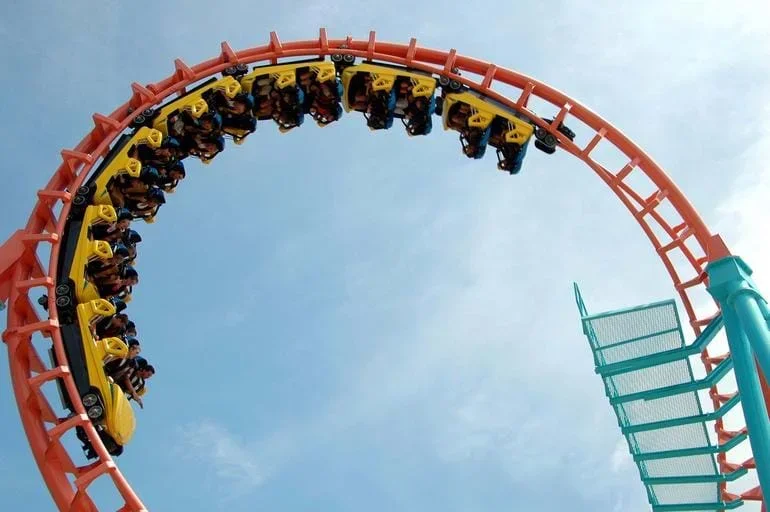 Copyright https://pixabay.com/photos/roller-coaster-ride-fun-amusement-1592917/
Restate that both potential energy and kinetic energy are forms of mechanical energy. Potential energy is the energy of position and kinetic energy is the energy of motion. A ball that you hold in your hand has potential energy, while a ball that you throw has kinetic energy. These two forms of energy can be transformed back and forth. When you drop a ball, you demonstrate an example of potential energy changing into kinetic energy.
Explain that energy is an important engineering concept. Engineers need to understand the many different forms of energy so that they can design useful products. An electric pencil sharpener serves to illustrate the point. First, the designer needs to know the amount of kinetic energy the spinning blades need in order to successfully shave off the end of the pencil. Then, the designer must choose an appropriately-powered motor to supply the necessary energy. Finally, the designer must know the electrical energy requirements of the motor in order for the motor to properly do its assigned task.
- energy
- Energy is the capacity to do work.
- mechanical energy
- Energy that is composed of both potential energy and kinetic energy.
- potential energy
- The energy of position, or stored energy.
- kinetic energy
- The energy of motion.
- conservation of energy
- A principle stating that the total energy of an isolated system remains constant regardless of changes within the system. Energy can neither be created nor destroyed.
Pre-Lesson Assessment
Discussion Questions: Solicit, integrate and summarize student responses.
- What are examples of dangerous unsafe placement of objects? (Possible answers: Boulders on the edge of a cliff, dishes barely on shelves, etc.).
Post-Introduction Assessment
Question/Answer: Ask the students and discuss as a class:
- What has more potential energy: a boulder on the ground or a feather 10 feet in the air? (Answer: The feather because the boulder is on the ground and has zero potential energy. However, if the boulder was 1 mm off the ground, it would probably have more potential energy.)
Lesson Summary Assessment
Group Brainstorm: Give groups of students each a ball (example, tennis ball). Remind them that energy can be converted from potential to kinetic and vice versa. Write a question on the board and have them brainstorm the answer in their groups. Have the students record their answers in their journals or on a sheet of paper and hand it in. Discuss the student groups' answers with the class.
- How can you throw a ball and have its energy change from kinetic to potential and back to kinetic without touching the ball once it relases from your hand? (Answer: Throw it straight up in the air.)
Calculating: Have students practice problems solving for potential energy and kinetic energy:
- If a mass that weighs 8 kg is held at a height of 10 m, what is its potential energy? (Answer: PE = (8 kg)*(9.8 m/s2)*(10 m) = 784 kg*m2/s2 = 784 J)
- Now consider an object with a kinetic energy of 800 J and a mass of 12 kg. What is its velocity? (Answer: v = sqrt(2*KE/m) = sqrt((2 * 800 J)/12 kg) = 11.55 m/s)
There is another form of potential energy, not related to height, which is called spring potential or elastic potential energy. In this case, energy is stored when you compress or elongate a spring. Have the students search the Internet or library for the equation of spring potential energy and explain what the variables in the equation represent. The answer is
PEspring = ½ k∙x2
where k is the spring constant measured in N/m (Newton/meters) and x is how far the spring is compressed or stretched measured in m (meters).
Argonne Transportation - Laser Glazing of Rails. September 29, 2003. Argonne National Laboratory, Transportation Technology R&D Center. October 15, 2003. http://www.anl.gov/index.html
Asimov, Isaac. The History of Physics. New York: Walker & Co., 1984.
Jones, Edwin R. and Richard L. Childers. Contemporary College Physics. Reading, MA: Addison-Wesley Publishing Co., 1993.
Kahan, Peter. Science Explorer: Motion, Forces, and Energy. Upper Saddle River, NJ: Prentice Hall, 2000.
Luehmann, April. Give Me Energy. June 12, 2003. Science and Mathematics Initiative for Learning Enhancement, Illinois Institute of Technology. October 15, 2003. http://www.iit.edu/~smile/ph9407.html
Nave, C.R. HyperPhysics. 2000. Department of Physics and Astronomy, Georgia State University. October 15, 2003. hyperphysics.phy-astr.gsu.edu/hbase/hframe.html
The Atoms Family - The Mummy's Tomb – Raceways. Miami Museum of Science and Space Transit Planetarium. October 15, 2003. http://www.miamisci.org/af/sln/mummy/raceways.html
- Motion: Kinetic and Potential Energy
- Kinetic and Potential Energy of Motion
- Collisions and Momentum: Bouncing Balls
- Puttin' It All Together
Browse the NGSS Engineering-aligned Physics Curriculum hub for additional Physics and Physical Science curriculum featuring Engineering.
Contributors
Bailey Jones; Matt Lundberg; Chris Yakacki; Malinda Schaefer Zarske; Denise Carlson
Supporting Program
Integrated Teaching and Learning Program, College of Engineering, University of Colorado Boulder
Acknowledgements
The contents of this digital library curriculum were developed under a grant from the Fund for the Improvement of Postsecondary Education (FIPSE), U.S. Department of Education and National Science Foundation GK-12 grant no. 0338326. However, these contents do not necessarily represent the policies of the Department of Education or National Science Foundation, and you should not assume endorsement by the federal government.
Copyright
2004 by Regents of the University of Colorado.