
Saving a Life: Heart Valve Replacement
Students use their knowledge about how healthy heart valves function to design, construct and implant prototype replacement mitral valves for hypothetical patients' hearts. Building on what they learned in the associated lesson about artificial heart valves, combined with the testing and scoring of their prototype heart valve designs in this activity, students discover the pros and cons of different types of artificial heart valves based on materials, surgery requirements, and lifespan.
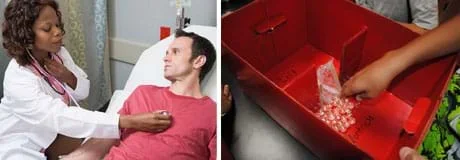 Students learn about artificial heart valves
Because diseases of the heart and circulatory system are a leading cause of death in the U.S., artificial heart valves are a leading area of research for biomedical engineers. Heart valve diseases can be fatal if the valve is not replaced. Engineers and physicians use the engineering design process to collaborate to design valves made of materials that the human body accepts and function for as long as possible, and that require the least invasive implantation procedures. This process involves asking to identifying the needs and constraints, researching, imagining possible solutions, planning by selecting a promising solution, creating a prototype, testing, and improving the designs so they are dependable solutions to replace non-functioning heart valves.
After this activity, students should be able to:
- Describe how real, healthy heart valves function.
- List some diseases that can affect the heart valves.
- Explain pros and cons of different types of artificial heart valves.
- 6.1.2.b Fluently add, subtract, multiply, and divide multidigit decimals using standard algorithms for each operation.
Grade 6
Do you agree with this alignment? - 6.1.1.c.iv Find a percent of a quantity as a rate per 100.
Grade 6
Do you agree with this alignment?
- Develop, communicate, and justify an evidence-based scientific explanation regarding the functions and interactions of the human body
Grade 7
Do you agree with this alignment?
- CCSS.Math.Content.6.NS.B.3 Fluently add, subtract, multiply, and divide multi-digit decimals using the standard algorithm for each operation.
Grade 6
Do you agree with this alignment? - CCSS.Math.Content.6.RP.A.3c Find a percent of a quantity as a rate per 100 (e.g., 30% of a quantity means 30/100 times the quantity); solve problems involving finding the whole, given a part and the percent.
Grade 6
Do you agree with this alignment?
- Students will develop an understanding of the attributes of design.
Grades K-12
Do you agree with this alignment? - Students will develop an understanding of engineering design.
Grades K-12
Do you agree with this alignment? - Students will develop an understanding of the relationships among technologies and the connections between technology and other fields of study.
Grades K-12
Do you agree with this alignment? - STEL-4T Evaluate how technologies alter human health and capabilities.
Grades 9-12
Do you agree with this alignment? - STEL-5F Analyze how an invention or innovation was influenced by its historical context.
Grades 6-8
Do you agree with this alignment? - STEL-7S Create solutions to problems by identifying and applying human factors in design.
Grades 6-8
Do you agree with this alignment?
- MS-ETS1-1 Define the criteria and constraints of a design problem with sufficient precision to ensure a successful solution, taking into account relevant scientific principles and potential impacts on people and the natural environment that may limit possible solutions.
Grades 6-8
This resource focuses on the following Three Dimensional Learning aspects of NGSS:
Science & Engineering Practices- Define a design problem that can be solved through the development of an object, tool, process or system and includes multiple criteria and constraints, including scientific knowledge that may limit possible solutions.Do you agree with this alignment?
Disciplinary Core Ideas- The more precisely a design task's criteria and constraints can be defined, the more likely it is that the designed solution will be successful. Specification of constraints includes consideration of scientific principles and other relevant knowledge that is likely to limit possible solutions.Do you agree with this alignment?
Crosscutting Concepts- The uses of technologies and any limitations on their use are driven by individual or societal needs, desires, and values; by the findings of scientific research; and by differences in such factors as climate, natural resources, and economic conditions.Do you agree with this alignment?
- All human activity draws on natural resources and has both short and long-term consequences, positive as well as negative, for the health of people and the natural environment.Do you agree with this alignment?
Do you agree with this alignment? - Define a design problem that can be solved through the development of an object, tool, process or system and includes multiple criteria and constraints, including scientific knowledge that may limit possible solutions.
- MS-ETS1-2 Evaluate competing design solutions using a systematic process to determine how well they meet the criteria and constraints of the problem.
Grades 6-8
This resource focuses on the following Three Dimensional Learning aspects of NGSS:
Science & Engineering Practices- Evaluate competing design solutions based on jointly developed and agreed-upon design criteria.Do you agree with this alignment?
Disciplinary Core Ideas- There are systematic processes for evaluating solutions with respect to how well they meet the criteria and constraints of a problem.Do you agree with this alignment?
Do you agree with this alignment? - Evaluate competing design solutions based on jointly developed and agreed-upon design criteria.
- MS-ETS1-4 Develop a model to generate data for iterative testing and modification of a proposed object, tool, or process such that an optimal design can be achieved.
Grades 6-8
This resource focuses on the following Three Dimensional Learning aspects of NGSS:
Science & Engineering Practices- Develop a model to generate data to test ideas about designed systems, including those representing inputs and outputs.Do you agree with this alignment?
Disciplinary Core Ideas- Models of all kinds are important for testing solutions.Do you agree with this alignment?
- The iterative process of testing the most promising solutions and modifying what is proposed on the basis of the test results leads to greater refinement and ultimately to an optimal solution.Do you agree with this alignment?
Do you agree with this alignment? - Develop a model to generate data to test ideas about designed systems, including those representing inputs and outputs.
Each group needs:
- 1 sheet of paper and a pencil or pen
- 1 pair of scissors
- 1 model heart, a cardboard box with a divider in the middle (see Figure 1)
- 30 marbles (representing blood cells)
- Valve Replacement Project Worksheet (PDF), one per group
To create a model heart box, one per group (made in advance by the teacher; see Figure 1):
- 1 box, size can vary, for example, use old banker's storage boxes or copy paper boxes, approximately 10 high x 12 wide x 15-inches deep (25 x 30 x 38 cm), no lid needed
- divider wall made from cardboard (cut from lid or flaps) and packing tape
- scissors or box cutter, to cut cardboard and tape
- (optional) marker, to identify heart chamber names
- (optional) red spray paint
To share with the entire class:
- tissue paper, 1 pack
- construction paper, 1 pack
- cardboard, scrap pieces, about 1 per group
- brown paper bags, available at grocery stores
- Popsicle sticks, available at hardware and hobby stores
- index cards, 1 pack
- wooden toothpicks, one box
- string, 1 roll (~280 ft or ~85 m)
- aluminum foil, 1 box
- duct tape, 3 rolls
- scotch tape, 5-10 rolls
An understanding of the circulatory system and the path of blood flow through the body and the heart, as provided in the Engineering the Heart: Heart Valves associated lesson.
From our previous lesson, we learned all about the valves in our hearts. Who can tell me why heart valves are so important? (Listen to student answers; looking for "they force the blood to flow in one direction.") Great! Can we live without heart valves or with heart valves that do not function correctly? (No.) Alright, so we know the heart valves are vital for human life. Can anyone name the four heart valves for me? (Answer: Tricuspid, mitral, aortic, pulmonary.) Does anyone remember anything special about the mitral valve? (Answer: It is the only valve in the human heart that has only two leaflets or flaps that open and close; it is the only bicuspid valve.) Great! Sounds like we already know a lot of about the valves in the human heart, which will be really important today.
Our activity today requires us to act, think and work like engineers. Does anyone remember the type of engineer that focuses on the human body? Yes, biomedical engineers. Today we will work as biomedical engineers to help save our patients' lives. Each group of engineers will have a patient whose mitral valve needs replacement. What are some reasons why a person might need an artificial or replacement valve? (Damaged in a car accident.) What are some of the diseases that can damage heart valves? (Valve prolapse, valve stenosis and valvulitis.) Think back to when we talked about this before. How are each of these diseases a little different?
- Valve prolapsed is when the leaflets on the heart valve become loose and floppy and allow some of the blood to "regurgitate," or flow back in the wrong direction through the valve.
- Valve stenosis is caused by a calcium build-up on the leaflets, making them stiff and inflexible, so they are not able to open fully, resulting in less blood flow through the valve.
- Valvulitis is the inflammation (swelling) of a valve. Often that is caused by a disease such as rheumatic fever. Eventually the swollen, infected valves degenerate or their leaflets become stiff and calcified, leading to valve stenosis.
Can our patient survive with one of these diseases if we do not replaced the unhealthy valve? (Answer: No, all of these disease are fatal if left untreated.) So, to save our patients' lives, we need to design, construct and implant artificial mitral valves in the left side of our patients' hearts.
Remember that we discussed two types of artificial valves; what are they? (Listen to student responses.) Mechanical valves are made with metals, wires and plastics; biological valves are made of animal tissue. What are the pros and cons of these different artificial valves?
Name for me a benefit of using a mechanical valve? (They last a long time.) Great, that's true. These valves usually outlive the patient. What are disadvantages of these types of valves? (They cause the blood to clot; the body considers them to be foreign) That's correct. These types of valves are foreign to our bodies and do not always operate the same way as real heart valves. Therefore, they can lead to blood clotting, which is very dangerous. People who receive mechanical heart valves must take blood thinning medicine for the rest of their lives and restrict their physical activities.
Now what about the valves made from animal tissue? What is a pro for these types of valves? (They work just like our original heart valves; they do not lead to blood clotting.) Yes, these valves are much more accepted by the body and do not require limiting physical activity or taking blooding thinning medicine. But, if they work so well, why wouldn't every patient choose this type of valve? What is the downside of these valves? (They do not last as long.) Right, they degrade over time and need to be replaced after about 10 years.
How are replacement valves implanted inside your body? (Listen to student responses.) Right now, the only method to implant artificial heart valves is through open heart surgery, which can be extremely traumatic and hard to recover from. Biomedical engineers are working on less-invasive procedures (instead of open heart surgery) to replace heart valves. For example, the FDA recently approved a new valve device that is inserted into a small opening in a person's leg artery and pushed through the blood vessels to access the damaged or diseased valve.
In terms of designing artificial valves, many factors must be considered. In theory, what would we want? Well, the best artificial valve would not require open heart surgery, would be made of materials that does not cause blood to clot and would last for the patient's lifespan. Materials used are very important, and they are a major aspect of our own design projects! Remember, our patients will not survive with diseased mitral valves. We are trying to save their lives by working as biomedical engineers and designing and implanting replacement valves!
Background
Heart valves are essential to the heart's ability to pump blood in one direction through all the chambers of the heart and through the body. Blood returning from the body enters the heart from the superior and inferior vena cava into the right atrium. From there, blood flows through the tricuspid valve into the right ventricle. When the ventricle contracts, blood moves through the pulmonary valve to the pulmonary artery to pick up oxygen and release carbon dioxide in the lungs. Blood re-enters the heart from the pulmonary veins into the left atrium. Then it moves through the mitral valve into the left ventricle. When the ventricle contracts again it moves through the aortic valve into the aorta to return to the body. All four valves mentioned are one way valves that force blood to move in one direction only. This is imperative for the body to maintain an appropriate blood pressure, and for each heart contraction to move blood appropriately. Refer to the attached Human Heart Visual Aid (PDF), as necessary.
Many pathologies afflict the heart valves. These three primary conditions can be caused by disease or are inherited.
- Valve prolapse is a condition in which the valve leaflets become floppy or stretched out, allowing blood to regurgitate (flow back in the wrong direction). Regurgitation can result in the heart increasing its workload (meaning pumping harder) to keep up the cardiac output (to keep enough blood flowing through the body). This condition is caused by many factors, but two main factors include magnesium deficiency and degraded hyaluronic acid (also called hyaluronan).
- Valve stenosis is calcium build-up in the valve leaflets, causing them to stiffen and fail to open completely. When the heart beats, blood flowing out of the left ventricle is impeded, causing pressure to build in the chamber. Over time, this can thicken the heart wall, and enlarge and weaken the heart. It can be caused by congenital heart defects at birth, such as a bicuspid aortic valves (instead of three leaflets), calcium build-up on the valve from calcium in your blood depositing on the valve, or rheumatic fever, which is a complication of strep throat that can result in scar tissue forming on the aortic valve. Sometimes calcium deposits collect on the rough surface of the scar tissue.
- Valvulitis is the inflammation of a valve. Inflammatory changes in the aortic, mitral and tricuspid heart valves are caused most commonly by rheumatic fever and less frequently by bacterial endocarditis and syphilis. Infected valves degenerate, or their cusps become stiff and calcified, resulting in valve stenosis and obstructed blood flow.
Defective heart valves often need to be replaced, usually with either pig valves or artificial components. Patients require immunosuppressive therapy to avoid the rejection of the replacements and monitoring to ensure deposition does not occur with the transplanted components.
Replacement valves can be made of animal tissue (such as porcine pericardium) or be purely mechanical. Purely mechanical valves outlast the patient, but cause thrombosis (clotting) unless the person takes blood thinning medication and lives a more sedentary lifestyle. Most young patients who need heart valve replacement go with this option. Older patients typically have animal tissue valves installed. These valves only last about 10 years, but operate just like normal heart valves so the person can be active. Getting a valve replaced is a traumatic process and involves open heart surgery. Biomedical engineers are designing new surgical techniques and valves that are less invasive.
See the associated lesson for additional background information.
Before the Activity
- Gather materials and arrange them in the classroom so that student teams can access them.
- Prepare large-scale model hearts from cardboard boxes (see Figure 1), one per group. Divide the space inside each open box into two sections by securing a dividing wall with a gap in it. The two sections represent the left atrium chamber and left ventricle chamber of a human heart, with the gap between them the space for a one-way mitral valve.
- Make copies of the Valve Replacement Project Worksheet (PDF), one per group.
- Go through the Introduction/Motivation with the students, including the group brainstorm on one-way valves, as described in the Assessment section.
- As necessary, review the seven basic steps of the engineering design process: 1) ask to identify the need or problem, 2) research the problem, 3) imagaine different designs, 3) plan by selecting the best idea 5) create a prototype, 6) test and analyze, and 7) improve and re-design. These are steps that teams of engineers around the world follow to create solutions that are essential to people's health, happiness and safety.
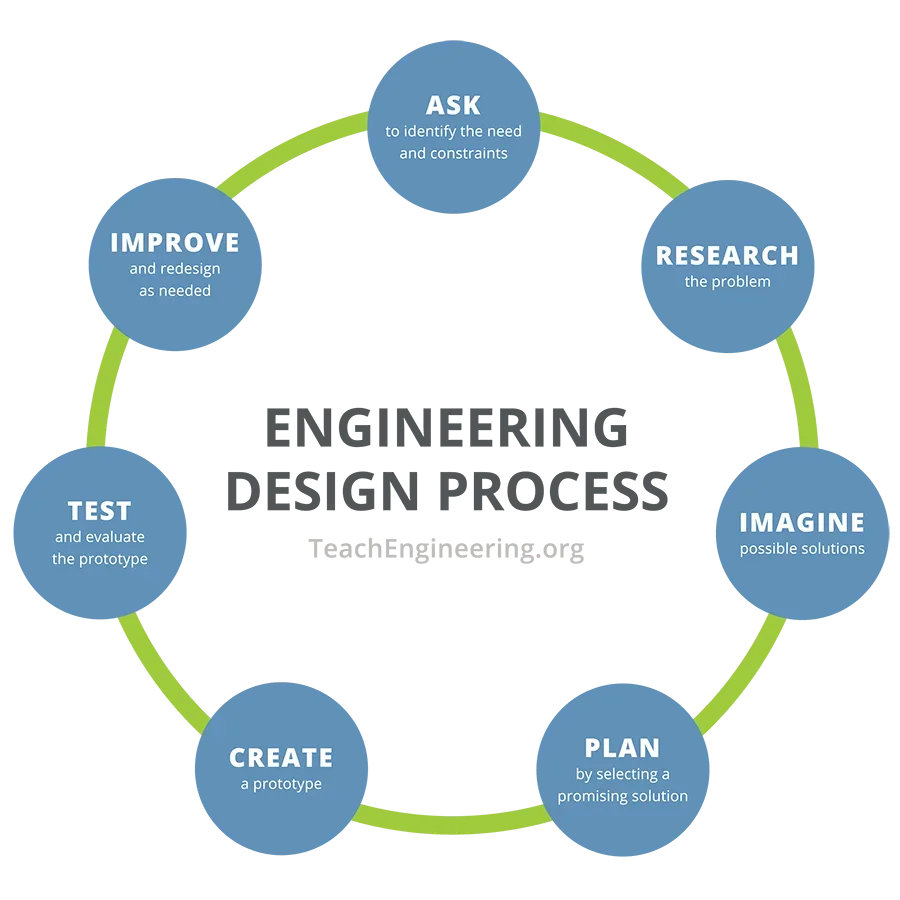 The steps of the engineering design process.Copyright TeachEngineering.org. All rights reserved.
With the Students
- Divide the class into groups of three (or four, if necessary) students each.
- Give each group a sheet of paper and a worksheet.
- Show students the large-scale model heart boxes and explain the design challenge, testing and evaluation.
- Demonstrate how the marbles act as blood cells by putting a few marbles in the left atrium and tipping the box to show how the marbles easily flow into the left ventricle. Tip the heart box the other direction so the marbles flow easily back into the left atrium.
- Tell students that their challenge is to design, construct and implant replacement mitral valves that allow the marbles to flow from the left atrium to the left ventricle, but not back the other direction when the heart box is tipped. The test for each heart valve is simply to tip the heart box towards the left ventricle and count how many marbles pass through into the left ventricle and then tip the heart box back towards the left atrium and count how many marbles remain in the left ventricle.
- Show them how the worksheet outlines the test evaluation procedure and scoring point system for grading their designs. Overall scoring is based on how well a valve allows marbles to enter the left ventricle and does not allow marbles to move back into the left atrium, the materials used (more strong "engineered" materials lose more points), and bonus points for bicuspid valves (having two leaflets or flaps that open and close). As necessary, go through an example on the worksheet.
- Direct groups to brainstorm ideas for their replacement valve designs and draw sketches of their ideas, labeling the materials they plan to use. When choosing materials, make sure they consider the "cost" of materials, based on the point system provided on the worksheet.
- Have each group choose two or three mitral valve designs to test. Let them know that they can alter their designs based on the test performance of their first valve design.
- After checking their valve designs, give each group a pair of scissors, a model heart box, and 30 marbles, and send one or two students to get the materials required for the team's design. Students do not have specific constraints on materials, other than keeping in mind that some materials cause them to lose more points than others. Have them return any unneeded materials to the classroom stock so they remain available for other groups to use.
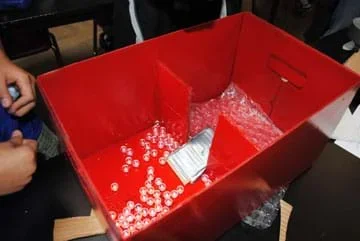 Figure 1: Example artificial mitral valve designed by students and being tested in a large-size model two-chamber heart, representing the left atrium and left ventricle. The marbles enable testing of the movement of blood through the prototype valve.Copyright 2010 Carleigh Samson, ITL Program, University of Colorado Boulder
 - Once groups have finished building their replacement valves, direct them to "implant" the prototype valves in their model heart boxes between the two chambers. Then have them test their valves by putting all the marbles on the left atrium side and tipping the box so that (hopefully) all the marbles travel through the valve into the left ventricle (see Figure 1). If marbles do not make it through, count and record on the worksheet how many made it through and how many did not. Then tip the box back the other way and (hopefully) the valve blocks any marbles from traveling back into the left atrium. Again count and record how many.
- After scoring its valve design, have each group work on its next design iteration and repeat steps 5-7.
- After testing, have teams complete their worksheets to score their designs. Points are based on effectiveness (how well the valve functioned during testing), choice of materials used, and how similar the valve design is to a real bicuspid mitral valve.
- When 10 minutes remain in the class period, have students clean up.
- After clean-up, have groups write their best scores on the board. Give each group 30 seconds to 1 minute to describe to the class their best design and explain why.
- Assign students to write one-page reflection and evaluation reports as described in the Assessment section.
- aortic valve
- The valve between the left ventricle and the aorta, normally with three leaflets.
- circulatory system
- An organ system that passes nutrients, gases, hormones and blood cells to and from cells in the body to fight diseases and help stabilize body temperature and pH to maintain homeostasis.
- heart valve
- A one-way valve that allow blood to flow through it in one direction. Four valves are present in mammalian hearts. They open and close depending on different pressures on each side of them.
- mitral valve
- The valve between the left atrium and left ventricle, with two leaflets. Also known as the bicuspid valve because it is the only valve in the human heart with just two flaps.
- pulmonary valve
- The valve between the right ventricle and the pulmonary artery, with three cusps or leaflets.
- tricuspid valve
- The valve between the right atrium and right ventricle, normally with three leaflets and three papillary muscles.
- valve
- Any device for halting or controlling the flow of a liquid, gas or other material through a passage, pipe, inlet, outlet, etc.
Pre-Activity Assessment
Group Brainstorm: As a class, brainstorm about one-way valves. What are they? What should they do? Where are they used? Is there anywhere they occur naturally? If we had to create one, what are some ideas? Write all the student responses on the board. Remind students that during brainstorming there are no bad ideas and wild ideas are encouraged.
Activity Embedded Assessment
Questioning: During the activity, students go through the engineering design process stages of brainstorming, designing, building, testing and redesign. This is a good time to walk around to groups and ask questions, such as those provided in the Investigating Questions section. If some students seem like they are not involved, direct some of the questions to them in order to gauge whether or not they are following along and working with their groups.
Quick Presentation: At activity end, have groups write their best scores on the board. Give each group 30 seconds to 1 minute to describe to the class their best design and explain why.
Post-Activity Assessment
Reflection and Evaluation Report: Have students write one-page reports summarizing their experiences during the activity. Require that they:
- Describe the valves they built (including drawings), explaining whether or not they worked and why.
- Explain why they chose certain materials, including the pros and cons of using those materials.
- Describe whether they think their designs are more similar to mechanical artificial valves or valves made of animal tissue, and why.
- Based on which type their designs are more similar to, explain the pros and cons of this type of artificial valve in terms of patient health and lifestyle.
Make sure students can access all of the materials and do not take more than they need. Encourage them to use scissors to cut away just what they need from the material stock.
Dictionary.com. Lexico Publishing Group, LLC. Accessed October 20, 2011. (Source of some vocabulary definitions, with some adaptation)
Edwards Lifesciences. Transcatheter Heart Valve. Accessed September 15, 2011 (Information about a replacement valve) http://www.edwards.com/products/transcathetervalve/Pages/THVcategory.aspx
Recently Approved Devices: Edwards SAPIEN Transcatheter Heart Valve (THV) - P100041. Last updated November 22, 2011. US Food and Drug Administration, US Department of Health and Human Services. Accessed March 28, 2012. http://www.fda.gov/MedicalDevices/ProductsandMedicalProcedures/DeviceApprovalsandClearances/Recently-ApprovedDevices/ucm280840.htm
Valves of the Heart. University of Southern California Cardiothoracic Surgery. Accessed September 21, 2011. (Information about the heart valves and diseases) http://www.cts.usc.edu/hpg-valvesoftheheart.html
Wikipedia.org. Wikimedia Foundation, Inc. Accessed on September 9, 2011. (Information about the heart valves and diseases)
- Engineering the Heart: Heart Valves
- Saving a Life: Heart Valve Replacement
Contributors
Carleigh Samson; Ben Terry; Brandi Briggs; Denise W. Carlson
Supporting Program
Integrated Teaching and Learning Program, College of Engineering, University of Colorado Boulder
Acknowledgements
The contents of this digital library curriculum were developed under a grant from the Fund for the Improvement of Postsecondary Education (FIPSE), U.S. Department of Education and National Science Foundation GK-12 grant no. 0338326. However, these contents do not necessarily represent the policies of the Department of Education or National Science Foundation, and you should not assume endorsement by the federal government.
Copyright
2011 by Regents of the University of Colorado.