
Engineering the Heart: Heart Valves
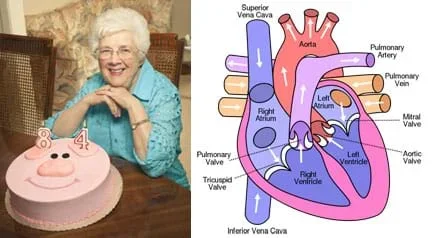 This Texas woman celebrates her 84th birthday; she received a replacement heart valve that was made with porcine heart tissue. A diagram of the human heart shows its four one-way valves (white flaps).Copyright (left) State of Texas and (right) Wapcaplet, Wikimedia Commons http://www.texasagriculture.gov/culture/medical/ http://commons.wikimedia.org/wiki/File:Diagram_of_the_human_heart_(cropped).svg
Students learn how healthy human heart valves function and the different diseases that can affect heart valves. They also learn about devices and procedures that biomedical engineers have designed to help people with damaged or diseased heart valves. Students learn about the pros and cons of different materials and how doctors choose which engineered artificial heart valves are appropriate for certain people.
Diseases of the heart and circulatory system are a leading cause of death in the U.S. and a leading area of research for biomedical engineers. Heart valve diseases, including valve stenosis, valvulitis and valve prolapse, can be fatal if the valve is not replaced. Engineers and physicians work together to design valves made of materials that the human body accepts and function for as long as possible, and that require the least invasive procedures for implantation.
After this lesson, students should be able to:
- Identify the four valves in the human heart.
- Describe the function of the heart valves.
- Explain three different diseases that can weaken or damage human heart valves.
- Explain the pros and cons of different materials used to build artificial heart valves.
- Develop, communicate, and justify an evidence-based scientific explanation regarding the functions and interactions of the human body
Grade 7
Do you agree with this alignment?
- Students will develop an understanding of the relationships among technologies and the connections between technology and other fields of study.
Grades K-12
Do you agree with this alignment? - STEL-3G Explain how knowledge gained from other content areas affects the development of technological products and systems.
Grades 6-8
Do you agree with this alignment? - STEL-7S Create solutions to problems by identifying and applying human factors in design.
Grades 6-8
Do you agree with this alignment?
- MS-LS1-3 Use argument supported by evidence for how the body is a system of interacting subsystems composed of groups of cells.
Grades 6-8
This resource focuses on the following Three Dimensional Learning aspects of NGSS:
Science & Engineering Practices- Apply scientific ideas to construct an explanation for real-world phenomena, examples, or events.Do you agree with this alignment?
Disciplinary Core Ideas- In multicellular organisms, the body is a system of multiple interacting subsystems. These subsystems are groups of cells that work together to form tissues and organs that are specialized for particular body functions.Do you agree with this alignment?
Crosscutting Concepts- Systems may interact with other systems; they may have sub-systems and be a part of larger complex systems.Do you agree with this alignment?
Do you agree with this alignment? - Apply scientific ideas to construct an explanation for real-world phenomena, examples, or events.
- The Circulatory System Pre/Post Quiz (doc)
- The Circulatory System Pre/Post Quiz (pdf)
- The Circulatory System Pre/Post Quiz Answers (doc)
- The Circulatory System Pre/Post Quiz Answers (pdf)
- Heart Valves Presentation (ppt)
- Heart Valves Presentation (pdf)
- Heart Valves Animation (wmv, 2:31-minutes, full length)
- Heart Valves Animation Shortened (wmv, 42-second, shortened version)
- Edwards Sapien Transcatheter Heart Valve Surgery Animation (wmv, 1:52-minutes)
- Design Evaluation Table (docx)
- Design Evaluation Table (pdf)
- Design Evaluation Table Answers (docx)
- Design Evaluation Table Answers (pdf)
Basic knowledge about the heart and the circulatory system.
Presentation
Following is suggested slide-by-slide narration to accompany the PowerPoint presentation, as well as additional, more in-depth background information for the teacher.
(Note: To play the two embedded animation videos, download the video files and save them in the same folder as the PowerPoint file. Or, play the videos directly from YouTube using the URLs provided in the notes section the two slides, or in the Slide 4 and Slide 7 paragraphs, below.)
Slide 1: Title slide: Heart Valves
Slide 2: (Review, as necessary, the path of blood flow in the human heart.) The blood enters the heart from the body through the superior vena cava and the inferior vena cava. Then the blood enters the right atrium chamber of the heart. The blood then moves through the tricuspid valve (shown as two white flaps) into the right ventricle chamber of the heart. Then the blood moves through the pulmonary valve (shown as two white flaps) into the pulmonary artery (one on each side of the heart). The blood re-enters the heart through the pulmonary veins (two on each side of the heart), and travels into the left atrium. The blood then passes through the mitral valve (shown as two white flaps) and into the left ventricle chamber of the heart. The blood then moves through the aortic valve (shown as two white flaps) and into the aorta.
Slide 3: In this cross-section drawing, we can see the four heart valves that are present in mammalian hearts. The four valves in your heart are the tricuspid valve, the pulmonary valve, the mitral valve and the aortic valve. The tricuspid valve is located between the right atrium and the right ventricle; the pulmonary valve is located between the right ventricle and the pulmonary arteries; the mitral valve is located between the left atrium and the left ventricle; and the aortic valve is located between the left ventricle and the aorta. The mitral and tricuspid valves are atrioventricular (AV) valves located between the atria and the ventricles. Two semilunar (crescent-shaped, like a half-moon) valves, the aortic and pulmonary valves, are located in the arteries leaving the heart. The mitral valve is the only bicuspid valve in the human heart.
The valves open and close with the movements of the heart. When the ventricles contract, the pulmonary valve and the aortic valve open so the blood can be pushed out in the correct direction, while the tricuspid valve and the mitral valve close, so the blood cannot slip back into the atria.
Slide 4: (Play the embedded Heart Valve Surgery – operation for replacement heart valves, a 2:31-minute animation video available at YouTube: http://www.youtube.com/watch?v=G5S0yQhK42s.) This animation shows how the valves open and close with the heart's motion. It also shows surgery to replace a damaged mitral valve, with options for a mechanical or biological valve. The stringy-looking material attached to the tricuspid and mitral valves are tendons attached to the ventricle walls; they assist in opening and closing these valves at the appropriate times.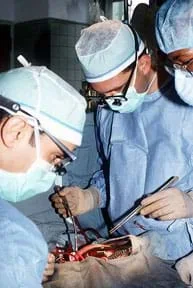 Open heart surgery to replace a mitral valve.Copyright US Military, Wikimedia Commons http://commons.wikimedia.org/wiki/File:Surgeon_operating,_Fitzsimons_Army_Medical_Center,_circa_1990.JPEG
Slide 5: Many pathologies can afflict the heart valves. The following three primary conditions can be caused by disease or be inherited and can affect the heart valves and endanger a person's life: valve prolapse, valve stenosis and valvulitis.
- Valve prolapse is a condition in which the valve leaflets become floppy or stretched out, allowing blood to regurgitate (flow back in the wrong direction). Regurgitation can result in the heart increasing its workload (meaning pumping harder) to keep up the cardiac output (to keep enough blood flowing through the body). This condition is caused by many factors, but two main factors include magnesium deficiency and degraded hyaluronic acid (also called hyaluronan).
- Valve stenosis is calcium build-up in the valve leaflets, causing them to stiffen and fail to open completely. When the heart beats, blood flowing out of the left ventricle is impeded, causing pressure to build in the chamber. Over time, this can thicken the heart wall, and enlarge and weaken the heart. It can be caused by congenital heart defects at birth, such as a bicuspid aortic valves (instead of three leaflets), calcium build-up on the valve from calcium in your blood depositing on the valve, or rheumatic fever, which is a complication of strep throat that can result in scar tissue forming on the aortic valve. Sometimes calcium deposits collect on the rough surface of the scar tissue.
- Valvulitis is the inflammation of a valve. Inflammatory changes in the aortic, mitral and tricuspid heart valves are caused most commonly by rheumatic fever and less frequently by bacterial endocarditis and syphilis. Infected valves degenerate, or their cusps become stiff and calcified, resulting in valve stenosis and obstructed blood flow.
Defective heart valves often need to be replaced, usually with either pig valves or artificial components. Patients require immunosuppressive therapy to avoid the rejection of the replacements and monitoring to ensure deposition does not occur with the transplanted components.
Slide 6: Replacement valves can be made of animal tissue (such as porcine pericardium) or be purely mechanical. Purely mechanical (top left example) valves outlast the patient, but cause thrombosis (clotting) unless the person takes blood thinning medication and lives a more sedentary lifestyle. Most young patients who need heart valve replacement go with this option. Older patients typically have animal tissue valves installed (top right example). These valves only last about 10 years, but operate just like normal heart valves so the person can be active. Getting a valve replaced is a traumatic process and involves open heart surgery (lower right). Biomedical engineers are designing new surgical techniques and valves that are less invasive (lower left picture is a prototype valve that is installed similar to how a stent is implanted, which can be seen in the video, next slide). Refer to the Saving a Life: Heart Valve Replacement activity to have students design and prototype their own replacement valve with common materials.
Slide 7: (Play the embedded Edwards Sapien transcatheter heart valve animation, a 1:52-minute video available at YouTube: http://www.youtube.com/watch?v=GAmq6ccC4Ws.) This animation shows how a new type of valve is implanted to replace a diseased aortic valve with aortic stenosis. This new valve is not yet on the market and is installed without open heart surgery, using a much less-invasive procedure.
(Administer a 10-question pre/post quiz to students before beginning the lesson. See the Assessment section for details. Be ready to show the attached PowerPoint presentation, which includes two short video animations.)
The heart is arguably the most important muscle in our bodies. What is the heart responsible for doing? (Expect answers such as "pumping blood.") One important job of the heart is to pump oxygenated blood to the cells in our bodies and pump deoxygenated blood back to our hearts and then the lungs, where those blood cells pick up oxygen. It is important that blood always flows in a certain direction, otherwise cells would not get oxygen or be able to release carbon dioxide when needed. To make sure blood always flows in one direction, the heart has four one-way valves
Many different types of valves exist, but all are devices that control or direct the flow of fluids. What are examples of valves in your home? (Listen to student answers.) You have plumbing valves such as the tap for your tap water. Washing machines and dishwashers have valves also. The valves in your heart are similar to the valves in your home, except they control the flow of blood instead of water.
Our heart valves allow blood to flow through them in one direction only. The four valves are the aortic valve, the mitral valve, the pulmonary valve and the tricuspid valve. Every time the muscles in the heart contract to pump blood, certain valves open and others close to make sure the blood is only pumped in the correct direction. All of the valves have leaflets or flaps that are the moving pieces of the valve. When a valve opens, its leaflets separate to allow blood flow, and when the valve closes, its leaflets come together to block the blood flow.
When a person is unwell, diseases can affect the heart valves so they do not work as well as they should. We will learn about these different diseases, which can all be fatal if the damaged valve is not replaced. We will also discuss pros and cons of different types of replacement valves that are designed by biomedical engineers. In theory, the best artificial valve would not require open heart surgery, be made of materials that do not cause blood to clot and last for a person's lifetime. All things we are about to learn!
(Next, show students the seven-slide Heart Valves Presentation (PPTX) while covering the next material. The PowerPoint file also includes useful photos and videos. See the Lesson Background section for a slide-by-slide guide to the presentation.)
What diseases can affect the heart valves and endanger a person's health? Three such diseases are valve prolapse, valve stenosis and valvulitis.
- Valve prolapse is a condition in which the leaflets become floppy or stretched out, allowing blood to regurgitate, or flow back in the wrong direction. Regurgitation can result in the heart increasing its workload, meaning pumping harder, to keep enough blood flowing through the body.
- Valve stenosis is calcium build-up in the valve leaflets, causing them to stiffen and fail to open completely. When the heart beats, blood flow is slowed down causing pressure to build in certain heart chambers. Over time, this can thicken the heart wall, as well as enlarge and weaken the heart.
- Valvulitis is the inflammation or swelling of a valve. This is most commonly caused by another disease called rheumatic fever, and less frequently by bacterial endocarditis and syphilis. Eventually, an inflamed valve can degenerate or its leaflets become stiff and calcified, leading to valve stenosis.
Once a patient has a disease that impairs his/her heart valves, often his/her best chance is to have the affected valve replaced. Biomedical engineers have developed a few different types of artificial valves and each type has pros and cons. Purely mechanical artificial valves are made with metal, wire and plastics that are foreign to cells in the human body. Blood cells do not like the presence of foreign materials, and their presence often leads to increased chances of fatal blood clots. As a result, patients who receive these types of artificial valves must take blood thinning medications and lower their levels of physical activity. On the other hand, these artificial valves do not degrade, meaning they will work for the rest of patients' lives without needing to be replaced. Other types of artificial valves are made with real animal tissue; these biological types are more accepted by the human body and do not lead to blood clotting. Because of this, people with these implants can maintain normal lifestyles and be active. The downside is that these artificial valves degrade and only last about 10 years.
Replacing the original heart valve or an artificial heart valve is a traumatic experience, requiring open heart surgery. Biomedical engineers are currently working on designing artificial heart valves that could be placed in the body similar to how stents are implanted (as we will see in a short video clip), avoiding open heart surgery.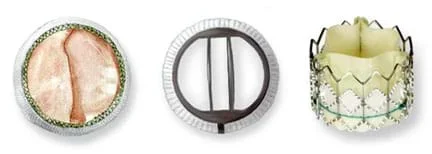 Example artificial heart valves (left to right): a biological valve (using human or porcine tissue), a mechanical valve, and recently FDA-approved tri-leaflet valve using bovine tissue. The far right valve is made of cow tissue attached to a stainless steel mesh frame with a polyester wrap and is inserted into the body through a small opening made in a leg artery.Copyright (left and middle) MedlinePlus, US National Library of Medicine and (right) US Food and Drug Administration http://www.nlm.nih.gov/medlineplus/ency/presentations/100161_4.htm http://www.fda.gov/MedicalDevices/ProductsandMedicalProcedures/DeviceApprovalsandClearances/Recently-ApprovedDevices/ucm280840.htm
When designing artificial valves, biomedical engineers consider many factors. What do you think would be important factors? (Listen to student ideas.) In theory, the best artificial valve would not require open heart surgery, be made of materials that does not cause blood to clot and lasts for a person's lifespan.
Today we learned all about how our heart valves operate, diseases that can damage our heart valves, and the artificial valves that biomedical engineers have created. We learned the pros and cons for each type of replacement valve, which are issue that engineers and physicians must consider. The design and creation of replacement valves is an example of how engineering can improve and save lives.
- aortic valve
- The valve between the left ventricle and the aorta, normally with three leaflets.
- circulatory system
- An organ system that passes nutrients, gases, hormones and blood cells to and from cells in the body to fight diseases and help stabilize body temperature and pH to maintain homeostasis.
- heart valve
- A one-way valve that allow blood to flow through it in one direction. Four valves are present in mammalian hearts. They open and close depending on different pressures on each side of them.
- mitral valve
- The valve between the left atrium and left ventricle, with two leaflets. Also known as the bicuspid valve because it is the only valve in the human heart with just two flaps.
- open heart surgery
- A surgery performed on the exposed heart while a heart-lung machine pumps and oxygenates the blood and diverts it from the heart.
- pulmonary valve
- The valve between the right ventricle and the pulmonary artery, with three cusps or leaflets.
- stent
- A slender tube of plastic or sprung metal mesh placed inside a hollow tube to open it or keep it open. For example, used in surgery to provide support to prevent blood vessels from closing, especially after they have just been unclogged.
- tricuspid valve
- The valve between the right atrium and right ventricle, normally with three leaflets and three papillary muscles.
- valve
- Any device for halting or controlling the flow of a liquid, gas or other material through a passage, pipe, inlet, outlet, etc.
Pre/Post-Lesson Quiz: Administer The Circulatory System Quiz (PDF), a 10-question pre- and post- assessment of content knowledge to determine students' prior knowledge of the subject matter. Administer the same quiz again, after lesson conclusion, to ascertain students' knowledge gain.
Divide the class in half and facilitate a classroom debate on whether to use a metal and plastic heart valve or a valve made from animal tissue for two patient scenarios. Have Patient #1 be a 75-year-old man and the Patient #2 be an 11-year-old girl. Have each student write down one reason to defend his/her side of the debate and share it with the class. To help students organize their points for the discussion, have them complete this table to evaluate the different valve replacement options.
Dictionary.com. Lexico Publishing Group, LLC. Accessed October 20, 2011. (Source of some vocabulary definitions, with some adaptation)
Edwards Lifesciences. Transcatheter Heart Valve. Accessed September 15, 2011 (Information about a replacement valve) http://www.edwards.com/products/transcathetervalve/Pages/THVcategory.aspx
Valves of the Heart. University of Southern California Cardiothoracic Surgery. Accessed September 21, 2011. (Information about the heart valves and diseases) http://www.cts.usc.edu/hpg-valvesoftheheart.html
Wikipedia.org. Wikimedia Foundation, Inc. Accessed on September 9, 2011. (Information about heart valves and diseases)
- Engineering the Heart: Heart Valves
Contributors
Carleigh Samson; Ben Terry; Brandi Briggs
Supporting Program
Integrated Teaching and Learning Program, College of Engineering, University of Colorado Boulder
Acknowledgements
The contents of this digital library curriculum were developed under a grant from the Fund for the Improvement of Postsecondary Education (FIPSE), U.S. Department of Education and National Science Foundation GK-12 grant no. 0338326. However, these contents do not necessarily represent the policies of the Department of Education or National Science Foundation, and you should not assume endorsement by the federal government.
Copyright
2011 by Regents of the University of Colorado.