
Shades of Gray(water)
Students are introduced to the concepts of graywater and water reuse within households. They calculate the amount of used water a family generates in one day and use a model of home plumbing to find out how much graywater is produced in homes every day. They graph their results and discuss energy efficiency implications. Students are then challenged to find ways to reduce water use within the home.
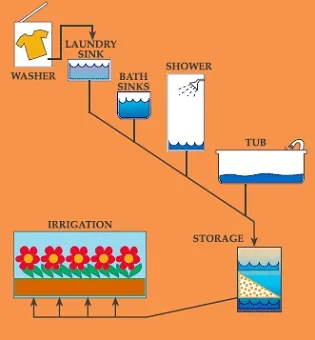 Engineers investigate the graywater cycle to increase household water availability.Copyright City of Tuscon AZ http://cms3.tucsonaz.gov/water/greywater
Many engineers are concerned with efficiency. In the case of our municipal water supplies, engineers design ways for people to use resources more efficiently. To help households use less water, engineers have come up with solutions such as low-flow fixtures that get used every day, helping with water conservation. Engineers also investigate ways to improve the water efficiency in homes, such as using treated graywater to flush toilets. They also design treatment systems to remove the contaminants in graywater so it is safe for public use.
After this activity, students should be able to:
- Explain the difference between potable and non-potable water.
- Graph household water usage.
- Make recommendations of ways to reduce freshwater use in households.
- 4.1.3.b Use the four operations with whole numbers to solve problems.
Grade 4
Do you agree with this alignment? - 6.3.1.d.i Display numerical data in plots on a number line, including dot plots, histograms, and box plots.
Grade 6
Do you agree with this alignment?
- Water on Earth is distributed and circulated through oceans, glaciers, rivers, ground water, and the atmosphere
Grade 6
Do you agree with this alignment? - Earth's natural resources provide the foundation for human society's physical needs. Many natural resources are nonrenewable on human timescales, while others can be renewed or recycled
Grade 6
Do you agree with this alignment? - Earth and Sun provide a diversity of renewable and nonrenewable resources
Grade 5
Do you agree with this alignment? - Use direct and indirect evidence to determine the types of resources and their applications used in communities
Grade 6
Do you agree with this alignment? - Describe where water goes after it is used in houses or buildings
Grade 6
Do you agree with this alignment?
- CCSS.Math.Content.3.MD.B.3 Draw a scaled picture graph and a scaled bar graph to represent a data set with several categories. Solve one- and two-step "how many more" and "how many less" problems using information presented in scaled bar graphs.
Grade 3
Do you agree with this alignment? - CCSS.Math.Content.4.MD.A.2 Use the four operations to solve word problems involving distances, intervals of time, liquid volumes, masses of objects, and money, including problems involving simple fractions or decimals, and problems that require expressing measurements given in a larger unit in terms of a smaller unit. Represent measurement quantities using diagrams such as number line diagrams that feature a measurement scale.
Grade 4
Do you agree with this alignment?
- STEL-1E Compare how things found in nature differ from things that are human-made, noting differences and similarities in how they are produced and used.
Grades 3-5
Do you agree with this alignment? - STEL-1J Develop innovative products and systems that solve problems and extend capabilities based on individual or collective needs and wants.
Grades 6-8
Do you agree with this alignment?
- 5-ESS3-1 Obtain and combine information about ways individual communities use science ideas to protect the Earth's resources and environment.
Grade 5
This resource focuses on the following Three Dimensional Learning aspects of NGSS:
Science & Engineering Practices- Obtain and combine information from books and/or other reliable media to explain phenomena or solutions to a design problem.Do you agree with this alignment?
Disciplinary Core Ideas- Human activities in agriculture, industry, and everyday life have had major effects on the land, vegetation, streams, ocean, air, and even outer space. But individuals and communities are doing things to help protect Earth's resources and environments.Do you agree with this alignment?
Crosscutting Concepts- A system can be described in terms of its components and their interactions.Do you agree with this alignment?
- Science findings are limited to questions that can be answered with empirical evidence.Do you agree with this alignment?
Do you agree with this alignment? - Obtain and combine information from books and/or other reliable media to explain phenomena or solutions to a design problem.
- MS-ESS3-3 Apply scientific principles to design a method for monitoring and minimizing a human impact on the environment.
Grades 6-8
This resource focuses on the following Three Dimensional Learning aspects of NGSS:
Science & Engineering Practices- Apply scientific principles to design an object, tool, process or system.Do you agree with this alignment?
Disciplinary Core Ideas- Human activities have significantly altered the biosphere, sometimes damaging or destroying natural habitats and causing the extinction of other species. But changes to Earth's environments can have different impacts (negative and positive) for different living things.Do you agree with this alignment?
Crosscutting Concepts- The uses of technologies and any limitations on their use are driven by individual or societal needs, desires, and values; by the findings of scientific research; and by differences in such factors as climate, natural resources, and economic conditions. Thus technology use varies from region to region and over time.Do you agree with this alignment?
- Relationships can be classified as causal or correlational, and correlation does not necessarily imply causation.Do you agree with this alignment?
Do you agree with this alignment? - Apply scientific principles to design an object, tool, process or system.
To make a household water fixtures use setup (see Figure 1, which the teacher constructs) for one group:
- shoebox (or any similarly-shaped box to support six funnels)
- (optional) 8 Popsicle sticks (to make shoebox more sturdy)
- (optional) duct tape (to make shoebox more sturdy)
- 6 funnels
- plastic tubing that fits snugly on the ends of the funnels
- 2 large measuring cups marked in ml
- marker
- masking tape
- scissors
- box cutter
Each group also needs:
- 1 medium-sized cup or beaker to hold and pour ≤ 100 ml water
- graduated cylinder or something to measure ≤ 100 ml
- colored pencils, markers or crayons (for coloring bar graphs)
- Shades of Gray(water) Worksheet (PDF), one per student
To share with the entire class:
- pitcher of water
- 1 container of liquid food coloring
- sponge/paper towels, for any clean-up needed
Note: Plan on each initial household water fixtures use setup costing ~$3 per group, and then about 10¢ each time you run the activity again because you are reusing the shoebox setup.
Before this activity, present to students the Human Water Cycle lesson, which explains how people obtain, treat and dispose of water, and helps students differentiate between graywater and blackwater in household water use.
Where are some places that we use water in our homes? (Pause and wait for answers, such as bathtubs, kitchen sinks, washing machines.) Do you every think of how much water we use everyday inside? And it adds up. A family of four can use almost 90,000 gallons of water per year!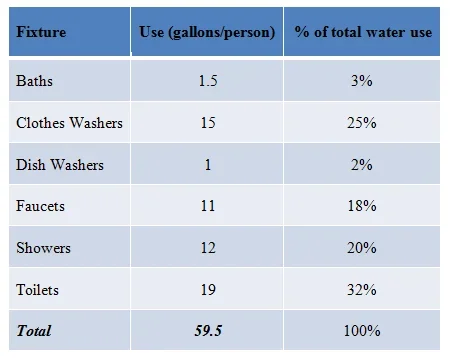 Table 1: Typical household water use in terms of gallons per person per day.Copyright (data source) James P. Heaney, et al., Boulder Community Network http://bcn.boulder.co.us/basin/local/heaney.html
If we look at how much water we use in each fixture, or device that uses drinking water, we can see that the highest use is for toilet flushing (show students Table 1, or write its information on the classroom board). Do you think it is kind of weird (wasteful) that we use nice, clean water just to empty our toilets? Engineers call drinking water "potable water," and they call water that is still clean but is not used for drinking by the name, "non-potable water." Flushing a toilet can be done using non-potable water because we do not drink water from the toilet bowl.
Due to many reasons, communities often experience a shortage of treated, clean and safe water. This means that engineers have to think of ways for those communities to reduce the use of treated water in households so enough is available. One way to do this is to use graywater, or used water from showers, sinks and clothes washers, to flush our toilets. Treated graywater is non-potable water and can be used in some household fixtures. We would not want to wash our dishes or our bodies in graywater, or drink graywater, but it is fine for flushing toilets.
Another way we can use less municipal water is to install low-flow fixtures in houses. Low-flow fixtures are designed to use less water than other models of the same fixtures. A low-flow faucet on a bathroom sink still allows enough water to come through for washing dirt off your hands and brushing teeth. By updating to low-flow fixtures, a household can reduce its yearly water usage by 35%.
Today we are going to act like engineers and examine how water is used in homes. We will think about which type of water could be used again and make recommendations for the family for reducing their household water use.
Background
Students model how water is used in a home, based on typical usage statistics and various family sizes. The shoebox-based structure contains funnels to represent various plumbing fixtures found in a house, such as bathtubs and faucets. After making calculations, students measure out scaled amounts of water into each funnel and then see which water is classified as blackwater and which is considered graywater.
Before the Activity
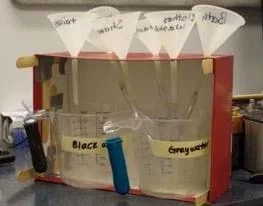 Figure 1: Example household water fixtures use setup.Copyright 2012 Katie Spahr, College of Engineering, University of Colorado Boulder
- Gather materials and make copies of the Shades of Gray(water) Worksheet (PDF).
- Make a graywater structure for each group by following the instructions in the Shades of Gray(water) Activity Set-up (PDF). This household water fixtures use setup is shown in Figure 1.
- Place a few drops of food coloring into each measuring cup labeled "Blackwater."
With the Students
- Divide the class into groups of three students each.
- Hand out the worksheets.
- Assign each group a family size from two to eight people, and tell them they are looking at how much water this family uses every day. Have students make calculations to complete the first two worksheets questions, based on their family size numbers.
- Explain how the model represents various plumbing fixtures found in a house. This is a way to model a household's water fixtures use. Engineers often use models to help them understand projects they are working on.
- For each fixture, have students measure into a cup or beaker the scaled amount of water (as calculated on the worksheet), and then pour it into the correct funnel.
- Expect students to notice that all the graywater sources go into one measuring cup, and the blackwater goes into the other measuring cup and appears colored (due to the food dye).
- Tell students that the clear water represents non-potable water and can be used again, and that the colored water represents blackwater and cannot be used again. Have students make observations about where their water went and record them on the worksheets (question 6).
- Ask students the following questions to further their comprehension:
- Which cup has more water? (Answer: The graywater cup.)
- What kind of things might be in the clear water, assuming that the water was used in a shower or sink and then went down the drain? (Answer: Soap, hair, grit, dirt, food particles, anything that goes down a drain.)
- In which of the fixtures could the non-potable (clear water) be used in again? (Answer: In the toilet for flushing.)
- Have students measure how much graywater was produced (the clear water) and calculate how many times that amount of graywater could flush a toilet (worksheet question 7).
- Have students finish their worksheets and color in their bar charts. Collect the worksheets.
- Conclude with a class discussion, sharing and comparing results and conclusions. Ask the Investigating Questions.
- Assign the post-activity assessments, as described in the Assessment section.
- blackwater
- Used water that has come into contact with human waste. Blackwater cannot be easily (that is, safely) reused at the household level and should be sent to the sewer system and wastewater treatment plant.
- graywater
- Used water from showers, sinks, baths, dishwashers and clothes washers. Since graywater is not contaminated with human waste, it can be used again before it goes to the sewer system.
- low-flow fixtures
- Re-designed faucets, showerheads and water-using appliances that use less water than older models.
- non-potable water
- Water that is treated not quite to drinking water standards, but can be used in situations in which people do not have direct contact with the water, such as for flushing toilets and irrigation.
- potable water
- Water that is treated to drinking water standards and can be consumed.
- water efficiency
- The concept of using water resources, from wastewater to water from natural water bodies, in the most efficient manner so as to minimize water waste.
- water reuse
- Reuse of treated wastewater. Depending on how much the wastewater is treated, water can be reused for everything from watering golf courses to augmenting drinking water supplies.
Pre-Activity Assessment
Discussion Questions: Ask questions to get students to access prior knowledge related to the activity.
- What is the difference between graywater and blackwater? (Answer: Graywater is used water from showers, sinks and clothes washers, whereas blackwater is used water from toilets, which has come into contact with human waste.)
- What ways do we use water in our homes? (Answer: Open ended; possible answers: washing dishes, washing hands, cleaning, taking baths, flushing toilets, drinking, making soup.)
Activity Embedded Assessment
Worksheet: Have students make calculations and follow along with the activity on their Shades of Gray(water) Worksheet (PDF). Review their calculations, answers and graphs to gauge their mastery of the subject.
Post-Activity Assessment
Drawing and Class Discussion: On paper, have students sketch and label the household uses activity setup, making sure to indicate which household fixtures use graywater and blackwater in this simplified model of household water usage. Have them each draw an arrow to indicate where graywater can be recycled in these household fixtures.
Communicate It! Ask students to think about engineering and water efficiency. Assign them to create flyers or journal entries offering recommendations for reducing family water use.
Have handy a sponge and/or paper towels to clean up any spills.
Be careful not to spill water on the shoebox too many times or the cardboard loses its structure/sturdiness.
Have students brainstorm and design water-saving fixtures (baths, showers, faucets, dishwashers, clothes washers, toilets) that use less water. Have them build prototypes with simple materials like construction paper and tape.
- For lower grades, do the scaling and measurements for the students, but have students pour water into the funnels. As necessary, adjust the worksheet to reflect their skill level.
- For upper grades, introduce more math, such as fixture flow rates (low-flow fixtures are 1.5 gallons/minute) and toilet flush capacity (4 gallons/flush). Have student groups construct their own activity setups.
Heaney, James P., William DeOreo, Peter Mayer, Paul Lander, Jeff Harpring, Laurel Stadjuhar, Courtney Beorn and Lynn Buhlig. "Nature of Residential Water Use & Effectiveness of Conservation Programs." Published September 1, 2010. Boulder Area Sustainability Information Network Library, Boulder Community Network. Accessed September 16, 2020. http://bcn.boulder.co.us/basin/local/heaney.html
Contributors
Katie Spahr; Malinda Schaefer Zarske
Supporting Program
Integrated Teaching and Learning Program, College of Engineering, University of Colorado Boulder
Acknowledgements
The contents of this digital library curriculum were developed under a grant from the Fund for the Improvement of Postsecondary Education (FIPSE), U.S. Department of Education and National Science Foundation GK-12 grant no. 0338326. However, these contents do not necessarily represent the policies of the Department of Education or National Science Foundation, and you should not assume endorsement by the federal government.
Copyright
2013 by Regents of the University of Colorado