
Human Water Cycle
Students learn about the human water cycle, or how humans impact the water cycle by settling down in civilizations. Specifically, they learn how people obtain, use and dispose of water. Students also learn about shortages of treated, clean and safe water and learn about ways that engineers address this issue through water conservation and graywater recycling.
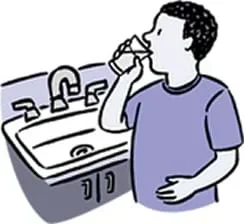 We use water for drinking and washing, part of the human water cycle.Copyright NIH http://newsinhealth.nih.gov/2008/October/feature2.htm
Engineers involved with water resources, drinking water and wastewater are responsible for designing ways for communities to obtain, treat and dispose of water. Each step in the human water cycle—from natural water sources to communities and back to natural water sources—requires the help of engineers. Some engineers focus on cultivating drinking water sources, while others treat water so it is safe for public consumption and treat wastewater before it is returned to the natural environment. When presented with problems such as water scarcity, engineers are challenged to think of ways to change traditional water management in order to provide enough water for future generations. Some of these changes require increasing water efficiency—how we can better use existing water supplies instead of creating new infrastructure to address water limitations.
After this lesson, students should be able to:
- Describe the human water cycle.
- Differentiate between graywater and blackwater.
- Evaluate ways in which people can change their water use to make sure we have enough (water conservation).
- Water on Earth is distributed and circulated through oceans, glaciers, rivers, ground water, and the atmosphere
Grade 6
Do you agree with this alignment? - Earth's natural resources provide the foundation for human society's physical needs. Many natural resources are nonrenewable on human timescales, while others can be renewed or recycled
Grade 6
Do you agree with this alignment? - Earth and Sun provide a diversity of renewable and nonrenewable resources
Grade 5
Do you agree with this alignment? - Describe where water goes after it is used in houses or buildings
Grade 6
Do you agree with this alignment?
- STEL-1E Compare how things found in nature differ from things that are human-made, noting differences and similarities in how they are produced and used.
Grades 3-5
Do you agree with this alignment? - STEL-1J Develop innovative products and systems that solve problems and extend capabilities based on individual or collective needs and wants.
Grades 6-8
Do you agree with this alignment?
- 5-ESS3-1 Obtain and combine information about ways individual communities use science ideas to protect the Earth's resources and environment.
Grade 5
This resource focuses on the following Three Dimensional Learning aspects of NGSS:
Science & Engineering Practices- Obtain and combine information from books and/or other reliable media to explain phenomena or solutions to a design problem.Do you agree with this alignment?
Disciplinary Core Ideas- Human activities in agriculture, industry, and everyday life have had major effects on the land, vegetation, streams, ocean, air, and even outer space. But individuals and communities are doing things to help protect Earth's resources and environments.Do you agree with this alignment?
Crosscutting Concepts- A system can be described in terms of its components and their interactions.Do you agree with this alignment?
- Science findings are limited to questions that can be answered with empirical evidence.Do you agree with this alignment?
Do you agree with this alignment? - Obtain and combine information from books and/or other reliable media to explain phenomena or solutions to a design problem.
Students should have a basic knowledge of the Earth's water cycle and understand the concepts of runoff and infiltration to the groundwater table. Prior knowledge of where we get our drinking water from and global warming is helpful.
Many people do not consider the impact that their personal water use has on a large scale. In cities, where drinking water is pumped in and wastewater flushed away, residents do not worry about obtaining and disposing of their water, so they are not aware of these "invisible" services. Students can calculate the amount of used water a families of different sizes generate in one day with the Teach Engineering activity Shades of Gray(water). You hear little talk about unacknowledged reuse, or the fact that treated wastewater augments natural flowing water sources that are used for drinking water downstream. For example, communities located downstream on the Colorado and Mississippi Rivers, which are popular drinking water sources, drink water that has been reused multiple times before it gets to them. Talking about the human water cycle, or how people get, use and dispose of water, can open up conversations about the future of water management and allow for more planning to be protective of public health.
Understanding how water is used impacts future water policy, especially when talking about water reuse. Water reuse is the reuse of treated wastewater. Depending on how much the wastewater is treated, water can be reused for everything from watering golf courses to augmenting drinking water supplies. One type of water reuse is graywater reuse, which is the reuse of shower, sink, dishwasher and clothes washer water. Since the water from these sources has not come into contact with human waste, the water is easier to treat and can be done with simple household filters. Graywater can be used for irrigation or treated and used to flush toilets. When used to flush toilets, households can experience up to 30% savings on their monthly water bills.
Water reuse, graywater recycling and water conservation can be grouped together as efforts to attain water efficiency. Water efficiency is the concept of using our water resources, from wastewater to water from natural water bodies, in the most efficient manner and cutting down on water waste. By using each source of water to its most appropriate use, water is not wasted and the threat of water shortages is lessened. It is the job of civil and environmental engineers, working closely with policy makers, to improve water efficiency.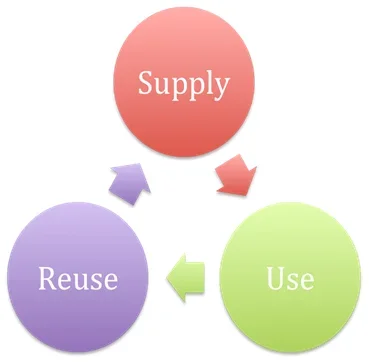 The human water cycle.Copyright 2013 Katie Spahr, College of Engineering, University of Colorado Boulder
Have you ever wondered where we get our drinking water? (Pause to listen to student ideas.) That's right! The water we drink comes from lakes, rivers, streams, glaciers and even groundwater (water located underground in soil pore spaces and rock fractures). The water is taken from these places, treated so that it will not make us sick, and then piped to our homes so that we can turn on the faucet and have clean water.
Once we use the water in our houses, do you know where it goes? Yes, down the drain and to the sewer system. The sewer brings our used water, called wastewater, to a wastewater treatment plant where all the harmful things we put into our water are removed. Once the water is cleaned at the wastewater treatment plant, it is put back into rivers and streams.
Did you notice that the cleaned wastewater ended up in one of the same places that we get our drinking water? That's because the way we use water is a cycle, much like the water cycle that we have learned about. In the Earth's water cycle, water molecules evaporate and transpire from water on the Earth to the atmosphere, condense into clouds, come back to the Earth through precipitation, and then make their way back to water bodies though runoff and infiltration. The cycle we just talked about, starting with obtaining and treating our drinking water, is called the human water cycle. The human water cycle describes how humans get, use and reuse water.
Sometimes, our household water sources in the natural environment run low on water. Can you think of some reasons why we could have less water in lakes and rivers? (Pause for ideas,) We run low on water for many reasons, such as when we use too much or experience a low precipitation year as part of variable weather patterns. Researchers are measuring a gradual heating of the Earth's atmosphere, called global climate change, and this can change weather patterns such as where it rains and how often. Because we have less water some years, engineers and policy makers must think of ways to deal with water shortages. One way is through water conservation, or using less water. If everyone in a town uses less water, then our supply lasts longer and serves more people.
Another way that engineers try to fix water shortages is through reusing graywater. Graywater is the used water from showers, sinks, baths, dishwashers and clothes washers. What kind of things do you think are in the water? Graywater has a little soap, dirt and even hair in it, but it is clean enough to use again for things like flushing toilets or watering gardens. Once water goes down a toilet, it is called blackwater. Blackwater has human waste in it, which can make us sick, so it goes straight to the sewer and the wastewater treatment plant where it is cleaned. When we use graywater for other purposes in our houses, we are using the same water more than once, which means that we end up using less water overall. Using less water means that we can have more water to share now and more water available for future use, which is pretty smart planning.
Environmental and civil engineers are involved in every step of the human water cycle. They choose which water supply we should use as a drinking water source and then design the pipes and canals that deliver the water to our towns. Once we have the water close by, civil and chemical engineers design water treatment plants where the water is made clean and healthy to drink. After the water is piped to our homes, used and then put into the sewer, all the harmful parts of wastewater are removed at wastewater treatment plants designed by engineers. Cleaned wastewater is then discharged back into natural water bodies. All along the way, these engineers also work on each of these steps to make them more efficient, such as creating water conservation programs. Not all engineering is building new things; some engineers examine existing ways that we do things and think of ways to make them run better for years to come.
Environmental and civil engineers are involved in every step of the human water cycle. They choose which water supply we should use as a drinking water source and then design the pipes and canals that deliver the water to our towns. Once we have the water close by, civil and chemical engineers design water treatment plants where the water is made clean and healthy to drink. After the water is piped to our homes, used and then put into the sewer, all the harmful parts of wastewater are removed at wastewater treatment plants designed by engineers. Cleaned wastewater is then discharged back into natural water bodies. All along the way, these engineers also work on each of these steps to make them more efficient, such as creating water conservation programs. Not all engineering is building new things; some engineers examine existing ways that we do things and think of ways to make them run better for years to come.
Today we learned about how we have two different water cycles: the Earth's water cycle and the human water cycle. When we are talking about the Earth's water cycle, we are not considering the impact of the humans and animals that live on the Earth. Because we use water everyday, we impact how the human water cycle works with the Earth's water cycle. We also learned about graywater and blackwater, and how engineers are designing ways to reuse and clean different types of water to help with water conservation.
- blackwater
- Used water that has come in contact with human waste. This water cannot be easily (safely) reused at the household level and thus is sent to the sewer system and wastewater treatment plant.
- graywater
- Used water from showers, sinks, baths, dishwashers and clothes washers. This water is not contaminated with human waste and can be used again before it goes to the sewer system.
- human water cycle
- How people get, use and dispose of water in their communities.
- unacknowledged reuse
- The process of using treated wastewater effluent as a downstream drinking water source. The general public typically does not acknowledge that this is happening.
- water conservation
- Using less water.
- water cycle
- The fate of water molecules in the environment; water can be transpiring, evaporating, condensating, precipitating, running off or infiltrating.
- water efficiency
- The concept of using our water resources, from wastewater to water from natural water bodies, in the most efficient manner and reducing water waste.
- water reuse
- The reuse of treated wastewater. Depending on how much the wastewater is treated, water can be reused for everything from watering golf courses to augmenting drinking water supplies.
- water shortage
- The condition of running low on water; may be due to cyclical water patterns, altered precipitation patterns, global climate change or other natural phenomena.
Discussion Question: Ask the following question to get students to think about the upcoming lesson. After soliciting answers, explain that this question will be answered during the lesson.
- How we can change how we use water to make sure we have enough for the future? (Possible answers: Water conservation, water reuse, water efficiency.)
Table Questions: Assign table groups one of the following questions. Give the groups time to discuss the answer. Pick one student from each table to share the group's thoughts with the class.
- What are the three stages of the human water cycle? (Answer: Supply, use, reuse.)
- How do engineers help with each of these steps? (Answer: They plan and design ways to obtain water supplies, design ways to treat our water and wastewater, and improve each step to operate at its best.)
- What causes water shortages? (Possible answers: Periods of drought, changing weather patterns, global warming.)
- What can we do to make sure we have enough water? (Answer: Conservation, and other ideas the students have brainstormed.)
Have students research water conservation on a home, industry or agricultural level. Have them make posters to present their findings to the class.
Have students brainstorm ways they can make fixtures in their houses more efficient. Give them simple materials to build prototypes of the improved fixtures.
Mayer, Peter W., William B. DeOrea, et al. Residential End Uses of Water. Denver, CO: AWWA Research Foundation and American Water Works Association, 1999. Accessed September 16, 2020. https://www.waterdm.com/sites/default/files/WRF%20(1999)%20Residential%20End%20Uses%20of%20Water.pdf
"Water Reuse Frequently Asked Questions." WaterReuse Association, Alexandria, VA. Accessed December 20, 2012. Originally found at http://www.watereuse.org/information-resources/about-water-reuse/faqs-0
Contributors
Katie Spahr; Malinda Schaefer Zarske
Supporting Program
Integrated Teaching and Learning Program, College of Engineering, University of Colorado Boulder
Acknowledgements
The contents of this digital library curriculum were developed under a grant from the Fund for the Improvement of Postsecondary Education (FIPSE), U.S. Department of Education and National Science Foundation GK-12 grant no. 0338326. However, these contents do not necessarily represent the policies of the Department of Education or National Science Foundation, and you should not assume endorsement by the federal government.
Copyright
2013 by Regents of the University of Colorado