
Product Development and the Environment
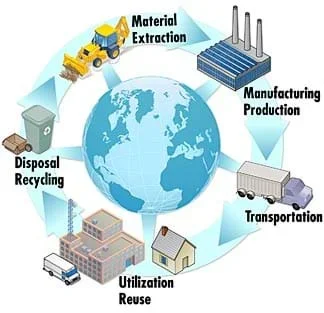 Students investigate the life cycles of engineered productsCopyright The National Institute of Standards and Technology (NIST) http://commons.wikimedia.org/wiki/File:Life_Cycle_Thinking_Product_System.jpg
Students investigate the life cycles of engineered products and how they impact the environment. They use a basic life cycle assessment method that assigns fictional numerical values for different steps in the life cycle. Then they use their analyses to compare the impacts of their products to other products, and suggest ways to reduce environmental impact based on their analyses.
Engineers are inspired by nature for many designs. In particular, engineers often strive to manage waste streams by reusing and recycling materials, as done so well in the natural environment. Engineers often think about the fate of a product from the point of development and construction to the end of its useful life, called a life cycle assessment. Steps in a product life cycle assessment include materials acquisition, materials processing, manufacturing, packaging, transportation, use, and disposal. A variety of goals can be considered when completing a life cycle assessment. Engineers sometimes design products with durable parts intended for a long lifespan and other times they design products intended to last a relatively short amount of time, but have easy-to-reuse or recycle parts.
After this activity, students should be able to:
- Describe the steps in a product life cycle assessment.
- Suggest ways to reduce the environmental impacts of engineered products.
- Explain how a life cycle assessment is a useful tool for engineers.
- 7.1.2.a Apply understandings of addition and subtraction to add and subtract rational numbers including integers.
Grade 7
Do you agree with this alignment?
- The management of waste produced by technological systems is an important societal issue.
Grades 6-8
Do you agree with this alignment? - STEL-4L Analyze how the creation and use of technologies consumes renewable and non-renewable resources and creates waste.
Grades 6-8
Do you agree with this alignment?
- MS-ESS3-3 Apply scientific principles to design a method for monitoring and minimizing a human impact on the environment.
Grades 6-8
This resource focuses on the following Three Dimensional Learning aspects of NGSS:
Science & Engineering Practices- Apply scientific principles to design an object, tool, process or system.Do you agree with this alignment?
Disciplinary Core Ideas- Human activities have significantly altered the biosphere, sometimes damaging or destroying natural habitats and causing the extinction of other species. But changes to Earth's environments can have different impacts (negative and positive) for different living things.Do you agree with this alignment?
Crosscutting Concepts- The uses of technologies and any limitations on their use are driven by individual or societal needs, desires, and values; by the findings of scientific research; and by differences in such factors as climate, natural resources, and economic conditions. Thus technology use varies from region to region and over time.Do you agree with this alignment?
- Relationships can be classified as causal or correlational, and correlation does not necessarily imply causation.Do you agree with this alignment?
Do you agree with this alignment? - Apply scientific principles to design an object, tool, process or system.
Each group needs:
- pencils
- Life Cycle Assessment Worksheet
- any manufactured product to analyze
- (optional) screwdrivers for disassembling products
Everywhere around us are products made from metals and plastics. Some of these products are as simple as a hairbrush or toothbrush; while others are as complex as a vehicle or a computer. Do you ever stop to think about how these products are made? Everything that involves metal and plastic uses natural resources, requires energy to manufacture, and produces waste in our environment. Some products have a large impact on the environment, and some have less of an impact. Products that can be recycled have less of an impact on the environment and are considered "environmentally friendly."
Engineers consider the environmental impacts to our air, water and other natural resources when creating new products. To do this, they consider the entire life cycle of products—including materials acquisition, materials processing, manufacturing, packaging, transportation, use and disposal. These represent all the life phases of products, similar to the life cycles of animals in nature. Looking at the life cycle of a product helps us understand how we use the Earth's natural resources and energy and, particularly, how we produce waste.
An engineer uses a life cycle assessment to measure how much energy is used to create a product and the impact a product has on the environment, from its creation to its final disposal. This includes several general steps to determining the overall environmental impact of a manufactured product. The first step is called an inventory analysis. In this step, the energy and materials used during a product's life cycle are calculated. A number value is assigned for energy and physical materials for all the phases of the life cycle (materials acquisition, materials processing, manufacturing, packaging, transportation, use, and disposal). The next step is an impact analysis—where the number values from step 1 are added together. This gives a final number which represents the total impact on the environment. Lastly, an improvement analysis is performed to determine any way to reduce the product's impact on the environment. For example, conserving energy or water during any of the phases of the life cycle or exchanging materials for less hazardous waste ones would help reduce the impact. Then, the changes are inserted back into the inventory analysis to determine if the total environmental impact can be reduced.
Today, we are going to think about the life cycle of some engineered products. Since we are not developing new products, we are going to re-engineer existing ones by breaking the products down into their individual parts and examine each part for our analysis. Using that information, we will assign representative numbers for the environmental impact of our products and compare those impact numbers with the other products of our classmates. Then we will think about ways to reduce our numbers, or in essence, the environmental impact of our products.
Background
This activity gives students an idea of how a life cycle assessment can be useful. The numbers on the worksheet are fictional and are only used to compare the environmental impacts of different objects to each other. In a real engineering life cycle analysis, the numbers of each step are determined using actual measurable inputs and outputs of energy, electricity, raw materials, water, waste and emissions.
 Copyright 2008 Microsoft Corporation, One Microsoft Way, Redmond, WA 98052-6399 USA. All rights reserved.
Before the Activity
- Gather several metal and plastic products for students to examine. Examples: a broken CD player, old VCR player, a Mr. Coffee machine, or a toy. (Note: More complex products take longer to analyze than simple products, such as staplers, hair brushes, mechanical pencils or tape dispensers, and are more interesting, too!)
- If you wish to have students take apart the products, gather a variety of screwdrivers to help with this.
With the Students
- Divide the class into teams of two students each.
- Give each student pair a product on which to perform a life cycle assessment.
- Have students follow along with the Life Cycle Assessment Worksheet (PDF) in determining a hypothetical number value for the impact of their products on the environment. (Remind students that the number is fictional, and for comparison purposes only.)
- Give students time to complete the life cycle analysis of their products.
- Ask teams to share their total impact analysis scores with the rest of the class. On the board, create a class list of products and scores. Discuss the range of impacts the products have on the environment.
- Have students think about modifications they might make to the life cycle of their products. Have them complete their improvement analysis on their worksheets and discuss any improvements with the class. What are recurring ideas for improvement in the class?
- life cycle
- The various stages through which something passes during its lifetime
- recycle
- To reuse or adapt for a new use.
- waste
- Damaged, defective or unusable material.
Pre-Activity Assessment
Class Discussion: Solicit, integrate and summarize student responses. Hold up a common item such as a stapler and ask students to think about the different parts and pieces that make up products. As a class, create a list of all the parts of the stapler on the classroom board.
Prediction: Have students predict the outcome of the activity before the activity is performed. Show students several example products that they will analyze during the activity. Ask them to predict which will prove to have the largest impact on the environment throughout their life cycles.
Activity Embedded Assessment
Worksheet: Have students follow along with the activity on the Product Life Cycle Assessment Worksheets. After students have finished their worksheets, have them compare answers with their peers.
Post-Activity Assessment
Considering Design Trade-Offs: Have students think about their suggested product improvements from the worksheets. Tell them that engineers must sometimes consider trade-offs in their designs. For example, might reducing the impact on the environment by reducing the amount of materials in the product also reduce the durability and effectiveness of the product? Have students determine any similar or possible product trade-offs that should be considered in their suggested product improvements.
Diagramming: Have students draw graphical models of the life cycles of their products. On their drawings, have them detail the materials, processes and energy involved in each phase of the life cycles. Require that they include the following phases: materials acquisition, materials processing, manufacturing, packaging, transportation, use and disposal of the product.
- Make sure students are careful when taking apart their products.
More complex products, such as CD players, are often more fun for the students, but they take longer to analyze. Choose the products wisely; if one group has a hairbrush while another has a toaster, they may finish at different speeds.
Have students look up the life cycles of some common products. A cell phone is a good example of a product that has changed significantly over time, from amount of materials, to packaging and accessories. Cell phone parts include the case, display, wiring, keypad, microphone, speaker, antennae and battery. Have students create life cycle assessments for the various parts of cell phones. Cell phone lives average about 18 months in the U.S. Have students compare the life cycle assessment of cell phones to conventional landline phones.
Have students research more about the development, use and disposal of plastic in products from toy dolls to cars. In fact, plastics account for 25% of all waste in landfills when buried (and many plastics end up in our oceans). Several online websites report the amount of plastics in different products and describe the options for recycling plastics. Have students create brochures for their school community about the use of plastics and where to dispose of them properly.
- For upper grades, have students look up the raw materials (oil, natural gas) that go into making plastics and different metals (ore). Have them create scoring systems to distinguish different ores and raw materials by their difficulty of extraction from the Earth, limited availability, and likelihood of being recycled.
- For lower grades, use simpler products, such as mechanical pencils and tape dispensers. Less complicated products help younger students understand the concepts behind the life cycle assessment.
U.S. Environmental Protection Agency, Systems Analysis Research, Office of Research & Development, National Risk Management Research Laboratory, Program Brief, "Life Cycle Assessment Framework," January 29, 2007, accessed February 14, 2007. http://www.epa.gov/nrmrl/std/
- Life Cycles
- Product Development and the Environment
Contributors
Malinda Schaefer Zarske; Janet Yowell; Kaelin Cawley
Supporting Program
Integrated Teaching and Learning Program, College of Engineering, University of Colorado Boulder
Acknowledgements
The contents of this digital library curriculum were developed under a grant from the Fund for the Improvement of Postsecondary Education (FIPSE), U.S. Department of Education and National Science Foundation GK-12 grant no. 0338326. However, these contents do not necessarily represent the policies of the Department of Education or National Science Foundation, and you should not assume endorsement by the federal government.
Copyright
2008 by Regents of the University of Colorado.