
Life Cycles
 Students explore various life cyclesCopyright 008 Microsoft Corporation, One Microsoft Way, Redmond, WA 98052-6399 USA. All rights reserved.
Students extend their knowledge of matter and energy cycles in organisms to engineering life cycle assessment of products. They learn about product life cycle assessment and the flow of energy through the cycle, comparing it to the flow of nutrients and energy in the life cycles of organisms.
Engineers use life cycle assessment, often called cradle-to-grave assessment, when designing and creating products. This type of analysis looks at products from raw materials through production, manufacture, packaging, distribution, use, end-of-life treatment and disposal. Life cycle assessments help engineers to understand the environmental impacts of designs at every stage of production and use, so they can implement improvements in recycling and waste reduction. One example that illustrates the use of life cycle assessment is plastic vs. paper packaging. Steps to consider in this analysis include the raw materials taken from the Earth, manufacturing of the plastic or paper material, creation of the packaging, use of the packaging, distribution of the packaged product, and disposal of the packaging, as well as air-water-noise emissions for all processes. All these issues are considered and tabulated to determine the overall environmental impact of the development of paper or plastic packaging.
After this lesson, students should be able to:
- Describe several basic steps in the life cycle assessment of products.
- Compare and contrast the life cycle of an organism and an engineered product.
- Describe the flow of energy through a product's life cycle.
- Compare and contrast the flow of energy with the cycling of matter in ecosystems
Grade 6
Do you agree with this alignment?
- The management of waste produced by technological systems is an important societal issue.
Grades 6-8
Do you agree with this alignment? - STEL-4L Analyze how the creation and use of technologies consumes renewable and non-renewable resources and creates waste.
Grades 6-8
Do you agree with this alignment?
- MS-LS2-3 Develop a model to describe the cycling of matter and flow of energy among living and nonliving parts of an ecosystem.
Grades 6-8
This resource focuses on the following Three Dimensional Learning aspects of NGSS:
Science & Engineering Practices- Develop a model to describe phenomena.Do you agree with this alignment?
Disciplinary Core Ideas- Food webs are models that demonstrate how matter and energy is transferred between producers, consumers, and decomposers as the three groups interact within an ecosystem. Transfers of matter into and out of the physical environment occur at every level. Decomposers recycle nutrients from dead plant or animal matter back to the soil in terrestrial environments or to the water in aquatic environments. The atoms that make up the organisms in an ecosystem are cycled repeatedly between the living and nonliving parts of the ecosystem.Do you agree with this alignment?
Crosscutting Concepts- The transfer of energy can be tracked as energy flows through a natural system.Do you agree with this alignment?
- Science assumes that objects and events in natural systems occur in consistent patterns that are understandable through measurement and observation.Do you agree with this alignment?
Do you agree with this alignment? - Develop a model to describe phenomena.
A familiarity with the basic life cycles of organisms in nature, such as butterflies.
Butterfly Life Cycle
Butterflies pass through four stages during their life cycles: egg, caterpillar, chrysalis and butterfly. The butterfly is an excellent and simple example to use when describing natural life cycles to students. Figure 2 illustrates the steps in a butterfly life cycle.
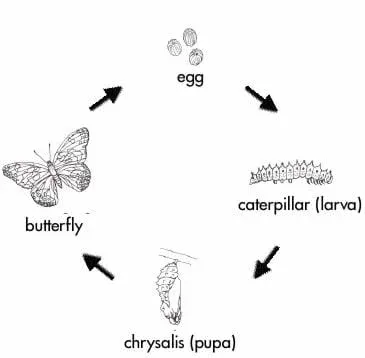 Figure 2. Life cycle of a butterfly.Copyright 1992 Town of Shrewsbury, MA. The National Academy of Science.
Steps in Engineering Life Cycle Assessment
A life cycle assessment measures how much a product impacts the environment, from its creation to final disposal. Several general steps are used to determine the overall environmental impact of a manufactured product.
- The first step is an inventory analysis. In this phase, the inputs and outputs of a product's energy and materials are calculated, including the environmental emissions that result from raw materials extraction, product manufacture, distribution, use and disposal.
- The next step is an impact analysis, in which the environmental impacts found in step 1 are calculated, looking at the impacts of generating electricity for each step in the product's life as well as any manufacturing by-products, including hazardous waste. This step results in a number that represents the impact on the environment.
- Lastly, an improvement analysis determines if any ways exist to reduce the impact on the environment. For example, conserving energy or water during any of the life cycle phases or exchanging materials for less hazardous waste-producing ones. Then the changes are inserted back into the inventory analysis to determine if the total environmental impact has been reduced.
Types of Engineering Life Cycle Assessment
Several types of life cycle assessments exist for engineered products. Some of them include:
- Cradle-to-Grave: The full life cycle of a product from raw materials (cradle) to the disposal phase (grave).
- Cradle-to-Gate: A partial product life cycle assessment that investigates a product from raw materials (cradle) to the gate of the manufacturing facility (gate) before transportation to the consumer.
- Cradle-to-Cradle: A product life cycle assessment, in which the end phase includes recycling of the product into a new product. The recycled product can be identical or different to the original product.
Today we are going to talk about the life cycles of creatures found in nature as well as how engineers model nature's life cycles as inspiration to improve the efficiency and environmental impact of their own designs.
Let's start with an example from nature. Many organisms have an observable life cycle. Think about a butterfly. Does anyone know what a butterfly is before it becomes a butterfly? Right, it starts out as an egg that its mother lays on leaves or tree branches. Once the egg hatches, what does it look like? It has become a caterpillar. The caterpillar spends all of its time eating the leaves and branches around it. Once it has had enough to eat, the caterpillar creates a chrysalis. What does the caterpillar do in the chrysalis? It changes from a caterpillar into a butterfly. How do butterflies and caterpillars look different? One has legs and crawls/hops, and the other has wings and flies. They eat different things as well. However, they are the same organism the whole time. As you can see, there is energy flow through the butterfly's life cycle as well, energy that butterfly takes in as food and gives back to the Earth as nutrients when it is decomposed. Can anyone name another organism that has a distinct life cycle? (Possible answers: ants, beetles, flies, any animal, etc.)
Engineers also think about life cycles when developing new products—implementing what is called life cycle assessment. A product's life cycle is similar to a butterfly's life cycle, as it follows the product from creation to decomposition.The steps of an engineering life cycle assessment might include: materials acquisition, materials processing, manufacturing, packaging, transportation, use, and disposal. Engineers think about the energy that flows through a product's life cycle as well. Energy is used to develop the product, package the product, deliver the product to market (transportation), use the product and dispose of the product. The energy that is used throughout a product's life cycle is combined with analyzing the physical steps of the cycle in order to determine the overall environmental impact of the product. Engineers use a product life cycle assessment to improve the environmental impacts of products, creating the best products that use the smallest amount of non-renewable natural resources and energy pollution possible.
Life cycle assessment helps engineers understand waste. Can you think of any examples of waste in nature? Nature is not wasteful like humans; the life cycles of organisms reuse and recycle nutrients for other purposes in the environment. Engineers think about the different ways that they can recycle energy and materials through every step of a product's life cycle. By analyzing the different steps of a product's life cycle, engineers can determine which steps are the most harmful to the air, water, land, or humans, and develop ways to decrease the impact of these steps.
Let's think about the life cycle of something with which we are familiar. How about a shopping bag? When you go to the grocery store, you usually take away your groceries in a bag. It might be plastic, paper or fabric, but for our purposes today, let's think about the product life cycle of a plastic grocery bag. The bag is made from fossil fuels that are removed from the Earth and transformed into plastic. The plastic is shaped and formed into a set of plastic bags, which is then packaged for sale and, stored in a warehouse, and eventually delivered to a grocery store. The plastic bag is used to hold your groceries after checkout, as you travel to your house. Often, the bag is discarded after the groceries are brought home. All that work to produce it, and it's life cycle is done once you get home.
Like the butterfly, the plastic grocery bag changes shape from nutrients in the Earth (fossil fuels) to a solid (plastic bag) that we use to carry our groceries. Over time, the bag will eventually break down (it might be a very long time), just as an adult butterfly does when decomposers break it down after its death. However, the butterfly is decomposed into organic nutrients, seeping into the soil to be taken up by plants as food that helps them grow. In time, the plant is eaten by the young caterpillars and the cycle begins again.
Unfortunately, the plastic bag will never turn back into fossil fuels that can be used to make new bags. We see much more recycling of nutrients in the butterfly life cycle than the plastic bag. Engineers might analyze the life cycle of the plastic bag and consider where the life cycle actually ends. Does it end with a pile of plastic bags in a landfill? Or, can the plastic bags be re-used as something else? Engineers are developing products that can be created from used plastics, such as playground equipment and furniture. But then, what happens when those products are "thrown away"? Following the lesson, students can conduct the associated activity Product Development and the Environment to employ their own engineering suggestions by comparing the environmental impacts of different products and suggest ways to reduce those impacts.
Today we discussed life cycles. What are some steps of the life cycle of a butterfly? (Answer: Birth, caterpillar, chrysalis, butterfly, decompose.) What are some steps in the life cycle of a product? (Answer: Materials acquisition, materials processing, manufacturing, packaging, transportation, use and disposal.) How is the life cycle of an organism similar to the life cycle of an engineered product? (Possible answers: Both life cycles follow the object from birth to death, beginning to end. Both cycles involve the flow of energy through the lifetime of the object.) How do the two cycles differ? (Answer: Often a product life cycle ends with disposal, whereas the life cycle of natural organisms continues on as they are recycled into nutrients [raw materials for new organisms] in the Earth.) Engineers strive to develop products that more closely resemble the life cycles in nature, in which all materials, energy and nutrients are recycled into the same or different new objects. Until then, we can reduce the impacts of manufacturing products on our environment by making the choice to use recyclable products over non-recyclable products when possible.
- life cycle
- The various stages through which something passes during its lifetime
- recycle
- To reuse or adapt for a new use.
- waste
- Damaged, defective or unusable material.
Pre-Lesson Assessment
Know / Want to Know / Learn (KWL) Chart: Before the lesson, ask students to write down in the top left corner of a piece of paper (or as a group on the board) under the title, Know, all the things they know about product life cycles. Next, in the top right corner under the title, Want to Know, ask students to write down anything they want to know about product life cycles.
Post-Introduction Assessment
Diagramming: Ask students to illustrate product life cycles through drawings. After reading the introduction, have them make drawings of the life cycles of common products that includes the materials acquisition, materials processing, manufacturing, packaging, transportation, use, and disposal of the product. For a more detailed diagram, have them label the energy flows in the cycles as well as any ideas for materials recycling.
Lesson Summary Assessment
Concept Reflections / Environmental Impacts: Have students reflect on their product life cycle assessments and write journal entries to summarize their thoughts. In thinking about product life cycle assessments of products they know, ask students the following questions:
- What types of steps might be involved in the life cycle of that product?
- During what steps are harmful impacts made to the environment (including pollution, waste and energy loss)?
- Are some steps more harmful than others?
- At what steps might recycling happen?
- What do you recommend for improving the environmental impacts of the entire life cycle of that product?
Know / Want to Know / Learn (KWL) Chart (Continued): Finish the remaining section of the KWL Chart as described in the Pre-Lesson Assessment section. After the lesson, ask students to list in the bottom half of the page under the title, Learned, all of the things that they have learned about product life cycles. Ask students to name a few items and write them on the board.
Many types of life cycle analyses are used by engineers as part of product development. A few of these are mentioned in the Lesson Background section. Have students investigate the different types of life cycle assessment and what types of product are developed with each type.
Expand this lesson with a more thorough discussion of the life cycles of living organisms. Only one living organism life cycle (a butterfly) was discussed in this lesson, but myriad exist. For example, mayflies live part of their life in the water and another in the air. An interesting discussion could include the life cycles of organisms in different environments and compare them to products developed for those same environments (water, air, etc.).
The EPA (Environmental Protection Agency) has a great poster for students that illustrates the product life cycle of a CD or DVD. http://www.epa.gov/wastes/education/pdfs/finalposter.pdf
Beal. Butterfly Life Cycle. 1992. Town of Shrewsbury, MA, Schools. The National Academy of Science. Accessed February 14, 2008. www.shrewsbury-ma.gov/schools/beal/curriculum/butterfly/cycle/nsrccycle.html
Life Cycle Assessment Framework, Program Brief. Last updated January 5, 2012. Systems Analysis Research, Office of Research & Development, National Risk Management Research Laboratory, U.S. Environmental Protection Agency. http://www.epa.gov/nrmrl/std/lca/pdfs/chapter1_frontmatter_lca101.pdf Accessed February 13, 2012.
Wastes. Last updated February 3, 2012. U.S. Environmental Protection Agency. www.epa.gov/epawaste/index.htm Accessed February 13, 2012.
- Life Cycles
Contributors
Malinda Schaefer Zarske; Janet Yowell; Kaelin Cawley
Supporting Program
Integrated Teaching and Learning Program, College of Engineering, University of Colorado Boulder
Acknowledgements
The contents of this digital library curriculum were developed under a grant from the Fund for the Improvement of Postsecondary Education (FIPSE), U.S. Department of Education and National Science Foundation GK-12 grant no. 0338326. However, these contents do not necessarily represent the policies of the Department of Education or National Science Foundation, and you should not assume endorsement by the federal government.
Copyright
2008 by Regents of the University of Colorado.