
Tightrope Trials
To learn about the concept of center of mass, students examine how objects balance. They make symmetrical cut-outs of different "creatures" and experiment with how they balance on a tightrope of string. Students see the concept of center of mass at work as the creatures balance.
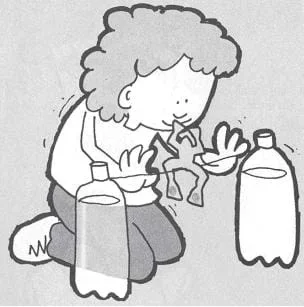 Students explore the concept of center of mass by examining how objects balance on a tightropeCopyright Hauser, 1999.
Engineers are interested in how objects balance so that they can build safe structures (auditoriums, Ferris wheels, shopping malls) and crafts (airplanes, cruise ships, kayaks). This is especially important in cases in which a structure may be impacted by heavy human loads, or unpredictable natural phenomena such as hurricanes or earthquakes.
After this activity, students should be able to:
- Relate static equilibrium and center of mass.
- Identify the movement of the center of mass of an object when weight is added to the object.
- Describe the influence of unequal forces on an object's balance.
- Recognize that engineers are interested in how objects balance so that they can build safe structures.
- Predict and evaluate the movement of an object by examining the forces applied to it
Grade 8
Do you agree with this alignment?
- CCSS.Math.Content.8.G.A.1 Verify experimentally the properties of rotations, reflections, and translations:
Grade 8
Do you agree with this alignment?
- STEL-3G Explain how knowledge gained from other content areas affects the development of technological products and systems.
Grades 6-8
Do you agree with this alignment?
- MS-PS2-2 Plan an investigation to provide evidence that the change in an object's motion depends on the sum of the forces on the object and the mass of the object.
Grades 6-8
This resource focuses on the following Three Dimensional Learning aspects of NGSS:
Science & Engineering Practices- Plan an investigation individually and collaboratively, and in the design: identify independent and dependent variables and controls, what tools are needed to do the gathering, how measurements will be recorded, and how many data are needed to support a claim.Do you agree with this alignment?
- Science knowledge is based upon logical and conceptual connections between evidence and explanations.Do you agree with this alignment?
Disciplinary Core Ideas- The motion of an object is determined by the sum of the forces acting on it; if the total force on the object is not zero, its motion will change. The greater the mass of the object, the greater the force needed to achieve the same change in motion. For any given object, a larger force causes a larger change in motion.Do you agree with this alignment?
- All positions of objects and the directions of forces and motions must be described in an arbitrarily chosen reference frame and arbitrarily chosen units of size. In order to share information with other people, these choices must also be shared.Do you agree with this alignment?
Crosscutting Concepts- Explanations of stability and change in natural or designed systems can be constructed by examining the changes over time and forces at different scales.Do you agree with this alignment?
Do you agree with this alignment? - Plan an investigation individually and collaboratively, and in the design: identify independent and dependent variables and controls, what tools are needed to do the gathering, how measurements will be recorded, and how many data are needed to support a claim.
Each group needs:
- Two, plastic two-liter bottles or two desks (If unable to gather enough two-liter bottles, make a tightrope with the string between two desks, or use coat hangers, as in the Perching Parrot activity.)
- String (about 2 ft. long)
- Cardboard (cereal boxes or paper plates work well) or tagboard.
- Paper clips
- Scissors
- Rulers
- Markers
Ask the students to try and balance on one leg. Is it hard to do? Why can some objects balance on a tightrope without moving, but other objects cannot? It all depends on how the mass of the object is spread with respect to the tightrope. Engineers are interested in how objects balance so that they can build safe structures, airplanes that fly and all sorts of other things. Engineers say that an object is in static equilibrium when it is balanced and not moving. They use the concept of a "center of mass" to determine whether or not an object can be in static equilibrium in a given situation. In this activity, we will learn about static equilibrium and an object's center of mass, just like engineers.
The center of mass can be described as an average mass point — the place at which there is the same amount of mass in every direction away from that point. Ask students where their own center of mass is? (Answer: It is around your belly button.) Engineers and scientists can find this for any object using some complicated math, but luckily, we can find this "average mass point" easily for certain objects, such as a ruler. All you have to do is to find the right place to put your finger under the ruler so that it will balance. Once it is balanced on your finger, what would happen if you added a small weight to one end of the ruler? For an object that is not skinny, like a ruler, we can find the line on which the center of mass is located. If the object can balance on a string (or a pin), the center of mass is somewhere on a vertical line that passes through the balance point. In this activity, you will observe that you can move an object's center of mass by adding weight to it. You will get to figure out where the center of mass is for cut-out paper creatures that have unusual shapes.
Before the Activity
- Gather materials.
- Print a copy of both worksheets and the creature template for each student.
With the Students
- Distribute The Fine Line Worksheet to all students and have them answer the first two questions on the worksheets. Go over answers to make sure everyone knows the concepts.
- Have the students use the shapes provided on the Tightrope Creatures Template to outline their own creatures on the cardboard and cut them out. Decorating the creatures is optional.
- Fill the soda bottles with water and seal with caps.
- Tie the string ends to each bottle neck (right below the cap). Pull the bottles apart from each other until the string is taut. Or, as an alternative, the string can be strung between two tables instead of two liter bottles.
- Place the creature on the tightrope. Observe: Does it balance? (Likely answer: No. Possible answer: Yes, but it is very easy to upset the balance.) Where is the creature's center of mass? (Answer: Above the tightrope, on its line of symmetry.)
- Add two paper clips to one foot of the creature. Observe: How does the addition change the creature's balance? How has the center of mass moved? (Answer: It has moved below the tightrope and off the line of symmetry; it is on a vertical line below the tightrope.)
- Add two paper clips to the creature's other foot. Observe how this affects the creature's balance.
- Distribute and have students complete the Lines of Symmetry Worksheet. When completed, have the students compare their answers with other students' answers.
- Using Questions 3-7 on The Fine Line Worksheet, have students play the "Toss a Question" activity described in the Assessment section. After the game, have them record the answers to these questions on their worksheets. Give students the vocabulary terms they need to know for tomorrow if they are going to continue to work on the subject tomorrow.
- center of gravity
- The point at the center of an object's weight distribution.
- center of mass
- The point at the center of an object's mass distribution. For objects on Earth, this is the same as the object's center of gravity.
- static equilibrium
- A condition in which an object is in balance and not moving.
- stable equilibrium
- A condition in which an object is in balance, and will return to balance if disturbed.
- unstable equilibrium
- A condition in which an object is in balance, and will not return to balance if disturbed.
- symmetry
- Exact correspondence of shape on opposite sides of a dividing line or plane through a center or an axis.
Pre-Activity Assessment
Discussion Questions: Solicit, integrate and summarize student responses. These questions are also the first two questions on The Fine Line Worksheet.
- What is the center of mass? (Answer: The point at the center of an object's mass distribution. For objects on Earth, this is the same as the object's center of gravity.)
- What is equilibrium and when does it occur? (Answer: A condition in which an object is in balance. It occurs when all forces on an object are equal.)
Activity Embedded Assessment
Worksheet: Have the students answer all of the questions on the Lines of Symmetry Worksheet; review their answers to gauge their mastery of the subject.
Pairs Check: After students finish working individually on worksheets, have them compare answers with a peer, giving all students time to finish the worksheets.
Post-Activity Assessment
Toss-a-Question: Using Questions 3-7 on The Fine Line Worksheet, have students work in groups and toss a ball (or wad of paper) back and forth. The student with the ball asks a question and then tosses the ball to someone to answer. If a student does not know the answer, s/he tosses the ball onward until someone gets it. The person who gets the answer correct gets to start the next question. Review the answers at the end and have the students write them down on their worksheets.
Students need to be careful when using scissors.
Students must cut out the creatures precisely if they are to be symmetrical.
Students must place the paper clips in identical locations on the creature for them to balance on the line of symmetry.
If the cardboard is heavy, students may need to add more than two paper clips to make the creature balance.
Have students design their own symmetrical creatures to balance on the tightrope.
For an extra challenge, have the students create creatures that are not symmetrical and try to balance them on the tightrope. Have the students rationalize where the center of mass is in their non-symmetrical creature.
- For upper grades, have students complete the activity extensions, and discuss the center of mass and line of symmetry in their original creature.
- For older students, there is no need for them to trace or outline the templates.
Hauser, Jill Frankel. Gizmos and Gadgets: Creating Science Contraptions that work (and knowing why). Charlotte, VT: Williamson Publishing, 1999. (Activity adapted from Hauser.)
Contributors
Sabre Duren; Ben Heavner; Malinda Schaefer Zarske; Denise Carlson
Supporting Program
Integrated Teaching and Learning Program, College of Engineering, University of Colorado Boulder
Acknowledgements
The contents of this digital library curriculum were developed under a grant from the Fund for the Improvement of Postsecondary Education (FIPSE), U.S. Department of Education, and National Science Foundation GK-12 grant no 0338326. However, these contents do not necessarily represent the policies of the Department of Education or National Science Foundation, and you should not assume endorsement by the federal government.
Copyright
2004 by Regents of the University of Colorado.