
Perching Parrot
Students explore the concepts of center of mass and static equilibrium by seeing how non-symmetrical objects balance. Using a paper cut-out shape of a parrot sitting on a wire coat hanger, they learn that their parrot exists in stable equilibrium — it returns to its balancing point after being disturbed. The weight of its tail makes the parrot balance upright. Give the parrot a push, and she knocks off balance, but swings back and forth until coming to rest in balance again.
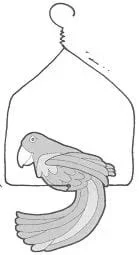 How does a parrot balance on a hanger?Copyright Hauser, 1999.
Engineers verify the safety and robustness of their designs by performing calculations to assure that the structure can withstand the anticipated loads (forces) due to gravity, vibration, pressure, etc. For example, an engineer who designs air conditioning units, ceiling fans or washing machines that continually vibrate must ensure that the support structure is in static equilibrium, and can resist the forces due to the vibration.
After this activity, students should be able to:
- Use a model to illustrate the concepts of equilibrium and center of mass.
- Explain how all forces on an object must cancel out exactly for an object to be stationary.
- Describe how engineers verify the safety and robustness of their designs by performing calculations to assure that the structure can withstand the anticipated loads (forces) due to gravity, vibration, pressure, etc.
- Predict and evaluate the movement of an object by examining the forces applied to it
Grade 8
Do you agree with this alignment?
- STEL-3G Explain how knowledge gained from other content areas affects the development of technological products and systems.
Grades 6-8
Do you agree with this alignment?
Each group needs:
- Empty cereal box or cardboard
- Wire hanger (alternative: string)
- Large paper clips
- Pencil
- Scissors
- Colored markers
- pencils or crayons
- Tape
So that bridges and buildings will not fall down, and roller coasters and parachutes work, engineers and designers must understand the concepts of balance and equilibrium. You might be interested in balance, too, if you like to ride a bike, move around or even sit in a chair! Like people, structures that engineers design need to be able to keep their balance when something pushes on them, such as wind, or the weight of people, snow or cars.
Sometimes things can balance themselves; think of the inflatable toy called a "bop bag" that stands back up after being punched. Engineers say that objects that can rebalance themselves are in stable equilibrium. Other objects are unable to rebalance themselves; if you push them out of balance, they fall over. Engineers say that things that cannot rebalance themselves are in unstable equilibrium.
Engineers who design things that balance – such as a skyscraper, a house or a bridge – must make sure that the objects are in stable equilibrium. If engineers did not do this, buildings and bridges might fall over when they were pushed by even a gust of wind! Understanding stable equilibrium is important for our day-to-day safety. In this activity, you will explore equilibrium and learn about stability. You will learn about what characteristics affect whether our paper cut-out parrot sitting on a wire is in stable or unstable equilibrium!
Before the Activity
- Gather materials: Ask students to bring in bendable wire coat hangers and cardboard (cereal box weight).
- Make 1 copy of the Parrot Template for each group.
With the Students
- Have students trace the parrot shape on the cardboard of a flattened cereal box. Cut out the parrot shape.
- On the parrot cut-out, cut a tiny slit and hole near the edge of the belly, where indicated.
- Decorate the parrot. Tape the tails on either side for added weight.
- Stretch the wire hanger wide to form a perch (see diagram). Place the parrot on the perch at the slit, so the wire goes through the hole. Tape the slit closed.
- Balance the parrot. Add paper clips to the tail or trim paper off the tail, as needed, to make the parrot sit upright.
- Try knocking Polly from the perch. What happens? (If the parrot is pushed or pulled a small amount, it will swing back and forth until it regains equilibrium. If the parrot is pushed or pulled too much, it will fall off of its perch.) Ask the students to write a paragraph, in their science journal or on a sheet of paper, to explain what happens to Polly when you try to knock her off her perch and why it happens, in terms of the concept of center of mass.
Pre-Activity Assessment
Concept Check: Ask students to define equilibrium and center of mass.
Brainstorming: Have the students engage in open discussion, creating a class list of real-life items that need to consider balance to work properly.
Concept Reflection: Have a few students describe a situation in which something was off-balance or in unstable equilibrium.
Activity Embedded Assessment
Pairs Check: After student groups have completed balancing Polly the Parrot on her perch, have them compare strategies with other classmates, giving time for all groups to balance their parrots.
Question/Answer: Ask the students and discuss as a class:
- Why does Polly balance after you have trimmed her tail and/or added paper clips? (Answer: You have adjusted her center of mass to right above the coat hanger.)
- Where are forces acting on Polly as she balances? (Answer: On all sides.)
- Is one force greater than the others? (Answer: No. Because she is in equilibrium.)
- What happens to Polly's center of mass when you push her? (Answer: If Polly is pushed or pulled a small amount, her center of mass stays above the wire perch and she swings back and forth until she regains equilibrium. If Polly is pushed or pulled too much, her center of mass falls over the wire hanger and she falls off of her perch.)
Post-Activity Assessment
Journal Reflection: Ask the students to write a paragraph, in their science journal or on a sheet of paper, to explain what happened to Polly when they tried to knock her off her perch and why it happened, in terms of the concept of center of mass.
Activity Discussion: Review and discuss the activity with the entire class. Use the answers to gauge students' mastery of the subject. If time permits, complete the Activity Extension.
Students need to be careful when using scissors.
Students need to be cautious with the sharp end of the wire hanger.
If the parrot does not balance right away when placed on its perch, advise the students to compensate by either adding paper clips to its tail or by trimming the tail, depending on which way the parrot is tipping off balance.
Have students experiment with their body's center of mass! In the classroom, push a chair against a wall and ask a student to sit in it. Then put your finger on the student's forehead and ask them to stand up. Have them explain why they cannot stand up, in terms of the concept of center of mass. Next, place a chair sideways against a wall. Have a student stand outside of the chair and bend at the waist until their forehead touches the wall over the chair. Then ask the student to pick up the chair and stand up. Why can girls do it and not boys? Have the students explain in terms of center of mass. Finally, conduct the same chair activities again, but have the person wear a backpack full of books. Have the students explain the results, in terms of their center of mass.
The Fine Line Worksheet (PDF): If this lesson's Tightrope Trials activity was not conducted, have the students complete the The Fine Line Worksheet.
Hauser, Jill Frankel. Gizmos and Gadgets: Creating Science Contraptions that Work (and Knowing Why). Charlotte, VT: Williamson Publishing, 1999. (Activity adapted from Hauser.)
Contributors
Sabre Duren; Ben Heavner; Malinda Schaefer Zarske; Denise Carlson
Supporting Program
Integrated Teaching and Learning Program, College of Engineering, University of Colorado Boulder
Acknowledgements
The contents of this digital library curriculum were developed under a grant from the Fund for the Improvement of Postsecondary Education (FIPSE), U.S. Department of Education, and National Science Foundation GK-12 grant no 0338326. However, these contents do not necessarily represent the policies of the Department of Education or National Science Foundation, and you should not assume endorsement by the federal government.
Copyright
2004 by Regents of the University of Colorado.