
Tippy Tap Plus Piping
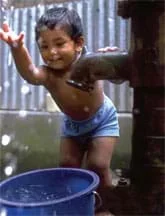 Students discover the physics behind piping systemsCopyright World Health Organization http://www.who.int/water_sanitation_health/monitoring/water.pdf
The Tippy Tap hand-washing station is an inexpensive and effective device used extensively in the developing world. One shortcoming of the homemade device is that it must be manually refilled with water and therefore is of limited use in high-traffic areas. In this activity, student teams design, prototype and test piping systems to transport water from a storage tank to an existing Tippy Tap hand-washing station, thereby creating a more efficient hand-washing station. Through this example service-learning engineering project, students learn basic fluid dynamic principles that are needed for creating efficient piping systems.
Humans have been creating engineering solutions to the transport of water for thousands of years. This may take the form of aqueducts, pipelines, canals or tunnels. Transporting water is very energy intensive, so engineers who create water moving systems are focused on achieving high efficiency. In piping systems, they consider hydrostatic head, friction and turbulence so as to hinder the flow as little as possible, and transport water with a minimum expenditure of energy. Working with people and their specific community needs to design low-cost hand-washing technology is especially important in rural communities with access to fewer resources and energy supplies.
After this activity, students should be able to:
- Calculate pressure, velocity and elevation in a simple piping system.
- Apply Bernoulli's equation to simple pipe systems.
- Perform simple estimates of head loss due to pipe fittings.
- Explain how to conserve energy in piping systems and what contributes to energy losses.
- 8.2.2.a Solve linear equations in one variable.
Grade 8
Do you agree with this alignment? - HS.2.4.a.iv Rearrange formulas to highlight a quantity of interest, using the same reasoning as in solving equations.
Grades 9-12
Do you agree with this alignment? - HS.1.2.a.i Use units as a way to understand problems and to guide the solution of multi-step problems.
Grades 9-12
Do you agree with this alignment? - 8.2.3.b Use functions to model relationships between quantities.
Grade 8
Do you agree with this alignment?
- CCSS.Math.Content.HSA-CED.A.4 Rearrange formulas to highlight a quantity of interest, using the same reasoning as in solving equations.
Grades 9-12
Do you agree with this alignment? - CCSS.Math.Content.HSA-REI.B.3 Solve linear equations and inequalities in one variable, including equations with coefficients represented by letters.
Grades 9-12
Do you agree with this alignment? - CCSS.Math.Content.HSN-Q.A.1 Use units as a way to understand problems and to guide the solution of multi-step problems; choose and interpret units consistently in formulas; choose and interpret the scale and the origin in graphs and data displays.
Grades 9-12
Do you agree with this alignment? - CCSS.Math.Practice.MP2 Reason abstractly and quantitatively.
Grades K-12
Do you agree with this alignment? - CCSS.Math.Practice.MP4 Model with mathematics.
Grades K-12
Do you agree with this alignment?
- Students will develop an understanding of the role of society in the development and use of technology.
Grades K-12
Do you agree with this alignment? - Students will develop an understanding of the attributes of design.
Grades K-12
Do you agree with this alignment? - Students will develop an understanding of engineering design.
Grades K-12
Do you agree with this alignment? - A prototype is a working model used to test a design concept by making actual observations and necessary adjustments.
Grades 9-12
Do you agree with this alignment?
- HS-ETS1-1 Analyze a major global challenge to specify qualitative and quantitative criteria and constraints for solutions that account for societal needs and wants.
Grades 9-12
This resource focuses on the following Three Dimensional Learning aspects of NGSS:
Science & Engineering Practices- Analyze complex real-world problems by specifying criteria and constraints for successful solutions.Do you agree with this alignment?
Disciplinary Core Ideas- Criteria and constraints also include satisfying any requirements set by society, such as taking issues of risk mitigation into account, and they should be quantified to the extent possible and stated in such a way that one can tell if a given design meets them.Do you agree with this alignment?
- Humanity faces major global challenges today, such as the need for supplies of clean water and food or for energy sources that minimize pollution, which can be addressed through engineering. These global challenges also may have manifestations in local communities.Do you agree with this alignment?
Crosscutting Concepts- New technologies can have deep impacts on society and the environment, including some that were not anticipated. Analysis of costs and benefits is a critical aspect of decisions about technology.Do you agree with this alignment?
Do you agree with this alignment? - Analyze complex real-world problems by specifying criteria and constraints for successful solutions.
- HS-ETS1-2 Design a solution to a complex real-world problem by breaking it down into smaller, more manageable problems that can be solved through engineering.
Grades 9-12
This resource focuses on the following Three Dimensional Learning aspects of NGSS:
Science & Engineering Practices- Design a solution to a complex real-world problem, based on scientific knowledge, student-generated sources of evidence, prioritized criteria, and tradeoff considerations.Do you agree with this alignment?
Disciplinary Core Ideas- Criteria may need to be broken down into simpler ones that can be approached systematically, and decisions about the priority of certain criteria over others (trade-offs) may be needed.Do you agree with this alignment?
Do you agree with this alignment? - Design a solution to a complex real-world problem, based on scientific knowledge, student-generated sources of evidence, prioritized criteria, and tradeoff considerations.
- HS-ETS1-3 Evaluate a solution to a complex real-world problem based on prioritized criteria and trade-offs that account for a range of constraints, including cost, safety, reliability, and aesthetics, as well as possible social, cultural, and environmental impacts.
Grades 9-12
This resource focuses on the following Three Dimensional Learning aspects of NGSS:
Science & Engineering Practices- Evaluate a solution to a complex real-world problem, based on scientific knowledge, student-generated sources of evidence, prioritized criteria, and tradeoff considerations.Do you agree with this alignment?
Disciplinary Core Ideas- When evaluating solutions it is important to take into account a range of constraints including cost, safety, reliability and aesthetics and to consider social, cultural and environmental impacts.Do you agree with this alignment?
Crosscutting Concepts- New technologies can have deep impacts on society and the environment, including some that were not anticipated. Analysis of costs and benefits is a critical aspect of decisions about technology.Do you agree with this alignment?
Do you agree with this alignment? - Evaluate a solution to a complex real-world problem, based on scientific knowledge, student-generated sources of evidence, prioritized criteria, and tradeoff considerations.
Purchase the following items at any hardware or home improvement store (such as The Home Depot or Lowe's). Each group needs:
- half-inch ID (inner diameter) PVC pipe, 5ft (1.5m) length
- 1-inch ID (inner diameters) PVC pipe, 5ft (1.5 m) length
- 4 half-inch 90° PVC elbow
- 4 1-inch 90° PVC elbow
- 2 1-inch to half-inch PVC reducers
- miscellaneous PVC valves (butterfly, ball, globe, etc.)
- miscellaneous sizes of flexible (vinyl) tubing and barbed connectors
- duct tape
- Fluid Dynamics Basics Handout (PDF), one per person
- (optional) Brainstorming Guidelines (PDF)
For the entire class to share:
- 1 Tippy Tap (or make one by following the attached Tippy Tap Construction (PDF) instructions and these supplies: clean and empty one-gallon plastic milk jug, candle, matches, nail, pliers, plastic net, string or rope, metal support, knife, bar of soap, string, tin can lid)
- string or rope, 5 ft (1.5m) length
- five-gallon plastic bucket
- half-inch threaded PVC fitting
- drill and half-inch drill bit, to make a hole in the five-gallon bucket wall for the PVC fitting
- adhesive, to adhere the PVC fitting into the bucket wall
- water supply to fill a five-gallon bucket
- PVC pipe cutting tools, such as a saw or a 4-inch steel PVC cutter (see example cutter description)
- towels or mop to clean up water spills (if conducting activity inside)
- Tippy Taps Construction (pdf)
- Brainstorming Guidelines (pdf)
- Brainstorming Guidelines (doc)
- Fluid Dynamics Basics Handout (pdf)
- Fluid Dynamics Basics Handout (doc)
- Fluid Dynamics Basics Handout Answers (pdf)
- Fluid Dynamics Basics Handout Answers (doc)
- Making Sense Assessment (pdf)
- Making Sense Assessment (docx)
Students must have a basic knowledge of algebra, exponents, and how to use mathematical formulae. Prior exposure to the design process is required. (Note: If students are unfamiliar with the design process, refer to https://www.teachengineering.org/engrdesignprocess.php or Teach Engineering's Creative Engineering Design unit.
You have been contacted by your local university's Engineers Without Borders program and asked to help them on a project. Through Engineers Without Borders, students work on projects that help communities around the world, not only now, but in the future as well. EWB is focused on sustainable projects for developing communities and educating the communities on all aspects of the systems. The EWB program works with two communities in Rwanda, Africa. In Mugonero, one of the communities, an orphanage is the home for kids as young as 4 or 5 and as old as 20. EWB needs your help to improve the sanitation and thus the overall health of children in this community.
About 38% of the world lacks access to improved sanitation (WHO, 2008), which makes it unlikely that hand washing occurs after bathroom use and before meals. Washing hands with soap has been shown to reduce the risk of diarrheal disease by 42-47% (Curtis, 2003), thus many people in less developed countries suffer from diseases that could be prevented if they had a way to wash their hands regularly. To this end, the Tippy Tap hand-washing station was developed and deployed in primarily rural areas of the developing world, such as Mugonero. The Tippy Tap (show students Figure 1 or the attached Tippy Tap Construction (PDF) document) is a simple invention that enables hand washing without plumbing and with a fraction of the water used by a conventional/modern faucet with plumbing. This device is made from a jug that releases a small amount of water when tipped. Releasing the Tippy Tap causes it to swing back to its original position and stop the water flow. And, if a foot control is added, it becomes very hygienic because only the soap is touched.
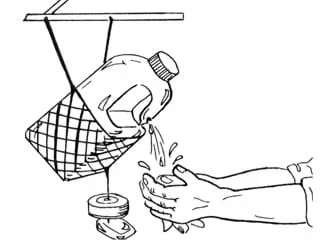 Figure 1. How the Tippy Tap works.Copyright Centers for Disease Control and Prevention, Foodborne and Diarrheal Disease Branch http://www.cdc.gov/safewater/publications_pages/tippy-tap.pdf
One drawback of the Tippy Tap is that it must be refilled by hand. Filling is a simple task that involves unscrewing the cap and pouring in clean water from a reservoir. Although filling is not complicated or time intensive, children in Mugonero often forgo washing hands rather than refill the Tippy Tap. This is especially problematic in high-traffic areas where the tap needs to be refilled often.
Our engineering challenge is to design a piping system that enables the Tippy Tap to be more easily and efficiently filled, thus eliminating the need to hand carry water to the device and manually fill it. We want our piping system to enable water to efficiently flow from a stationary reservoir (a five-gallon bucket) located behind a small obstruction to the Tippy Tap. As part of your design, you and your team will choose pipe, fittings, valves and tubing to enable filling of the Tippy Tap, yet still allow it to rotate and dispense water.
You will follow the steps of the engineering design process to create this device. The first step is already done, which is to identify the need. Next, we'll be brainstorming solutions, deciding on our best ideas, constructing a prototype, and testing it. Let's get started!
Background
Water is required for human survival and thus the necessary and creative transport of water has been occurring for thousands of years. This is just one example of how engineers have always made a world of difference! Water may be transported with aqueducts, pipelines, canals, tunnels and various other means. Transporting water is very energy intensive, so engineers who create water-moving systems are always concerned about efficiency. In piping systems, several phenomena affect the efficient flow of water:
- Hydrostatic head, which is the pressure caused by elevation that either helps or hinders the flow
- Friction between the fluid and the walls of the pipe hinders the flow
- Friction between adjacent fluid particles as they move relative to one another hinders the flow
- Turbulence caused whenever the water direction is altered hinders the flow
Engineers, therefore, always try to minimize piping system components that hinder the flow, and are constantly looking for new and innovative ways of increasing and using hydrostatic head to transport water with a minimum expenditure of energy.
In this open-ended design project, student teams design, build and test piping systems that enable water to flow from a five-gallon bucket (representing a water source, such as a rainwater catchment holding tank) to the Tippy Tap. They use elbow-style fittings or some other method to route the piping systems in non-direct paths to the Tippy Tap — similar to how engineers encounter and work around the unique obstacles that are found in all real-world projects. They choose pipe, fittings, valves and tubing to enable filling of the Tippy Tap, yet still allow it to rotate and dispense water (therefore, rigid connections are not acceptable).
This service-engineering project works well and engages students, even if you don't have an actual client. However, we have noticed that students of both genders and all ethnicities tend to respond with more enthusiasm and interest in real-world projects with actual clients. In lieu of creating a piping system for a faraway community, which may be unrealistic to arrange, consider taking the time to find a local client, such as a scout troop, summer camp organization, remote ranch/farm, or rural recreational area, for which the project would be a useful device.
Before the Activity
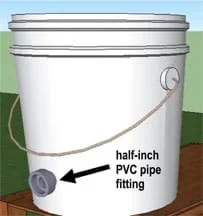 Figure 2. Five-gallon bucket with a half-inch PVC fitting.Copyright 2010 Benjamin S. Terry, ITL Program, College of Engineering, University of Colorado at Boulder
- Procure a Tippy Tap hand-washing station or build one using following the attached Tippy Top Construction (PDF)instructions.
- Procure a five-gallon bucket to use as the water reservoir. Drill a hole in the side of the bucket at the bottom and use adhesive to attach a half-inch PVC fitting (see Figure 2).
- Gather materials and make copies of the Fluid Dynamics Basics Handout (PDF) and (optional) Brainstorming Guidelines (PDF).
- Choose an appropriate location (outdoors is preferred) to test the piping systems created by the students.
- Set up the test area according to Figure 3. Suspend the Tippy Tap from a piece of playground equipment, a tree, etc. Note that the PVC fitting on the five-gallon bucket is 18 inches (46 cm) higher than the fill cap on the Tippy Tap and that the horizontal distance between the two is 60 inches (152 cm). Height above the ground is not critical, so choose a convenient height. Place an obstruction (as shown in Figure 3; can be anything, such as a large cardboard box) to ensure that students must use elbow style fittings or some other method to route the piping system in a non-direct path to the Tippy Tap.
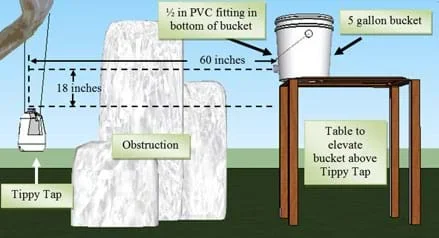 Figure 3. Test site set-up for activity.Copyright 2010 Benjamin S. Terry, ITL Program, College of Engineering, University of Colorado at Boulder
With the Students – Day 1 (50 minutes)
- Explain the project motivation and show students the Tippy Tap and how it operates. (10 minutes) As time permits, ask students the pre-activity discussion questions described in the Assessment section.
- Explain the project objective — to provide an efficient conduit for water from the reservoir to the Tippy Tap. Lay out the requirements and constraints. (10 minutes) The conduit must:
- Fill the Tippy Tap quickly (teams compete based on time to fill)
- Not hinder the function of the Tippy Tap (it still must tip!)
- Not waste/spill water
- Be easier to use than filling the Tippy Tap carrying water by hand
- Divide the class into groups of three or four students each. To engage students prior to learning about basic fluid dynamics, have teams brainstorm possible solutions. (12 minutes) If students are unfamiliar with brainstorming, give each team a copy of the attached Brainstorming Guidelines (PDF). (Note: If time permits, incorporate an extensive activity on the brainstorming process described in TE's Brainstorm Possible Solutions activity.)
- Distribute the handouts to the students and discuss. (18 minutes) This handout is a self-contained tutorial on the fundamentals of fluid flow with 11 homework problems. First, lead an in-class discussion about the material discussed in the handout, and then assign the questions as homework.
With the Students – Day 2 (50 minutes)
- Review handout answers and discuss any questions the students may have. (25 minutes)
- Revise initial brainstorming solutions and sketch designs. (10 minutes)
- After teams produce sketches, distribute materials and have students start building their prototypes. As groups finish their first prototypes, assist them with testing. Instruct the students to all work together in order to test their designs. With no support structure to hold their systems during testing, a few students may need to hold the pipe while others open the flow to the system at the five-gallon bucket and operate their fill mechanisms to the Tippy Tap. (15 minutes)
With the Students – Day 3 (50 minutes)
- Give groups time for multiple rebuild/test cycles in accordance with the design process. Record their best fill times and post class results.
- Discuss results as a class (as described in the post-activity assessment activity in the Assessment section).
- constraint
- A restriction or limitation on the degree of freedom one has in providing a solution to problem or challenge.
- developing country
- A nation with a low level of material well-being. Also called the "developing world" or "less developed countries."
- head loss
- Energy in a moving fluid that is lost due to friction and turbulence. Head loss is associated with the length and diameter of the pipe, bends, fittings, valves, etc.
- hydrostatic head
- The distance between a source of water and the point where it is used.
- improved sanitation
- A sanitation system that has a connection to a public sewer, septic system, pour-flush latrine, or access to a pit latrine.
- prototype
- A working model (or iteration) of a finished product that provides function. A prototype is used to test a design concept by making actual observations and necessary adjustments.
- requirement
- What a particular product or service should do — a necessary attribute, capability, characteristic or quality. In engineering, sets of requirements are inputs into the design stages of product development.
- specific weight
- The density of a fluid multiplied by the acceleration of gravity constant.
- streamline
- A curve tangent to the velocity direction of the flow of a fluid or gas. Streamlines show the direction fluid particles will travel.
- tangent
- A straight line approximation of a curve at a particular point.
- tippy tap
- A simple handmade water dispenser that enables people to wash their hands without wasting water. The device primarily consists of a container that releases a small amount of water (just enough for a clean hand wash) each time it is tipped. And when the "tap" is released, it swings back to its initial upright position.
- turbulence
- A fluidic region where the particles that make up a fluid are chaotic or random in motion.
Pre-Activity Assessment
Discussion Questions: Stimulate discussion regarding clean water availability in the developing world and the engineer's role in facilitating its availability. Ask the students:
- Think of the last time you washed your hands. Was the water clean? Where did it come from?
- Trace the path from the faucet to the original water source. What roles have engineers and modern technology played in developing this path? (Possible answers: Mass production and standardized sizing makes piping and fittings inexpensive. New engineering materials make components durable, inexpensive, and biologically compatible. Computer modeling and design enables engineers to create, simulate, and optimize systems virtually. Access to global markets through advanced shipping techniques also reduces cost of components. Water treatment plants designed by engineers provide clean water from sources that would otherwise be unsafe to drink.)
- How do populations without engineers or modern technology access water? What are the drawbacks of these water transportation methods? How would your life be different if you were a member of such a population? (Possible answers: Clean water is carried by hand from wells or streams. The cost of clean water, therefore, is very high [in time and resources]. As a result, crops are irrigated with wastewater, which has the potential to spread disease. Personal hygiene [such as bathing and hand washing] is limited, which also facilitates the spread of disease. Services and amenities such as indoor plumbing, car washing, garden/lawn watering, swimming pools, water parks, fountains, etc., do not exist in or are rare in communities without ample and clean water supplies.)
Activity Embedded Assessment
Activity Handout: The Fluid Dynamics Basics Handout (PDF) is a self-contained tutorial on the fundamentals of fluid flow with 11 homework problems. First, lead an in-class discussion about the material discussed in the handout, then have students work through the content and instructions provided in the handout, and assign the questions as homework.
Post-Activity Assessment
Concluding Discussion: Use the following suggested questions to lead a concluding discussion for this activity. Ask the students:
- Whose piping design filled the Tippy Tap the quickest? Why did it work so well?
- Were some designs easier to use with the Tippy Tap? Are some designs less prone to spilling water? What are the tradeoffs between the various designs? How would you combine the best features from each design? (Possible answers: Perhaps a design was easier and more intuitive to use, but filled the Tippy Tap slower. Engineers often have to optimize their design, which means they try to maximize one aspect of their design [such as ease of use], while minimizing another aspect [such as fill time]. Optimization requires tradeoffs between competing requirements.)
- Big picture question: Some regions of the developing world have ample supplies of salty ocean water, but no fresh water. Suppose an efficient method for desalination is developed. What are some of the challenges associated with transporting water from coastal regions inland? (Possible answer: Moving water from a coastal region inland entails an increase in elevation. Increased elevation is one cause of head loss.)
Making Sense: Have students reflect about the science phenomena they explored and/or the science and engineering skills they used by completing the Making Sense Assessment (PDF).
Homework
Handout: As a homework assignment, have students answer the 11 questions in the Fluid Dynamics Basics Handout (PDF). Review their answers to gauge their understanding of the material.
- Take appropriate precautions as students use saws or knives to cut PVC pipes.
- Watch that spilled water does not make the floors (or ground) slippery.
Open-ended design projects can be difficult for students because no clear path to one solution exists. Keep students on task, working towards a feasible design, watching that they do not get stuck wasting too much time brainstorming or building unrealistic designs.
Take a look at a 2:16 minute video showing how to make a Tippy Tap; see "The Tippy Tap, a hand washing device with running water," at https://www.youtube.com/watch?v=P-Lk-GJtTbM
For more information on high school engineering design process activities and projects, see Teach Engineering's Creative Engineering Design unit.
Learn more about the engineering design process at https://www.teachengineering.org/engrdesignprocess.php
Curtis, Val and Sandy Cairncross. May 2003. Effect of Washing Hands with Soap on Diarrhoea Risk in the Community: A Systematic Review. The Lancet Infectious Diseases. Vol. 3, pp. 275-281. http://www.cleantheworld.org/docs/CurtisHandwashing.pdf
Low-cost hand-washing technology. Last updated December 8, 2009. IRC International Water and Sanitation Centre. Accessed December 16, 2010. (Tippy Tap definition) http://www.irc.nl/page/13215
Progress on Drinking Water and Sanitation: Special Focus on Sanitation. 2008. World Health Organization, UNICEF, Geneva, New York; pp. 1-54. http://www.who.int/water_sanitation_health/monitoring/jmp2008/en/index.html
Tippy Taps: A design for simple, economical and effective hand-washing stations. Foodborne and Diarrheal Disease Branch, Centers for Disease Control and Prevention. Accessed December 16, 2010. (Construction, installation and maintenance instructions)http://www.cdc.gov/safewater/publications_pages/tippy-tap.pdf
Hygiene Challenges and Resources in Less Developed Countries. Last updated December 28, 2009. Centers for Disease Control and Prevention. Accessed December 16, 2010. http://www.cdc.gov/healthywater/hygiene/ldc/hygiene_challenges.html
Contributors
Benjamin S. Terry; Kaisa Wallace-Moyer; Stephanie Rivale; Denise W. Carlson
Supporting Program
Integrated Teaching and Learning Program, College of Engineering, University of Colorado at Boulder, University of Colorado Boulder
Acknowledgements
The contents of this digital library curriculum were developed under a grant from the Fund for the Improvement of Postsecondary Education (FIPSE), U.S. Department of Education, and National Science Foundation GK-12 grant no 0338326. However, these contents do not necessarily represent the policies of the Department of Education or National Science Foundation, and you should not assume endorsement by the federal government.
Copyright
2010 by Regents of the University of Colorado.