
The Magician's Catapult
In this activity, students reinforce their understanding of compound machines by building a catapult. This compound machine consists of a lever and a wheel-and-axel. Catapults have been designed by engineers for a variety of purposes — from lifting boulders into the air for warfare to human beings for entertainment; the projectiles in this activity are grapes for a magic act. Given the building materials, students design and build their catapult to launch a grape a certain distance.
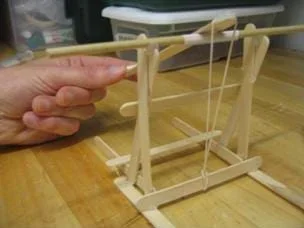 Figure 1. A student-constructed catapult, ready to fire!
Simple machines and compound machines are the foundation of many modern conveniences. Engineers use a combination of levers, wedges, screws, wheels-and-axels, pulleys and inclined planes to develop simple tools such as a pencil sharpener to complex machines such as an elevator or airplane. Compound machines are everywhere. Engineers usually design machines for a specific function, as specified by their clients. Engineers also have to design within certain constraints, including time, money and human resources.
After this activity, students should be able to:
- Use the engineering design process to create a compound machine – the catapult.
- Describe the interrelationship of the simple machines within a compound machine.
- Describe the constraints of their model in the context of engineering.
- 7.1.2.c Solve real-world and mathematical problems involving the four operations with rational numbers.
Grade 7
Do you agree with this alignment?
- Predict and evaluate the movement of an object by examining the forces applied to it
Grade 8
Do you agree with this alignment?
- CCSS.Math.Content.6.SP.A.3 Recognize that a measure of center for a numerical data set summarizes all of its values with a single number, while a measure of variation describes how its values vary with a single number.
Grade 6
Do you agree with this alignment? - CCSS.Math.Content.6.SP.B.5 Summarize numerical data sets in relation to their context, such as by:
Grade 6
Do you agree with this alignment? - CCSS.Math.Content.6.SP.B.5a Reporting the number of observations.
Grade 6
Do you agree with this alignment? - CCSS.Math.Content.6.SP.B.5b Describing the nature of the attribute under investigation, including how it was measured and its units of measurement.
Grade 6
Do you agree with this alignment? - CCSS.Math.Content.6.SP.B.5c Giving quantitative measures of center (median and/or mean) and variability (interquartile range and/or mean absolute deviation), as well as describing any overall pattern and any striking deviations from the overall pattern with reference to the context in which the data were gathered.
Grade 6
Do you agree with this alignment?
- Make two-dimensional and three-dimensional representations of the designed solution.
Grades 6-8
Do you agree with this alignment? - STEL-7R Refine design solutions to address criteria and constraints.
Grades 6-8
Do you agree with this alignment?
- MS-ETS1-1 Define the criteria and constraints of a design problem with sufficient precision to ensure a successful solution, taking into account relevant scientific principles and potential impacts on people and the natural environment that may limit possible solutions.
Grades 6-8
This resource focuses on the following Three Dimensional Learning aspects of NGSS:
Science & Engineering Practices- Define a design problem that can be solved through the development of an object, tool, process or system and includes multiple criteria and constraints, including scientific knowledge that may limit possible solutions.Do you agree with this alignment?
Disciplinary Core Ideas- The more precisely a design task's criteria and constraints can be defined, the more likely it is that the designed solution will be successful. Specification of constraints includes consideration of scientific principles and other relevant knowledge that is likely to limit possible solutions.Do you agree with this alignment?
Crosscutting Concepts- The uses of technologies and any limitations on their use are driven by individual or societal needs, desires, and values; by the findings of scientific research; and by differences in such factors as climate, natural resources, and economic conditions.Do you agree with this alignment?
- All human activity draws on natural resources and has both short and long-term consequences, positive as well as negative, for the health of people and the natural environment.Do you agree with this alignment?
Do you agree with this alignment? - Define a design problem that can be solved through the development of an object, tool, process or system and includes multiple criteria and constraints, including scientific knowledge that may limit possible solutions.
Each group needs:
- 11 Popsicle® sticks
- 1 tongue depressor
- Hot glue sticks and glue gun
- 1 drinking straw (non-flexible)
- 1 wooden dowel, with diameter smaller than straw, but not shorter than popsicle stick
- 1 small rubber band
- 6-8 grapes
Compound machines are two or more simple machines interacting with one another to do work. We can find them all around us in everyday items, including a can opener, a pencil sharpener, a wheelbarrow, a pair of scissors and a piano. Compound machines are dependant on each of its simple machines. If just one of the simple machines in a compound machine is removed, the compound machine will not function nearly as well. Engineers use their knowledge of simple machines to create many of the compound machines we use every day.
Engineering firms do work for people in a variety of ways. A structural engineering firm, for instance, may one time help build a skyscraper for people to work in, the next time build a bridge that connects people with one another, and the next design the devices used in a circus performance to entertain people. A structural engineer is one who designs the structures, or the "built things" around us. Like the buildings towering above us, devices used in entertainment acts must be structurally engineered for, above all, safety. These devices in entertainment include the chains and supports of a swing holding intertwined trapeze artists and the web of metal giving form to the main tent, or big top. During our activity today, we are going to imagine that we are structural engineers.
Your engineering consulting firm has been contacted by a professional magician by the name of Mary Splendini. She needs a compound machine, a catapult, for use during her routine to throw a grape three meters. A volunteer from the audience will wait for a trumpet call, let go of the catapult arm and send the grape to a specific point on the stage. Simultaneously, Mary will appear from a bursting cloud of smoke and catch the grape in her teeth. You think the whole thing sounds a bit ridiculous, but building the catapult will be a nice challenge, so you accept the job offer.
First, you have to define your audience (client) and then the problem. Well, your audience is Mary Splendini. How about the problem? You know that the problem needs to be well-thought out, but does not limit the solutions. How about, "throw a grape three meters?"
Then, an engineer needs to think about the design requirements and constraints (limitations) for the problem. Can anyone think of some design requirements or constraints for our problem? Your client (Mary Spendini) wants the catapult to be as inexpensive as possible, and since less material implies less cost in this case, the constraint is that the engineering teams cannot use more than the allotted materials.
Now we think about information that might help us solve the problem. Here is some information that could be useful to us: the client said she could catch the grape if it's within one-fifth of a meter. We will have to take measurements. We will probably want to try out our catapult several times to makes sure it is consistent. Our challenge will be to convince our client the machine will perform to her satisfaction given our data (the three or more measured launches) and analysis (the calculated average and our judgment).
Now, we are ready to start on our design. Let's get into engineering teams and gather our materials.
Before the Activity
- You may wish to prepare a large table with glue guns if you do not have enough to go around.
- Designate floor space to measure the length of the launch. Make marks (with tape or chairs) every one-fifth (or one-tenth) of a meter. When they are finished building, the students will place their catapult on the designated floor space to measure the length the grape flies. Students catapult the grape three times and write down each value. Then they will sit down and analyze the data.
- Build an example of the catapults as shown above.
With the Students
Part I: Preparing the Design
- Arrange the students in groups of two.
- Hand out or make available the necessary project materials.
- Remind students that Mary Splendini, the client, wants the catapult to be as inexpensive as possible. Since less material implies less cost in this case, the constraint is that the engineering teams cannot use more than the allotted materials.
Part II: Building the Catapult
- Stress to students that good engineering is characterized by well thought-out designs that are also attractive. An unnecessary amount of building material, such as glue, is not attractive and is considered wasteful. Just a daub of hot glue on each connection should suffice. Remind students that the hot glue dries quickly and becomes quite strong.
- Build each upright and connect the two pieces together as shown in Figure 2.
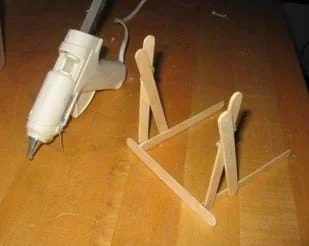 Figure 2. The base of the catapult.Copyright Photo by Michael Bendewald, University of Colorado at Boulder, ITLL, 2007.
- Tie a rubber band to the stick that connects the two uprights as shown in Figure 3, leaving a loop extending upwards.
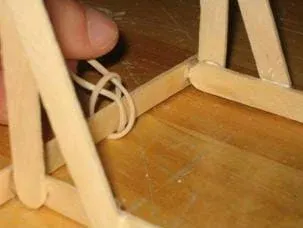 Figure 3. Securing the rubber band around the base of the catapult.Copyright Photo by Michael Bendewald, University of Colorado at Boulder, ITLL, 2007.
- Cut a short piece of straw and slide over wooden dowel.
- Attach wooden dowel across top of side braces with two daubs of glue.
- Glue rubber band to tongue depressor and the tongue depressor to the straw, as shown in Figure 4. Horizontal braces should be added to stiffen the structure.
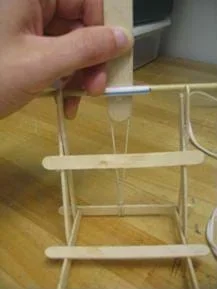 Figure 4. Securing the tongue depressor to the wooden dowel/straw.Copyright Photo by Michael Bendewald, University of Colorado at Boulder, ITLL, 2007.
- The tongue depressor, which is the arm of the catapult, should rotate freely about the dowel allowing for the tension in the rubber band to be felt. See the Figure 5.
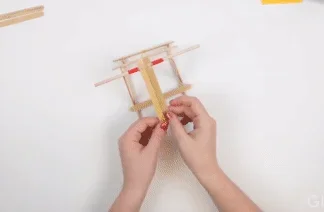 Figure 4. Stretching out the rubber band and testing the rotation around wooden dowel.
- Finish the catapult with a portion of straw glued to the arm to keep the grape in place. Also add two more sticks to the front (left side, see Figure 6) of the catapult to stabilize it after launch.
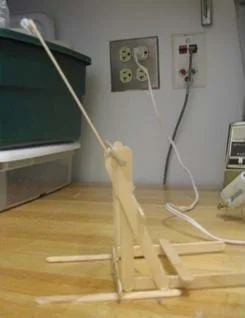 Figure 6. Front and rear stabilizers keep catapult from flipping. A straw is added to the end of the tongue depressor to prevent the grapes from sliding off during launch.Copyright Photo by Michael Bendewald, University of Colorado at Boulder, ITLL, 2007.
Part III: Measuring the Launch
- Have each engineering team take a turn to launch their grape. (Note: each grape should be about the same size.)
- Each time their grape is launched, the team should write down the length of flight to the nearest tenth of a meter.
- Have students calculate the average of their three measurements. Challenge them to do it in their head or longhand, without a calculator.
- The client, Mary Splendini, said she can catch the grape if it's within one-fifth of a meter of its destination. Therefore, if each group's average length is within one-fifth meter of three meters, they have a successful catapult.
- Have students make adjustments if necessary. The glue is strong but can be peeled away if changes need to be made. Try moving the arm back and forth along the dowel. Try adding a smaller rubber band.
- Challenge students to convince our client the machine will perform to her satisfaction given our data (the three or more measured launches) and analysis (the calculated average and our judgment).
- Remind the teams that if they alter the catapult, not to include measurements from before it was altered, only take measurements from one catapult.
- average
- A mathematical calculation used to predict or understand a phenomenon.
- compound machine
- Consists of two or more simple machines and allows for work to be done easier.
- constraint
- A restriction or limitation.
- consulting
- The profession of giving advice.
- simple machine
- The fundamental parts of any machine. Simple machines can exist on their own and are also sometimes hidden in the mechanical devices around you; a device which performs work by increasing or changing the direction of force, making work easier for people to do.
- structural engineering
- The branch of civil engineering that is responsible for the design of structures.
Pre-Activity Assessment
Brainstorming: As a class, have the students engage in open discussion. Remind students that in brainstorming, no idea or suggestion is "silly." All ideas should be respectfully heard. Take an uncritical position, encourage wild ideas and discourage criticism of ideas. Have them raise their hands to respond. Write their ideas on the board. Ask the students:
- What does a catapult look like? (Discuss where the students get their ideas. Perhaps from a film.)
- Does anyone have an idea on how to build one out of Popsicle sticks and a wooden dowel? Have a willing student draw it on the board.
Activity Embedded Assessment
Discussion Question: Solicit, integrate and summarize student responses.
- Ask students what units to use for measuring the grape-launch of our catapult. Since we wish to use SI units, which is appropriate: centimeters or meters or kilometers? (Answer: meters)
- Ask the students what simple machines are found in the catapult they are building? (Answer: The arm is a lever and the straw around the dowel forms a wheel-and-axel.)
Post-Activity Assessment
Discussion Questions: Solicit, integrate and summarize student responses.
- How can you adjust the length of grape-flight?
- Why would the grape fly less distance if the dowel is closer to the other side of the arm, near the grape-projectile? Think of what we learned about levers.
Re-Engineering: Ask the students how they could improve the catapults and have them sketch or test their ideas.
Presentation: Have the team that got the grape closest to the target distance (and runner-up if time allows) present their design to the rest of the class. Ask them to explain why they think their design worked so well.
Students should know how to apply hot glue in a safe and appropriate manner.
Do not allow students to launch the grapes at each other.
Many cities organize catapult competitions to launch pumpkins or eggs at certain times of the year. Find out if there is one of these competitions in your area and invite the students to observe.
For lower grades, do activity as is. Provide help to students who are having difficulty gluing their sticks in place.
For upper grades, let them deviate from the given design for the catapult. Just be sure they have a lever, a wheel and axel, and the rubber band.
Contributors
Michael J. Bendewald; Malinda Schaefer Zarske
Supporting Program
Integrated Teaching and Learning Program and Laboratory, University of Colorado Boulder
Acknowledgements
The contents of this digital library curriculum were developed under a grant from the Fund for the Improvement of Postsecondary Education (FIPSE), U.S. Department of Education, and National Science Foundation GK-12 grant no 0338326. However, these contents do not necessarily represent the policies of the Department of Education or National Science Foundation, and you should not assume endorsement by the federal government.
Copyright
2007 by Regents of the University of Colorado.