
Simple Machines
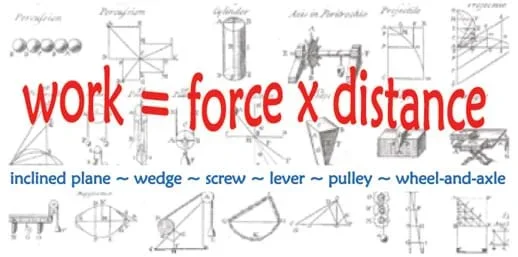 Students investigate the six simple machinesCopyright 1728 Fletcher Sculp and Ephraim Chambers, Table of Mechanicks, from Cyclopaedia {PD} Wikimedia Commons http://en.wikipedia.org/wiki/File:Table_of_Mechanicks,_Cyclopaedia,_Volume_2.png
Overview of topics by lesson: 1) work [as defined by physical science] and the mechanical advantages of six simple machines that make work easier, 2) more about the inclined plane, wedge and screw, including each machine's mechanical advantages and work = force x distance, 3) more about the lever, pulley, and wheel-and-axle, 4) introduction to compound machines including an examination of machine inventions and their place in our everyday lives, and 5) introduction to Rube Goldberg contraptions, known for making simple tasks more difficult to complete, as a way to engage students in critical thinking to evaluate everyday machines.
The fundamental mechanical devices that have come to be known as "simple machines" through the years are basic human inventions that help accomplish physical tasks through mechanical advantage. The same simple machines used by ancient engineers to build pyramids are employed by today's engineers to construct modern structures such as houses, bridges, roller coasters and skyscrapers. From everyday hand tools (crowbars, nails, wheels, ramps) to intricate "compound machines" that marry together many simple machines in endless combinations (pencil sharpeners, bicycles, elevators, medical devices, airplanes), engineers of all types continually work together to design better and more creative tools, devices, equipment and products of modern convenience that help people do more with less, incorporating the principles of simple machines.
- CCSS.Math.Content.6.NS.B.3 Fluently add, subtract, multiply, and divide multi-digit decimals using the standard algorithm for each operation.
Grade 6
Do you agree with this alignment?
- MS-ETS1-1 Define the criteria and constraints of a design problem with sufficient precision to ensure a successful solution, taking into account relevant scientific principles and potential impacts on people and the natural environment that may limit possible solutions.
Grades 6-8
This resource focuses on the following Three Dimensional Learning aspects of NGSS:
Science & Engineering Practices- Define a design problem that can be solved through the development of an object, tool, process or system and includes multiple criteria and constraints, including scientific knowledge that may limit possible solutions.Do you agree with this alignment?
Disciplinary Core Ideas- The more precisely a design task's criteria and constraints can be defined, the more likely it is that the designed solution will be successful. Specification of constraints includes consideration of scientific principles and other relevant knowledge that is likely to limit possible solutions.Do you agree with this alignment?
Crosscutting Concepts- The uses of technologies and any limitations on their use are driven by individual or societal needs, desires, and values; by the findings of scientific research; and by differences in such factors as climate, natural resources, and economic conditions.Do you agree with this alignment?
- All human activity draws on natural resources and has both short and long-term consequences, positive as well as negative, for the health of people and the natural environment.Do you agree with this alignment?
Do you agree with this alignment? - Define a design problem that can be solved through the development of an object, tool, process or system and includes multiple criteria and constraints, including scientific knowledge that may limit possible solutions.
- MS-PS2-2 Plan an investigation to provide evidence that the change in an object's motion depends on the sum of the forces on the object and the mass of the object.
Grades 6-8
This resource focuses on the following Three Dimensional Learning aspects of NGSS:
Science & Engineering Practices- Plan an investigation individually and collaboratively, and in the design: identify independent and dependent variables and controls, what tools are needed to do the gathering, how measurements will be recorded, and how many data are needed to support a claim.Do you agree with this alignment?
- Science knowledge is based upon logical and conceptual connections between evidence and explanations.Do you agree with this alignment?
Disciplinary Core Ideas- The motion of an object is determined by the sum of the forces acting on it; if the total force on the object is not zero, its motion will change. The greater the mass of the object, the greater the force needed to achieve the same change in motion. For any given object, a larger force causes a larger change in motion.Do you agree with this alignment?
- All positions of objects and the directions of forces and motions must be described in an arbitrarily chosen reference frame and arbitrarily chosen units of size. In order to share information with other people, these choices must also be shared.Do you agree with this alignment?
Crosscutting Concepts- Explanations of stability and change in natural or designed systems can be constructed by examining the changes over time and forces at different scales.Do you agree with this alignment?
Do you agree with this alignment? - Plan an investigation individually and collaboratively, and in the design: identify independent and dependent variables and controls, what tools are needed to do the gathering, how measurements will be recorded, and how many data are needed to support a claim.
- Day 1: The Advantage of Machines lesson and A Simple Solution for the Circus activity
- Day 2: Just Plane Simple lesson
- Day 3: Tools and Equipment, Part I activity
- Day 4: Levers That Lift lesson
- Day 5: Machines and Tools, Part II activity
- Day 6: Not So Simple lesson
- Day 7: The Magician's Catapult activity
- Day 8: Rube Goldberg and the Meaning of Machines lesson and Design and Build a Rube Goldberg activity (first 25 minutes)
- Day 9: Design and Build a Rube Goldberg activity
Supporting Program
Integrated Teaching and Learning Program, College of Engineering and Applied Science, University of Colorado Boulder
Acknowledgements
This digital library content was developed by the Integrated Teaching and Learning Program under National Science Foundation GK-12 grant no. 0338326. However, these contents do not necessarily represent the policies of the National Science Foundation, and you should not assume endorsement by the federal government.
Copyright
2007 by Regents of the University of Colorado