
Solar Water: Heat it Up!
Students explore energy efficiency, focusing on renewable energy, by designing and building flat-plate solar water heaters. They apply their understanding of the three forms of heat transfer (conduction, convection and radiation), as well as how they relate to energy efficiency. They calculate the efficiency of the solar water heaters during initial and final tests and compare the efficiencies to those of models currently sold on the market (requiring some additional investigation by students). After comparing efficiencies, students explain how they would further improve their devices. Students learn about the trade-offs between efficiency and cost by calculating the total cost of their devices and evaluating cost per percent efficiency and per degree change of the water.
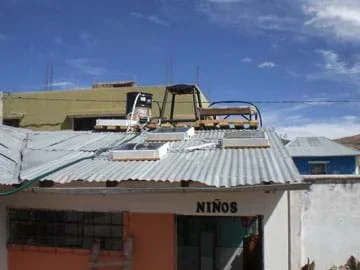 A school in Peru with a tin roof and three solar water heaters in series.Copyright 2011 Montoya Lab
With a growing need to reduce our nation's dependency on fossil fuels, improved energy efficiency is the key to the successful design of renewable energy options, but at what cost? Engineers spend a great deal of time and effort in improving efficiency of their designs, and the trade-off between cost and efficiency is an important concept to understand in the engineering world. To engineers, efficiency often means maximizing the amount of work done or energy produced from a given design while also minimizing the resources used. In the developing world, minimizing the use of resources and keeping costs low are two important factors that must be considered when deciding on the suitability of a given technology and its ability to improve a community's quality of life. Engineers use the engineering design process to help strike this balance between cost and efficiency.
After this activity, students should be able to:
- Identify heat transfer properties of different materials.
- Explain the concept of efficiency and how it relates to energy.
- Calculate the efficiency of a solar water heater given heat input and output of a system.
- Compare the efficiency of built solar water heaters to those achieved by commercial models and explain why they might differ.
- Explain the engineering design process.
- HS.1.2.a Reason quantitatively and use units to solve problems.
Grades 9-12
Do you agree with this alignment? - HS.2.4.a.iv Rearrange formulas to highlight a quantity of interest, using the same reasoning as in solving equations.
Grades 9-12
Do you agree with this alignment? - HS.2.4.b.i Explain each step in solving a simple equation as following from the equality of numbers asserted at the previous step, starting from the assumption that the original equation has a solution.
Grades 9-12
Do you agree with this alignment? - HS.2.4.c Solve equations and inequalities in one variable.
Grades 9-12
Do you agree with this alignment? - HS.3.1.a Summarize, represent, and interpret data on a single count or measurement variable.
Grades 9-12
Do you agree with this alignment? - HS.3.1.b.ii Represent data on two quantitative variables on a scatter plot, and describe how the variables are related.
Grades 9-12
Do you agree with this alignment? - HS.1.2.a.i Use units as a way to understand problems and to guide the solution of multi-step problems.
Grades 9-12
Do you agree with this alignment?
- Physical Science
Grades -1-12
Do you agree with this alignment? - There are costs, benefits, and consequences of exploration, development, and consumption of renewable and nonrenewable resources
Grades 9-12
Do you agree with this alignment? - Evaluate the energy conversion efficiency of a variety of energy transformations
Grades 9-12
Do you agree with this alignment? - Describe energy transformations both quantitatively and qualitatively
Grades 9-12
Do you agree with this alignment?
- CCSS.Math.Content.HSA-CED.A.4 Rearrange formulas to highlight a quantity of interest, using the same reasoning as in solving equations.
Grades 9-12
Do you agree with this alignment? - CCSS.Math.Content.HSA-REI.A.1 Explain each step in solving a simple equation as following from the equality of numbers asserted at the previous step, starting from the assumption that the original equation has a solution. Construct a viable argument to justify a solution method.
Grades 9-12
Do you agree with this alignment? - CCSS.Math.Content.HSA-REI.B.4 Solve quadratic equations in one variable.
Grades 9-12
Do you agree with this alignment? - CCSS.Math.Content.HSN-Q.A Reason quantitatively and use units to solve problems.
Grades 9-12
Do you agree with this alignment? - CCSS.Math.Content.HSN-Q.A.1 Use units as a way to understand problems and to guide the solution of multi-step problems; choose and interpret units consistently in formulas; choose and interpret the scale and the origin in graphs and data displays.
Grades 9-12
Do you agree with this alignment? - CCSS.Math.Content.HSS-ID.A Summarize, represent, and interpret data on a single count or measurement variable
Grades 9-12
Do you agree with this alignment? - CCSS.Math.Content.HSS-ID.B.6 Represent data on two quantitative variables on a scatter plot, and describe how the variables are related.
Grades 9-12
Do you agree with this alignment?
- Students will develop an understanding of the attributes of design.
Grades K-12
Do you agree with this alignment? - Students will develop an understanding of engineering design.
Grades K-12
Do you agree with this alignment? - Students will develop an understanding of the role of troubleshooting, research and development, invention and innovation, and experimentation in problem solving.
Grades K-12
Do you agree with this alignment? - Students will develop abilities to apply the design process.
Grades K-12
Do you agree with this alignment? - Students will develop abilities to assess the impact of products and systems.
Grades K-12
Do you agree with this alignment? - STEL-7W Determine the best approach by evaluating the purpose of the design.
Grades 9-12
Do you agree with this alignment?
- HS-ETS1-1 Analyze a major global challenge to specify qualitative and quantitative criteria and constraints for solutions that account for societal needs and wants.
Grades 9-12
This resource focuses on the following Three Dimensional Learning aspects of NGSS:
Science & Engineering Practices- Analyze complex real-world problems by specifying criteria and constraints for successful solutions.Do you agree with this alignment?
Disciplinary Core Ideas- Criteria and constraints also include satisfying any requirements set by society, such as taking issues of risk mitigation into account, and they should be quantified to the extent possible and stated in such a way that one can tell if a given design meets them.Do you agree with this alignment?
- Humanity faces major global challenges today, such as the need for supplies of clean water and food or for energy sources that minimize pollution, which can be addressed through engineering. These global challenges also may have manifestations in local communities.Do you agree with this alignment?
Crosscutting Concepts- New technologies can have deep impacts on society and the environment, including some that were not anticipated. Analysis of costs and benefits is a critical aspect of decisions about technology.Do you agree with this alignment?
Do you agree with this alignment? - Analyze complex real-world problems by specifying criteria and constraints for successful solutions.
- HS-ETS1-2 Design a solution to a complex real-world problem by breaking it down into smaller, more manageable problems that can be solved through engineering.
Grades 9-12
This resource focuses on the following Three Dimensional Learning aspects of NGSS:
Science & Engineering Practices- Design a solution to a complex real-world problem, based on scientific knowledge, student-generated sources of evidence, prioritized criteria, and tradeoff considerations.Do you agree with this alignment?
Disciplinary Core Ideas- Criteria may need to be broken down into simpler ones that can be approached systematically, and decisions about the priority of certain criteria over others (trade-offs) may be needed.Do you agree with this alignment?
Do you agree with this alignment? - Design a solution to a complex real-world problem, based on scientific knowledge, student-generated sources of evidence, prioritized criteria, and tradeoff considerations.
- HS-ETS1-3 Evaluate a solution to a complex real-world problem based on prioritized criteria and trade-offs that account for a range of constraints, including cost, safety, reliability, and aesthetics, as well as possible social, cultural, and environmental impacts.
Grades 9-12
This resource focuses on the following Three Dimensional Learning aspects of NGSS:
Science & Engineering Practices- Evaluate a solution to a complex real-world problem, based on scientific knowledge, student-generated sources of evidence, prioritized criteria, and tradeoff considerations.Do you agree with this alignment?
Disciplinary Core Ideas- When evaluating solutions it is important to take into account a range of constraints including cost, safety, reliability and aesthetics and to consider social, cultural and environmental impacts.Do you agree with this alignment?
Crosscutting Concepts- New technologies can have deep impacts on society and the environment, including some that were not anticipated. Analysis of costs and benefits is a critical aspect of decisions about technology.Do you agree with this alignment?
Do you agree with this alignment? - Evaluate a solution to a complex real-world problem, based on scientific knowledge, student-generated sources of evidence, prioritized criteria, and tradeoff considerations.
- HS-PS3-3 Design, build, and refine a device that works within given constraints to convert one form of energy into another form of energy.
Grades 9-12
This resource focuses on the following Three Dimensional Learning aspects of NGSS:
Science & Engineering Practices- Design, evaluate, and/or refine a solution to a complex real-world problem, based on scientific knowledge, student-generated sources of evidence, prioritized criteria, and tradeoff considerations.Do you agree with this alignment?
Disciplinary Core Ideas- Criteria and constraints also include satisfying any requirements set by society, such as taking issues of risk mitigation into account, and they should be quantified to the extent possible and stated in such a way that one can tell if a given design meets them.Do you agree with this alignment?
- At the macroscopic scale, energy manifests itself in multiple ways, such as in motion, sound, light, and thermal energy.Do you agree with this alignment?
- Although energy cannot be destroyed, it can be converted to less useful forms—for example, to thermal energy in the surrounding environment.Do you agree with this alignment?
Crosscutting Concepts- Energy cannot be created or destroyed—it only moves between one place and another place, between objects and/or fields, or between systems.Do you agree with this alignment?
- Modern civilization depends on major technological systems. Engineers continuously modify these technological systems by applying scientific knowledge and engineering design practices to increase benefits while decreasing costs and risks.Do you agree with this alignment?
Do you agree with this alignment? - Design, evaluate, and/or refine a solution to a complex real-world problem, based on scientific knowledge, student-generated sources of evidence, prioritized criteria, and tradeoff considerations.
- SEP.3.9-12.5 Design, evaluate, and/or refine a solution to a complex real-world problem, based on scientific knowledge, student-generated sources of evidence, prioritized criteria, and tradeoff considerations.
Grades 9-12
Do you agree with this alignment?
For solar water heater construction, each group needs access to:
- drills
- hand saws
- hot glue guns
- hammers
- box cutters
- scissors
Groups should also have access to as many of the following building material options as possible: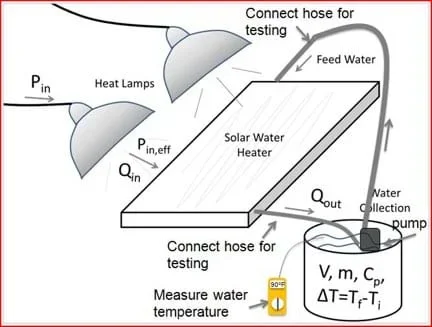 Figure 1: Set-up for testing the solar water heaters.Copyright 2012 Odessa Gomez, College of Engineering, University of Colorado Boulder
- newspaper
- tar paper
- plexiglass
- 2" x 4" wood
- plywood
- ¼" ID clear plastic tubing, available at hardware stores
- 5/8" ID PVC
- 5/8" PVC elbow/T connectors
- ¼" ID black rubber hosing
- black spray paint
- cardboard
- zip ties
- hot glue sticks
- duct tape
- rigid insulation
- nails
- screws
- aluminum foil
- bubble wrap
- 14 gauge wire
- 4 mm clear plastic sheeting
- plastic wrap
Testing station materials (Note: it is recommended to have one testing station per group):
- 2 250-Watt heat lamps (heat lamps need to be placed on stands; try using chemistry lab stands with clamps so students can position the lamps to their liking)
- submersible fountain pump with adjustable flow control (aim for maximum flow rate of 130 gallon per minute, gpm; make sure pump is completely submerged throughout the entire test)
- a container that holds at least 1 gallon of water (make sure water completely submerges fountain pump)
- a temperature probe or thermometer
- stopwatch
- hose connections to connect the testing station tubing and the solar water heater tubing (students are given the option of using PVC, hosing or clear tubing, so the testing set-up must be able to adapt to the different connections between the water heaters and the hosing for pumping and draining the water into the container; see Figure 1)
- SWH Project Introduction and Outline Presentation (ppt)
- SWH Project Introduction and Outline Presentation (pdf)
- Materials Budget Worksheet (doc)
- Materials Budget Worksheet (pdf)
- Solar Water Heater Efficiency Analysis Worksheet (doc)
- Solar Water Heater Efficiency Analysis Worksheet (pdf)
- Final Budget and Efficiency Worksheet (doc)
- Final Budget and Efficiency Worksheet (pdf)
Familiarity with basic Algebra skills and graphing. An understanding of the three types of heat transfer: conduction, convection and radiation. Conduct this activity after the associated lesson, Solar Power.
Can you imagine waking up and not having access to hot water to take a morning shower? Imagine this scenario in the middle of winter! Or not having hot water for cleaning? Well, for billions of people around the world, this is a reality. Communities that lack access to clean water, electricity and/or a way to get rid of waste (such as a sewage system) are considered developing communities or countries. As engineers we can help improve the quality of life for communities like these around the world. We are going to start exploring engineering applications for a sustainable world by using the engineering design process to design, build and test our own solar water heaters!
Background
In this 14-day activity, student groups design, build and test their own solar water heaters while experiencing the entire cycle of the engineering design process. This activity goes beyond building a "model" solar water heater by reducing the number of constraints on materials and encouraging students to explore how different variables, such as material selection and device shape and volume, affect the overall efficiency of the devices.
Students design their solar water heaters based on the materials needed, cost per material, and an overall cost of their devices. They use a detailed worksheet to help them calculate the efficiency of their solar water heaters during the initial and final tests. Then, they compare the efficiencies and costs from their initial and final designs. Exploratory questions are posed to groups to get them thinking about additional changes they would make to their designs if they did this project again with access to more materials. Students also think about how their efficiencies compare to commercial solar water heater models (requiring them to do some online research).
Before the Activity
- Make copies of the attached Materials Budget Worksheet (PDF), two per group (students need one copy for the initial design and one for the final design). Before printing them, fill in appropriate price estimates for each of the materials provided (example prices are included). Try to use the actual material costs to make the activity more realistic.
- Make copies of the attached Solar Water Heater Efficiency Analysis Worksheet (PDF), two per student (students need one copy for the initial design and one for the final design).
- Make copies of the attached Final Budget and Efficiency Worksheet (PDF), one per student.
- Prepare to project the attached SWH Project Introduction and Outline Presentation (PPT), a PowerPoint file.
- Make sure students are trained to knowledgeably and safely use the tools provided. Depending on their designs, students may need to use drills, hammers and hand saws.
- Divide the class into groups of three students each.
With the Students
Day 1: Introduction and brainstorming.
- Show students the PowerPoint presentation slides using the following script:
Slide 1 [Title slide]
Slides 2-3 [Appropriate technologies can improve...] - Engineers design appropriate technologies to help improve the quality of life for communities around the world. Examples of appropriate technologies include the Q Drum, a container that is easy to roll so that water can be easily carried long distances, say from a river to a village. Another example of an appropriate technology is the Big Boda Load-Carrying Bicycle, a low-cost design that can transport hundreds of pounds of cargo. And this solar dish kitchen is used in rural communities throughout Mexico. The solar dish concentrates solar energy for cooking.
Slide 4 [Alternative energy...] - Appropriate technologies for developing communities might also use alternative energies. What are some examples of alternative energies that you can think of?
Slide 5 [Alternative energy...] - How about wind energy and solar energy? In Malawi, 14-year-old William Kamkwamba figured out how to build a windmill to produce electricity for his family's home. In a rural Peruvian home, engineers helped design and build a Trombe wall that absorbs solar energy and directs the heat to the inside of the home. They also built a solar water heater to heat water for bathing in the small bathroom outside.
Slide 6 [Solar water heaters...] – Here are a few examples of solar water heaters that you can currently buy for home use.
Slide 7 [Energy Efficiency] – To engineers, efficiency usually means maximizing the amount of work done or energy produced from a design while also minimizing resources used. For solar water heaters, efficiency is measured as the amount of heat transferred to water divided by the amount of heat used by the solar water heater (from the Sun or a heat lamp). This equation shows this in terms of heat energy out (or heat absorbed by water) divided by heat energy in (or heat put into the solar water heater by the heat lamp). Improving efficiency is an important aspect of engineers' work. Engineers strive to get the most work done or energy produced using the least amount of input work or energy possible. In the developing world, reducing resources used and cost are important factors to consider in deciding on appropriate technologies. This is why we care about efficiency!
Slide 8 [Heat Transfer Basics] – Heat can be transferred in three ways. Through conduction, heat travels through matter because of a gradient in temperature (hot to cold), like a metal poker heating up near a fire. Another method of heat transfer is thermal radiation, which occurs when a warm object gives off energy that can be absorbed by another object. An example of thermal radiation is the Earth getting heated from the Sun's energy. The final method of heat transfer is convection, which occurs when the molecules in a fluid, such as air, heat up and circulate to cooler areas. An example of convection is the hot air coming off of a campfire. Can you think of some heat transfer properties of different materials? For instance, think about wearing a black vs. white t-shirt outside on a sunny day. Which absorbs more heat? Can you think of certain materials that heat up faster than others, say metal vs. Styrofoam? Do some materials reflect energy better than others, such as shiny materials vs. dull materials? Material properties are really important to consider designing devices that use solar energy to heat up water.
Slide 9 [Solar Water Heaters!] – Students at the University of Colorado in Boulder designed, built, and installed a solar water heating system for a school in the rural highlands of Peru. Students at this Peruvian school do not have access to warm water at home, so this system helps kids in the village take baths and wash their hands with warm water. We are going to design and build flat-plate solar water heaters of our own!
Slide 10 [Constraints for the design...] – You will work in groups to design, build and test solar water heaters. The overall volume of your water heater must be between four to six cubic feet. You will need to cycle one gallon of water through the water heater two times in 45 minutes. You will be able to place two 250 Watt heating lamps wherever you want, but they cannot be closer than 12 inches from any point on your design. Lastly, your designs should be waterproof!
Slide 11 [Testing Set-up] – This is the testing set-up. We are using heating lamps to simulate the sun so that everything is as consistent as possible for determining and comparing the efficiencies of your solar water heaters. We will connect the testing station tubing to the inlet and outlet of your water heater. The water pump will be turned on in the collection reservoir and you will measure the initial water temperature and the water temperature every minute for the first 10 minutes, then every five minutes after that until the 45 minutes is up. You will then graph the water temperature vs. time to see how well you heated up the water. Then you will calculate the efficiency of your water heater, or how well you heated up the water given the amount of heat you had to put into the water heater. Finally, you will compare efficiencies between groups and with commercial models.
Slide 12 [Project Timeline] – Now, I will explain how this project will work over the next couple of weeks. Today we are covering the details of this project and you will start to brainstorm ideas for your solar water heaters. On day 2, your group will need to submit detailed design drawings (to scale) that include two views, materials labels and dimensions. Also, be sure to note the purpose of each material on your drawings. For example, the insulation traps the heat in the water heater, or the foil reflects the light to the pipes to concentrate the heat. You will also need to fill out your budget worksheet to let me know how much of each material you need and the overall cost of your initial design. On days 3 through 5, you will build your solar water heaters. On day 6 you will conduct an initial leak test in order to seal up any leaks before you finalize your initial design. On day 7 you will have time to make any final modifications to your water heater before doing your initial test.
Slide 13 [Project Timeline] – On day 8, you will conduct your initial solar water heater test. You will connect your device to the inlet and outlet hose at a testing station, take the initial water temperature, and turn on the water pump. You will record your results and make a graph that displays water temperature vs. time. Day 9 will be set aside for you to make any design modifications to improve efficiency or fix any problems. You will also need to calculate the overall efficiency of your water heater using a detailed worksheet that guides you through the process. The final testing will take place on day 10. For your final solar water heater test, you will conduct the test and make temperature graphs the same way you did on the initial test day.
Slide 14 [Project Timeline] – On days 11 and 12 you will calculate final design efficiencies and compile your results. You will need to make a six-minute presentation using PowerPoint on day 12. This presentation will need to include all of your data (graphs, efficiencies, final costs and efficiency/cost) and compare your efficiency to commercial model efficiencies, so you may need to do some internet research. Be sure to include pictures and drawings in your presentation. Everyone should contribute equally in making and giving the presentation. On day 13, all groups will give a six-minute presentation to the class.
Slide 15 [Materials List] – Here is the list of materials you can use. You will be given a budget worksheet that lists the cost of each material to help you make the budget for your heater. You can use as much of any material as you want— just keep in mind the overall cost of your device!
Slide 16 [Brainstorm Pointers] - Let's split up into groups and start the 3rd step of the engineering design process: imagine possible solutions by brainstorming ideas for the solar water heater designs. Keep in mind the materials you have access to and their heat transfer properties. You will have 15 minutes to come up with at least 10 ideas. While you brainstorm, write down as many ideas as possible. You can sort through all the ideas later. Encourage wild ideas. This is only brainstorming, so do not get critical yet and do not put down your teammates. Piggyback on each other's ideas; no one owns them during brainstorming. Write down or draw all of your ideas.
Slide 17 [Brainstorm Pointers] - After brainstorming, your group will go into the 4th step of the engineering design process: plan: select the most promising idea and create a detailed drawing that includes labeled materials and dimensions. Your group will also need to fill out an initial budget sheet with the cost and quantity of materials you need to start building. Questions?
- Divide the class into groups of three students each.
- Give each group a Materials Budget Worksheet (PDF).
- Direct students to start brainstorming designs for their solar water heaters. Remind students to consider the properties they know about the materials listed. (What color materials absorb more heat? How fast do we want the water to flow through the device? How would we control the flow of water?) Require students to submit a list of 10 ideas for their project, then decide on the most promising design.
Day 2: Scaled Drawings and Materials List
- Have teams decide on their most promising design, create scaled design drawings and fill out a budget sheet before they begin building. Drawings can be done by hand or created using computer aided design software such as Google SketchUp (available for free with free online tutorial at: http://sketchup.google.com/).
- Require the design drawings to have two views (such as top and side) with material labels and dimensions. On their drawings, students should note why each of the major materials was chosen. For example: "we chose tar paper for the bottom to absorb more heat" or "we are sealing the solar water heater with Plexiglas to keep the heat inside the device, but still let the light in."
- When filling out the budget sheet, ask students to put down specific quantities (such as 30 ft of 1/4" plastic tubing or 2' x 3' piece of tar paper). Use group budget worksheets to inform material purchases.
Days 3 – 5: Build Days
- Remind students that they are going into the 5th step of the engineering design process: create a prototype. Give students time to build the first iteration of their solar water heater designs based on their submitted drawings.
Day 6: Leak Test
- The 6th and 7th steps of the engineering design process are testing/evaluating and improving the prototype. This is a crucial step that you will repeat several times to improve your design. The intention of the leak test is to check that no leaks exist inside the solar water heaters before the groups conduct their initial and final tests. Advise students to do their leak tests before they seal up their devices. Set up the testing stations as shown in the Figure 1 testing schematic with the exception of the heat lamps, which are not yet needed.
Day 7: Build Day
- Give students time to fix leaks and finalize their designs before initial testing begins.
Day 8: Initial Test
- Set up testing stations. Because the testing time for each group is 45 minutes, each group should have their own testing station. See Figure 1 for an idea of how to arrange everything. Testing station materials are listed in the Materials List.
- Have students attach the hosing to their devices using adapters. Make sure they do not leak! Fill a container with 1 gallon of water and check to see that the fountain pump is completely submerged before turning it on. Students can arrange the heat lamps however they choose, as long as they remain at least 12 inches from any point on the device. Have students take an initial water temperature reading before turning on the pump and lights.
- Have students attach the fountain pumps to their devices with tubing and connectors.
- Turn on heat lamps and fountain pumps.
- Have students record the temperature of the water every minute for the first 10 minutes, then every five minutes thereafter until the 45 minute testing time is up.
- Instruct students to graph the temperature change each minute to see where the highest change in temperature occurred.
Day 9-10: Modifications & Efficiency Calculations
- Give students time to make design modifications. Tell students to focus on improving the efficiency of their devices. They should list any additional materials they are using in their budget. Consider passing out a new budget sheet for students to use.
- Have each group complete the Solar Water Heater Efficiency Analysis Worksheet (PDF) to determine the efficiency for their initial test.
Day 11: Final Test
- Set up testing stations (one per group if supplies permit) and have students attach the fountain pumps to their devices with tubing and connectors.
- Turn on heat lamps and fountain pumps (making sure the pumps are fully submerged in water).
- Have students record the temperature of the water every minute for the first 10 minutes, then every five minutes thereafter until the 45 minute testing time is up.
- Instruct students to graph the temperature change each minute to see where the highest change in temperature occurred.
Day 12-13: Compile Results and Prepare Presentations
- Hand out the Final Budget and Efficiency Worksheet (PDF)for the groups to complete. Have groups compile the results for both tests from days 8 and 11, including temperature graphs, efficiencies, total costs, cost/degree change, and cost/percent efficiency. For cost/degree change, have students divide the total device cost by the change in water temperature. For the cost/percent efficiency, have them divide total device cost by the overall efficiency.
- Also, have students do some research on costs and efficiencies of commercial solar water heaters and compare their devices. Ask them how they would change their designs if they could rebuild their devices over again with the materials provided (specifically, ask students if they would change the volume or use different materials). If students could rebuild their devices to improve efficiencies using an unlimited budget and choice of materials, what would they do differently? (For example, would they use real glass or copper tubing or stick to the materials they were offered in this activity?)
- Instruct groups to prepare six-minute PowerPoint presentations (during which each group member must talk for an equal amount of time). Encourage groups to include pictures and drawings of their designs and testing. The groups should also include the temperature vs. time graphs from the initial and final testing, as well as the information from the Final Budget and Efficiency Worksheet.
Day 14: Presentations
- Have groups present to the class for six minutes using their prepared PowerPoint slides. Encourage peer review, with constructive criticism.
Constructing the Solar Water Heater Testing Stations
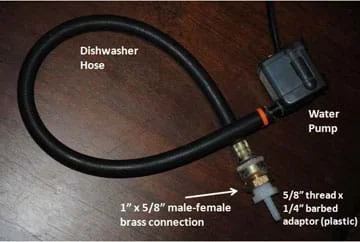 Connect the water pump to SWH devices with ½" ID PVC.Copyright 2012 Odessa Gomez, College of Engineering, University of Colorado Boulder.
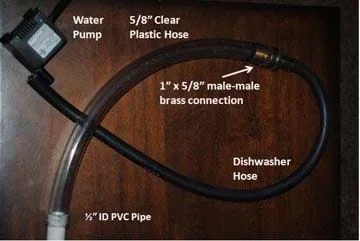 Connect the water pump to SWH devices with ¼" ID clear plastic hose.Copyright 2012 Odessa Gomez, College of Engineering, University of Colorado Boulder.
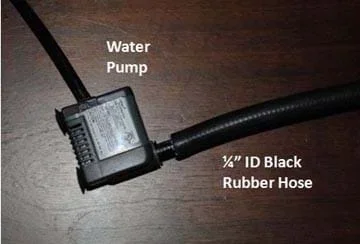 Connect the water pump to SWH devices with ¼" ID clear black rubber hose.Copyright 2012 Odessa Gomez, College of Engineering, University of Colorado Boulder.
- appropriate technologies
- Technologies that are small-scale, energy efficient, environmentally sound, and typically implemented in developing communities.
- conduction
- Transfer of energy between matter due to gradient in temperature. Usually associated within or between solids.
- convection
- Energy is transferred through the bulk flow of fluid, such as air or water.
- developing communities
- A materially poor community that lacks access to electricity, clean water, and/or proper sanitation.
- energy efficiency
- The ratio between useful output energy to input energy of a device. The larger the ratio the more efficient. Sometimes seen as a percent.
- heat transfer
- The exchange of thermal energy between materials and systems.
- radiation
- Electromagnetic radiation that is given off by a warm object and can be absorbed by another object, heating it up. The Earth is heated through radiation transfer from the Sun.
- renewable energy
- Energy that comes from natural resources that can be naturally replenished over a reasonable time period.
- solar energy
- Energy derived from the Sun's radiation and used for heating and electrical applications.
- specific heat
- The amount of heat per unit mass needed to raise the temperature by one degree Celsius.
- trombe wall
- A wall designed to use passive solar heating by absorbing the Sun's energy and directing it toward the inside of a house.
Pre-Activity Assessment
Discussion Questions: Ask students what they know about renewable energy and the different types of renewable energy available. Ask them where in the country they think the most solar energy might be available? (Possible answers: Arizona, California, Colorado, New Mexico, Nevada.) What about the least? (Possible answers: Alaska, Maine, Washington.) Prompt students to think about locations where engineers would be most needed for solar power applications in the U.S.
Activity Embedded Assessment
Worksheets: During the activity, have students complete the Solar Water Heater Efficiency Analysis Worksheet and the Materials Budget Worksheet.
Post-Activity Assessment
Final Worksheet: Following the final test, have students complete the Final Budget and Efficiency Worksheet, and present their findings to the class in a six-minute PowerPoint presentation.
Practice safe workshop techniques when using saws, drills, box cutters and hammers. Students are typically required to complete a tool safety overview along with a consent form signed by their parents before they are allowed to use any tools.
The connections between the different tubing used in the solar water heaters and the tubing used to pump and drain the water for testing can be difficult to coordinate. Make sure that connections for each type of combination are available. These connectors can be purchased at hardware stores, such as Home Depot.
- To challenge students more, provide additional options for tubing, including 1/2" PVC and ¼" clear tubing. These additional options help students learn about trade-offs in flow rate of water through the device and the amount of time the water is exposed to solar energy for heating. Keep in mind that if students use varied tubing sizes, you need multiple hosing adapters in order to connect the hosing to the solar water heaters and garden fountain pumps.
- Solar Power: When & Where Is Best?
- Solar Water: Heat it Up!
Contributors
Odessa Gomez; Darcie Chinnis; Amanda Giuliani; Marissa H. Forbes
Supporting Program
Integrated Teaching and Learning Program, College of Engineering, University of Colorado Boulder
Acknowledgements
The contents of this digital library curriculum were developed under a grant from the Fund for the Improvement of Postsecondary Education (FIPSE), U.S. Department of Education, and National Science Foundation GK-12 grant no 0338326. However, these contents do not necessarily represent the policies of the Department of Education or National Science Foundation, and you should not assume endorsement by the federal government.
Copyright
2012 by Regents of the University of Colorado.