
Spin It: Designing the Ultimate Spinner (en español)
Students build simple spinners to learn about rotation.
Each group needs:
- poster board, 24 x 24 inches (60 x 60 cm)
- large paper plate
- small paper plate
- 2 pencils
- scissors
- dark-colored marker
- 2 rubber bands
- stopwatch
- piece of paper
- 12 pennies or washers
- masking tape, 3 or 4 12-inch (30-cm) lengths
Engineers need to understand the concepts associated with circular motion and angular momentum as they design equipment, systems and products with spinning components. Aerospace engineers design satellites to spin as they orbit around the Earth so that they do not tumble out of control. Automotive engineers design car parts to spin in specific ways so that they do not come apart at high speeds. Mechanical engineers design generators, washers, dryers, fans and other machines so that they are balanced as they spin. Even a forward pass in a football game is more effective and stable when the ball is thrown with the ideal spin.
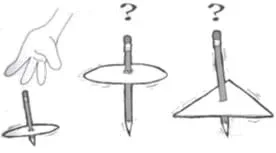 Figure 1. Which one will spin best?Copyright 1999 Jill Frankel Hauser, Gizmos and Gadgets: Creating Science Contraptions that Work (and Knowing Why). Charlotte, VT: Williamson Publishing
Overview
Students build and experiment with different spinner designs to determine which design features create the most effective spinners.
Procedure
- Present and discuss the introduction content with students. Ask them to come up with a few more examples of engineering designs in which rotation is important. (If students are stumped, prompt them with examples such as wind turbines/blades, amusement park rides, spinning computer and mechanical parts, etc.).
- Ask students if any of them ever played with spinners or tops when they were younger. Review how spinners work (you grasp the spinner so its point is down and give it a good twirl with your hand and wrist) and what features spinners have in common (a point on the bottom to spin on, a place at the top to grasp it to spin, a specific shape [round], etc.).
- Organize students into groups of two and hand out the supplies.
- Direct students on how to make and test a spinner:
- Trace one of the paper plates onto the poster board with a pencil, and cut out the drawn circle.
- Use a dark-colored marker to draw a large dot at any point along the circle. (Later, this dot will help us count how many times the spinner goes around.)
- Poke a pencil into the middle of the poster board circle (refer to Figure 1), leaving at least part of the pencil poked through. Then, secure the circle firmly in place by wrapping rubber bands around the pencil, one above and one below the paper circle.
- Practice spinning the spinner on the pencil tip. Watch the colored dot to count the number of rotations the spinner makes.
- Using a stopwatch, have groups spin their spinners for 10 seconds, recording on paper the number of spins.
- Run at least three trials with the spinner to get an average spin value.
- Next, repeat step 4, trying many variations, such as:
- Moving the circle up several inches higher on the pencil.
- Making a new circle and pushing the pencil through the circle at a point away from its center.
- Taping six pennies or washers on the circle (balanced or not—let students figure out if balancing makes a difference).
- With what they have learned from the previous spinners and tests, have groups make new spinners with the engineering challenge to create a spinner that makes the most spins in 10 seconds.
- Encourage students to perform many trials, adjusting the following:
- Size/shape of the poster board
- Height of the circle on the pencil
- Location of pennies/washers on the poster board
- How fast they spin the pencil
- As a class, have teams describe their final spinner designs, including the number of spins they were able to achieve in 10 seconds, as well as why they think their spinner designs did/did not work well.
Wrap Up - Thought Questions
- Which design(s) worked the best? Why?
- Which design(s) did not work? Why not?
- How might changing the pencil length affect your results?
This resource was modified from Super Spinners to create a shorter, more streamlined version suitable for informal learning settings.
Copyright
2016 by Regents of the University of Colorado