
Super Spinners!
Students are challenged to design and build spinners that spin the longest. They build at least two simple spinners to conduct experiments with different mass distributions and shapes. Use this hands-on activity to demonstrate rotational inertia, rotational speed, angular momentum, and velocity.
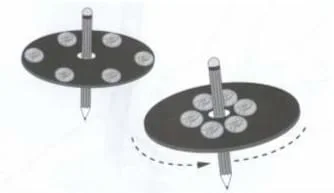 A super spinner demonstrating rotational inertia.Copyright 1999 Jill Frankel Hauser. Gizmos and Gadgets: Creating Science Contraptions that Work (and Knowing Why). Charlotte, VT: Williamson Publishing.
Engineers understand the concepts associated with circular motion and angular momentum as they design equipment, systems and products with spinning components. Aerospace engineers design satellites to spin as they orbit around the Earth so that they do not tumble out of control. Automotive engineers design car parts to spin in specific ways so that they do not come apart at high speeds. Mechanical engineers design generators, washers, dryers, fans and other machines so that they are balanced as they spin. Even a forward pass in football is more effective and stable with the right spin.
After this activity, students should be able to:
- Explain how mass and radius relate to angular momentum.
- Describe the law of conservation of angular momentum.
- Collect, analyze and interpret data on the rotational speed of an object and correlate the speed to variations in the geometry of the object
- Explain how engineers apply the concepts associated with circular motion and angular momentum to design equipment, systems, and products with spinning components.
- 6.1.2.b Fluently add, subtract, multiply, and divide multidigit decimals using standard algorithms for each operation.
Grade 6
Do you agree with this alignment? - 8.2.2.a Solve linear equations in one variable.
Grade 8
Do you agree with this alignment? - 6.1.2.a Fluently divide multi-digit numbers using standard algorithms.
Grade 6
Do you agree with this alignment?
- Use mathematical expressions to describe the movement of an object
Grade 8
Do you agree with this alignment?
- CCSS.Math.Content.6.NS.B.2 Fluently divide multi-digit numbers using the standard algorithm.
Grade 6
Do you agree with this alignment? - CCSS.Math.Content.6.NS.B.3 Fluently add, subtract, multiply, and divide multi-digit decimals using the standard algorithm for each operation.
Grade 6
Do you agree with this alignment? - CCSS.Math.Content.8.EE.C.7 Solve linear equations in one variable.
Grade 8
Do you agree with this alignment? - CCSS.Math.Practice.MP2 Reason abstractly and quantitatively.
Grades K-12
Do you agree with this alignment?
- Some technological problems are best solved through experimentation.
Grades 6-8
Do you agree with this alignment?
- MS-ETS1-4 Develop a model to generate data for iterative testing and modification of a proposed object, tool, or process such that an optimal design can be achieved.
Grades 6-8
This resource focuses on the following Three Dimensional Learning aspects of NGSS:
Science & Engineering Practices- Develop a model to generate data to test ideas about designed systems, including those representing inputs and outputs.Do you agree with this alignment?
Disciplinary Core Ideas- Models of all kinds are important for testing solutions.Do you agree with this alignment?
- The iterative process of testing the most promising solutions and modifying what is proposed on the basis of the test results leads to greater refinement and ultimately to an optimal solution.Do you agree with this alignment?
Crosscutting Concepts- Models can be used to represent systems and their interactions.Do you agree with this alignment?
Do you agree with this alignment? - Develop a model to generate data to test ideas about designed systems, including those representing inputs and outputs.
- MS-PS2-2 Plan an investigation to provide evidence that the change in an object's motion depends on the sum of the forces on the object and the mass of the object.
Grades 6-8
This resource focuses on the following Three Dimensional Learning aspects of NGSS:
Science & Engineering Practices- Science knowledge is based upon logical and conceptual connections between evidence and explanations.Do you agree with this alignment?
- Analyze and interpret data to provide evidence for phenomena.Do you agree with this alignment?
- Construct a scientific explanation based on valid and reliable evidence obtained from sources (including the students' own experiments) and the assumption that theories and laws that describe the natural world operate today as they did in the past and will continue to do so in the future.Do you agree with this alignment?
Disciplinary Core Ideas- The motion of an object is determined by the sum of the forces acting on it; if the total force on the object is not zero, its motion will change. The greater the mass of the object, the greater the force needed to achieve the same change in motion. For any given object, a larger force causes a larger change in motion.Do you agree with this alignment?
- All positions of objects and the directions of forces and motions must be described in an arbitrarily chosen reference frame and arbitrarily chosen units of size. In order to share information with other people, these choices must also be shared.Do you agree with this alignment?
Do you agree with this alignment? - Science knowledge is based upon logical and conceptual connections between evidence and explanations.
Each group needs:
- a flat round object, such as a jar lid, compact disk or paper plate
- 2 pencils (or, alternatively, thumbtacks or pushpins)
- tape
- 2 rubber bands
- cereal box-weight cardboard
- 6 pennies
- scissors
- markers
- The Spin on Things Worksheet (PDF), one per person
Aerospace engineers design satellites to spin as they fly above the Earth so that they do not tumble out of control. Automotive engineers design car parts to spin in very certain ways so that they do not come apart. Mechanical engineers design generators and other machines so that they are balanced as they spin. Even children on playgrounds who play on swings and spinning merry-go-rounds for fun care a lot about how things spin!
With today's activity and worksheet, you will explore how things spin. What makes some things spin a long time, and other things fall over right away? What is the best shape for a spinner? How do spinners work? We will find the answers to these questions and more!
Before the Activity
- Gather materials and make copies of The Spin on Things Worksheet (PDF).
- Have students bring in from home some circular objects such as jar lids and old CDs, pennies, and cardboard cereal boxes or paper plates.
With the Students
- Discussion: Ask students if any of them has ever built a spinner. If necessary, explain what a spinner is. With what did they make the spinner? (Examples: A football, a penny, etc.) How do their spinners work? Explain that in this activity students will learn more about how spinners work as they design and build their own spinners.
- Draw three circles on cardboard by tracing around a circular object. Cut them out.
- Poke a pencil through the middle of one of the cardboard circles. Hold it firmly in place by winding rubber bands around the pencil above and below the cardboard.
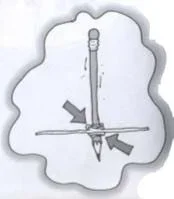 Secure the cardboard shape on the pencil (axis of rotation) by placing wound rubber bands on the pencil above and below where you want it.Copyright 1999 Jill Frankel Hauser. Gizmos and Gadgets: Creating Science Contraptions that Work (and Knowing Why). Charlotte, VT: Williamson Publishing.
- With a marker, draw a thick, dark line at any point on the cardboard spinner top. Have the students spin the spinner. Count the number of rotations the spinner makes within 10 seconds. Write this number down. (The line must be very dark to be able to read it while the shape is spinning.)
- Poke the pencil through another disk at a point away from its center. Describe the motion.
- Give your spinner a long handle and a short tip by pushing just a little of the pencil through the hole. How well does the spinner spin?
- Now push most of the pencil through the cardboard circle to make a long-tipped spinner with a short handle. Does the spin change?
- Now tape six pennies on to the outer rim of one spinner, and six pennies close to the center of another spinner (both spinners should have the pencil at the center of the circle).
- Repeat Step 4 with both of these spinners.
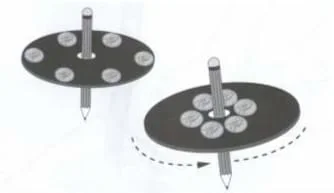 Different weight distributions. Which one will spin best?Copyright 1999 Jill Frankel Hauser. Gizmos and Gadgets: Creating Science Contraptions that Work (and Knowing Why). Charlotte, VT: Williamson Publishing.
- Cut a square or triangle shape from cardboard. Poke a pencil through the center and give it a whirl. Which top stays spinning the longest? Repeat Step 4 with this spinner.
- Have student groups fill out the worksheet and check their answers with another student group.
- Review the worksheets with the entire class.
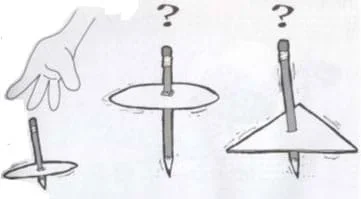 Different spinner shapes. Which one will spin best?Copyright 1999 Jill Frankel Hauser. Gizmos and Gadgets: Creating Science Contraptions that Work (and Knowing Why). Charlotte, VT: Williamson Publishing.
Pre-Activity Assessment
Discussion Questions: Ask the students and discus as a class:
- Has anyone has ever built a spinner? If necessary, explain what a spinner. With what did they make spinners? (Examples: A football, a penny, etc.) How do their spinners work? Explain that in this activity, students will learn more about how spinners work as they make and test their own spinner designs.
Activity Embedded Assessment
Worksheet: Have students use the activity worksheet to help them complete the activity. Review their answers to gauge their mastery of the subject.
Pairs Check: As student groups finish their worksheets, have them check their answers with another team, giving all groups time to finish the worksheet.
Post-Activity Assessment
Class Presentation: Have the groups present their best spinner designs to the rest of the class and discuss why they worked best, in terms of the rotation concepts.
Sharp pencil points and thumbtacks present a hazard.
If the pencils are too unstable, thumbtacks or pushpins may serve as a better axis for the spinners to rotate about.
Sometimes the spinner is hard to keep balanced. It may take the students several tries before they can balance the spinner and count the line as it passes.
Keys to spinner design (Hauser, 1999):
- A disk shape evenly distributes the mass about the center. That is also why poking the pencil through the center works best.
- A long handle and a short tip. The top is more stable when it has a low center of gravity.
- Weight evenly distributed at the outer edge gives the top more spinning inertia.
- The harder you twist when you start the spinner, the longer the spin.
Have students devise their own spinning creations at home, using lids, plates, cardboard and other household materials. Have them report back to the class what designs worked best. Have them demonstrate using their homemade spinners.
Hold a contest to see which spinner can spin the longest. Ask the team with that spinner to explain why their spinner lasts the longest.
Hauser, Jill Frankel. Gizmos and Gadgets: Creating Science Contraptions that Work (and Knowing Why). Charlotte, VT: Williamson Publishing, 1999. (Activity adapted from Hauser.)
Contributors
Ben Heavner; Sabre Duren; Malinda Schaefer Zarske; Denise W. Carlson
Supporting Program
Integrated Teaching and Learning Program, College of Engineering, University of Colorado Boulder
Acknowledgements
The contents of this digital library curriculum were developed under grants from the Fund for the Improvement of Postsecondary Education (FIPSE), U.S. Department of Education, and National Science Foundation (GK-12 grant no 0338326). However, these contents do not necessarily represent the policies of the Department of Education or National Science Foundation, and you should not assume endorsement by the federal government.
Copyright
2004 by Regents of the University of Colorado