
Action-Reaction! Rocket
Students construct rockets from balloons propelled along a guide string. They use this model to learn about Newton's three laws of motion, examining the effect of different forces on the motion of the rocket.
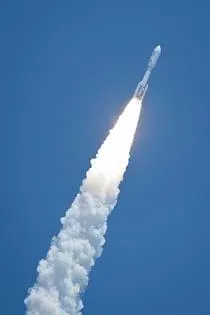 Students examine rocket motionCopyright NASA. WIkimedia Commons https://commons.wikimedia.org/wiki/File:Launch_of_Juno.jpg
Engineers of all disciplines apply their understanding Newton's laws of motion to quantify the "invisible" forces acting on all objects. Just like a ball can be twirled on the end of a string, satellites and spacecraft stay in orbit around the Earth due to the balance between gravitational and centripetal forces. Eventually, satellites slow down due to the miniscule drag in the upper atmosphere, to the point at which gravity pulls them out of orbit. To keep them in orbit, engineers exploit the second law by designing thrusters that burn fuel and expel it from the thruster. The spacecraft moves forward in an amount equal to the force of the gas leaving the thruster, causing enough movement to re-orient the path of the object and keep it in orbit.
After this activity, students should be able to:
- Explain practical applications of Newton's laws of motion.
- Use a balloon model explain the different forces that act on the rocket.
- Collect data from the experiment and graph the results.
- 6.1.2.b Fluently add, subtract, multiply, and divide multidigit decimals using standard algorithms for each operation.
Grade 6
Do you agree with this alignment? - 8.3.1.a Construct and interpret scatter plots for bivariate measurement data to investigate patterns of association between two quantities.
Grade 8
Do you agree with this alignment?
- Predict and evaluate the movement of an object by examining the forces applied to it
Grade 8
Do you agree with this alignment?
- CCSS.Math.Content.6.NS.B.3 Fluently add, subtract, multiply, and divide multi-digit decimals using the standard algorithm for each operation.
Grade 6
Do you agree with this alignment? - CCSS.Math.Content.8.SP.A.1 Construct and interpret scatter plots for bivariate measurement data to investigate patterns of association between two quantities. Describe patterns such as clustering, outliers, positive or negative association, linear association, and nonlinear association.
Grade 8
Do you agree with this alignment?
- STEL-3G Explain how knowledge gained from other content areas affects the development of technological products and systems.
Grades 6-8
Do you agree with this alignment?
- MS-PS2-2 Plan an investigation to provide evidence that the change in an object's motion depends on the sum of the forces on the object and the mass of the object.
Grades 6-8
This resource focuses on the following Three Dimensional Learning aspects of NGSS:
Science & Engineering Practices- Plan an investigation individually and collaboratively, and in the design: identify independent and dependent variables and controls, what tools are needed to do the gathering, how measurements will be recorded, and how many data are needed to support a claim.Do you agree with this alignment?
- Science knowledge is based upon logical and conceptual connections between evidence and explanations.Do you agree with this alignment?
Disciplinary Core Ideas- The motion of an object is determined by the sum of the forces acting on it; if the total force on the object is not zero, its motion will change. The greater the mass of the object, the greater the force needed to achieve the same change in motion. For any given object, a larger force causes a larger change in motion.Do you agree with this alignment?
- All positions of objects and the directions of forces and motions must be described in an arbitrarily chosen reference frame and arbitrarily chosen units of size. In order to share information with other people, these choices must also be shared.Do you agree with this alignment?
Crosscutting Concepts- Explanations of stability and change in natural or designed systems can be constructed by examining the changes over time and forces at different scales.Do you agree with this alignment?
Do you agree with this alignment? - Plan an investigation individually and collaboratively, and in the design: identify independent and dependent variables and controls, what tools are needed to do the gathering, how measurements will be recorded, and how many data are needed to support a claim.
Each group needs:
- plastic drinking straw
- plastic bag, about the size of an inflated balloon
- paper streamers
- fishing line, 25 ft (20-50g weight) or string (nylon [slippery] string works better than twine [rough])
- long, tube-shaped balloon
- tape measure or meter stick
- Action-Reaction! Worksheet (PDF), one per student
Start with an in-class demonstration. For example, have a student or the teacher stand on a skateboard and throw a basketball. What happens? Have a student or the teacher throw a basketball filled with lead weights or medicine ball, very heavy object (this could be dangerous; be careful not to fall). What happens? (Answer: The person rolls backwards on the skateboard.)
Or, as another demonstration: Pass around three containers (such that students cannot see the contents), one filled with something light such as feathers or foam peanuts, one filled with something heavy such as lead weights and one filled with something in the middle such as rice or grains. Ask students which is heavier. Ask them what they think is inside. Tell them that the heaviest one is heavier because it has a higher mass.
Rockets and rocket-propelled flight has been in use for more than 2,000 years. People in ancient China used gunpowder to make fireworks and rockets. In the past 300 years, people have gained a scientific understanding of how rockets work. Now, aerospace engineers use their understanding to make rockets fly farther, faster, higher and more accurately. Our understanding of how rockets work arises from Sir Isaac Newton's three laws of motion. It is important for engineers to understand Newton's laws because they not only describe how rockets work, they explain how everything that moves or is at rest works!
This activity demonstrates all three of Newton's laws of motion. The focus of the activity is Newton's third law of motion, but the first and second laws are intrinsically involved with the motion of the rocket as well. The air pushing its way out of the balloon is an action force, and it causes an equal reaction, which is the movement of the balloon. The more air initially in the balloon, the further the balloon travels along the string because the action force is greater. By the same token, if only a small amount of air is initially in the balloon, the balloon travels a shorter distance.
Simply stated, Newton's three laws of motion are:
Law #1: Objects at rest stay at rest, and objects in motion stay in motion in a straight line unless they are acted upon by an unbalanced force. (law of inertia)
Law #2: Force is equal to mass multiplied by acceleration. (F = ma)
Law #3: For every action, there is always an opposite and equal reaction.
Before the Activity
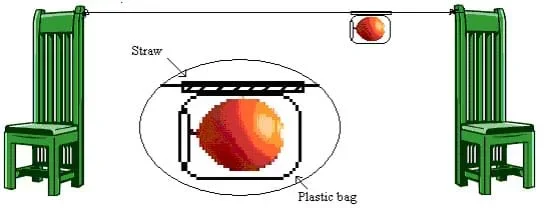 Figure 1. Setup for the action-reaction rocket activity.Copyright 2005 Ashleigh Bailey, ITL Program, College of Engineering, University of Colorado Boulder
- Gather materials and make copies of the Action-Reaction! Worksheet (PDF).
- Choose appropriate locations for students to set up the experiment.
With the Students
- Have students vote on which of Newton's three laws of motion applies to the flight of rockets. Tabulate votes on the board. (Answer: Trick question! All three laws apply.)
- Hand out a worksheet to each student.
- Tape a drinking straw along the side of a plastic bag (see Figure 1).
- Tape streamers along the open edge of the plastic bag.
- Thread the string through the straw.
- Tie each end of the string to a chair, and pull the chairs apart so that the string is taut (see Figure 1).
- Position the bag at one end of the string, with the open end of the bag facing toward the chair.
- Blow up a balloon and put it into the bag, holding the balloon closed.
- Count down to zero, and let go of the balloon. . . ZOOOOM!
- Have students measure the distance their balloon rockets traveled on the string and complete the worksheet.
- While waiting for other students to finish their worksheets, direct students with completed worksheets to compare their answers with their peers.
- As a class, review and discuss the worksheet answers.
Pre-Activity Assessment
Voting: Ask students to vote on which of Newton's three laws applies to the flight of rockets. Tabulate votes on the board. Give the answer: It's a trick question! All three laws apply.
Activity Embedded Assessment
Worksheet: Have students follow along with the activity on their worksheets. After students have finished their worksheets, have them compare answers with their peers. Review their answers to gauge their mastery of the concepts.
Graphing: Have students calculate the volume of the balloon and then plot volume vs. distance traveled.
Post-Activity Assessment
Numbered Heads: Have students on each team pick numbers (or number off) so each member has a different number. Ask students questions from the worksheet. Have the members of each team work together on the answer and everyone on the team must know the answer. Call a number at random. Students with that number raise their hands to answer the question. If not all the students with that number raise their hands, let the teams work a little longer. Encourage students to include terms that they have learned in the answers.
Flashcards: Have each group make three flash cards with a question on one side and its answer on the other. In writing the questions and answers, have students incorporate the new terms that they have learned. Have students pass the cards to the group next to them to answer the questions and then pass them along. Example questions:
- What is inertia? (Answer: When an object is at rest or in a constant state of motion.)
- How are action and reaction forces related? (Answer: They are equal.)
- If acceleration = 6 m/s2 and mass = 6,254 g what is the force? (Answer: 37,524 Newtons [gm/s2].)
- What would happen if you changed the direction of the force (that is, the balloon blew out toward the floor)? Would the balloon travel a shorter distance, longer distance or the same? (Answer: The balloon would travel a shorter distance if it moves at all, because it would not be able to travel in the direction opposite the force.)
- According to Newton's third law, how do you know that the action and reaction forces on the balloon are equal? (Answer: Because for every action there is an equal and opposite reaction.)
- What vocabulary word best describe your experience when you are a "couch potato"? (Answer: Inertia.)
- If an equal forces is applied to a Mini Cooper and a semi-trailer truck, which will have greater acceleration? (Answer: A Mini Cooper, due to its smaller mass.)
- What does acceleration depend on? (Answer: Mass and force.)
- If you kick two balls that weigh the same, which ball goes further? (Answer: The ball that you kick harder.)
- Does air have mass? (Answer: Yes. It can be measured on a scale.)
- When mass is multiplied by acceleration, what results? (Answer: Force.)
Straws make excellent projectile shooters. Make sure to collect them at activity end.
Be sure the students blow up their balloon to different sizes—small, medium and large—to compare the different magnitudes of reaction that are produced.
Thicker fishing line (20-50g) works best for this activity. Next best is nylon string. Rough string or twine creates too much friction for the balloons to travel as far.
Make sure to pull the string taut for the balloon rocket launch. The balloon does not travel as far on a slack string.
This activity can also be done without the plastic bag by taping the straw directly to the balloon. In this case, use large round balloons instead of long balloons.
Run the experiment with a bigger or smaller balloon.
Have students fill up their balloons with water and repeat the experiment. Ask them why the balloon moved so slowly (if at all) and why. (Answer: Because the water is heavy, it takes more force to move water than air, and the water spills out of the balloon slowly (compared to air), thus the reaction force is equally as slow as the action force. Note: This is messy! Make sure to follow the water-balloon with a bucket to catch the water or do this activity outside.
Tape pennies to the outside of a rocket to increase its mass. How does increased mass affect the flight of the rocket? (Answer: Because of Newton's second law, the same force exerted upon a larger mass will result in a lower acceleration–the rocket will not go as far!)
Have students re-engineer their balloon rockets again, adding extra features to make the balloon go further. Permit them to use more straw and tape, and more than one balloon. Conduct a race to see which engineering team built the best balloon rocket. Ask that team to explain why their design worked as it did, in terms of Newton's three laws of motion.
Ask students to write journal entries on how the balloon rocket experiment could relate to something else they've encountered. Why are Newton's laws of motion so important in our world?
- For lower grades, complete the worksheet as a class, with different groups using different sized balloons. Use the data from each group's work to construct a plot together, as a class.
- Give more advanced students all materials except the worksheet that tells them how to put the rocket together. Ask them to figure out on their own how to construct the rocket.
Hauser, Jill Frankel.Gizmos and Gadgets: Creating Science Contraptions That Work (and Knowing Why). Charlotte, VT: Williamson Publishing, 1999. (Activity adapted from Hauser.)
NASA Quest > Space Team Online: http://quest.nasa.gov/space/teachers/liftoff/newton.html.
Browse the NGSS Engineering-aligned Physics Curriculum hub for additional Physics and Physical Science curriculum featuring Engineering.
Contributors
Sabre Duren; Ben Heavner; Malinda Schaefer Zarske; Denise W. Carlson
Supporting Program
Integrated Teaching and Learning Program, College of Engineering, University of Colorado Boulder
Acknowledgements
The contents of this digital library curriculum were developed under grants from the Fund for the Improvement of Postsecondary Education (FIPSE), U.S. Department of Education, and the National Science Foundation (GK-12 grant no 0338326). However, these contents do not necessarily represent the policies of the DOE or NSF, and you should not assume endorsement by the federal government.
Copyright
2004 by Regents of the University of Colorado