
Catapults!
Students observe the relationship between the angle of a catapult (a force measurement) and the flight of a cotton ball. They learn how Newton's second law of motion works by seeing directly that F = ma. When they pull the metal "arm" back further, thus applying a greater force to the cotton ball, it causes the cotton ball to travel faster and farther. Students also learn that objects of greater mass require more force to result in the same distance traveled by a lighter object.
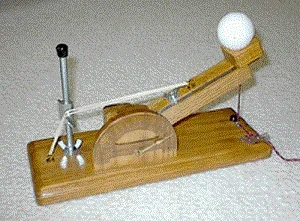 Students make model catapults to explore Newton's second law of motion.Copyright National Institute of Standards and Technology http://www.itl.nist.gov/div898/handbook/pri/section4/gifs/catapul2.gif
Understanding the scientific concepts of Newton's laws of motion has made it possible for engineers to build airplanes that fly, elevators and amusement park rides that are exciting but safe, cars that drive safely at high speeds and structures that do not collapse. Aerospace engineers save fuel by exploiting the second law when they let the planet's force of gravity pull a spacecraft towards the planet to increase its velocity, and then steer the spacecraft away from crashing into the planet.
After this activity, students should be able to:
- Recognize that understanding the scientific concepts described by Newton's laws of motion enables engineers to design airplanes, amusement park rides, elevators, and much more.
- Use the catapult model to explore the force exerted on the cotton ball and graph the correlation between angle (force) and distance traveled (acceleration).
- Collect data throughout this experiment, including the maximum height of the cotton ball in flight and the distance traveled until it lands on the floor.
- Calculate the average of a data set.
- 8.3.1.a Construct and interpret scatter plots for bivariate measurement data to investigate patterns of association between two quantities.
Grade 8
Do you agree with this alignment?
- Predict and evaluate the movement of an object by examining the forces applied to it
Grade 8
Do you agree with this alignment?
- CCSS.Math.Content.8.SP.A.1 Construct and interpret scatter plots for bivariate measurement data to investigate patterns of association between two quantities. Describe patterns such as clustering, outliers, positive or negative association, linear association, and nonlinear association.
Grade 8
Do you agree with this alignment?
- STEL-3G Explain how knowledge gained from other content areas affects the development of technological products and systems.
Grades 6-8
Do you agree with this alignment?
- MS-PS2-2 Plan an investigation to provide evidence that the change in an object's motion depends on the sum of the forces on the object and the mass of the object.
Grades 6-8
This resource focuses on the following Three Dimensional Learning aspects of NGSS:
Science & Engineering Practices- Plan an investigation individually and collaboratively, and in the design: identify independent and dependent variables and controls, what tools are needed to do the gathering, how measurements will be recorded, and how many data are needed to support a claim.Do you agree with this alignment?
- Science knowledge is based upon logical and conceptual connections between evidence and explanations.Do you agree with this alignment?
Disciplinary Core Ideas- The motion of an object is determined by the sum of the forces acting on it; if the total force on the object is not zero, its motion will change. The greater the mass of the object, the greater the force needed to achieve the same change in motion. For any given object, a larger force causes a larger change in motion.Do you agree with this alignment?
- All positions of objects and the directions of forces and motions must be described in an arbitrarily chosen reference frame and arbitrarily chosen units of size. In order to share information with other people, these choices must also be shared.Do you agree with this alignment?
Crosscutting Concepts- Models can be used to represent systems and their interactions.Do you agree with this alignment?
Do you agree with this alignment? - Plan an investigation individually and collaboratively, and in the design: identify independent and dependent variables and controls, what tools are needed to do the gathering, how measurements will be recorded, and how many data are needed to support a claim.
Each group needs:
- 2 wooden blocks
- 1 thin strip of metal banding (8-inches long)
- 1 protractor
- 4 long nails (or a C-clamp, or duct tape)
- 1 small nail
- 1 cotton ball
- 1 hammer
- tape measure or meter stick
- Newton's Second Law – Catapult Worksheet (PDF), one per student
Catapults were first used around 400 BC in Greece and China as weapons to launch rocks, arrows and other projectiles against enemies. In the centuries after their first appearance, bigger and bigger catapults were constructed. Over time, catapults were made so big that they became too difficult to use, and eventually were no longer used. However, the fundamental concepts used in working catapults are still in use every day.
Engineers need to understand how much force is required to make an object with a certain mass move. Catapults are one good way to learn about the relationship between force, mass and acceleration. The relationship F = ma is called Newton's second law of motion because it is a mathematical description of the relationship among force, mass and acceleration.
Before the Activity
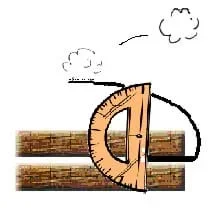 Figure 1. Diagram of the activity's simple catapult.Copyright 2005 Ashleigh Bailey, ITL Program, College of Engineering, University of Colorado Boulder
- Gather materials and make copies of the Newton's Second Law – Catapult Worksheet (PDF).
- Choose appropriate locations for students to fire their catapults.
With the Students
- Open with a discussion question: Has anyone ever seen or built a catapult? How does it work? Tell the students that we will find out more about this in today's activity.
- Hand out a worksheet to each student.
- Bend the metal banding into an L shape and insert the "L" end between the two wooden blocks (see Figure 1).
- Hold the blocks securely in place by one of three options: Nail them together by hammering two nails on either side of the metal stripping, use a C-clamp or use duct tape to hold the blocks together.
- Tape the protractor vertically to the front of the catapult, close to the metal band (arm).
- Ask students make predictions (hypotheses) of what angle of the catapult they expect will make the cotton ball travel highest and furthest.
- Once the catapult is built, assign roles to each team member. Instruct one student to fire the cotton ball, one to spot the maximum height of the cotton ball when in flight, one to spot the landing point where the cotton ball first hits the ground, and two to measure the height and distance of flight.
- Place cotton ball at the end of the arm.
- Pull the metal band (arm) back 10° and release. If it flies straight up or backwards, fire again. Conduct two trials.
- Have students record their measurements on the worksheet as they proceed through the activity.
- Repeat firing process at 20° through 90°.
- Have students complete the rest of the worksheet.
- While waiting for other students to finish their worksheets, have students with completed worksheets compare their answers with their peers.
- Review worksheet answers as a class.
Pre-Activity Assessment
Discussion Questions: Solicit, integrate and summarize student responses.
- Has anyone ever seen or built a catapult? How does it work?
Activity Embedded Assessment
Worksheet: Have students record measurements and follow along with the activity on the Newton's Second Law – Catapult Worksheet (PDF). After students have finished their worksheets, have them compare answers with their peers.
Post-Activity Assessment
Worksheet Discussion: As a class, review and discuss the worksheet answers. Student answers reveal their depth of understanding and mastery of the subject.
While cotton balls are of minimal concern, have students wear safety glasses if they use other objects as projectiles.
The cotton ball may fly straight up or even backwards from the catapult. If this occurs, have the student repeat the process for that angle again.
Students need to pay close attention to observe exactly where the maximum height occurs. Tell them to be sure to keep their "eye on the ball."
Make sure students record the distance traveled with respect to where the ball lands, not where it rolls to a stop.
Repeat the experiment with different objects to examine the affect of mass on the force and acceleration due to the catapult.
Internet research: What is the biggest catapult ever made? When were catapults used as weapons? How are catapults still used today? (Hint: Search for catapults and aircraft carriers.)
- For lower grades, work together to complete the worksheet; do the averages together as a class. Substitute a bar graph for the X-Y plot.
- For upper grades, have each individual complete his/her own worksheet, computing averages and making the plots.
Activity adapted from AIMS Education Foundation, 1987. http://www.aimsedu.org/
Contributors
Sabre Duren; Ben Heavner; Malinda Schaefer Zarske; Denise W. Carlson
Supporting Program
Integrated Teaching and Learning Program, College of Engineering and Applied Science, University of Colorado Boulder
Acknowledgements
The contents of this digital library curriculum were developed under grants from the Fund for the Improvement of Postsecondary Education (FIPSE), U.S. Department of Education, and National Science Foundation (GK-12 grant no. 0338326). However, these contents do not necessarily represent the policies of the Department of Education or National Science Foundation, and you should not assume endorsement by the federal government.
Copyright
2004 by Regents of the University of Colorado