
Swing in Time
Students examine the motion of pendulums and come to understand that the longer the pendulum string, the fewer the number of swings in a given time interval. Student groups conduct an experiment, collecting and graphing data on a worksheet. They see that changing the weight on the pendulum does not have an effect on the period.
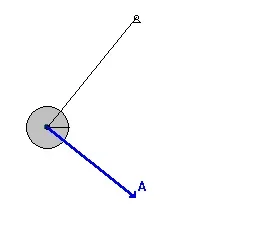 Students examine the motion of pendulumsCopyright Wikimedia Commons http://upload.wikimedia.org/wikipedia/commons/2/21/Pendulum_animation.gif
Engineers use the motion concepts learned from pendulums in many applications, including timekeeping, earthquake detection, satellite orbits and energy dissipation. Control engineers incorporate pendulums into vibration isolation systems for manufacturing and industrial equipment, and controlling walking robots and rocket thrusters. Inverted pendulum systems monitor dam performance and structural behavior by detecting angular movement. Anti-sway software builds upon pendulum concepts to provide more safe and efficient operation of construction cranes, yard cranes, telescoping boom cranes and shipboard cranes.
After this activity, students should be able to:
- Describe the motion of pendulums.
- Collect data while experimenting with pendulums, and use that data to predict future behavior.
- Use collected data to explain the relationship between pendulum length and frequency.
- Give examples of situations in which engineers use pendulums.
- (activity extension) Use knowledge acquired from data analysis to create a pendulum that solves a design challenge.
- 7.1.2.c Solve real-world and mathematical problems involving the four operations with rational numbers.
Grade 7
Do you agree with this alignment? - HS.3.1.a.i Represent data with plots on the real number line (dot plots, histograms, and box plots).
Grades 9-12
Do you agree with this alignment?
- Use mathematical expressions to describe the movement of an object
Grade 8
Do you agree with this alignment?
- CCSS.Math.Content.6.NS.B.3 Fluently add, subtract, multiply, and divide multi-digit decimals using the standard algorithm for each operation.
Grade 6
Do you agree with this alignment? - CCSS.Math.Content.HSS-ID.A.1 Represent data with plots on the real number line (dot plots, histograms, and box plots).
Grades 9-12
Do you agree with this alignment?
- STEL-3G Explain how knowledge gained from other content areas affects the development of technological products and systems.
Grades 6-8
Do you agree with this alignment?
- CCC.1.6-8.12 Patterns can be used to identify cause and effect relationships.
Grades 6-8
Do you agree with this alignment? - CCC.1.6-8.13 Graphs, charts, and images can be used to identify patterns in data.
Grades 6-8
Do you agree with this alignment?
Each group needs:
- 110 cm of string
- fishing weights (1 oz. and 2 oz.)
- tape
- metric ruler or tape measure
- colored markers
- protractor
- stopwatch
Basic understanding of forces such as lift, weight, thrust and drag, plus rotational motion and angular momentum.
Waves in water go up and down, cars bounce up and down when they hit a bump, and people go back and forth when they are playing on a swing. Can you think of other things that have a regular back and forth motion? Items that move back and forth regularly move in similar ways. If scientists and engineers can understand one kind of back and forth motion, such as a swing, then they can apply that understanding to other items that move in a back and forth motion.
In this activity, you will examine the motion of a pendulum. If you have ever played on a swing set, you are already familiar with some of the ways that a pendulum can move. In this lab, you will examine specific factors that might affect the way a pendulum swings. You will time a pendulum swinging back and forth, and see what factors make it speed up and what conditions make it slow down.
The motion of a pendulum was first mathematically described by a man named Galileo Galilei in the late 1500s. Galileo also investigated how things fall, how planets move, and many other scientific phenomena. Many of his discoveries grew out of his observations of how pendulums swing. Just think—maybe you can figure out how something works by understanding pendulums!
Pendulums were not only used in the 1500s, though. Engineers use the motion of pendulums today. In fact, some of the most advanced building designs incorporate large pendulums to dissipate the energy if the building is shaken by an earthquake. Engineers use pendulums in robots and in clocks. Can you think of useful ways to use a pendulum?
Before the Activity
- Cut string pieces to 110 cm.
- Attach either the 1 oz. or the 2 oz. weight to all pendulums.
- Label fishing weights 1 oz. and 2 oz.
- Make copies of the Swing in Time Worksheet (PDF), one per student.
With the Students
- Introduce the activity: Ask students if they know what a pendulum is. Ask them if they know how pendulums are used. Tell them they will learn more about pendulums and their movements in this activity. See the associated lesson for more background information and motivation.
- Hand out the worksheets. Direct students to use the worksheets to follow along with the activity.
- Working in groups of three, have students measure and mark their string at 10-cm intervals, starting measurement at the middle of the weight and marking up to 100 cm.
- Have students tape the pendulum to their desks at the 10-cm mark.
- Pull the weight back at a 45-degree angle for consistency in the swing.
- Predict and test: First have students predict the number of times the pendulum will swing back to its original starting point (a swing or oscillation) during a 30-second timing, for the pendulum length and weight being tested, and record this in the worksheet table. Next, have one student time the swing for 30 seconds and two other students count the number of complete swings (oscillations), and record this in the worksheet table.
- Repeat the "predict and test" process, taping at the next 10-cm increment (20 cm). Repeat again, up to a 50-cm length.
- Have students create bar graphs with the number of swings (oscillations) on the vertical axis and the pendulum length on the horizontal axis. Expect students to observe a pattern.
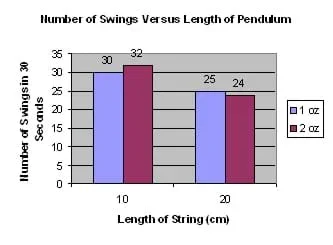
- Repeat the procedure using the second weight. Ask students to observe any differences between the two weights (there should be no difference).
- Expect their bar graphs to look similar to the example below. (Note: The weight has a negligible effect on the number of swings, but due to experimental error, there may be a slight discrepancy.)
- Following the pattern, students should be able to make predictions for the results at the 60-cm to 100-cm lengthsn.
- Have students continue to record their predictions, test and record their results on the worksheet.
- Conclude with a class discussion to review and share results, worksheet answers and conclusions.
- pendulum
- A string with a weight at one end suspended from a fixed support, so that it swings freely back and forth, under the influence of gravity.
- bob
- The swinging weight at the end of a pendulum.
- gravity
- The force that attracts bodies toward the center of the Earth.
- period
- The amount of time it takes the bob of a pendulum to return to its initial position.
- oscillation
- The back and forth swinging motion of the bob of a pendulum. One oscillation is complete when the bob returns to its starting position.
Pre-Activity Assessment
Discussion Question: Solicit, integrate and summarize student responses. Ask students: What is a pendulum? Then brainstorm examples of pendulums. (Possible answers: Playground swings, rope or tire swings hanging from trees, grandfather clocks, circus trapeze swings and ropes, balancing mechanisms for some robots, etc.)
Activity Embedded Assessment
Worksheet: Have students follow along with the activity using the Swing in Time Worksheet (PDF) and use it to record their lab observations and measurements.Review their data, answers and graph to gauge their depth of engagement and comprehension.
Pairs Check: After student groups finish working on worksheets, have them compare answers with another completed group, giving all students time to finish the worksheet.
Post-Activity Assessment
Worksheet Discussion: Review and discuss worksheet answers with the entire class. Students' answers indicate their mastery of the subject.
Small weights can be a choking hazard.
It may be helpful to model this activity for the students.
Make sure that students keep an accurate count of the pendulum's oscillations. Have two students count and agree on the number of swings.
Sand Pendulum: Make a cone-shaped cup and fill it with sand or salt. Swing the cone like a pendulum, letting the sand pour out from a hole in the bottom of the cone. Observe the pattern it makes.
Experiment with two or more pendulums at one time: Swing the pendulums in the same direction, in the opposite directions, two one-way and one another, criss-cross, etc.
Predict the amount of time it will take the pendulum to come to a complete stop.
Ask students to find a string length that makes the pendulum swing exactly 60 times per minute. How would this be useful? (Answer: A pendulum could be used as a clock if each swing took one second.)
Design Challenge: Challenge students to design a pendulum that swings back and forth 10 times in 1 minute. Encourage students to "fail quickly," so they can test many different designs within the allotted time. Also encourage students to use what they learned about pendulums from this activity to make the necessary adjustments to their designs.
- For younger students, have them draw pictures of something that swings, such as a tire swing or a clock pendulum. After they have finished drawing, have them show the class what they drew. Ask students what they think controls how fast the pendulum swings—the mass or the length of the pendulum?
- For older students, have them create line graphs rather then bar graphs.
Contributors
Sabre Duren; Ben Heavner; Malinda Schaefer Zarske; Denise W. Carlson
Supporting Program
Integrated Teaching and Learning Program, College of Engineering, University of Colorado Boulder
Acknowledgements
The contents of this digital library curriculum were developed under grants from the Fund for the Improvement of Postsecondary Education (FIPSE), U.S. Department of Education, and National Science Foundation (GK-12 grant no 0338326). However, these contents do not necessarily represent the policies of the Department of Education or National Science Foundation, and you should not assume endorsement by the federal government.
Copyright
2004 by Regents of the University of Colorado