
Motion Commotion
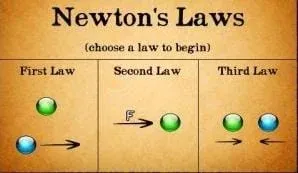 Students explore Newton's laws of motionCopyright OLGA LEDNICHENKO https://www.flickr.com/photos/olga-lednichenko-photos-albums-images/6417813593
Students learn why and how motion occurs and what governs changes in motion, as described by Newton's three laws of motion. They gain hands-on experience with the concepts of forces, changes in motion, and action and reaction. In an associated literacy activity, students design a behavioral survey and learn basic protocol for primary research, survey design and report writing.
Whether they design moving objects (scooters, boats, compact disk players, blenders) or stationary objects (dams, bridges, stoves, sunglasses, picture hangers), understanding Newton's laws of motion helps engineers of all disciplines quantify the "invisible" forces acting on the objects.
After this lesson, students should be able to:
- Identify Newton's three laws and explain what each law physically describes with respect to motion.
- Predict results from the various motions presented in the activities and be able to explain why these motions occurred.
- Give examples of why Newton's laws are important to engineering.
- Relate the variables in the F = ma equation
- HS.2.4.c.i Solve linear equations and inequalities in one variable, including equations with coefficients represented by letters.
Grades 9-12
Do you agree with this alignment? - 7.1.2.c Solve real-world and mathematical problems involving the four operations with rational numbers.
Grade 7
Do you agree with this alignment?
- Predict and evaluate the movement of an object by examining the forces applied to it
Grade 8
Do you agree with this alignment? - Use mathematical expressions to describe the movement of an object
Grade 8
Do you agree with this alignment?
- STEL-3G Explain how knowledge gained from other content areas affects the development of technological products and systems.
Grades 6-8
Do you agree with this alignment?
- MS-PS2-2 Plan an investigation to provide evidence that the change in an object's motion depends on the sum of the forces on the object and the mass of the object.
Grades 6-8
This resource focuses on the following Three Dimensional Learning aspects of NGSS:
Science & Engineering Practices- Plan an investigation individually and collaboratively, and in the design: identify independent and dependent variables and controls, what tools are needed to do the gathering, how measurements will be recorded, and how many data are needed to support a claim.Do you agree with this alignment?
- Science knowledge is based upon logical and conceptual connections between evidence and explanations.Do you agree with this alignment?
Disciplinary Core Ideas- The motion of an object is determined by the sum of the forces acting on it; if the total force on the object is not zero, its motion will change. The greater the mass of the object, the greater the force needed to achieve the same change in motion. For any given object, a larger force causes a larger change in motion.Do you agree with this alignment?
- All positions of objects and the directions of forces and motions must be described in an arbitrarily chosen reference frame and arbitrarily chosen units of size. In order to share information with other people, these choices must also be shared.Do you agree with this alignment?
Crosscutting Concepts- Explanations of stability and change in natural or designed systems can be constructed by examining the changes over time and forces at different scales.Do you agree with this alignment?
Do you agree with this alignment? - Plan an investigation individually and collaboratively, and in the design: identify independent and dependent variables and controls, what tools are needed to do the gathering, how measurements will be recorded, and how many data are needed to support a claim.
Simply stated, Newton's three laws of motion are:
Law #1: Objects at rest will stay at rest, and objects in motion will stay in motion in a straight line unless they are acted upon by an unbalanced force. (law of inertia)
Law #2: Force is equal to mass multiplied by acceleration. (F = ma)
Law #3: For every action, there is always an opposite and equal reaction.
Newton's first law is also known as the law of inertia. It says that if you were to kick a ball and there were no forces acting on the ball, it would keep going in a straight line forever! This law is somewhat abstract because on Earth, invisible forces are always at work. Gravity, friction and air pressure are examples of "invisible" forces that act on objects everywhere. Therefore, objects on Earth are constantly changing direction, speeding up and slowing down — a ball does not keep going forever because there are forces acting to slow it down. Scientists and engineers must always keep in mind these "invisible" forces acting on the object's motion.
Newton's second law means that if you kick two balls that weigh the same, the ball you kick harder will go farther (that is, for a constant mass, exerting a greater force yields a greater acceleration). The second law also says that if you have a heavy ball and a light ball, you have to kick the heavy ball harder to make it go as fast as the lighter ball (that is, for a constant acceleration, a greater mass requires a greater force). The mathematical way to state this law is:
F = m x a
(Force = mass times acceleration)
If you hit a golf ball and a baseball with the same amount of force, which one would go farther? The golf ball! Why? Because the golf ball has less mass than the baseball, therefore less force is needed for the golf ball to achieve the same distance as the baseball.
Newton's third law is possibly the most widely known — for every action, there is an equal but opposite reaction. There is always a partner of forces at play: an action force and a reaction force. Even though this is possibly the most famous of his three laws, it is not necessarily the most intuitive. For example, when you walk on the ground (action force), the ground pushes up on you with an equal reaction force. You cannot see the force, and we are so accustomed to walking on the ground, we do not even realize there must be a reaction force that keeps us from sinking into the ground. Imagine sinking into the ground with every step we take! That's exactly what would happen if this third law were not true.
When Isaac Newton was 23 years old, he identified three traits of moving objects. His identification of these traits, now accepted as Newton's laws of motion, revolutionized science and transformed human understanding of the natural world. Newton's laws are universal, describing the motion of everything, everywhere!
Scientific application of Newton's laws led to advancements in every aspect of engineering, from building machines and structures to the functioning of airplanes and rockets. Sir Isaac Newton is the founder of the modern study of movement and balance because of his development of the three laws of motion.
Newton's laws hold true everywhere and at all times. Understanding the laws of motion helps us to understand what causes every movement we make throughout the day. The laws apply to ALL movement, from you, to a running stream, to a falling leaf, to a bird's flight. Having three laws that describe the why and how of all motion is an incredibly useful tool!
Ask the students to explain Newton's three laws of motion. Have them give some examples of what life on Earth would be like if these laws were not true. Ask the students why Newton's laws are so important to engineers. Have them write on the board at least three reasons why Newton's laws are important to engineers, or what has become possible with the understanding of these laws. (Possible answers: Has made it possible to build airplanes that fly, elevators that move, amusement park rides and roller coasters, cars that drive safely, seatbelts in cars, bridges and buildings that do not collapse; basically, Newton's laws are the foundation for all structures that move or are stationary.)
- force
- Something that acts from the outside to push or pull an object. For example, an adult pulling a child in a wagon exerts a force upon the wagon.
- mass
- The amount of material (matter) present in an object.
- acceleration
- Rate of change in velocity with respect to magnitude, direction or both.
Pre-Lesson Assessment
Discussion Question: Ask a question to get students to think about the upcoming lesson. After soliciting answers, explain that these questions will be answered during the lesson.
- When you kick a soccer ball up in the air, why does it come back down? Should it not just keep going? (See Background section to add more depth to this discussion.)
Post-Introduction Assessment
Question/Answer: Ask the students and discuss as a class
- Who came up with the three laws of motion? (Answer: Sir Isaac Newton)
- How old was Sir Isaac Newton when he came up with the three laws of motion? (Answer: 23)
Lesson Summary Assessment
Flashcards: Using index cards, have the student groups write Newton's three laws or questions that apply to one of the three laws. Have them write the appropriate law number or answer on the back of the card. Have the teams exchange flashcards. Each member of the team reads a flashcard, and everyone attempts to answer it. If they are right, they can pass on the card to the next team. Give the team five minutes to figure out, through teamwork, the answers to the flashcards. If they feel they have another correct answer, they should write their answer on the back of the flashcard as an alternative. Keep rotating the cards until all teams have had a chance to look at all the flashcards. Clarify any questions.
Inertia Zoom Ball
In this hands-on demonstration of Newton's first law of motion, students use plastic bottles and string to see how force causes an object to change in motion.
More Power to You
Newton's third law of motion is illustrated in this hands-on activity in which students fuel a plastic bottle boat to move on water.
Library research project
Have the students research Sir Isaac Newton, write a book report and present their findings to the class.
Gittewitt, Paul. Conceptual Physics. Menlo Park, CA: Addison-Wesley, 1992.
Hauser, Jill Frankel. Gizmos and Gadgets: Creating Science Contraptions that Work (and Knowing Why). Charlotte, VT: Williamson Publishing, 1999.
Kagan, Spencer. Cooperative Learning. San Juan Capistrano, CA: Kagan Cooperative Learning, 1994. (Source for the Flashcards assessment.)
Newton's laws of motion: zonalandeducation.com/mstm/physics/mechanics/forces/newton/newton.html
Newton's laws of motion: www.schools.utah.gov/curr/science
Contributors
Sabre Duren; Ben Heavner; Malinda Schaefer Zarske; Denise Carlson
Supporting Program
Integrated Teaching and Learning Program, College of Engineering, University of Colorado Boulder
Acknowledgements
The contents of this digital library curriculum were developed under a grant from the Fund for the Improvement of Postsecondary Education (FIPSE), U.S. Department of Education and National Science Foundation GK-12 grant no. 0338326. However, these contents do not necessarily represent the policies of the Department of Education or National Science Foundation, and you should not assume endorsement by the federal government.
Copyright
2004 by Regents of the University of Colorado.