
Aerogels in Action
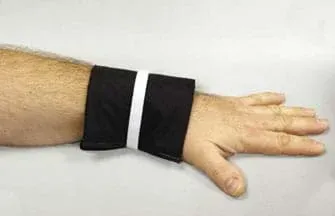 Aerogel insulation can assist in controlling and maintaining blood temperature and increasing blood flow to the hands and feet.Copyright NASA http://www.nasa.gov/images/content/661709main_aerogel2_full.jpg
Students experiment with a new material—aerogel. Aerogel is a synthetic (human-made) porous ultra-light (low-density) material, in which the liquid component of a gel is replaced with a gas. In this activity, student pairs use aerogel to simulate the environmental engineering application of cleaning up oil spills. In a simple and fun way, this activity incorporates density calculations, the material effects of surface area, and hydrophobic and hydrophilic properties.
Two major branches of engineering are threaded through this activity. Students learn how materials science engineers create new and amazing materials with desired properties, and how environmental engineers find aerogels helpful in cleaning up oil spills because of their high surface areas and strong hydrophobicity. Further, this activity touches on nanotechnology and engages students' math skills to determine the density of aerogel particles.
After this activity, students should be able to:
- Describe the nanoscale and nanotechnology.
- Explain that aerogels are often hydrophobic and used in a few special applications.
- Discuss the differences in hydrophobicity and density between water, oil and aerogel.
- 8B/M5 Efforts to find replacements for existing materials are driven by an interest in finding materials that are cheaper to obtain or produce or that have more desirable properties.
Grades 6-8
Do you agree with this alignment?
- Measure mass and volume, and use these quantities to calculate density
Grade 6
Do you agree with this alignment?
- Manufacturing systems use mechanical processes that change the form of materials through the processes of separating, forming, combining, and conditioning them.
Grades 6-8
Do you agree with this alignment?
- 6.P.2 Understand the structure, classifications and physical properties of matter.
Grade 6
Do you agree with this alignment?
Each group needs:
- 1 cup with ¼ cup of vegetable oil
- 1 glass with ½ cup of water
- 1 plastic spoon
- Aerogels in Action Worksheet, (PDF) one per student
To share with the entire class:
- 100 cc of millimeter-sized silica aerogel particles (Lumira® LA1000); available for $10 from Cabot Corporation at http://www.buyaerogel.com/product/lumira-aerogel-particles/
- 1 four-color box of liquid food dye (dropper style)
- soap, water and paper towels for cleanup
Conduct this activity after the associated lesson, The Amazing Aerogel.
Nano is a scientific term representing one-billionth of something (1/1,000,000,000 or 10-9). A nanometer is one-billionth of a meter. To put this in perspective, a sheet of paper is about 100,000 nanometers thick, a piece of human hair measures about 75,000 nanometers thick, and our fingernails grow one nanometer every second! So, the nanoscale is very small!
Nanotechnology uses materials at the nanoscale to take advantage of the properties that materials have at this small scale. This can often mean working with only a single molecule. Today, we are going to be working with a nanoscale material—aerogel!
We learned about the aerogel in our previous lesson (The Amazing Aerogel). What do you know about aerogels? (Listen to student responses.) One property we are going to study today is hydrophobicity. What does hydrophobic mean? (Hydrophobic is the property of a substance to repel water.) What is the opposite of hydrophobic? (Listen to student answers.) That's right, hydrophilic. Hydrophilic means having an attraction for water.
I'm sure you remember that another materials property of aerogels is that they are very lightweight. That means they have a low density. What does density mean? How do we calculate it? (Listen to student explanations.) That's right, density is equal to the mass of a material divided by its volume. To calculate the density of a material, we measure the mass and volume of the object, and then divide those values.
We also talked about some cool applications of aerogels. Who can name one? (Listen to several answers. Possible answers: NASA uses aerogel for its stardust collector, as well as spacecraft and spacesuit insulation. Other real-world uses include fire retardant and insulation materials used in vehicles, clothing, kitchens and home construction, as well as for medical equipment, cell phones, hair spray, sound insulation, shock absorption.) Another application is cleaning up oil spills. Who remembers hearing about the BP oil spill or the Exxon Valdez spill? What were some consequences of those oil spills? (Possible answers: Fish, birds and other animals were injured and killed due to the polluted ecosystems; the oil caused fires; industries that rely on the ocean, fishing and tourism were hurt, etc.) Oil spills are often difficult and extremely expensive to remediate or clean up. That's why engineers and scientists are researching how we might use aerogels to clean up some oil spills.
Knowing that aerogels are often hydrophobic, do you think they have an affinity or repulsion towards oil? Repulsion! That's right, because oil is also hydrophobic and like goes with like. Now, do oil and water mix? No? Why not? That's right! We just said it—it's hydrophobic! But which one is denser? Water is denser than oil, that's right! So this means when you try to mix oil and water, what happens? The oil sits on top of the water! This is similar to what happens in an oil spill in the ocean, just on a much larger scale. Now that you are experts on this topic, let's simulate oil spills and an environmental engineering clean-up effort.
Before the Activity
- Gather materials and make copies of the Aerogels in Action Worksheet (PDF), one per student.
- If possible, identify an outdoor location to conduct the activity, such as a pavilion or covered area. This activity can be done inside, but when used in small enclosures, the aerogels can make your throat dry, so try to conduct the activity in a location with good air exchange.
- Tip for how to correctly use the word "aerogel" in a sentence: In your mind, replace "aerogel" with the word "plastic" and think of how you would use that word in a similar context. For example: "plastics are useful materials" = "aerogels are useful materials," or "plastic has greatly impacted society" = "aerogel can greatly impact society." Source: http://www.aerogel.org/?p=3
With the Students
- Take the class outside, bringing the activity materials.
- Divide the class into groups of two students each.
- Have one student from each group get a cup containing some vegetable oil. Tell these students that they represent oil tankers, each carrying a supply of oil.
- Then have the second student from each group get a cup containing some water. Tell these students that they each represent a body of water, such as the ocean or a lake.
- Ask students for their predictions on the following questions: Will the liquids mix? Which liquid is denser? When combined, which will be on the top? Which will be on the bottom?
- Then go around to each group with the blue red and green liquid food coloring. Into each oil cup, add two or three drops of food coloring. (Alternatively, have the students help, going around with the other colors.) As you do this, ask the class: Is this liquid food coloring hydrophobic or hydrophilic? (It is hydrophilic.) Does it want to be with the oil or the water? Why?
- Have student pairs try to mix the food coloring into the oil by shaking, spinning and/or stirring. Direct them to make observations about what happens. Expect them to notice how the food coloring does not dissolve, but instead makes little bubbles of itself in the oil.
- Continue the hypothetical scenario by directing the "oil tanker students" to pretend to crash (perhaps they hit an iceberg or a whale or something fun) and "accidentally" spill the oil into the body of water (the cup of water). DO NOT HAVE STUDENTS STIR THE MIXTURE because if the food coloring is thoroughly mixed it will come out of the oil.
- Direct the students to observe what happens. Then ask them: Were your predictions correct? Do oil and water mix? Does the oil sit on top of the water?
- Continuing with the scenario, ask students to imagine the oil-contaminated water is an ocean or lake. We now have an environmental contamination problem. How might you remove the oil from the water to clean it up? This is a challenge that environmental engineers face all the time—water pollution. You cannot pour the oil off an entire ocean or huge lake, and you cannot scrape it off because the oil is too slippery and slimy.
- Walk around to each group with the aerogel particles. Into each group's food coloring-filled oil, pour about 2 tablespoons of aerogel particles. As you are distributing the aerogel, ask the students to make some predictions. Ask them: Will these aerogel particles like or repel the oil? Will the aerogel like or repel the food coloring? What do you think the food coloring is going to do? (After a few seconds, expect the coloring to begin to fall out of the oil.) Why do you think the food coloring responded like that? (The hydrophobic oil and aerogel are attractive, both repelling the food coloring, while the hydrophilic water and food coloring are attracted to each other.) Listen to student observations, questions and conclusions, leading a class discussion so students understand what is happening.
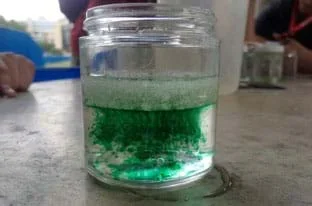 Since aerogel and oil are hydrophobic, they are attracted, while the hydrophilic food dye is pulled towards the water.Copyright 2014 Lauren Redfern, Duke University
 - Using plastic spoons, have students scoop the aerogel-oil mixture back into the cup the oil was in. The food coloring remaining in the water represents any hydrophilic material that may have been spilled with the oil.
- Direct students to clean up. Have them pour the water down the sink and throw the cups of oil into the trash.
- Hand out the worksheets for students to individually complete by the end of class or as homework.
- density
- The mass per unit volume.
- hydrophilic
- A property of a substance to have a strong affinity for water.
- hydrophobic
- A property of a substance to repel water.
- nanotechnology
- Science, engineering and technology conducted at the nanoscale, which is about 1 to 100 nanometers, or around 1 billionth of a meter. The challenge is to exploit the different materials properties that exist at this tiny scale.
Pre-Activity Assessment
Informal Review: Use the Introduction/Motivation section content to lead a class discussion to see what material students retained from the associated lesson that introduced aerogels. Example discussion questions:
- What is aerogel? (Answer: Aerogel is a synthetic [or human-made] porous ultra-light [low-density] material derived from a gel, in which the liquid component of the gel was replaced with a gas. Aerogel is typically made from silica and is more than 99% air.)
- What are some properties of aerogels? (Answer: They are low-density/lightweight; composite aerogel can be very strong, often hydrophobic; they are absorptive and have a high surface area.)
- What are some ways we use aerogels? (Answer: NASA uses them for stardust collection and insulation; environmental engineers use them to clean up oil spills; textile engineers use them in jackets and blankets because of their low thermal conductivity, etc.)
- What is density? (Answer: Mass per unit volume, M/V, mass divided by volume.)
Activity Embedded Assessment
Activity Participation: During the activity, watch to make sure students are participating and answering the questions. Encourage students to work with their partners and participate in the activity and discussion.
Post-Activity Assessment
Worksheet: Assign students to individually complete the Aerogels in Action Worksheet (PDF), turning it in for grading. Review their answers to assess their depth of comprehension of the subject matter.
Avoid aerogel contact with the mouth and eyes, as it can be irritating to the respiratory tract. Refer to the full MSDS for Lumira® LA1000 at http://www.cabotcorp.com/solutions/products-plus/aerogel/particles.
For lower grades:
- Provide more in-depth explanations and examples of density and hydrophobicity.
- Have students work in groups of three: one representing a body of water, one as the oil tanker and one as the environmental engineering clean-up crew (oil scooper).
For upper grades:
- Have students work individually.
- Provide quicker-paced, less in-depth explanations for density and hydrophobicity.
- Ask students to name example materials that are highly dense (such as iron and lead) and low in density (such as air, packing peanuts and cotton candy).
- Ask students to name other materials that are extremely hydrophobic (such as cooking grease, candle wax and lotus leaves) and hydrophilic (such as water, milk, wood).
What is aerogel? What are aerogels made of? Special properties of aerogels. Aerogel.org. Accessed November 11, 2014. (Excellent photos and explanations) http://www.aerogel.org/?p=3
- The Amazing Aerogel
- Aerogels in Action
Contributors
Lauren K. Redfern; Osman Karatüm; Claudia K. Gunsch; Desiree L. Plata
Supporting Program
Department of Civil and Environmental Engineering, Pratt School of Engineering, Duke University
Acknowledgements
This curricular content was developed in the Department of Civil and Environmental Engineering in the Pratt School of Engineering with funding from Duke University.
Copyright
2014 by Regents of the University of Colorado; original © 2014 Duke University