
The Amazing Aerogel
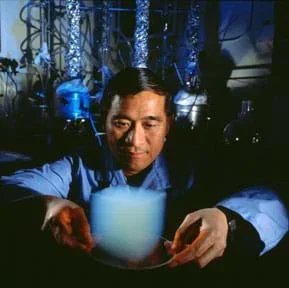 Aerogel is the lightest known solid.Copyright Jet Propulsion Laboratory, NASA http://stardust.jpl.nasa.gov/photo/aerogel.html
Aerogel, commonly called "frozen smoke," is a super-material with some amazing properties. In this lesson and its associated activity, students learn about this silicon-based solid with a sponge-like structure. Students also learn about density and how aerogel is 99.8% air by volume, making it the lightest solid known to humans! Further, students learn about basic heat transfer and how aerogel is a great thermal insulator, having 39 times more insulation than the best fiberglass insulation. Students also learn about the wide array of aerogel applications.
The man who invented aerogel, Samuel Stephens Kistler, was a chemical engineer who published his findings in a 1931 edition of the journal, Nature. Since then, his discovery has been applied to a wide variety of uses: NASA's aeronautical engineers use aerogel to bring home pieces of comets and dust from outer space, biomedical engineers use aerogel bands to control and maintain people's blood temperatures, and environmental engineers use aerogel to clean up oil and chemical spills. Creative engineers of many specialties take advantage of the extreme properties of the aerogel—high surface area, low density, low thermal conductivity, robustness, etc.—to best suit their designs.
After this lesson, students should be able to:
- Explain the distinctions between transmitting, reflecting and absorbing light waves.
- Describe the differences between opaque, translucent and transparent materials.
- Relate an aerogel property to a new engineering application or idea.
- 8B/M5 Efforts to find replacements for existing materials are driven by an interest in finding materials that are cheaper to obtain or produce or that have more desirable properties.
Grades 6-8
Do you agree with this alignment?
- Measure mass and volume, and use these quantities to calculate density
Grade 6
Do you agree with this alignment?
- Students will develop an understanding of the relationships among technologies and the connections between technology and other fields of study.
Grades K-12
Do you agree with this alignment?
- MS-PS4-2 Develop and use a model to describe that waves are reflected, absorbed, or transmitted through various materials.
Grades 6-8
This resource focuses on the following Three Dimensional Learning aspects of NGSS:
Science & Engineering Practices- Develop and use a model to describe phenomena.Do you agree with this alignment?
Disciplinary Core Ideas- A sound wave needs a medium through which it is transmitted.Do you agree with this alignment?
- When light shines on an object, it is reflected, absorbed, or transmitted through the object, depending on the object's material and the frequency (color) of the light.Do you agree with this alignment?
- The path that light travels can be traced as straight lines, except at surfaces between different transparent materials (e.g., air and water, air and glass) where the light path bends.Do you agree with this alignment?
- A wave model of light is useful for explaining brightness, color, and the frequency-dependent bending of light at a surface between media.Do you agree with this alignment?
- However, because light can travel through space, it cannot be a matter wave, like sound or water waves.Do you agree with this alignment?
Crosscutting Concepts- Structures can be designed to serve particular functions by taking into account properties of different materials, and how materials can be shaped and used.Do you agree with this alignment?
Do you agree with this alignment? - Develop and use a model to describe phenomena.
- 6.P.2 Understand the structure, classifications and physical properties of matter.
Grade 6
Do you agree with this alignment?
This lesson provides an introduction to aerogel—a diverse class of porous, solid materials that exhibit an array of extreme materials properties. The content presented to students highlights the unique aerogel properties, focusing on density (mass per unit volume) and low thermal conductivity (resistance to temperature change; insulation). The lesson also reviews the difference between transparency, translucency and opaqueness and how the absorption, reflection or transmission of light waves is related to this. The pertinent lesson information is provided below and in the PowerPoint® notes; additional information may be found at the websites listed in the Additional Multimedia Support section.
In advance, make copies of the Aerogel Worksheet (PDF), one per student, and prepare to show the class the 16-slide Aerogel Presentation (PPTX).
The following steps are suggested for teaching this lesson:
- With the PowerPoint® up, present the Introduction/Motivation section to students to introduce aerogels and begin the presentation.
- Lead a discussion and lecture, as guided by the presentation. To help with the presentation, each slide has notes on the bottom; the same slide notes are provided below.
- Assign students to individually complete the worksheet.
- Have students share and discuss their ideas for aerogel applications with the rest of the class, relating the properties of the aerogel to practical applications, as engineers would.
Tip for how to correctly use the word "aerogel" in a sentence: In your mind, replace "aerogel" with the word "plastic" and think of how you would use that word in a similar context. For example: "plastics are useful materials" = "aerogels are useful materials," or "plastic has greatly impacted society" = "aerogel can greatly impact society." Source: http://www.aerogel.org/?p=3
Presentation Slide Notes
(slide 1) Introduce aerogels to the class, as outlined in the Introduction/Motivation section.
(slide 2) Aerogels are created by removing moisture from a gel while maintaining the gel structure. (For more advanced students: Aerogels are synthesized by removing moisture from a highly porous gel structure [commonly silica] and replacing the liquid with air or carbon dioxide.) So aerogel is a porous solid that is mostly air—more than 99% air. Aerogel is commonly a silica-based solid, often with the chemical formula, SiO2 Do you know any other silica-based solids? (One common silica-based solid is sand, such as common beach sand.) In addition to those made of silica, other types of aerogels have been created, such as graphene and polyimide aerogels, and increasingly polymer-composite aerogels, which are aerogels mixed with a polymer. Though ghostly in appearance, aerogel is very solid and feels like hard Styrofoam to the touch.
(slide 3) Aerogels have very high surface areas. Surface area is the total area of the surface of a three-dimensional object. How would you calculate the surface area of a cube with two-inch edge-length sides? (The surface area of a cube is 6 × [edge length]2.)
(slide 4) Aerogels are known for their extreme low densities, which range from 0.0011 to ~0.5 g cm-3. What is density? Density is mass divided by volume. What are some examples of high- and low-density objects? The lowest density solid materials that have ever been produced are all aerogels!
(slide 5) Aerogels are often very hydrophobic. What do we mean by hydrophobic and hydrophilic? Tip: Consider the root words hydro- and phobic/phillic. Hydrophobic is a property of a substance to repel water, while hydrophilic is having a strong affinity for water. What are some examples? Refer to the Aerogels in Action activity to have students investigate the interaction between some aerogels and liquids and relevant clean up procedures. The photograph on the slide shows a drop of dew on a leaf; the surfaces of many leaves are hydrophobic.
(slide 6) What do we mean by transparency? Transparency is "the property of transmitting light through a substance so the objects situated beyond or behind can be distinctly seen." What are some examples of other materials and objects that are transparent? (Examples: Eyeglass lenses, drinking glasses, window glass, microscope lenses, thin films, etc.)
Before moving to the next slide (about translucency), ask students: What is the material characteristic that permits light to pass through, but diffuses the light? (See if anyone answers correctly: translucency.)
(slide 7) Like transparency, light is able to pass through the surface. Unlike transparency, the light is diffused. The aerogel shown is translucent. Other examples are stained glass and foggy bathroom windows.
What do we mean by opaque? Opaque surfaces are not transparent or translucent, meaning all the light waves are either absorbed or reflected, and no light waves are transmitted. So you cannot see through opaque materials.
(slide 8) Basic silica aerogels are often brittle and easily broken, so aerogel composites are often created to improve their characteristics to be more desirable.
(slide 9) Notice in this photograph a piece of polyimide aerogel under the front wheel; it can withstand the weight of a car without being crushed. The new polyimide aerogels are designed to be much stronger—500 times stronger than conventional (more brittle) silica aerogels. This type of aerogel composite—a mixture of an aerogel and another compound—is strong, flexible and foldable.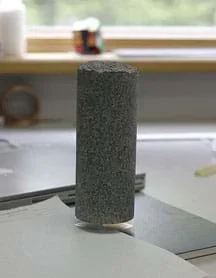 A two-inch square block of aerogel holds up a 4-kilogram cylinder of granite with no apparent deformation.Copyright 2006 Rich Kaszeta, Wikimedia Commons http://commons.wikimedia.org/wiki/File:Two_inch_square_block_of_Aerogel_(500_mg_in_mass)_holding_up_a_4_kg_cylinder_of_Granite.jpg
(slide 10) This photo illustrates the excellent insulating properties of aerogel. An aerogel blanket held over a blue flame remains cool to the touch and keeps the crayons from melting. This is because aerogels have very low thermal conductivity. That means they resist temperature change. For this reason, aerogels are often used as insulators. What are your ideas about where aerogels could be used for insulation purposes? (Possible answers: Beverage thermos, winter jacket, pipe insulation, etc.) Aerogel provides 39 times more insulation than the best fiberglass insulation.
(slide 11) Aerogels are often mixed with various compounds to create composite aerogels, which may help to strengthen the aerogel or emit light, as in the photograph. These pieces of silica aerogel have been coated with nanoparticles using chemical vapor methods. The composites emit red light when excited with ultraviolet light.
(slide 12) Aerogels have little particles or bubbles in them that scatter light. The term for this is "Rayleigh scattering," which is defined as the elastic scattering of light by particles much smaller than the wavelength of light. As you can see in the graph on the screen, the highest percentage of scattering due to sunlight is in the blue range.
(slide 13) The sky, glaciers and some aerogels all have tiny particles or bubbles in them that scatter light; blue scatters the most, making them appear bluish.
(slide 14) From all the remarkable materials properties exhibited by different types of aerogels, you can imagine that aerogels have been used and imagined for all sorts of applications. For example, since aerogels have very good insulation properties, they are used for thermal insulation in jackets, space suits, the Mars Rover and many other home, construction and automotive applications.
(slide 15) Aerogels are also used to clean up chemical and oil spills.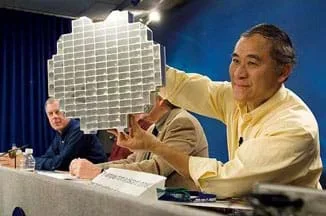 A stardust collector made with aerogels was designed to collect dust samples in outer space.Copyright 2006 NASA http://www.nasa.gov/mission_pages/stardust/multimedia/jsc2006e01800.html
(slide 16) Stardust are the grains of dust formed around stars that pre-date our sun. Stardust travels more than 10,000 mph, explodes on impact with solids and zips through gases. So to collect these flying particles, NASA designed a stardust collector (left image) composed of aerogel blocks held in a device placed on a spacecraft; the aerogel traps the streams of interstellar dust encountered in space. When a particle hits the aerogel block, it buries itself in the material, creating a carrot-shaped track up to 200 times its own length (right image). The aerogel material slows down the sample and brings it to a gradual stop without damaging it. Since the aerogel used is mostly transparent—with a distinctive smoky blue cast—researchers can follow the little paths to find the tiny particles. Examination of the dust helps researchers investigate the origin of our Solar system.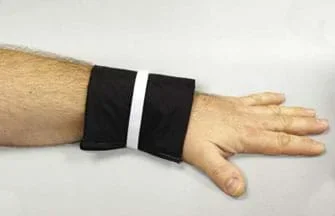 Aerogel insulation can assist in controlling and maintaining blood temperature and increasing blood flow to the hands and feet—a medical application.Copyright NASA http://www.nasa.gov/images/content/661709main_aerogel2_full.jpg
Ask students to start thinking of their own ideas for good purposes to use aerogels. Hand out the worksheets and direct students to individually complete them.
(Pull up the first slide of the Aerogel Presentation (PPTX), a Microsoft PowerPoint® file.)
Aerogel, sometimes called "frozen smoke," is a super-material with some awesome properties.
(Show students the aerogel photographs on slide 1.) By looking at these pictures, does anyone have any ideas about what some aerogel properties might be? For instance, do you think aerogels are heavy or light? Do you think that aerogels are strong or do you think they break easily? (Listen to student ideas. If participation is low, ask students to raise their hands if they think it is heavy, and then again for light.)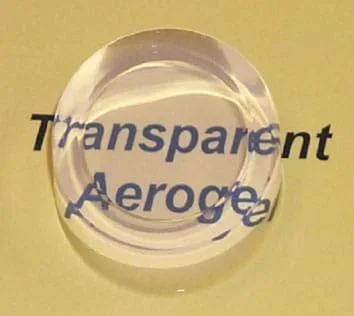 NASA uses transparent aerogel for many purposes, including thermal protection and space dust collection.Copyright NASA http://spinoff.nasa.gov/spinoff2001/ch5.html
Well, for those of you who guessed that it is lightweight, you are right! It's extremely light because it is mostly air. In fact, some aerogels are 99.8% air!
Aerogel is also a great thermal insulator. Does anyone know what I mean by that? (Listen to student responses.) Right! It means that it resists changes in temperature, like a thermos or coffee mugs that keeps your drink cold or hot for a long time. In fact, aerogels can provide up to 39 times more insulation than the best fiberglass insulation.
Today we will explore some additional awesome properties of aerogels and we will look at how engineers use aerogels in a wide variety of applications.
- absorb
- To take up or receive by molecular or chemical reaction; to incorporate; to occupy or fill.
- density
- The mass per unit volume.
- opaque
- The property of being impenetrable by visible light; thus, having neither transparent (allowing all light to pass through) nor translucent (allowing some light to pass through) properties. Example: a mirror.
- reflect
- To cast back from a surface (light, heat, sound, etc.).
- translucent
- The property of permitting light to pass through, but diffusing it. Example: stained glass.
- transmit
- To send or forward, as to a recipient or destination; dispatch; convey.
- transparent
- The property of transmitting light through a substance so the objects situated beyond or behind can be distinctly seen. Example: clear glass.
Pre-Lesson Assessment
Informal Discussion: Lead a class discussion on various materials and materials engineering. Ask students:
- For what purposes do we use different materials? (Example answers: We use plastic for storing food and metal to create cars and bicycles.)
- What are some reasons plastics are so widely used? (Answers: Plastics are inexpensive, light and durable. They are easy to make and versatile.)
- Why is cotton such a large industry? What are its material properties? (Answers: It is easy to grow and harvest; it is lightweight and gentle on the skin; it is easy to clean, etc.)
- Can you think of any materials that have advantageous properties? (Possible answers: Aluminum's lightness and strength, glass' transparency, Teflon's repellency, silk's softness, Styrofoam's thermal insulation, sponge's absorbency, graphene's strength, etc.)
- Why do we use these materials? (Answers: Various reasons, which might include look, feel, weight, smell, availability, cost, etc. Ask students to explain their answers.)
- What materials do you think we use to build rocket ships? Or the international space station? Or submarines? (Answers: We use steel to withstand the heat, aerogels for their lightness, plastics for their cost and versatility, etc., matching the materials properties to the needs in any given situation.)
- Can you think of any other items that might be made with special materials?
Lesson Summary Assessment
Worksheet: After the presentation, assign students to individually complete the five-question Aerogel Worksheet (PDF). Review students' answers to gauge their understanding of the lesson subject matter.
Class Discussion: As a class, have students share and discuss their ideas for aerogel applications (worksheet question 5). Ask students to constructively comment on other students' ideas for aerogel applications.
- What are some drawbacks to aerogels? (Answers: The early aerogels were all cloudy; now they can be made to be transparent. Some aerogels were brittle; now they can be made to be more flexible and stronger. The chemistry and manufacturing process is expensive and has the potential for explosions. Through ongoing research and testing, the technology continues to address these issues to suit different purposes.)
- What direction do they think aerogel research should take?
- Can you find any aerogel projects for sale from places like Target or Amazon? What types of products might be sold by these vendors? (This may require some research. Examples: fire-retardant materials in ovens, grills and furnaces; insulation in automobile parts, kitchen appliances, and home construction such as pipes and ducts, etc.)
Assign students to conduct Internet research on aerogel-containing products. Ask them to each write-up and share with the class one interesting aerogel application, describing how the aerogel properties contribute to the product benefits. Examples: Hairspray; medical products such as wrist wraps; cell phones; tennis racquets; military use; fire retardants; thermal insulation in vehicle parts, clothing, footwear, kitchens and home construction; water absorption; shock absorption; sound insulation.
For an in-depth article about aerogels, including photographs, see the HowStuffWorks website at http://science.howstuffworks.com/aerogel.htm
For more photographs of different forms of aerogels, see this NASA website at http://stardust.jpl.nasa.gov/photo/aerogel.html
For excellent photographs and explanations (What is aerogel? What are aerogels made of? Special properties of aerogels, etc.), see the Aerogel.org website at http://www.aerogel.org/?p=3
Aerogel | World's Lightest Material | Aerogel Lighter than Air | Aerogel Insulation. September 29, 2014. Mechanical Engineering: A Complete Online Guide for Mechanical Engineers. (Good description about properties and example applications) Accessed November 13, 2014. http://www.mechanicalengineeringblog.com/tag/carbon-aerogel/
Harrod, Horatia. "Inside the Materials Library." April 22, 2013. The Telegraph. Accessed November 13, 2014. http://www.telegraph.co.uk/science/10000305/Inside-the-Materials-Library.html
Woods, Tori. Aerogels: Thinner, Lighter, Stronger. Last updated September 20, 2013. SGT Inc., Glenn Research Center, NASA. Accessed November 7, 2014. http://www.nasa.gov/topics/technology/features/aerogels.html#.VF2Dh_nF-Sp
- The Amazing Aerogel
Scaling for lower grades:
- Provide more in-depth explanations of density, thermal insulation and mechanical robustness.
- Have students work in groups to complete the worksheet.
- Go through the presentation more thoroughly, providing more explanations at each slide.
- Focus more on vocabulary and review the concepts presented before moving on to conduct the activity.
Contributors
Lauren K. Redfern; Osman Karatüm; Claudia K. Gunsch; Desiree L. Plata
Supporting Program
Department of Civil and Environmental Engineering, Pratt School of Engineering, Duke University
Acknowledgements
This curricular content was developed in the Department of Civil and Environmental Engineering in the Pratt School of Engineering with funding from Duke University.
Copyright
2014 by Regents of the University of Colorado; original © 2014 Duke University