
Buoyant Boats
Students conduct a simple experiment to see how the water level changes in a beaker when a lump of clay sinks in the water and when the same lump of clay is shaped into a bowl that floats in the water. They notice that the floating clay displaces more water than the sinking clay does, perhaps a surprising result. Then they determine the mass of water that is displaced when the clay floats in the water. A comparison of this mass to the mass of the clay itself reveals that they are approximately the same.
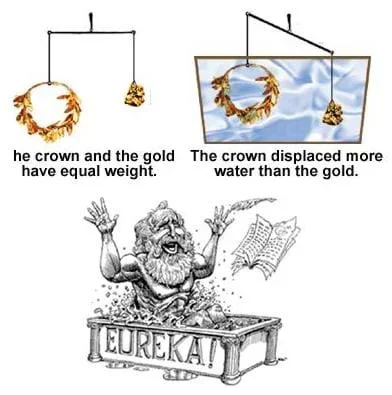 Archimedes was a great mathematician and scientist who was born in 287 BC. It is said that while taking a bath one day, he got the idea for using the displacement of water to compare the densities of objects. In particular, he was able to use this method to determine that a crown made for the king did not contain the full amount of gold that it should have.Copyright Sandia National Laboratories http://www.sandia.gov/tp/SAFE_RAM/AP.HTM
When designing boats and ships, engineers must determine the total amount of water displaced when. They also apply the same concept when designing waterways in order to determine the maximum sized boat that can pass through a human-made waterway such as the Panama Canal.
- Students will be able to describe a means to make a material that is denser than water (modeling clay) float.
- Students will be able to describe the parallels between the design process used to create a dense but floatable object, and the scientific method of inquiry.
- CCSS.Math.Content.8.G.C.9 Know the formulas for the volumes of cones, cylinders, and spheres and use them to solve real-world and mathematical problems.
Grade 8
Do you agree with this alignment? - CCSS.Math.Content.HSG-GMD.A.3 Use volume formulas for cylinders, pyramids, cones, and spheres to solve problems.
Grades 9-12
Do you agree with this alignment? - CCSS.Math.Content.HSG-MG.A.1 Use geometric shapes, their measures, and their properties to describe objects (e.g., modeling a tree trunk or a human torso as a cylinder).
Grades 9-12
Do you agree with this alignment?
- Students will develop an understanding of the relationships among technologies and the connections between technology and other fields of study.
Grades K-12
Do you agree with this alignment? - STEL-7W Determine the best approach by evaluating the purpose of the design.
Grades 9-12
Do you agree with this alignment?
- MS-PS2-2 Plan an investigation to provide evidence that the change in an object's motion depends on the sum of the forces on the object and the mass of the object.
Grades 6-8
This resource focuses on the following Three Dimensional Learning aspects of NGSS:
Science & Engineering Practices- Plan an investigation individually and collaboratively, and in the design: identify independent and dependent variables and controls, what tools are needed to do the gathering, how measurements will be recorded, and how many data are needed to support a claim.Do you agree with this alignment?
- Science knowledge is based upon logical and conceptual connections between evidence and explanations.Do you agree with this alignment?
Disciplinary Core Ideas- The motion of an object is determined by the sum of the forces acting on it; if the total force on the object is not zero, its motion will change. The greater the mass of the object, the greater the force needed to achieve the same change in motion. For any given object, a larger force causes a larger change in motion.Do you agree with this alignment?
- All positions of objects and the directions of forces and motions must be described in an arbitrarily chosen reference frame and arbitrarily chosen units of size. In order to share information with other people, these choices must also be shared.Do you agree with this alignment?
Crosscutting Concepts- Explanations of stability and change in natural or designed systems can be constructed by examining the changes over time and forces at different scales.Do you agree with this alignment?
Do you agree with this alignment? - Plan an investigation individually and collaboratively, and in the design: identify independent and dependent variables and controls, what tools are needed to do the gathering, how measurements will be recorded, and how many data are needed to support a claim.
- CCSS.Math.Content.8.G.C.9 Know the formulas for the volumes of cones, cylinders, and spheres and use them to solve real-world and mathematical problems.
Grade 8
Do you agree with this alignment? - CCSS.Math.Content.HSG-GMD.A.3 Use volume formulas for cylinders, pyramids, cones, and spheres to solve problems.
Grades 9-12
Do you agree with this alignment? - CCSS.Math.Content.HSG-MG.A.1 Use geometric shapes, their measures, and their properties to describe objects (e.g., modeling a tree trunk or a human torso as a cylinder).
Grades 9-12
Do you agree with this alignment?
Each group needs
- balance, accurate to at least 0.1 g (such as a triple beam balance)
- 500-ml beaker
- 50- or 100-ml graduated cylinder
- modeling clay, one-half stick (50-60 grams)
- pan or tray to catch water that overflows from the beaker during the displacement process
- (optional) funnel, helps to limit the amount of spilled water
- 1-2 sponges and/or dishrags for wiping up drips and spills
- fine-point permanent marker or grease pencil, to write on the beaker; alternative: transparent tape that can be written on with a pencil
- several paper towels
- access to water and a sink
Completion of the Floaters and Sinkers lesson and its associated activity, Determining Densities.
Remember back to the density experiments you completed earlier. What happened when you put an object, such as a lump of clay, into a full beaker of water? (Listen to student responses.) That's right, the water spilled over the top of the beaker. Why did this happen? (Listen to student responses.) That's right, in in order for the clay to enter the water, it had to push some of the water out of the way, or displace it. The only place the displaced water could go was up and over the top of the beaker. How much water spilled over? (Listen to student answers.) The amount of displaced water equaled the volume of the lump of clay.
Think back to the Clay Boats activity. You took a lump of clay and shaped it so that it floated on top of the water. Since the clay was denser than the water in both situations, why was it able to float when it was molded into a bowl-like shape? Today you will attempt to answer that question by taking a closer look at the relationship between floating objects and displaced water. By studying buoyancy, we will also learn about how forces acting on an object must be balanced when the object is at rest.
- Gather materials and make copies of the Instructions for Students Handout (PDF).
- Divide the class into teams of three to four students each.
- Provide groups with materials and handouts.
- Oversee the groups as they conduct the activity, guided by the handout instructions.
- Determine and record the clay lump's mass.
- Find and record the clay lump's volume.
- Fill a 500-ml beaker about three-quarters full of water. Mark on the outside of the beaker the water level.
- Without splashing any water, lower your lump of clay into the beaker. Make a new mark to show the new water level.
- Without overflowing the water in the beaker, remove the clay and pat it dry with a paper towel. Shape the clay into a boat shape that your team thinks will float inside the beaker. Before putting the clay in the water, predict where you think the new water level will be by drawing a short, dashed line on the outside of the beaker.
- Carefully place the clay boat on the water surface. Mark the new water level. What happened? How close was your prediction to the actual water level?
- Find and record the volume of the water displaced by the clay boat.
- Find and record the mass of the water displaced by the clay boat.
- Compare the volumes and masses of the displaced water to the volumes and masses of the original clay lump.
- Squash your clay boat back into a lump and remove about one-quarter of the clay. Set it aside. Using the remaining clay (the larger portion), repeats the procedure again.
- When you repeated the steps with a smaller lump of clay, did you get similar results?
- Draw a diagram of the sum of the forces on the clay. Just think about forces in the up and down directions. If gravity is pulling the boat down, what is pushing it up? If these forces are equal, will the boat float? What if these forces are not equal?
- Conclude by leading a class discussion and giving a quiz, as described in the Assessment section.
- density
- The mass per unit volume of a substance at a given pressure and temperature.
- buoyancy
- The ability to float in a liquid (or rise in a gas).
Concluding Discussion: Lead a class discussion in which students share and compare their results, observations, conclusions and questions. Ask the Investigating Questions. Use this opportunity to assess students' understanding of the experiment and concepts.
Quiz: In the form of a quiz or written assignment, ask students to predict the weight of water that would be displaced by an empty canoe weighing 120 pounds. Assume the canoe is afloat. Also, ask if the amount of water displaced by the same canoe would increase or decrease if the canoe tipped over, filled with water and sank. Have students draw diagrams of the sum of the forces acting on the canoe in both the floating and sinking examples. Review students' answers to gauge their comprehension.
See the Extension Activities section provided in the associated lesson for similar experiments students can conduct to explore the differences between buoyancy in fresh and salt water, and warm and cold water.
Contributors
Mary R. Hebrank
Supporting Program
Engineering K-PhD Program, Pratt School of Engineering, Duke University
Acknowledgements
This content was developed by the MUSIC (Math Understanding through Science Integrated with Curriculum) Program in the Pratt School of Engineering at Duke University under National Science Foundation GK-12 grant no. DGE 0338262. However, these contents do not necessarily represent the policies of the NSF, and you should not assume endorsement by the federal government.
This activity was originally published, in slightly modified form, by Duke University's Center for Inquiry Based Learning (CIBL). Please visit http://ciblearning.org/ for information about CIBL and other resources for K-12 science and math teachers.
Copyright
2013 by Regents of the University of Colorado; original © 2004 Duke University