
Floaters and Sinkers
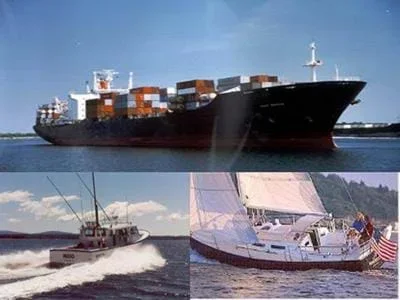 The ability to design boats that float enhances our abilities to transport cargo, catch fish, and enjoy recreational activities.Copyright NOAA http://www.sarsat.noaa.gov/images/boats.jpg
In the first lesson, Floaters and Sinkers, students gain an intuitive understanding of density by comparing objects of equal volumes but different masses. They use different methods to determine the densities of solid objects, including water displacement to determine volumes of irregularly-shaped objects. By comparing densities of various solids to the density of water and considering the behavior of different solids when placed in water, students conclude that objects with densities greater than water usually sink while those with densities less than water float. Through the associated activity, Determining Densities, students learn to determine densities of objects and depict their results graphically (mass vs. volume). They use two different methods to determine the densities of a variety of materials and objects, some of simple geometric shapes (direct measurement of volume) and others irregularly-shaped (water displacement). Results reveal that objects with densities less than water (floaters) lie above the graph's diagonal line while those with densities greater than water (sinkers) lie below the diagonal.
Next, students complete the Clay Boats activity, which challenges them to design and build boats from modeling clay (a material that normally sinks in water) that are able to carry as much weight as possible. After discussing their observations and conclusions, students complete the Buoyant Boats activity, in which they conduct a simple experiment to see how the water level changes in a beaker when a lump of clay sinks in the water and when the same lump of clay is shaped into a bowl that floats. The surprising observation is that the floating clay displaces more water than the sinking clay. Comparing the mass of water that is displaced when the clay floats to the mass of the clay itself reveals that they are about the same. These activities prepare students to receive the content material of the second lesson, What Floats Your Boat?, giving them a full understanding of the principle of buoyancy and Archimedes' principle.
Density is a scientific property that is important in many materials engineering applications. In this unit, students experience engineering by designing boats to float with various amounts of weight.
- CCSS.Math.Content.HSG-GMD.A.3 Use volume formulas for cylinders, pyramids, cones, and spheres to solve problems.
Grades 9-12
Do you agree with this alignment?
- MS-PS2-2 Plan an investigation to provide evidence that the change in an object's motion depends on the sum of the forces on the object and the mass of the object.
Grades 6-8
This resource focuses on the following Three Dimensional Learning aspects of NGSS:
Science & Engineering Practices- Plan an investigation individually and collaboratively, and in the design: identify independent and dependent variables and controls, what tools are needed to do the gathering, how measurements will be recorded, and how many data are needed to support a claim.Do you agree with this alignment?
- Science knowledge is based upon logical and conceptual connections between evidence and explanations.Do you agree with this alignment?
Disciplinary Core Ideas- The motion of an object is determined by the sum of the forces acting on it; if the total force on the object is not zero, its motion will change. The greater the mass of the object, the greater the force needed to achieve the same change in motion. For any given object, a larger force causes a larger change in motion.Do you agree with this alignment?
- All positions of objects and the directions of forces and motions must be described in an arbitrarily chosen reference frame and arbitrarily chosen units of size. In order to share information with other people, these choices must also be shared.Do you agree with this alignment?
Crosscutting Concepts- Explanations of stability and change in natural or designed systems can be constructed by examining the changes over time and forces at different scales.Do you agree with this alignment?
Do you agree with this alignment? - Plan an investigation individually and collaboratively, and in the design: identify independent and dependent variables and controls, what tools are needed to do the gathering, how measurements will be recorded, and how many data are needed to support a claim.
- SEP.2.6-8.1 Ask questions that can be investigated within the scope of the classroom, outdoor environment, and museums and other public facilities with available resources and, when appropriate, frame a hypothesis based on observations and scientific principles.
Grades 6-8
Do you agree with this alignment?
- Day 1-3: Floaters and Sinkers lesson
- Day 4-5: Determining Densities activity
- Day 6-8: What Floats Your Boat? lesson
- Day 9: Clay Boats activity
- Day 10: Buoyant Boats activity
Contributors
Mary R. Hebrank
Supporting Program
Engineering K-Ph.D. Program, Pratt School of Engineering, Duke University
Acknowledgements
This content was developed by the MUSIC (Math Understanding through Science Integrated with Curriculum) Program in the Pratt School of Engineering at Duke University under National Science Foundation GK-12 grant no. DGE 0338262. However, these contents do not necessarily represent the policies of the NSF, and you should not assume endorsement by the federal government.
The lessons and activities in this curricular unit were originally published, in slightly modified form, by Duke University's Center for Inquiry Based Learning (CIBL). Visit http://ciblearning.org/ for information about CIBL and other resources for K-12 science and math teachers.
Copyright
2013 by Regents of the University of Colorado; original © 2004 Duke University