
Lights On Demo & Build! Intro to Simple Circuits
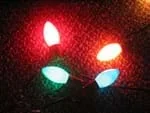 Christmas lights.Copyright 2004 Duke University
Students are introduced to circuits through a teacher demonstration using a set of Christmas lights. Then student groups build simple circuits using batteries, wires and light bulbs. They examine how electricity is conducted through a light bulb using a battery as a power source. Students also observe the differences between series and parallel circuits by building each type.
This introduction to circuits also serves as an introduction to electrical engineering since every electrical device has a circuits designed by electrical engineers.
After this activity, students should be able to distinguish the difference between a parallel circuit and a series circuit.
- The process of experimentation, which is common in science, can also be used to solve technological problems.
Grades 3-5
Do you agree with this alignment? - Select and safely use tools, products, and systems for specific tasks.
Grades 3-5
Do you agree with this alignment? - STEL-2G Illustrate how, when parts of a system are missing, it may not work as planned.
Grades 3-5
Do you agree with this alignment? - STEL-3C Demonstrate how simple technologies are often combined to form more complex systems.
Grades 3-5
Do you agree with this alignment? - STEL-8D Follow directions to complete a technological task.
Grades 3-5
Do you agree with this alignment?
- 3-5-ETS1-1 Define a simple design problem reflecting a need or a want that includes specified criteria for success and constraints on materials, time, or cost.
Grades 3-5
This resource focuses on the following Three Dimensional Learning aspects of NGSS:
Science & Engineering Practices- Define a simple design problem that can be solved through the development of an object, tool, process, or system and includes several criteria for success and constraints on materials, time, or cost.Do you agree with this alignment?
Disciplinary Core Ideas- Possible solutions to a problem are limited by available materials and resources (constraints). The success of a designed solution is determined by considering the desired features of a solution (criteria). Different proposals for solutions can be compared on the basis of how well each one meets the specified criteria for success or how well each takes the constraints into account.Do you agree with this alignment?
Crosscutting Concepts- People's needs and wants change over time, as do their demands for new and improved technologies.Do you agree with this alignment?
Do you agree with this alignment? - Define a simple design problem that can be solved through the development of an object, tool, process, or system and includes several criteria for success and constraints on materials, time, or cost.
- 3.P.3 Recognize how energy can be transferred from one object to another.
Grade 3
Do you agree with this alignment? - 4.P.3.1 Recognize the basic forms of energy (light, sound, heat, electrical, and magnetic) as the ability to cause motion or create change.
Grade 4
Do you agree with this alignment? - 7.P.2 Understand forms of energy, energy transfer and transformation and conservation in mechanical systems.
Grade 7
Do you agree with this alignment? - 7.P.2.3 Recognize that energy can be transferred from one system to another when two objects push or pull on each other over a distance (work) and electrical circuits require a complete loop through which an electrical current can pass.
Grade 7
Do you agree with this alignment?
- 1 set of Christmas lights (a string of lights)
- 1 alkaline lantern battery per group, 6 volt size
- 6 alligator clips or wires
- 2 to 3 light bulbs per group, whatever size fits into the light bulb holder
- 1 light bulb holder per light bulb; available at electronics stores or online at www.hometrainingtools.com
Plug the string of lights into an electrical outlet and explain how electrical current flows through the circuit to make the lights work. Refer to the associated lesson for background information to help with this.
Have students each take out a light bulb from the string of lights to see how current flows to the light bulb through the metal wires on the side of the light.
Screw the light bulbs into the light bulb holders.
Build a simple circuit using one battery, two alligator clips, and a light bulb.
- Attach one end of an alligator clip to the positive terminal of a battery.
- Then, take the other end of the clip and attach it to one side of the light bulb holder's conducting material (typically this is another piece of metal).
- Take another alligator clip and attach one end to the other side of the light bulb holder's conducting material.
- Finally, attach the free end of the second alligator clip to the negative terminal of the battery to complete the circuit.
Now using the diagram below as a guide, build a series circuit.
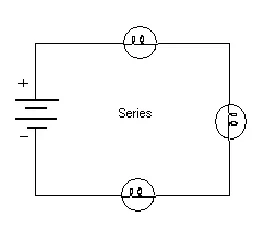 An example series circuit.Copyright 2004 Wendy Lin, Duke University
Now, using the diagram below, try to build a parallel circuit.
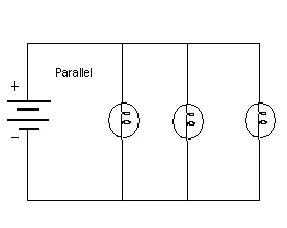 An example parallel circuit.Copyright 2004 Wendy Lin, Duke University
- circuit
- A path through which electrical current can flow.
- circuit diagram
- An illustrative picture used to explain the paths through which electricity can flow.
- conductor
- A material that allows for electrical current to flow.
- current
- The flow of electrons through a condutor.
- electricity
- A source of power generated from the flow of electrical current.
- electron
- A small, atomic particle with a negative charge.
- energy
- The ability to do work.
Descriptions: Have students briefly describe the differences between parallel and series circuits.
Drawings: Have students draw simple sketches of parallel and series circuits.
Make sure the Christmas lights are not plugged into an outlet while students are trying to remove the bulbs from the circuit.
Make sure the batteries are new.
Make sure that no lights are broken.
Make sure that all the wires are securely attached to each connection point to avoid gaps in the connections (short circuits).
For students who have a good understanding of how to build circuits, have them build combination series and parallel circuits.
Harris, Tom. How Light Bulbs Work. Posted February 19, 2002. How Stuff Works. Accessed June 15, 2004. http://science.howstuffworks.com/light-bulb.htm
Comparing Parallel and Series Circuits. Applied Science - Technology (4A) Post Lab, Math/Science Nucleus. Accessed June 15, 2004. http://www.msnucleus.org/membership/html/k-6/as/technology/4/ast4_3a.html
- Electrifying the World
- Lights On Demo & Build! Intro to Simple Circuits
Contributors
Wendy Lin
Supporting Program
Engineering K-PhD Program, Pratt School of Engineering, Duke University
Acknowledgements
This content was developed by the MUSIC (Math Understanding through Science Integrated with Curriculum) Program in the Pratt School of Engineering at Duke University under National Science Foundation GK-12 grant no. DGE 0338262. However, these contents do not necessarily represent the policies of the NSF, and you should not assume endorsement by the federal government.
Copyright
2013 by Regents of the University of Colorado; original © 2004 Duke University