
Electrifying the World
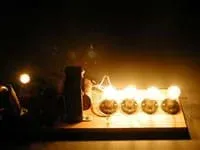 Light bulbs use electrical energy to light the light bulbsCopyright groups.physics.umn.edu/
Students are introduced to the fundamental concepts of electricity. They address questions such as "How is electricity generated?" and "How is it used in every-day life?" Illustrative examples of circuit diagrams are used to help explain how electricity flows.
The introduction to circuits is actually an introduction to electrical engineering. Every electrical device has a circuit designed by electrical engineers.
After this lesson, students should be able to:
- Explain which direction current flows through a circuit.
- Compare and contrast a parallel and a series circuit.
- Describe how current flows through a parallel and a series circuit.
- STEL-1F Describe the unique relationship between science and technology, and how the natural world can contribute to the human-made world to foster innovation.
Grades 3-5
Do you agree with this alignment? - STEL-2H Identify the resources needed to get a technical job done, such as people, materials, capital, tools, machines, energy, and time.
Grades 3-5
Do you agree with this alignment?
- 3-PS2-3 Ask questions to determine cause and effect relationships of electric or magnetic interactions between two objects not in contact with each other.
Grade 3
This resource focuses on the following Three Dimensional Learning aspects of NGSS:
Science & Engineering Practices- Ask questions that can be investigated based on patterns such as cause and effect relationships.Do you agree with this alignment?
Disciplinary Core Ideas- Electric, and magnetic forces between a pair of objects do not require that the objects be in contact. The sizes of the forces in each situation depend on the properties of the objects and their distances apart and, for forces between two magnets, on their orientation relative to each other.Do you agree with this alignment?
Crosscutting Concepts- Cause and effect relationships are routinely identified, tested, and used to explain change.Do you agree with this alignment?
Do you agree with this alignment? - Ask questions that can be investigated based on patterns such as cause and effect relationships.
- 4-PS3-2 Make observations to provide evidence that energy can be transferred from place to place by sound, light, heat, and electric currents.
Grade 4
This resource focuses on the following Three Dimensional Learning aspects of NGSS:
Science & Engineering Practices- Make observations to produce data to serve as the basis for evidence for an explanation of a phenomenon or test a design solution.Do you agree with this alignment?
Disciplinary Core Ideas- Energy can be moved from place to place by moving objects or through sound, light, or electric currents.Do you agree with this alignment?
- Energy is present whenever there are moving objects, sound, light, or heat. When objects collide, energy can be transferred from one object to another, thereby changing their motion. In such collisions, some energy is typically also transferred to the surrounding air; as a result, the air gets heated and sound is produced.Do you agree with this alignment?
- Light also transfers energy from place to place.Do you agree with this alignment?
- Energy can also be transferred from place to place by electric currents, which can then be used locally to produce motion, sound, heat, or light. The currents may have been produced to begin with by transforming the energy of motion into electrical energy.Do you agree with this alignment?
Crosscutting Concepts- Energy can be transferred in various ways and between objects.Do you agree with this alignment?
Do you agree with this alignment? - Make observations to produce data to serve as the basis for evidence for an explanation of a phenomenon or test a design solution.
- 3.P.3 Recognize how energy can be transferred from one object to another.
Grade 3
Do you agree with this alignment? - 4.P.3.1 Recognize the basic forms of energy (light, sound, heat, electrical, and magnetic) as the ability to cause motion or create change.
Grade 4
Do you agree with this alignment? - 7.P.2 Understand forms of energy, energy transfer and transformation and conservation in mechanical systems.
Grade 7
Do you agree with this alignment? - 7.P.2.3 Recognize that energy can be transferred from one system to another when two objects push or pull on each other over a distance (work) and electrical circuits require a complete loop through which an electrical current can pass.
Grade 7
Do you agree with this alignment?
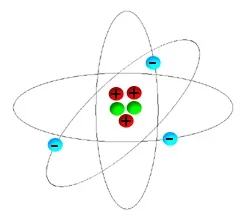 Figure 1. An atom. Protons are colored red with a "+" charge. Neutrons are green with no charge. Electrons are blue with a "-" charge.Copyright Fermilab conferences.fnal.gov/ lp2003/forthepublic/qcd/
All matter is made up of atoms. An atom consists of a nucleus in the center, which is comprised of positively charged and uncharged particles. The uncharged particles are called neutrons and the positively charged particles are called protons. Surrounding the nucleus are negatively charged particles called electrons. There are an equal number of protons and electrons. Refer to Figure 1, an animation of an atom. The nucleus is represented in the center by the red and yellow dots, and the electrons are represented by the blue dots.
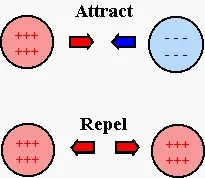
Something important to remember is that opposite charges attract one another and like charges repel one another. In other words, protons are attracted to electrons and repelled by other protons. Likewise, electrons are attracted to protons and repelled by other electrons.
This phenomenon is caused by what is known as an electric force. Most matter has no overall electrical charge because of the balance between the number of protons and electrons. However, when the balance of the electrical force between protons and electrons is disturbed by another force (e.g. magnetic forces) an atom may gain or lose an electrical charge. When this occurs, the atom will either have an overall negative or overall positive charge. The atom in this state is now called an ion. Now that the atom has an overall electrical charge it will interact with other charged ions in the same manner as described earlier. In other words, oppositely charged ions will attract one another, and like ions will repel one another.
 Charges.Copyright learn.wwtc.edu/.../ Cffs/cf1/cf1unit2/VCRsep.html
The loss in electrical charge from an atom allows for the free movement of electrons. The movement of electrons creates what is called current. Electricity is a source of power generated from the flow of electrical current. When a material called a conductor is placed between two charged objects, the loose electrons are pushed away by the negatively charged object, and the electrons are then drawn into the positively charged object. There are many different types of conductors. An example of a good conductor is metal, which is the reason why wiring is made out of metal. Water is also a conductor, and since the human body contains a lot of water, it is too!
A path through which electrical current can flow is called a circuit. An example of some simple circuits can be seen below. Essentially circuits work in the following way. A power source will pump electrons from the positive terminal to the negative terminal at a faster rate, then a device connected to the power source can drain the electrons. The electrical energy provided will continue as long as the power source does not stop. In the case of the circuits below, chemical reactions within the battery pumps electrons from the positive terminal to the negative terminal faster than the light bulb connected to the battery can drain them. The battery continues to supply the required amount of current to light the light bulbs until the chemicals within the battery are used up. Once the chemical reactions cease to occur the battery is dead and must be replaced.
Two different types of circuits are series and parallel circuits. A series circuit is a circuit in which the components (e.g. lights) are connected in line with one another and the wire. In other words, a series circuit contains components that all "share" the same wire. A series circuit does not contain any three or more wire junctions. However, a parallel circuit is a different matter. It's a circuit in which there are junctions of three or more wires. Components don't "share" the same wire, instead each component has it's own wire. When examining circuits, engineers often use pictures called circuit diagrams. Circuit diagrams are used to illustrate the pathways through which electricity can flow.
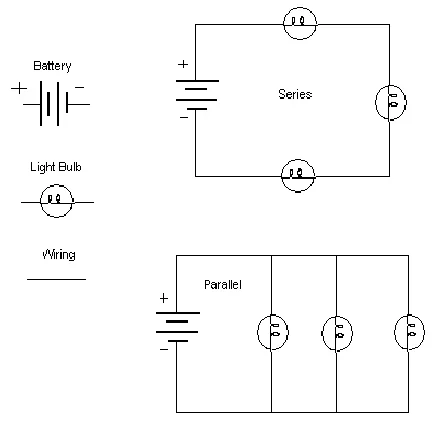 Circuit diagrams for circuits in series and parallel.
As stated earlier, electricity travels through conductors. A break in the wiring stops the flow of electrical current. For instance, in the series circuit shown below, the flow of current is stopped after the first light by the break in the wiring. Since there is a break in the wire, none of the lights will light up.
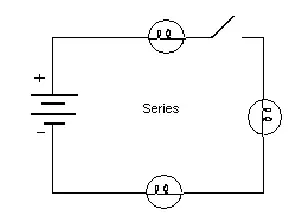 Open circuit.Copyright Wendy Lin
For a parallel circuit, current has more then one path through which it can flow. As seen from the figure below, this particular parallel circuit has three different paths through which it can travel (path 1: red, path 2: blue, path 3: green). This means that if there is a break in the wire at point A in the diagram, the first and the third light bulb will still light, but the second light bulb will not. This is because current is still able to reach the other two light bulbs to light them.
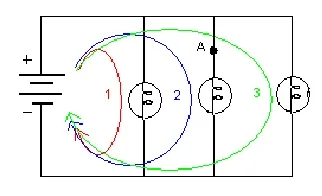 Parallel circuit.Copyright Wendy Lin
Essentially, the main point to remember here is that as long as current has a path to travel, current will flow through the circuit. When the current can not flow, this is called static electricity. Refer to the Lights On Demo & Build! Intro to Simple Circuits activity to have students expand their knowledge by creating their own circuits.
Ask students what they know about electricity. Ask them to list various examples of electrical energy.
Talk about Benjamin Franklin and his interest in electricity (that is, the lightning hitting the kite experiment). If they are not familiar with this experiment, read aloud to the class a description of the story.
Demonstrate the effects of static electricity using an inflated balloon. Rub the balloon on your head, or if you have enough balloons for half the students, have them form groups of 2. Each group can have a balloon which they need to inflate, and then rub on their partners head. Explain to the children that both air and rubber are good electrical insulators, and do not conduct electricity well. When you rub the balloon on your hair, electrons are transferred TO the balloon where they stay. Since your hair has less electrons, it is positively charged. Show the students the figure below and explain that OPPOSITES ATTRACT. Anything with more electrons than protons (negative charge, like the balloon in this example) will want to find something with a positive charge (more protons than electrons, like your hair in this example). When this happens, the charges on the objects can even out. This is what causes a shock when you open a car door, or walk across carpet and touch a conductor (metal). Lightning is like a huge shock in the sky!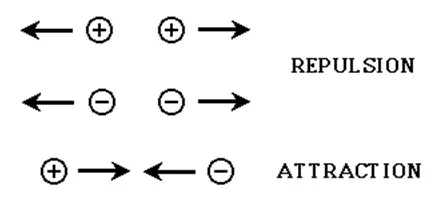 Copyright http://aether.lbl.gov/elements/stellar/strong/attract_repel.gif
Close by asking the class questions like "What is a parallel circuit?" Expect students to know the basic information from this lesson.
- circuit
- A path through which electrical current can flow.
- circuit diagram
- An illustrative picture used to explain the paths through which electricity can flow.
- conductor
- A material that allows for electrical current to flow.
- current
- The flow of electricity through a conductor.
- electricity
- A source of power generated from the flow of electrical current.
- electron
- A small, atomic particle with a negative charge.
- energy
- The ability to do work.
- Ask students to give examples of electrical energy throughout the lesson.
- Make sure students understand what electricity is by displaying various pictures of electrical and non-electrical devices at the end of the lesson. Have them decide which pictures are examples of the use of electrical energy and which ones use another type of energy.
- Draw a simple circuit diagram and have student explain the path in which current flows through the circuit.
- Ask students why their hair was attracted to the balloon. (Answer: Electrons had moved from their hair to the balloon, causing the balloon to have a negative charge, and the hair a positive charge. OPPOSITES ATTRACT so the balloon wants to move to the hair.)
- Ask the students what causes lightning. (Answer: That's right, the exact same principle! Basically different parts of a cloud will accumulate lots of electrons, or lots of protons, and there will be a difference between them.) Show the students the figure below. Point out that the ground may have an unequal charge also, and usually when a negatively charged part of the cloud gets near a positively charged part of the ground, A LIGHTNING STRIKE HAPPENS AND THE CHARGES EQUALIZE!
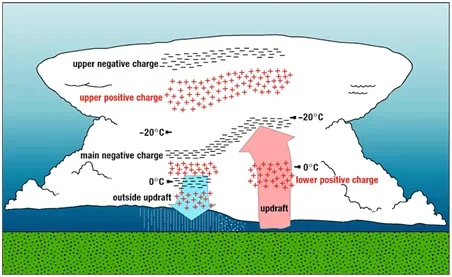 Schematic of Electrostatic Potential in a Storm Cloud (Makings of Lightning)Copyright http://www.nssl.noaa.gov/education/svrwx101/lightning/images/tstm-lightning-structure-800.png
Benjamin Franklin and Discovery of Electricity, The American Revolution. Accessed 7/23/2007. http://www.americanrevolution.com/BenjaminFranklinElectricity.htm
Comparing Parallel and Series Circuits, Applied Science: Our Technological World. Accessed 7/23/2007. http://www.msnucleus.org/membership/html/k-6/as/technology/4/ast4_3a.html
Electricity Tutorial, Swanson Technologies. Accessed 7/23/2007. http://www.swansontec.com/set.html
- Electrifying the World
Contributors
Wendy Lin
Supporting Program
Engineering K-PhD Program, Pratt School of Engineering, Duke University
Acknowledgements
This content was developed by the MUSIC (Math Understanding through Science Integrated with Curriculum) Program in the Pratt School of Engineering at Duke University under National Science Foundation GK-12 grant no. DGE 0338262. However, these contents do not necessarily represent the policies of the NSF, and you should not assume endorsement by the federal government.
Copyright
2013 by Regents of the University of Colorado; original © 2004 Duke University