
Sliding and Stuttering
Students use a spring scale to drag an object such as a ceramic coffee cup along a table top or the floor. The spring scale allows them to measure the frictional force that exists between the moving cup and the surface it slides on. By modifying the bottom surface of the cup, students find out what kinds of surfaces generate more or less friction.
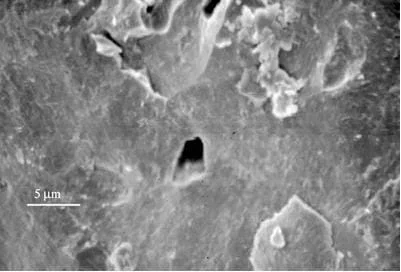 Most coffee mugs (like the ones used in this activity) are made of glazed stoneware, which may look and feel smooth. This scanning electron micrograph of a piece of glazed stoneware, however, shows that at a magnification of ~7000X this material is not as smooth as we think.
Engineers must understand how friction affects all sorts of situations, from the bottom of skis in which friction is a disadvantage to hiking boots where friction provides helpful traction.
After this activity, students should be able to:
- Describe friction as a force that impedes motion.
- Distinguish between static friction and kinetic friction.
- Explain why friction occurs.
- CCSS.Math.Content.6.NS.B.3 Fluently add, subtract, multiply, and divide multi-digit decimals using the standard algorithm for each operation.
Grade 6
Do you agree with this alignment? - CCSS.Math.Content.6.SP.B.4 Display numerical data in plots on a number line, including dot plots, histograms, and box plots.
Grade 6
Do you agree with this alignment? - CCSS.Math.Content.6.SP.B.5 Summarize numerical data sets in relation to their context, such as by:
Grade 6
Do you agree with this alignment? - CCSS.Math.Content.6.SP.B.5a Reporting the number of observations.
Grade 6
Do you agree with this alignment? - CCSS.Math.Content.6.SP.B.5b Describing the nature of the attribute under investigation, including how it was measured and its units of measurement.
Grade 6
Do you agree with this alignment? - CCSS.Math.Content.8.SP.A.1 Construct and interpret scatter plots for bivariate measurement data to investigate patterns of association between two quantities. Describe patterns such as clustering, outliers, positive or negative association, linear association, and nonlinear association.
Grade 8
Do you agree with this alignment?
- Some technological problems are best solved through experimentation.
Grades 6-8
Do you agree with this alignment? - STEL-8M Use instruments to gather data on the performance of everyday products.
Grades 6-8
Do you agree with this alignment?
- MS-PS2-2 Plan an investigation to provide evidence that the change in an object's motion depends on the sum of the forces on the object and the mass of the object.
Grades 6-8
This resource focuses on the following Three Dimensional Learning aspects of NGSS:
Science & Engineering Practices- Plan an investigation individually and collaboratively, and in the design: identify independent and dependent variables and controls, what tools are needed to do the gathering, how measurements will be recorded, and how many data are needed to support a claim.Do you agree with this alignment?
- Science knowledge is based upon logical and conceptual connections between evidence and explanations.Do you agree with this alignment?
- Analyze and interpret data to provide evidence for phenomena.Do you agree with this alignment?
Disciplinary Core Ideas- The motion of an object is determined by the sum of the forces acting on it; if the total force on the object is not zero, its motion will change. The greater the mass of the object, the greater the force needed to achieve the same change in motion. For any given object, a larger force causes a larger change in motion.Do you agree with this alignment?
- All positions of objects and the directions of forces and motions must be described in an arbitrarily chosen reference frame and arbitrarily chosen units of size. In order to share information with other people, these choices must also be shared.Do you agree with this alignment?
Crosscutting Concepts- Graphs, charts, and images can be used to identify patterns in data.Do you agree with this alignment?
Do you agree with this alignment? - Plan an investigation individually and collaboratively, and in the design: identify independent and dependent variables and controls, what tools are needed to do the gathering, how measurements will be recorded, and how many data are needed to support a claim.
- CCSS.Math.Content.6.NS.B.3 Fluently add, subtract, multiply, and divide multi-digit decimals using the standard algorithm for each operation.
Grade 6
Do you agree with this alignment? - CCSS.Math.Content.6.SP.B.4 Display numerical data in plots on a number line, including dot plots, histograms, and box plots.
Grade 6
Do you agree with this alignment? - CCSS.Math.Content.6.SP.B.5 Summarize numerical data sets in relation to their context, such as by:
Grade 6
Do you agree with this alignment? - CCSS.Math.Content.8.SP.A.1 Construct and interpret scatter plots for bivariate measurement data to investigate patterns of association between two quantities. Describe patterns such as clustering, outliers, positive or negative association, linear association, and nonlinear association.
Grade 8
Do you agree with this alignment?
- 5.P.1.4 Predict the effect of a given force or a change in mass on the motion of an object.
Grade 5
Do you agree with this alignment? - 7.P.1 Understand motion, the effects of forces on motion and the graphical representations of motion.
Grade 7
Do you agree with this alignment? - 7.P.1.2 Explain the effects of balanced and unbalanced forces acting on an object (including friction, gravity and magnets).
Grade 7
Do you agree with this alignment? - Psc.1.2 Understand the relationship between forces and motion.
Grades 9-12
Do you agree with this alignment? - PSc.1.2.2 Classify frictional forces into one of four types: static, sliding, rolling, and fluid.
Grades 9-12
Do you agree with this alignment? - PSc.3.1.3 Explain work in terms of the relationship among the applied force to an object, the resulting displacement of the object and the energy transferred to an object.
Grades 9-12
Do you agree with this alignment?
- spring scales, preferably having a 500 g capacity and 5-10 g accuracy, one per team of 2 to 4 students; Ohaus makes one that works well for this exercise; it is available from suppliers such as Ward for about $6
- ceramic coffee mugs, one per team, have students bring these from home or purchase them from thrift stores
- scissors, one per team
- roll of masking or wide transparent tape per team, or one roll shared between two teams
- string, about 30 cm per team
- several beakers, yogurt containers or paper cups filled with pebbles, nails or pennies; one container per team; these relatively heavy materials provide "ballast" to offset any weight differences in the bottom surfaces attached to the sliding objects
- (optional) lubricating materials, such as household oil like WD40™, vegetable oil, waxed paper, talcum powder, graphite powder, liquid and/or bar soap; make these available if students are curious about lubricants, as described in the Activity Extensions section
Vary the bottom surfaces of the coffee mugs by making several "plates" out of differently-textured materials, and taping these plates to the undersides of the mugs. Cut the materials into circular or square pieces slightly larger than the mug bottoms. Example materials to make these interchangeable bottom surfaces:
- poster board and/or cardboard
- stiff glossy paper, such as from a folder or catalog cover
- glass, from an art supply store or as scraps from a window repair company
- carpet, linoleum and/or ceramic tiles, ask for samples or scraps from a flooring company
- thin plywood or balsa wood, ask for scraps from a building supply store or hobby shop
- metal, such as jar lids
- plastic, such as margarine tub lids or laminated cardboard
- Styrofoam™, cut from the bottom of a disposable picnic plate
- sandpaper glued to heavy cardboard
Choose these materials so they are as flat, clean and free of gouges and scratches as possible.
Students should know how to compute the average of three numbers.
The Introduction/Motivation content in the associated lesson serves as most of the activity introduction. Once students have considered how changing the bottom surface of the coffee mug might affect the frictional force that occurs when it slides down a ramp, show them how they can attach different surface materials to the bottom of the cup using tape. With different materials attached, they can test to see which ones create more or less friction between the cup and the table. Point out that they must make sure the tape does not affect the surface being tested. Expect students to be able to make loops of tape, sticky side out, to invisibly attach their interchangeable surfaces to the bottoms of their cups.
When performing their experiments, have the cups always contain some additional weight; the student instructions say that the cups should be about one-third filled with pebbles, pennies or similar objects. This additional weight, which should not be altered during the course of the experiment, ensures that the effects of weight differences in the surface materials being tested are relatively small. For example, attaching a ceramic tile to the bottom of an empty cup would make it much heavier than would attaching a similarly shaped piece of Styrofoam. Adding pebbles, however, increased the total cup weight to it is much greater than the ceramic tile. Thus, the mass of the tile contributes relatively little to the total frictional force. In this way, the variable of mass is more or less eliminated from the experiment.
Next, show the class a spring scale, and point out that it is usually used for weighing small objects by hanging them from the hook while holding the scale vertically. (Point out that students should not try to weigh very heavy objects, since this might damage the scale.) Then show them how they can also use a spring scale to measure the amount of force it takes to drag a coffee cup across a table. (See Figure 1, which is also included in the Instructions for Students Handout.) The force indicated by the scale is equal to the amount of friction that is being generated, because it is the force that must be overcome in order to move the cup. Be sure to show students how to zero the spring scale before they begin their experiments. This is done by pulling out or pushing in the metal tab that protrudes from the top of the scale.
Before the Activity
Gather materials and make copies of the Instructions for Students Handout (PDF) and Sliding and Stuttering Datasheet (PDF).
Divide the class into teams of 2 to 4 students each, and provide each student with a copy of the instructions and datasheet. Make the other materials available and direct students to begin.
With the Students
You will measure friction using a simple device called a spring scale. Take a few minutes to examine it and see if you can figure out how it works. Then attach a piece of string about 20-30 cm long to the hook at the bottom of the scale, and tie the other end of the string to the middle of your cup's handle. Add pennies, nails or pebbles to your cup until it is about one-third full.
Working on a clean table or counter top, hold the scale next to your cup. The scale should be a few inches above the table top, not resting on it. Keeping the scale flat (parallel to the table), pull on the top end of the scale until the string goes taught and you begin to pull gently on the cup (as shown in Figure 1 or the diagram in the instructions handout). Try to keep both the string and the scale parallel to the table as you pull. At the point where you just begin to move the cup, notice that the marker on the scale has moved away from the zero point and down onto the gauge of the scale. Watch carefully to see what the marker does. You might find that it is hard to pull evenly enough so the marker stays in one place on the scale once you get the cup moving. Take turns in your group so that everyone can practice both pulling and reading the scale. Try to pull the cup so that it slides at a steady speed across the table, and does not "stutter" (stop and start several times.)
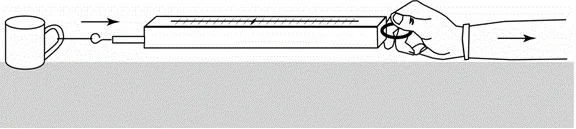 Figure 1. Diagram illustrating the use of a scale to measure the force of friction.Copyright 2000 Mary Hebrank, Center for Inquiry-Based Learning, Duke University http://www.biology.duke.edu/cibl/exercises/sliding_and_stuttering_ifs.htm
You probably noticed that the marker also jumps around, or "stutters," when the cup does.Once you get good at setting the cup in motion smoothly and keeping it moving at a steady pace, however, you will probably see that the gauge marker still does something unexpected. You may see it go pretty far down the scale before the cup starts to move -- for example, to 135 g. But then, just as the cup starts to move smoothly, the marker moves up some -- perhaps to a gauge reading of 95 g. What do you think is happening? Which gauge reading is the correct one?
It turns out they are both correct, and as you do your experiments you can think about and discuss with your group why that is so. In the meantime, however, record both gauge readings in your data table: 1) the higher one that occurred just before the cup moved, and 2) the lower one corresponding to the steady sliding of the cup. Do three trials, and then find the averages of each set of measurements.
After you have a attached a different material to the bottom of your cup, repeat this procedure. When you record your measurements in the datasheet table, be sure to note the test material used for the bottom surface of the cup. Do this for as many different surfaces as you have time. Then, if you still have more time to experiment, try sliding your cup, either plain or with a modified bottom, on a different surface, such as a concrete or linoleum floor.
Create a dot plot for the different average friction forces for each material. Create one graph for the higher number and one for the lower number. What patterns do you see in the data?
- friction
- A resistance to motion that occurs when two surfaces are in contact with each other.
- static friction
- The resistance to motion that must be overcome in order to allow one surface to begin sliding against another surface.
- kinetic friction
- The resistance to motion that occurs once one surface is in motion, sliding against another surface.
Use the first four Investigating Questions to check for understanding of the process of scientific inquiry involved in this activity. Also, check to see that students are reading the spring scales with reasonable accuracy and are accurately recording their data.
Make sure that students are holding the spring scales above the table surface and parallel to it as they drag the coffee mugs, rather than allowing the scale to also drag along the table surface.
Have students experiment with different lubricating materials (wet and dry) with only minor changes to the setup used in this exercise. Ideally, some students will ask to do these experiments before you even suggest them. This is an important aspect of research and scientific experimentation and one worth pointing out to students: a good experiment raises as many questions as it answers.
Contributors
Mary R. Hebrank
Supporting Program
Engineering K-PhD Program, Pratt School of Engineering, Duke University
Acknowledgements
This content was developed by the MUSIC (Math Understanding through Science Integrated with Curriculum) Program in the Pratt School of Engineering at Duke University under National Science Foundation GK-12 grant no. DGE 0338262. However, these contents do not necessarily represent the policies of the NSF, and you should not assume endorsement by the federal government.
This activity was originally published, in slightly modified form, by Duke University's Center for Inquiry Based Learning (CIBL). Please visit http://ciblearning.org/ for information about CIBL and other resources for K-12 science and math teachers.
Copyright
2013 by Regents of the University of Colorado; original © 2004 Duke University