
Discovering Friction
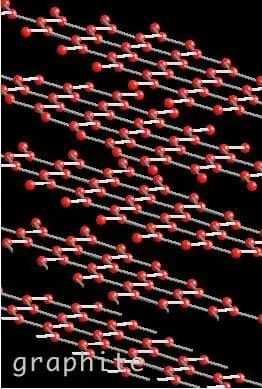 Graphite crystals consist of hexagonal arrays of carbon molecules that form two-dimensional, crystalline plates. This structure allows the plates to slide freely over one another, making graphite a very useful lubricating material.
With a simple demonstration activity, students are introduced to the concept of friction as a force that impedes motion when two surfaces are in contact. Then, in the associated activity, Sliding and Stuttering, they work in teams to use a spring scale to drag an object such as a ceramic coffee cup along a table top or the floor. They use the spring scale to measure the frictional force that exists between the moving cup and the surface on which it slides. By modifying the bottom surface of the cup, students experiment to find out what kinds of surfaces generate more or less friction. They also discover that both static and kinetic friction are involved when an object initially at rest is caused to slide across a surface.
Whether engineers are trying to design a better set of automobile brakes or a more efficient wind turbine, a thorough understanding of friction is a vital prerequisite. Engineers must understand how friction affects all sorts of everyday situations, from the bottom of skis in which friction is a disadvantage to hiking boots where friction provides important traction.
After this lesson, students should be able to:
- Describe friction as a force that impedes motion and generates heat.
- Distinguish between static friction and kinetic friction.
- Explain why friction occurs.
- Describe common occurrences of friction, including those in which friction can be used to advantage in everyday life.
- Describe ways in which friction can be reduced.
- Students will develop an understanding of the relationships among technologies and the connections between technology and other fields of study.
Grades K-12
Do you agree with this alignment?
- MS-PS2-2 Plan an investigation to provide evidence that the change in an object's motion depends on the sum of the forces on the object and the mass of the object.
Grades 6-8
This resource focuses on the following Three Dimensional Learning aspects of NGSS:
Science & Engineering Practices- Science knowledge is based upon logical and conceptual connections between evidence and explanations.Do you agree with this alignment?
- Laws are regularities or mathematical descriptions of natural phenomena.Do you agree with this alignment?
Disciplinary Core Ideas- The motion of an object is determined by the sum of the forces acting on it; if the total force on the object is not zero, its motion will change. The greater the mass of the object, the greater the force needed to achieve the same change in motion. For any given object, a larger force causes a larger change in motion.Do you agree with this alignment?
- All positions of objects and the directions of forces and motions must be described in an arbitrarily chosen reference frame and arbitrarily chosen units of size. In order to share information with other people, these choices must also be shared.Do you agree with this alignment?
Do you agree with this alignment? - Science knowledge is based upon logical and conceptual connections between evidence and explanations.
- 5.P.1.4 Predict the effect of a given force or a change in mass on the motion of an object.
Grade 5
Do you agree with this alignment? - 7.P.1.2 Explain the effects of balanced and unbalanced forces acting on an object (including friction, gravity and magnets).
Grade 7
Do you agree with this alignment? - Psc.1.2 Understand the relationship between forces and motion.
Grades 9-12
Do you agree with this alignment? - PSc.1.2.2 Classify frictional forces into one of four types: static, sliding, rolling, and fluid.
Grades 9-12
Do you agree with this alignment? - PSc.3.1.3 Explain work in terms of the relationship among the applied force to an object, the resulting displacement of the object and the energy transferred to an object.
Grades 9-12
Do you agree with this alignment?
A basic understanding of the concept of force; an awarenes of the existence of the gravitational force.
Friction occurs whenever two surfaces are in contact with each other, and in general, it is the roughness of the surfaces that determines the amount of friction that results. Even surfaces that look and feel smooth may contain thousands of irregular bumps, pits, ridges and valleys, although a microscope may be required to see them. When two such surfaces slide past one another, the tiny bumps and ridges on one surface can get hung up briefly in the pits and ridges on the other surface. It is the brief locking together of the surface irregularities that creates friction and impedes their motion.
Static friction is the force that must be overcome in order to set a body in motion. Kinetic friction is the force that must be overcome in order to keep a body in motion. Kinetic friction is usually less than static friction, but both types occur mainly because of the surface macro- and microscopic imperfections.
When an object such as a coffee cup is at rest on a table top, some of its surface imperfections are pressed up against the similar imperfections of the table, with the tiny peaks of one surface nestled into the tiny valleys of the other. To set the cup in motion and make it slide across the table, enough force must be applied to get the peaks and valleys on the upper surface up and out of the valleys and peaks on the stationary surface below. Static friction is the force that must be overcome to disengage these peaks and valleys in order for the cup to begin sliding across the table.
While friction is primarily caused by surface roughness, many modern synthetic materials have exceptionally smooth surfaces. For these materials, the friction that results from surface roughness can be very, very small. However, another source of friction can become important in these materials. Although the mechanisms are not yet well understood, molecular attraction between two very smooth surfaces can create a surprising amount of friction. These commonly occur between some types of plastics, and can also occur with some glass surfaces.
Also, soft materials can deform and thereby produce increased resistance to motion. Sliding a coffee cup across a carpet is one example of deformation friction. In this case, the surface roughness contributes relatively little to the frictional force observed; instead, the weight of the cup bends the carpet fibers down, making the cup sink into the carpet's pile. In order to move the cup across the carpet, the unbent fibers adjacent to it must be pushed aside and/or compressed by the cup, and this "plowing through" may require considerable force.
For better or for worse, friction is an inescapable force we encounter every moment of our lives. We depend on friction in order to walk, we take advantage of friction in order to light a match, we try to reduce friction in our car engines and door hinges, and friction is generated as the muscle fibers of our hearts contract and relax with each heart beat. most often, physicists and engineers invest a lot of time and energy into trying to reduce or eliminate friction within the moving parts of machinery, but sometimes they look for ways to increase friction. Whether an engineer is trying to design a better set of automobile brakes or a more efficient wind turbine, a thorough understanding of friction is a vital prerequisite. You can easily master the fundamentals of friction, and even conduct simple experiments in order to discover most of the fundamental ideas for yourselves.
Demonstration: Start by making an inclined plane at a shallow angle using a flat piece of plywood, a kitchen cutting board or even a large book. Place two coffee cups on the board -- one cup on its rough, unglazed bottom; the other on its smooth, glazed side (see Figure 1). Ask the students to predict what will happen when you slowly raise the plane to a steeper angle. You can then perform the experiment.
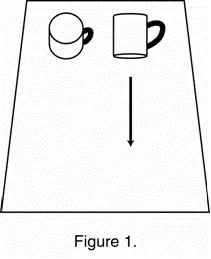 Figure 1. Position two cups as shown in the diagram.Copyright 2000 Mary Hebrank, Duke Center for Inquiry-Based Learning http://www.biology.duke.edu/cibl/exercises/sliding_and_stuttering.htm
Ask students if they can explain what makes the cup on its side slide down while the cup on its bottom does not (until you increase the plane to a steeper angle). The point is to give students only a basic definition of friction and then let them see what they can find out about it for themselves. Depending on their prior knowledge, they may answer that the force of gravity makes the smooth cup slide, but that gravity isn't strong enough to make the rough cup slide until you make the angle steeper. You can point out that the force of gravity must be great enough to overcome another force, the force of friction, in order for the cups to move. Friction is a force that occurs between two surfaces, and it acts to impede motion.
If the students suggest inertia as the reason why the cups do not slide, you might introduce Newton's first law of motion: An object at rest will stay at rest unless it is acted on by an outside force. Then you can point out that friction can be what keeps an object at rest until another, stronger force, gravity, causes it to begin moving. Conversely, once an object is in motion, it will stay in motion until a force acts to stop it. Friction is one such force. For example, the friction a cup encounters as it slides across a flat table will eventually stop the cup; the cup will not keep sliding forever. Please note, however, that if students do not bring up the subject of inertia, it is not necessary to discuss it at this point. In fact, if your students are relatively naïve, they may be confused by trying to understand inertia at this time. (That discussion can wait until after the students have had time to explore friction through experimenting with different surfaces as presented in the associated activity, Sliding and Stuttering).
Then ask the students what they think would happen if you changed the bottom of the cup by gluing sandpaper to it. Would the cup slide more or less freely down the inclined plane. In other words, would there be more or less friction between the cup and surface of the plane? They will probably predict that the cup would slide less freely. Instead of asking for their reasoning, however, tell them that if they want to compare the amounts of friction involved between the two surfaces, there is a way to measure it directly. They can use this method to experiment with different surfaces and see for themselves what they can discover about friction in the associated activity, Sliding and Stuttering.
After students have completed the associated activity, Sliding and Stuttering, ask each group for its answer to the first question on the student data sheet. Expect students to be able to make some general observations, such as, "There is usually less friction when two smooth surfaces slide past each other than when one (or both) of the surfaces is rough." Once this has been established, ask them why they think the rougher surfaces create more friction than the smoother ones. Expect them to answer to the effect that rough surfaces are bumpy and the bumps on the two surfaces hit each other and make it harder for one surface to slide past the other. This is exactly right, but you can point out that it happens on a microscopic scale, too (see the Lesson Background & Concepts for Teachers section). If students found that some of the smooth-feeling surfaces generated a lot of friction also, point out that molecular attraction and deformation are also responsible for friction.
Ask students for examples of situations in which people try to take advantage of either reduced or increased amounts of friction between two surfaces. Good examples include oiling a squeaky door hinge, going down a water slide, using a bath mat in the tub or shower, opening a jar with the help of a rubber gripper, and taping the end of a baseball bat.
Also, ask students to note what happens when they vigorously rub their palms together, or rub their palms against their thighs—this works especially well for those wearing jeans. Expect them to notice that heat is generated. This is always true of friction: friction generates heat. The reason is that some of the kinetic energy of the moving object is reduced by the force of friction. Since energy cannot be lost from a system, that kinetic energy is converted to heat energy.
We take advantage of the heat generated by friction every time we light a match. And although we keep our mammalian bodies warm by the metabolic, fuel-burning activity of our millions of cells, we feel particularly hot during strenuous activity. This is not only due to the fact that we are burning fuel faster when we exercise, but it is also partly due to the friction created by large blocks of muscles moving back and forth next to each other. When we run, for example, the muscles in the fronts of our thighs, known collectively as the quadriceps, or "quads", rub back and forth against those in the backs of our thighs, known as the "hamstrings." Heat is also generated by the movement of hundreds of thousands of muscle cells and their protein components as they slide past one another when we alternately contract and relax our muscles. These sources of friction build up heat and cause us to sweat and fan ourselves in an effort to cool off.
On the other hand, if we are too cold, we shiver. Shivering is a special type of involuntary, cyclical pattern of muscle contraction and relaxation. It is a physiological adaptation that causes us to burn fuel and produce heat whether we want to or not, but it also lets friction help us maintain our body temperature when our clothing and shelters are not sufficient. Regardless of the type of situation-—physiological or mechanical—the amount of heat produced is proportional to the amount of friction generated.
- friction
- A resistance to motion that occurs when two surfaces are in contact with each other.
- static friction
- The resistance to motion that must be overcome in order to allow one surface to begin sliding against another surface.
- kinetic friction
- The resistance to motion that occurs once one surface is in motion, sliding against another surface.
Questions: In the form of a writing assignment or quiz, ask students the following questions to assess their comprehension of the lesson subject matter.
- Define friction.
- Distinguish between static friction and kinetic friction.
- Explain why friction occurs.
- Describe common occurrences of friction, including those in which friction can be used to advantage in everyday life.
- Describe ways in which friction can be reduced.
- Rolling friction is the type of resistive force that can slow the motion of a wheel, tire or ball bearing. Rolling friction is generally much less than kinetic friction, which is why wheels and ball bearings are such remarkable inventions. In rolling friction, both the deformation and the molecular attractions of the materials involved are important determinants of the amount of rolling resistance produced. Students can learn more about rolling friction through simple experiments, library and/or Internet research, and taking apart ball bearings to see how they work.
- Take a field trip to an ice skating rink to let students experience movement in a low-friction environment, or take a trip to an indoor rock climbing facility for a challenging way to experience the interactions of gravity and friction.
Contributors
Mary R. Hebrank
Supporting Program
Techtronics Program, Pratt School of Engineering, Duke University
Acknowledgements
This content was developed by the MUSIC (Math Understanding through Science Integrated with Curriculum) Program in the Pratt School of Engineering at Duke University under National Science Foundation GK-12 grant no. DGE 0338262. However, these contents do not necessarily represent the policies of the NSF, and you should not assume endorsement by the federal government.
This lesson and its associated activity were originally published, in slightly modified form, by Duke University's Center for Inquiry Based Learning (CIBL). Please visit the http://ciblearning.org/ website for information about CIBL and other resources for K-12 science and math teachers.
Copyright
2013 by Regents of the University of Colorado; original © 2004 Duke University