
Permeability Materials Experiment: What Trickles Down?
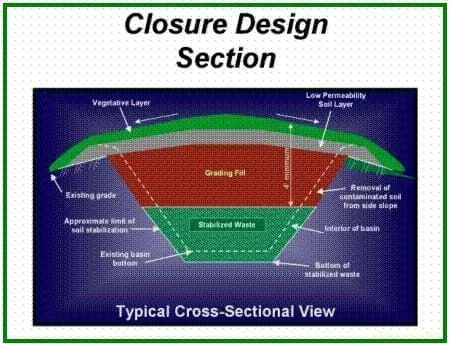 Materials of differing permeability must be used to control the flow of liquids in a landfill.Copyright Savanannah River Site, Westinghouse Savannah River Company http://sti.srs.gov/fulltext/ms9900729r1/ms9900729r1.html
Permeability is the degree to which water or other liquids are able to flow through a material. Different substances such as soil, gravel, sand and asphalt have varying levels of permeability. In this activity, students explore different levels of permeability and compare the permeabilities of several different materials. They also are introduced to the basic concepts of building design, landscape architecture and environmental pollutant transport. As an extension, they discuss the importance of correct drainage and urban design issues in sensitive environments such as coastal areas.
Environmental and civil engineers consider the permeability of the ground around major construction projects when designing drainage systems. Carefully planned systems can reduce pollution due to runoff and prevent flooding. Closely related to this, during this activity, students experiment with the material property of permeability and discuss applications for materials that are more permeable and less permeable.
After this activity, students should be able to:
- Identify different materials based on their level of permeability.
- Identify and explain which materials (permeable vs. impermeable) are better for development or agriculture in various settings (urban vs. rural, coastal vs. inland) and why.
- CCSS.Math.Content.6.RP.A.3c Find a percent of a quantity as a rate per 100 (e.g., 30% of a quantity means 30/100 times the quantity); solve problems involving finding the whole, given a part and the percent.
Grade 6
Do you agree with this alignment?
- Identify trends and monitor potential consequences of technological development.
Grades 6-8
Do you agree with this alignment? - STEL-7Q Apply the technology and engineering design process.
Grades 6-8
Do you agree with this alignment? - STEL-8L Interpret the accuracy of information collected.
Grades 6-8
Do you agree with this alignment? - STEL-8M Use instruments to gather data on the performance of everyday products.
Grades 6-8
Do you agree with this alignment?
- MS-ETS1-4 Develop a model to generate data for iterative testing and modification of a proposed object, tool, or process such that an optimal design can be achieved.
Grades 6-8
This resource focuses on the following Three Dimensional Learning aspects of NGSS:
Science & Engineering Practices- Develop a model to generate data to test ideas about designed systems, including those representing inputs and outputs.Do you agree with this alignment?
Disciplinary Core Ideas- Models of all kinds are important for testing solutions.Do you agree with this alignment?
- The iterative process of testing the most promising solutions and modifying what is proposed on the basis of the test results leads to greater refinement and ultimately to an optimal solution.Do you agree with this alignment?
Do you agree with this alignment? - Develop a model to generate data to test ideas about designed systems, including those representing inputs and outputs.
- 6.E.2.3 Explain how the formation of soil is related to the parent rock type and the environment in which it develops.
Grade 6
Do you agree with this alignment? - PSc.2.1 Understand types, properties, and structure of matter.
Grades 9-12
Do you agree with this alignment?
Each group needs:
- graduated cylinder
- 4 medium empty steel soup cans with tops and bottoms removed (ask students to bring some from home)
- gravel (enough to fill one soup can 3/4 of the way up)
- sand (enough to fill one can 3/4 of the way up)
- soil (enough to fill one can 3/4 of the way up)
- marbles (enough to fill one can 3/4 of the way up)
- 4 pieces of cheesecloth, cut into squares large enough to cover the bottom of a can plus a little extra
- 4 large rubber bands (big enough to go around a can)
- medium size mixing bowl or small bucket to catch water
To share with the entire class:
- water and sink/drain
- can opener, for the teacher to prepare the soup cans
- extra can, rubber bands, tape/hook, bucket/tray and cheese cloth, for teacher demonstration
Students must be able to calculate fractions and percentages, and use a graduated cylinder.
Show students a permeability demonstration. Prepare by cutting off the top and bottom ends of a soup can. Then tape or hook the can to the edge of a table with cheesecloth on the bottom, but no material in the can. On the floor under the can, place a bucket or tray to catch the water. For the demonstration, pour the water through and let students see how it falls. Discuss the connection to permeability, that is, how cheesecloth is a good example of permeability.
Before the Activity
- Gather materials.
- Use a can opener to remove both ends of all the soup cans.
- Cut out the cheesecloth pieces, making them large enough so each can be attached with a rubber band to the end of an open-ended soup can.
- Lay out all materials for student groups to pick up.
With the Students
- Divide the class into groups of four students each.
- Using the laid out materials, challenge groups to design experiment to determine the relative permeability of each substance (that is, gravel, sand, soil and marbles). Following is an example of an experiment that students might create.
Example Experiment
- Use rubber bands to attach cheesecloth to one end of each of the cans.
- Make sure the open end of the can (without cheesecloth) is facing up and the cheesecloth end is resting on the table.
- Fill each can three-quarters of the way up with the materials: one with gravel, one with soil, one with sand and the other with marbles.
- Make sure each student in the group has his or her own can for the material s/he is assigned.
Steps for Each Can
- Fill the graduated cylinder with 20 ml water.
- Hold the can over the empty bowl.
- Slowly pour the water (through non-cheesecloth end) into the can (make sure can is held over the bowl).
- Write down observations about permeability and how water traveled.
- Measure the amount of water that permeated through the can and fell into the bowl.
- Calculate and record the percentage of the water that permeated in milliliters (ml).
- Record observations and discuss group conclusions.
- permeability
- The degree to which water or another liquid is able to flow through a material.
- porosity
- The ratio of the volume of gaps of a material to the volume of its mass.
- sediment
- Material deposited by water, wind or glaciers.
- runoff
- The portion of precipitation on land that ultimately reaches streams, often carrying dissolved or suspended material.
Pre-Activity Assessment
- Ask students what they notice when they put water in topsoil vs. sand.
- Ask what they know about the difference between topsoil, sand and gravel and similar substances.
Activity Embedded Assessment
- As students conduct their experiments, have them make lists of what they noticed and wonder about.
Post-Activity Assessment
- Have students list the materials used in order of most to least permeable.
- Give students graph paper and ask them to measure amounts of permeable vs. non-permeable area of their yards at home. Include trees and vegetation.
- Discuss ongoing development areas in town. Ask students to think of possible effects and predict problem areas.
- Have an adult cut the cans smoothly with a can opener before the activity. Alert students to be careful of the sharp can edges.
- Watch that students do not shoot the rubber bands.
The students with gravel and fewer marbles may have to use slightly less so the cheesecloth can support the weight of these materials.
Add more materials, such as clay.
Experiment with mixtures of materials, such as clay and gravel.
- To scale up the assignment, adjust the rate of flow of the water and record observations.
- To scale down the activity, prepare the cans and give students charts to record observations and conclusions.
- Pollutants & Ground Permeability: The Other Water Cycle
- Permeability Materials Experiment: What Trickles Down?
Contributors
Usman Zaheer; Sherry McGauvran
Supporting Program
Engineering K-PhD Program, Pratt School of Engineering, Duke University
Acknowledgements
This content was developed by the MUSIC (Math Understanding through Science Integrated with Curriculum) Program in the Pratt School of Engineering at Duke University under National Science Foundation GK-12 grant no. DGE 0338262. However, these contents do not necessarily represent the policies of the NSF, and you should not assume endorsement by the federal government.
Copyright
2013 by Regents of the University of Colorado; original © 2005 Duke University