
Pollutants & Ground Permeability: The Other Water Cycle
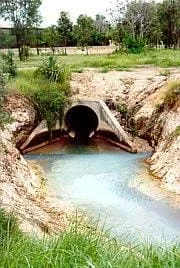 Runoff from a storm water drain.Copyright U.S. Geological Survey
For students who have already been introduced to the water cycle, this lesson is intended as a logical follow-up. Students learn about human impacts on the water cycle that create a pathway for pollutants beginning with urban development and joining the natural water cycle as surface runoff. The extent of surface runoff in an area depends on the permeability of the materials in the ground. Permeability is the degree to which water or other liquids are able to flow through a material. Different substances such as soil, gravel, sand and asphalt have varying levels of permeability. In this lesson, along with the associated activity, students learn about permeability and compare the permeability of several different materials for the purpose of engineering landscape drainage systems.
Landscape engineers, environmental engineers and civil engineers consider the permeability of the ground around major construction projects when designing drainage systems and altering terrain. Human infrastructure has historically reduced permeable materials in exchange for non-permeable materials, resulting in increased stormwater runoff and pollution concentration. Carefully planned systems can reduce pollution due to runoff as well as prevent flooding.
After this lesson, students should be able to:
- Identify different materials based on their level of permeability.
- Identify which materials (permeable vs. impermeable) would be better for development of agriculture in various (urban vs. rural, coastal vs. inland) settings and why.
- Describe how pollutants concentrate and runoff over non-permeable surfaces.
- Describe some human impacts on the natural environment.
- Learn how to link anthropogenic pollutants and contaminants to local environmental issues such as water quality and estuary health.
- Describe how non-permeable surfaces cause runoff and affect the health of local watersheds.
- The management of waste produced by technological systems is an important societal issue.
Grades 6-8
Do you agree with this alignment? - Structures rest on a foundation.
Grades 6-8
Do you agree with this alignment? - STEL-4L Analyze how the creation and use of technologies consumes renewable and non-renewable resources and creates waste.
Grades 6-8
Do you agree with this alignment?
- MS-ESS3-4 Construct an argument supported by evidence for how increases in human population and per-capita consumption of natural resources impact Earth's systems.
Grades 6-8
This resource focuses on the following Three Dimensional Learning aspects of NGSS:
Science & Engineering Practices- Construct an oral and written argument supported by empirical evidence and scientific reasoning to support or refute an explanation or a model for a phenomenon or a solution to a problem.Do you agree with this alignment?
Disciplinary Core Ideas- Typically as human populations and per-capita consumption of natural resources increase, so do the negative impacts on Earth unless the activities and technologies involved are engineered otherwise.Do you agree with this alignment?
Crosscutting Concepts- Cause and effect relationships may be used to predict phenomena in natural or designed systems.Do you agree with this alignment?
- Scientific knowledge can describe the consequences of actions but does not necessarily prescribe the decisions that society takes.Do you agree with this alignment?
- All human activity draws on natural resources and has both short and long-term consequences, positive as well as negative, for the health of people and the natural environment.Do you agree with this alignment?
Do you agree with this alignment? - Construct an oral and written argument supported by empirical evidence and scientific reasoning to support or refute an explanation or a model for a phenomenon or a solution to a problem.
- 5.P.2 Understand the interactions of matter and energy and the changes that occur.
Grade 5
Do you agree with this alignment? - 5.P.2.1 Explain how the sun's energy impacts the processes of the water cycle (including, evaporation, transpiration, condensation, precipitation and runoff).
Grade 5
Do you agree with this alignment? - 6.E.2.3 Explain how the formation of soil is related to the parent rock type and the environment in which it develops.
Grade 6
Do you agree with this alignment? - 6.L.2 Understand the flow of energy through ecosystems and the responses of populations to the biotic and abiotic factors in their environment.
Grade 6
Do you agree with this alignment? - PSc.2.1 Understand types, properties, and structure of matter.
Grades 9-12
Do you agree with this alignment?
Permeability is the degree to which water or another liquid is able to flow through a material. Different substances such as soil, gravel, sand and asphalt have varying levels of permeability. Materials that are densely packed are less permeable than those that are loosely packed. The porosity of the material enables permeability: the more gaps, the more permeable the material. Students can further investigate this idea of permeability with the investigative associated activity Permeability Materials Experiment: What Trickles Down?
As the population of the Earth increases and as more development and urbanization occur, more of the Earth's surface is replaced by impervious or non-permeable surfaces such as roads, houses, parking lots, and buildings. The cumulative effect is a reduction in the seepage of water into the ground and an acceleration of runoff inito ditches, streams and detention basins.
Increases in imperviousness, removal of vegetation and soil, gradation of the land surface, and construction of drainage networks all result in higher runoff volumes and shortened runoff time into streams from stormwater (rain, melting snow).
Over time, this new and human-induced movement of pollutants through an area creates the "other" water cycle, sometimes called the urban stormwater cycle. This cycle is a way to describe the journey of rainfall from the atmosphere to the surface of the Earth, over land, and eventually into the terrestrial water system (groundwater, rivers, ocean and estuaries). In this way, pollutants accompany the natural water cycle and are inadvertently spread and able to contaminate other water sources.
Hook the students by showing a photograph of a large commercial parking lot (such as a Wal-Mart store), focusing on the detention ponds. Ask them what they see in the picture, and what they think the purpose of the ponds is. Expect them to come up with esthetic and practical reasons. Encourage all answers and suggest that they think about why the ponds might be there from an engineering perspective. The purpose of the ponds is to collect and treat surface water runoff.
To aid in an explanation of permeability, show pictures of flooding. Ask questions to encourage students to think about why flooding occurs.
Ask students the following questions:
- What is permeability? (Permeability is the degree to which water or another liquid is able to flow through a material.)
- Why is runoff a problem? (Runoff leads to the introduction of pollutants and excess nutrients into the water cycle and leads to the contamination of bodies of water.)
- How can runoff be prevented? (Runoff can be reduced by using more permeable materials in engineering designs and taking advantage of the natural ability of wetlands and soils to capture and filter water.)
- permeability
- The degree to which water or another liquid is able to flow through a material.
- porosity
- The ratio of the volume of gaps of a material to the volume of its mass.
- sediment
- Material deposited by water, wind or glaciers.
- runoff
- The portion of precipitation on land that ultimately reaches streams, often carrying dissolved or suspended material.
- asphalt
- A brownish-black solid or semisolid mixture of bitumens obtained from n.ative deposits or as a petroleum byproduct, used in paving, roofing and waterproofing.
- estuary
- An arm of the sea that extends inland to meet the mouth of a river.
- Expect students to be actively involved in the discussion and able to explain which materials are more permeable than others.
- List materials and ask the class to identify which are the most permeable.
- Ask students to give examples of runoff.
Surface Runoff - The Water Cycle, U.S. Geological Survey http://water.usgs.gov/edu/watercyclerunoff.html
What Are Detention Ponds and Why Are They Important? Greenville County, SC http://www.greenvillecounty.org/land_development/detention_ponds.asp
- Pollutants & Ground Permeability: The Other Water Cycle
Contributors
Usman Zaheer; Sherry McGauvran
Supporting Program
Engineering K-PhD Program, Pratt School of Engineering, Duke University
Acknowledgements
This content was developed by the MUSIC (Math Understanding through Science Integrated with Curriculum) Program in the Pratt School of Engineering at Duke University under National Science Foundation GK-12 grant no. DGE 0338262. However, these contents do not necessarily represent the policies of the NSF, and you should not assume endorsement by the federal government.
Copyright
2013 by Regents of the University of Colorado; original © 2005 Duke University