
Bubbling Plants Experiment to Quantify Photosynthesis
Students learn a simple technique for quantifying the amount of photosynthesis that occurs in a given period of time, using a common water plant (Elodea). They use this technique to compare the amounts of photosynthesis that occur under conditions of low and high light levels. Before they begin the experiment, however, students must come up with a well-worded hypothesis to be tested. After running the experiment, students pool their data to get a large sample size, determine the measures of central tendency of the class data, and then graph and interpret the results.
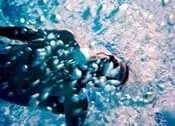 Bubbles can be produced by many things, even plants.Copyright http://clubs.arizona.edu/~tricats/Photos.html
Students perform data analysis and reverse engineering to understand how photosynthesis works. Both are important aspects of being an engineer.
After this activity, students should be able to:
- Explain that photosynthesis is a process that plants use to convert light energy into glucose, a source of stored chemical energy for the plant.
- Describe photosynthesis as a set of chemical reactions in which the plant uses carbon dioxide and water to form glucose and oxygen.
- Describe a simple experiment that provides indirect evidence that photosynthesis is occurring.
- Describe the effects of varying light intensity on the amount of photosynthesis that occurs.
- CCSS.Math.Content.6.SP.A Develop understanding of statistical variability.
Grade 6
Do you agree with this alignment? - CCSS.Math.Content.6.SP.A.3 Recognize that a measure of center for a numerical data set summarizes all of its values with a single number, while a measure of variation describes how its values vary with a single number.
Grade 6
Do you agree with this alignment? - CCSS.Math.Content.6.SP.B.4 Display numerical data in plots on a number line, including dot plots, histograms, and box plots.
Grade 6
Do you agree with this alignment? - CCSS.Math.Content.6.SP.B.5 Summarize numerical data sets in relation to their context, such as by:
Grade 6
Do you agree with this alignment? - CCSS.Math.Content.6.SP.B.5a Reporting the number of observations.
Grade 6
Do you agree with this alignment? - CCSS.Math.Content.6.SP.B.5b Describing the nature of the attribute under investigation, including how it was measured and its units of measurement.
Grade 6
Do you agree with this alignment? - CCSS.Math.Content.6.SP.B.5c Giving quantitative measures of center (median and/or mean) and variability (interquartile range and/or mean absolute deviation), as well as describing any overall pattern and any striking deviations from the overall pattern with reference to the context in which the data were gathered.
Grade 6
Do you agree with this alignment? - CCSS.Math.Content.6.SP.B.5d Relating the choice of measures of center and variability to the shape of the data distribution and the context in which the data were gathered.
Grade 6
Do you agree with this alignment? - CCSS.Math.Practice.MP2 Reason abstractly and quantitatively.
Grades K-12
Do you agree with this alignment?
- Models are used to communicate and test design ideas and processes.
Grades 3-5
Do you agree with this alignment? - Compare, contrast, and classify collected information in order to identify patterns.
Grades 3-5
Do you agree with this alignment? - Artificial ecosystems are human-made complexes that replicate some aspects of the natural environment.
Grades 6-8
Do you agree with this alignment? - STEL-7I Apply the technology and engineering design process.
Grades 3-5
Do you agree with this alignment? - STEL-8L Interpret the accuracy of information collected.
Grades 6-8
Do you agree with this alignment? - STEL-8M Use instruments to gather data on the performance of everyday products.
Grades 6-8
Do you agree with this alignment?
- 5-LS1-1 Support an argument that plants get the materials they need for growth chiefly from air and water.
Grade 5
This resource focuses on the following Three Dimensional Learning aspects of NGSS:
Science & Engineering Practices- Support an argument with evidence, data, or a model.Do you agree with this alignment?
Disciplinary Core Ideas- Plants acquire their material for growth chiefly from air and water.Do you agree with this alignment?
Crosscutting Concepts- Matter is transported into, out of, and within systems.Do you agree with this alignment?
Do you agree with this alignment? - Support an argument with evidence, data, or a model.
- MS-LS1-6 Construct a scientific explanation based on evidence for the role of photosynthesis in the cycling of matter and flow of energy into and out of organisms.
Grades 6-8
This resource focuses on the following Three Dimensional Learning aspects of NGSS:
Science & Engineering Practices- Construct a scientific explanation based on valid and reliable evidence obtained from sources (including the students' own experiments) and the assumption that theories and laws that describe the natural world operate today as they did in the past and will continue to do so in the future.Do you agree with this alignment?
- Science knowledge is based upon logical connections between evidence and explanations.Do you agree with this alignment?
Disciplinary Core Ideas- Plants, algae (including phytoplankton), and many microorganisms use the energy from light to make sugars (food) from carbon dioxide from the atmosphere and water through the process of photosynthesis, which also releases oxygen. These sugars can be used immediately or stored for growth or later use.Do you agree with this alignment?
- The chemical reaction by which plants produce complex food molecules (sugars) requires an energy input (i.e., from sunlight) to occur. In this reaction, carbon dioxide and water combine to form carbon-based organic molecules and release oxygen.Do you agree with this alignment?
Crosscutting Concepts- Within a natural system, the transfer of energy drives the motion and/or cycling of matter.Do you agree with this alignment?
Do you agree with this alignment? - Construct a scientific explanation based on valid and reliable evidence obtained from sources (including the students' own experiments) and the assumption that theories and laws that describe the natural world operate today as they did in the past and will continue to do so in the future.
- CCSS.Math.Content.6.SP.A Develop understanding of statistical variability.
Grade 6
Do you agree with this alignment? - CCSS.Math.Content.6.SP.A.3 Recognize that a measure of center for a numerical data set summarizes all of its values with a single number, while a measure of variation describes how its values vary with a single number.
Grade 6
Do you agree with this alignment? - CCSS.Math.Content.6.SP.B.4 Display numerical data in plots on a number line, including dot plots, histograms, and box plots.
Grade 6
Do you agree with this alignment? - CCSS.Math.Content.6.SP.B.5 Summarize numerical data sets in relation to their context, such as by:
Grade 6
Do you agree with this alignment? - CCSS.Math.Content.6.SP.B.5c Giving quantitative measures of center (median and/or mean) and variability (interquartile range and/or mean absolute deviation), as well as describing any overall pattern and any striking deviations from the overall pattern with reference to the context in which the data were gathered.
Grade 6
Do you agree with this alignment? - CCSS.Math.Content.6.SP.B.5d Relating the choice of measures of center and variability to the shape of the data distribution and the context in which the data were gathered.
Grade 6
Do you agree with this alignment? - CCSS.Math.Practice.MP2 Reason abstractly and quantitatively.
Grades K-12
Do you agree with this alignment?
- 6.L.1 Understand the structures, processes and behaviors of plants that enable them to survive and reproduce.
Grade 6
Do you agree with this alignment? - 6.L.1.2 Explain the significance of the processes of photosynthesis, respiration, and transpiration to the survival of green plants and other organisms.
Grade 6
Do you agree with this alignment? - 6.L.2.3 Summarize how the abiotic factors (such as temperature, water, sunlight, and soil quality) of biomes (freshwater, marine, forest, grasslands, desert, Tundra) affect the ability of organisms to grow, survive and/or create their own food through photosynthesis.
Grade 6
Do you agree with this alignment?
- 5 liters (about 1¼ gallons) of aged tap water (tap water in an open container that has been allowed to sit for 36-48 hours to eliminate the chlorine used in municipal water supplies)
- 15-20 total Elodea plants; these are hardy freshwater aquarium plants sold in bunches at pet stores and suppliers such as Carolina Biological Supply Company (www.carolina.com)
- string, yarn or twist ties for tying Elodea plants into bunches
- small rocks or similar objects to serve as weights to hold the Elodea plants underwater
- 500-ml beakers, 1 per team
- baking soda, a few tablespoons (sodium bicarbonate)
- timers or watches with second hands, 1 per team
- small adjustable desk lamps that can be set up so that their light bulbs are a few inches above the beakers and shine vertically down onto them; flashlights with strong beams that are mounted on ring stands also work; 1 light source per team
An understanding of photosynthesis, as presented in the associated lesson, Do Plants Eat?
(Get the class' attention and ask them to do as you say.) With one hand, pinch your nose closed. Raise your other hand high in the air. Now take a deep breath and hold it for as long as you can. When you cannot hold your breath any longer, lower your raised hand and unpinch your nose. (Once all hands are down and no one is left holding their breath, move on.) Why did you need to start breathing again? (From their elementary school studies, expect students to be able to tell you that their bodies need air in order to survive.)
What, exactly, is in air? (Students may not know that air contains more than oxygen.) Most of the air we breathe—the atmosphere—consists of nitrogen gas (about 78%). Oxygen is the next largest component (about 21%) and a tiny part (1%) is made up of argon (an inert gas), water vapor and carbon dioxide.
So, specifically what component(s) of air do our bodies need? (Expect them to be able to answer that it is oxygen.) And what do our bodies do with oxygen? That's right, oygen from the air is picked up in the lungs by the blood and carried to all parts of the body, where it is used by muscles and the brain and all the other organs and tissues of the body. We cannot live without it.
From where did the oxygen in the atmosphere come? (They may know or be able to reason that it is the result of all the plants that have lived on the Earth and have been doing photosynthesis for many millions of years.) Today, you will work in teams to conduct an experiment to see if the amount of light plants receive can affect this production of oxygen.
Overall Experiment Plan
- In a class discussion format, students establish a hypothesis to be tested by the class in the experiment.
- Working in teams, students set up and conduct the experiment. Each team conducts two trials: one with the plants lit only by the ambient light available in the classroom when some or all of the room lights are turned off, and one with the plants receiving bright light from the desk lamps. The data collected are the number of bubbles of oxygen that are given off by the plants in a five-minute period, first at low-light levels, and then at high-light levels.
- Then the groups come together to pool their data from each of the two trials. From these data, students individually determine the mean, median and modes for the numbers of bubbles produced during the two different light conditions.
- Then students individually graph the data, using bar graphs that show the mean numbers of bubbles and the ranges for each test condition.
Part 1: Generating a Hypothesis
Explain to the class that before researchers start experiments, they first create a prediction about the expected outcome of the experiment. This prediction is known as a hypothesis. A hypothesis is not simply a guess, however. Instead, it is a prediction based on prior knowledge of or experience with the subject. For example, if a gardener wanted to find out if it was really necessary to fertilize zucchini plants, they might grow 12 zucchini plants, but fertilize only half of them. In this case, the hypothesis being tested might be: Fertilized zucchini plants produce more zucchinis than unfertilized zucchini plants. The data collected to support or refute the hypothesis would be the total number of zucchinis produced by the fertilized plants, compared to the total number produced by the unfertilized plants.
Point out that in the zucchini experiment, the gardener collected data that involved numbers. In science, this is usually the case, because numbers can easily be compared and are cumulative for many things that actually happen, as opposed to things that the experimenter thought might happen.
Then, explain briefly how the photosynthesis experiment will be set up and ask the class to determine a hypothesis to be tested. It shouldn't take them long to come up with a statement such as: The plants that receive more light produce more bubbles than the plants that receive less light.
Part 2: Setting up the Experiment
Perform the following steps with some or all of the classroom lights turned off. Ideally, the room should not be brightly lit, nor should it be dark; adequate light should be present for students to easily see.
- Each team fills a beaker with about 500 ml of aged water for the Elodea. To this water, add a scant one-quarter teaspoon of sodium bicarbonate (baking soda) to provide a source of carbon dioxide for the plants, since they cannot get it from the atmosphere like terrestrial plants do. Stir the water until the sodium bicarbonate is dissolved and the water looks clear.
- Each team obtains enough sections of Elodea plants so that it has about 18-24 inches of total plant length. Arrange them so that all of the plants are at least 1½" under the water in the beaker. Use string or twist ties to hold them together, and then add a small rock to keep the plants from floating to the surface. Point out that the more area exposed to the light above the plant, the more photosynthesis can occur within the leaves. If students form clumps of Elodea, many of leaves will be shaded by those above, and thus may not be able to perform as much photosynthesis. It is best to form the plants into loops that cover the entire bottom of a beaker, instead of a single clump in the middle of the beaker.
Part 3: Running the Experiment
- As soon as the plants are arranged in the beakers, have the team start timing for five minutes. Direct two team members to have their eyes glued to the beaker for those five minutes, watching for bubbles to rise to the water surface. Announce to the third team member the sighting of any bubbles that rise, so s/he can keep count (using tally marks is helpful) and monitor the time, indicating when the five minutes are up. The bubbles are fairly large, about 2 mm in diameter, and so are easily seen when they rise to the surface.
- When all teams have counted bubbles for five minutes (it is quite possible that some teams see no bubbles at all), turn on the room lights and have students position the desk lamps directly above the beakers with the light bulbs only be a few inches above the beakers. Once the lights are in place, have the teams again begin timing and counting/recording bubbles for five minutes.
Part 4: Pooling and Analyzing the Data
- Make a large chart on the classroom board in which teams can fill in the number of bubbles they counted during each of the two light conditions.
- Once the chart is filled in, have students work individually to determine the mean, median, mode and range of each of the two data sets. Allow enough time so that all students arrive at the same answers.
- Provide students with grid paper and direct them to make vertical bar graphs that compare the mean number of bubbles in the two light conditions. Be sure that students include titles, axes labels and legends if different colors are used for the two bars. Then show them how they can indicate the ranges of the data by adding a vertical line segment to the center top of each bar, with the lower end of the line segment situated at the lowest number of bubbles observed by a team, and the upper end of the line segment at the highest number of bubbles observed.
Part 5: Interpreting the Data
- As a class, examine all the data and graphs and revisit the hypothesis. What do these numbers tell us about the amount of photosynthesis that occurred in each of the two light conditions. In other words, was the hypothesis the class tested supported or not?
- Continue with a class discussion to analyse the data. How do you know that the bubbles you saw rise to the surface were bubbles of oxygen? Students may answer that they know photosynthesis produces oxygen, so the bubbles must have been oxygen. However, without a way to determine the chemical composition of the bubbles, it is only an assumption that the bubbles contain oxygen. They might just as well have been bubbles of nitrogen or carbon dioxide, or some other gas from some other process that was occurring in the plants instead of photosynthesis. Nevertheless, since the plants were exposed to light, the bubbles were most likely made of oxygen. Point out that it is important for researchers to make sure they recognize the difference between what they know about an experiment and what they assume about it.
- mean
- The sum of all the values in a set of data, divided by the number of values in the data set; also known as the average. For example, in a set of five temperature measurements consisting of 22 ºC, 25 ºC, 18 ºC, 22 ºC and 19 ºC, the mean temperature is 106 ºC divided by 5, or 21.2 ºC.
- median
- Tthe middle value in a set of data, obtained by organizing the data values in an ordered list from smallest to largest, and then finding the value that is at the half-way point in the list. For example, in a set of five temperature measurements consisting of 22º C, 25º C, 18º C, 22 º C, and 19º C, the ordered list of temperatures would be 18º C, 19º C, 22º C, 22º C, and 25º C. The middle value is the third value, 22º C. If the data set consists of an even number of values, the median is determined by averaging the two middle values. For example, in a set of six temperature measurements consisting of 20 ºC, 22 ºC, 25 ºC, 18 ºC, 24 ºC and 19 ºC, the middle values are 20 ºC and 22 ºC. Thus, the median value is the average of 20 ºC and 22 ºC, which is 21 ºC.
- mode
- The value in a set of data that occurs most frequently. For example, in a set of five temperature measurements consisting of 22 ºC, 25 ºC, 18 ºC, 22 ºC and 19 ºC, the measurement of 22 ºC occurs most frequently, so it is the mode. It is possible to have two or more modes in a set of data, if two or more values occur with equal frequency.
Questions: Evaluate students' comprehension by asking them questions such as:
- What "things" are needed in order for photosynthesis to occur?
- What are the products of photosynthesis?
- Where in the plant does photosynthesis occur?
- Why do plants need water in order to survive?
Graph Analylsis: Provide a graph of data from an experiment similar to the one students just performed, and ask them to draw conclusions from it. For example, the data could represent the heights of corn plants, half of which were grown in the shade of a forest and half of which were grown in an open field.
The light that comes from the sun consists of light waves of many different wavelengths. In the visible spectrum of light, these range from red with the longest wavelength, to violet with the shortest wavelength. Chlorophyll does not respond equally to all wavelengths, or colors of light. Have students use the same experimental setup to determine what color or colors of light result in the most photosynthetic activity. The only modification they need to make is to loosely cover the beaker with colored plastic wrap or cellophane during the five minutes of bubble counting. Since blue wavelengths are the best for most plants, be sure that this is one of the colors available. If possible, have red and one other color available as well.
- Do Plants Eat? All About Photosynthesis
- Bubbling Plants Experiment to Quantify Photosynthesis
Contributors
Mary R. Hebrank
Supporting Program
Engineering K-PhD Program, Pratt School of Engineering, Duke University
Acknowledgements
This content was developed by the MUSIC (Math Understanding through Science Integrated with Curriculum) Program in the Pratt School of Engineering at Duke University under National Science Foundation GK-12 grant no. DGE 0338262. However, these contents do not necessarily represent the policies of the NSF, and you should not assume endorsement by the federal government.
Copyright
2013 by Regents of the University of Colorado; original © 2004 Duke University