
Do Plants Eat? All About Photosynthesis
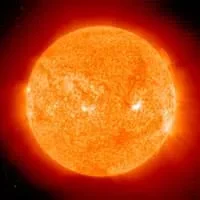 The sun serves as a source of energy for all living things on Earth.Copyright NASA Goddard Space Flight Center http://umbra.nascom.nasa.gov/images/latest_eit_304.gif
Through a teacher-led discussion, students realize that the food energy plants obtain comes from sunlight via the plant process of photosynthesis. They learn what photosynthesis is, at an age-appropriate level of detail and vocabulary, and then begin to question how we know that photosynthesis occurs, if we cannot see it happening. This prepares students for the associated activity using Elodea, a common water plant suitable to directly observe evidence of photosynthesis. When Elodea is placed in a glass beaker near a good light source, bubbles of oxygen release as products of photosynthesis. By counting the number of bubbles that rise to the surface in a five-minute period, students can compare the photosynthetic activity of Elodea in the presence of high and low light levels.
Students perform data analysis and reverse engineering to understand how photosynthesis works. Both are important aspects of being an engineer.
After this lesson, students should be able to:
- Explain that photosynthesis is a process that plants use to convert light energy into glucose, a source of stored chemical energy for the plant.
- Summarize photosynthesis as a chemical process in which plants use carbon dioxide and water to form glucose and oxygen.
- MS-LS1-6 Construct a scientific explanation based on evidence for the role of photosynthesis in the cycling of matter and flow of energy into and out of organisms.
Grades 6-8
This resource focuses on the following Three Dimensional Learning aspects of NGSS:
Science & Engineering Practices- Construct a scientific explanation based on valid and reliable evidence obtained from sources (including the students' own experiments) and the assumption that theories and laws that describe the natural world operate today as they did in the past and will continue to do so in the future.Do you agree with this alignment?
- Science knowledge is based upon logical connections between evidence and explanations.Do you agree with this alignment?
Disciplinary Core Ideas- Plants, algae (including phytoplankton), and many microorganisms use the energy from light to make sugars (food) from carbon dioxide from the atmosphere and water through the process of photosynthesis, which also releases oxygen. These sugars can be used immediately or stored for growth or later use.Do you agree with this alignment?
- The chemical reaction by which plants produce complex food molecules (sugars) requires an energy input (i.e., from sunlight) to occur. In this reaction, carbon dioxide and water combine to form carbon-based organic molecules and release oxygen.Do you agree with this alignment?
Crosscutting Concepts- Within a natural system, the transfer of energy drives the motion and/or cycling of matter.Do you agree with this alignment?
Do you agree with this alignment? - Construct a scientific explanation based on valid and reliable evidence obtained from sources (including the students' own experiments) and the assumption that theories and laws that describe the natural world operate today as they did in the past and will continue to do so in the future.
- 6.L.1 Understand the structures, processes and behaviors of plants that enable them to survive and reproduce.
Grade 6
Do you agree with this alignment? - 6.L.1.2 Explain the significance of the processes of photosynthesis, respiration, and transpiration to the survival of green plants and other organisms.
Grade 6
Do you agree with this alignment? - 6.L.2.3 Summarize how the abiotic factors (such as temperature, water, sunlight, and soil quality) of biomes (freshwater, marine, forest, grasslands, desert, Tundra) affect the ability of organisms to grow, survive and/or create their own food through photosynthesis.
Grade 6
Do you agree with this alignment?
Plants make their own fuel, a simple sugar called glucose. They make it through the process of photosynthesis, which for almost all plants, occurs in the leaves. The simple description of photosynthesis is that plants are able to absorb light energy from the sun, and use this energy to combine carbon dioxide and water in such a way as to form glucose and oxygen. The glucose that is created provides the fuel for all the plant's internal activities. Thus, plants do not need to eat because they make their own food source.
In reality, photosynthesis is a highly complex process. It occurs in small structures in the leaf cells called chloroplasts. These are microscopic in size but can easily be seen in some plants with an ordinary light microscope (see the Lesson Extension Activity section). Chloroplasts are bright green in color and oblong in shape.The chemical chlorophyll, with which they are filled, is what gives them their color, and makes the entire leaf green as well.
Chlorophyll is remarkable because when light strikes it, it is able to convert the light energy into a form of chemical energy. This first part of photosynthesis is known as the light reactions. Through a series of events within the chloroplast, the chemical energy is used to split water molecules into hydrogen and oxygen.This splitting of water molecules in turn provides hydrogen and an energy source for the second part of photosynthesis, the Calvin cycle. In the meantime, though, the oxygen from the split water molecules is not needed, so it is released to the outside world through pores in the leaf surface.
The light reactions make up the photo part of photosynthesis, and the Calvin cycle makes up the synthesis part. The Calvin cycle consists of a series of chemical reactions in which carbon dioxide, taken in from the atmosphere through the same pores in the leaf that allow the passage of oxygen, is combined with water molecules to form glucose. Like the light reactions, the reactions of the Calvin cycle also take place within the chloroplasts. And while the Calvin cycle does not require light (it used to be known as "the dark reactions"), it nevertheless cannot occur unless preceded by the light reactions.
Once glucose molecules are produced by the plant, these can be used as a fuel source for the plant's immediate needs, or they can be stored for future use. In the latter case, two or more glucose molecules are usually combined into more complex sugars known as starches. These starches are very familiar to us as the part of the potato plant that we eat, along with the fleshy parts of fruits such as apples, pears, melons and strawberries. Cellulose is another familiar combination of glucose molecules. It makes up the support structures for the plant, so it is what makes celery crisp, tree trunks strong and grass fibrous. Refer to the Bubbling Plants Experiment to Quantify Photosynthesis activity to have students learn a simple technique for quantifying the amount of photosynthesis that occurs in a given period of time.
Body of Lesson
When you ask students how plants obtain food to grow and sustain themselves, students may respond that they get food from the soil. Some may even think that the roots somehow eat soil. Explain that plants do get some things from the soil, but they do not eat it. Instead, plant roots are able to remove water from the soil. Since soil contains minerals, the water that is taken up by the roots will contain small amounts of these minerals, and these are needed by the plant. However, they cannot really be considered food for the plant. If these minerals alone were enough to sustain the plant, it would be like us humans being able to live and grow by simply taking a vitamin pill each day, without eating anything else.
Explain that instead, plants are able to make their own food, and then use that food in much the same way that we use food: it provides a source of energy for all their activities. While we do not normally think of plants as active, inside the plant a lot going on. Plants grow by making new parts of the plant, and they also make new plants, mainly by producing flowers, seeds and fruits. They are also able to repair damage from having parts eaten by insects and other animals, and repair wounds, such as when a storm or hail breaks branches and leaves.
Next, explain how plants make their own food from the process of photosynthesis. Students can also learn the simplified "equation" for photosynthesis:
light + carbon dioxide + water > glucose + oxygen
Emphasize, however, that this process cannot happen without the chemical chlorophyll.
Pick three or four students and ask them to name their favorite foods. As they answer, point out the source plant or animal of the food. For example, if a student says "ice cream," respond by saying something like, "Hmmm, that's mostly milk or cream, from a cow, and sugar, from the sugar cane plant." If a student says "chocolate cake," respond with "That's flour, sugar, eggs and chocolate: flour from wheat plants, sugar from sugar cane or beets, eggs from chickens, and chocolate from the cocoa bean, which comes from a rain forest tree."
Next, point out that these foods all come from either animals (meat, fish, milk, eggs), or plants. These are foods that humans eat, and we need to eat to fuel our bodies so they function correctly. But what about other animals, such as the cows and chickens, whose meat, milk or eggs we eat? What do they eat? (Expect students to respond that cows eat grass and chickens eat plants, seeds and insects.)
Then ask students, "What do plants eat, then?" Expect students to know that plants do not eat, except for the few that consume insects, such as pitcher plants and Venus flytraps. If most plants do not eat, how do they grow and fuel themselves to make fruits and seeds and new leaves, etc.? All other living things need food, so what about plants? How plants fuel themselves is the subject of this lesson.
If a house plant is available in your classroom, ask students to look at it carefully and see if they can find any evidence that photosynthesis is occurring. If you do not have a plant or one to borrow, take a walk outside to a small tree bearing green leaves or a patch of green grass, and ask the same question.
This is actually a trick question, because there is no evidence that photosynthesis is occurring. Students may suggest that the green color of the leaves is evidence. However, the green color is only evidence that the leaves contain something that is green, which may or may not be chlorophyll. Even if it is chlorophyll, there is still no way to determine if the chlorophyll is involved in photosynthesis at the moment.
Since we cannot see photosynthesis, how do we know it is happening Ask students if they have any ideas. It is unlikely that they will come up with any practical suggestions, especially since carbon dioxide and oxygen are invisible gasses. Any means to detect these gasses as they move to or from the atmosphere would require expensive and complicated equipment. You can, however, let the class know that you have an idea, and they can try it in the activity that follows.
Concluding Questions: Ask students questions, such as:
- What things are needed in order for photosynthesis to occur?
- What are the products of photosynthesis?
- Where in the plant does photosynthesis occur?
- Why do plants need water in order to survive?
Using the same Elodea aquarium plants (available at pet stores) that are used for the associated activity, have students look through microscopes at leaf cells to easily spot the chloroplasts. To do this, students need to prepare microscope slides by placing a single drop of tap water in the center of the slide. Next, snip the tip off a single Elodea leaf to provide a somewhat triangular piece of leaf, about 3 - 6 millimeters in length. With the leaf tip on a finger or the scissors, touch it to the water drop on the slide and let it float off into the water. Then lower a clean cover slip onto the water drop. Holding the cover slip at an angle while lowering it onto the water helps to prevent trapping air bubbles in the preparation.
Using low power, direct students to look for a good viewing area of the leaf -- an area that is free of air bubbles and where the leaf is not folded over onto itself. The structure of the leaf resembles a brick wall made of plant cells. At a higher power, about 100X, the chloroplasts are readily apparent as bright green, round or football-shaped objects inside the cells. Most likely they are arranged along the cell walls, with about one to two dozen in each cell.
- Do Plants Eat? All About Photosynthesis
Contributors
Mary R. Hebrank
Supporting Program
Engineering K-PhD Program, Pratt School of Engineering, Duke University
Acknowledgements
This content was developed by the MUSIC (Math Understanding through Science Integrated with Curriculum) Program in the Pratt School of Engineering at Duke University under National Science Foundation GK-12 grant no. DGE 0338262. However, these contents do not necessarily represent the policies of the NSF, and you should not assume endorsement by the federal government.
Copyright
2013 by Regents of the University of Colorado; original © 2004 Duke University