
Building Roller Coasters
Students build their own small-scale model roller coasters using pipe insulation and marbles, and then analyze them using physics principles learned in the associated lesson. They examine conversions between kinetic and potential energy and frictional effects to design roller coasters that are completely driven by gravity. A class competition using different marbles types to represent different passenger loads determines the most innovative and successful roller coasters.
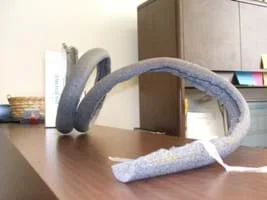 Example student-built marble rollercoaster.Copyright 2007 Engineering K-PhD Program, Pratt School of Engineering, Duke University
During the design of model roller coasters, students encounter many of the same issues that real-world roller coaster engineers address. In order to build working roller coasters, students must recognize the constraints placed on their designs and the design of real roller coasters by the fundamental laws of physics. Students learn that their ability to understand and work within these constraints is paramount to the success of their roller coasters.
After this activity, students should be able to:
- Explain why it is important for engineers to understand how roller coasters work.
- Explain in physics terms how their model roller coasters work.
- Discuss the effects of gravity and friction in the context of their roller coaster designs.
- Use the principle of conservation of energy to explain the design and layout of roller coasters.
- Identify points in a roller coaster track at which a car has maximum kinetic and potential energy.
- Identify points in a roller coaster track where a car experiences more or less than 1 g-force.
- Identify points in a roller coaster track where a car accelerates and decelerates.
- CCSS.Math.Content.6.NS.B.2 Fluently divide multi-digit numbers using the standard algorithm.
Grade 6
Do you agree with this alignment? - CCSS.Math.Content.6.NS.B.3 Fluently add, subtract, multiply, and divide multi-digit decimals using the standard algorithm for each operation.
Grade 6
Do you agree with this alignment? - CCSS.Math.Content.6.RP.A.3d Use ratio reasoning to convert measurement units; manipulate and transform units appropriately when multiplying or dividing quantities.
Grade 6
Do you agree with this alignment? - CCSS.Math.Content.8.SP.A.1 Construct and interpret scatter plots for bivariate measurement data to investigate patterns of association between two quantities. Describe patterns such as clustering, outliers, positive or negative association, linear association, and nonlinear association.
Grade 8
Do you agree with this alignment?
- Students will develop an understanding of the attributes of design.
Grades K-12
Do you agree with this alignment? - Students will develop an understanding of engineering design.
Grades K-12
Do you agree with this alignment? - Students will develop an understanding of the role of troubleshooting, research and development, invention and innovation, and experimentation in problem solving.
Grades K-12
Do you agree with this alignment? - Requirements for design are made up of criteria and constraints.
Grades 6-8
Do you agree with this alignment? - Brainstorming is a group problem-solving design process in which each person in the group presents his or her ideas in an open forum.
Grades 6-8
Do you agree with this alignment? - Make two-dimensional and three-dimensional representations of the designed solution.
Grades 6-8
Do you agree with this alignment? - Energy is the capacity to do work.
Grades 6-8
Do you agree with this alignment? - Energy can be used to do work, using many processes.
Grades 6-8
Do you agree with this alignment? - STEL-7J Evaluate designs based on criteria, constraints, and standards.
Grades 3-5
Do you agree with this alignment? - STEL-7S Create solutions to problems by identifying and applying human factors in design.
Grades 6-8
Do you agree with this alignment?
- MS-ETS1-4 Develop a model to generate data for iterative testing and modification of a proposed object, tool, or process such that an optimal design can be achieved.
Grades 6-8
This resource focuses on the following Three Dimensional Learning aspects of NGSS:
Science & Engineering Practices- Develop a model to generate data to test ideas about designed systems, including those representing inputs and outputs.Do you agree with this alignment?
Disciplinary Core Ideas- Models of all kinds are important for testing solutions.Do you agree with this alignment?
- The iterative process of testing the most promising solutions and modifying what is proposed on the basis of the test results leads to greater refinement and ultimately to an optimal solution.Do you agree with this alignment?
Do you agree with this alignment? - Develop a model to generate data to test ideas about designed systems, including those representing inputs and outputs.
- MS-PS3-2 Develop a model to describe that when the arrangement of objects interacting at a distance changes, different amounts of potential energy are stored in the system.
Grades 6-8
This resource focuses on the following Three Dimensional Learning aspects of NGSS:
Science & Engineering Practices- Develop a model to describe unobservable mechanisms.Do you agree with this alignment?
Disciplinary Core Ideas- A system of objects may also contain stored (potential) energy, depending on their relative positions.Do you agree with this alignment?
- When two objects interact, each one exerts a force on the other that can cause energy to be transferred to or from the object.Do you agree with this alignment?
Crosscutting Concepts- Models can be used to represent systems and their interactions—such as inputs, processes and outputs—and energy and matter flows within systems.Do you agree with this alignment?
Do you agree with this alignment? - Develop a model to describe unobservable mechanisms.
- MS-PS3-5 Construct, use, and present arguments to support the claim that when the kinetic energy of an object changes, energy is transferred to or from the object.
Grades 6-8
This resource focuses on the following Three Dimensional Learning aspects of NGSS:
Science & Engineering Practices- Construct, use, and present oral and written arguments supported by empirical evidence and scientific reasoning to support or refute an explanation or a model for a phenomenon.Do you agree with this alignment?
- Science knowledge is based upon logical and conceptual connections between evidence and explanations.Do you agree with this alignment?
Disciplinary Core Ideas- When the motion energy of an object changes, there is inevitably some other change in energy at the same time.Do you agree with this alignment?
Crosscutting Concepts- Energy may take different forms (e.g. energy in fields, thermal energy, energy of motion).Do you agree with this alignment?
Do you agree with this alignment? - Construct, use, and present oral and written arguments supported by empirical evidence and scientific reasoning to support or refute an explanation or a model for a phenomenon.
- CCSS.Math.Content.6.NS.B.2 Fluently divide multi-digit numbers using the standard algorithm.
Grade 6
Do you agree with this alignment? - CCSS.Math.Content.6.NS.B.3 Fluently add, subtract, multiply, and divide multi-digit decimals using the standard algorithm for each operation.
Grade 6
Do you agree with this alignment? - CCSS.Math.Content.6.RP.A.3d Use ratio reasoning to convert measurement units; manipulate and transform units appropriately when multiplying or dividing quantities.
Grade 6
Do you agree with this alignment? - CCSS.Math.Content.8.SP.A.1 Construct and interpret scatter plots for bivariate measurement data to investigate patterns of association between two quantities. Describe patterns such as clustering, outliers, positive or negative association, linear association, and nonlinear association.
Grade 8
Do you agree with this alignment?
- 6.P.3 Understand characteristics of energy transfer and interactions of matter and energy.
Grade 6
Do you agree with this alignment? - 7.P.2 Understand forms of energy, energy transfer and transformation and conservation in mechanical systems.
Grade 7
Do you agree with this alignment? - 7.P.2.1 Explain how kinetic and potential energy contribute to the mechanical energy of an object.
Grade 7
Do you agree with this alignment? - 7.P.2.2 Explain how energy can be transformed from one form to another (specifically potential energy and kinetic energy) using a model or diagram of a moving object (roller coaster, pendulum, or cars on ramps as examples).
Grade 7
Do you agree with this alignment?
Each group needs:
- 2-meter (6 foot) long foam tube (1/2" pipe insulation) cut in half lengthwise (Usually, one side of the tube comes perforated, making it easy to use scissors or a utility knife to cut through the perforation and the other side of the tube to form two halves, essentially making two long channels perfectly shaped to hold marbles; thus, one cut tube provides the track material for two groups; see Figures 1 and 2.)
- glass marble
- wooden marble
- steel marble
- paper or plastic cup
- roll of masking tape
- set of markers, crayons or pencils
- blank sheet of paper
- stopwatch
- Roller Coaster Specifications Worksheet (PDF), one per student or one per group
- Suggested Scoring Rubric (PDF), one per group
Students need basic prior knowledge about forces, particularly gravity and friction, as well as some familiarity with kinetic and potential energy. They should also know Newton's second law of motion and understand basic concepts of motion, such as position, velocity and acceleration. Prior to conducting this activity, teach students the physics and engineering concepts in the Physics of Roller Coasters lesson.
During today's activity, you are going to design your own model roller coasters using foam tubes and marbles. I'd like for you to start by drawing your roller coaster on paper before building it. Along with your drawing, give your roller coaster a fun and descriptive name and make a sign for it.
(At this point, show students photographs of some real roller coasters to help them imagine the possibilities for their own coasters. See examples of some of the best current roller coasters in the country at https://www.ultimaterollercoaster.com/coasters/pictures/.)
When engineers design objects and structures, such as the appliances in your homes and other products you use, bridges and roadways, skyscrapers and other structures like amusement park rides, or even bicycles and chair lifts at ski resorts, they work within what they call "constraints." Constraints are project requirements and/or limitations. Engineers must take into consideration these constraints in order to come up with successful design solutions.
In the case of designing roller coasters, what might be some constraints that engineers would have to consider? (Let students think about this and make some suggestions.) Yes, they might have some practical limitations, such as available or preferred building materials, a construction budget and timeframe, safety measures for users, ongoing maintenance requirements and/or anticipated weather conditions. The amusement park client may also give requirements for the type of movement they want for the ride, such as upside-down loops, corkscrews, specific degree turns, length of drops or maximum speed, or safety assurances for users (safe for people taller than four feet high). Another basic constraint that always applies is consideration of the natural physical laws that exist in our world, such as the limits of gravity and effects of slope, speed and friction. This is an example of how an engineer's understanding of the fundamental laws of physics is very important to the success of a project. Coming up with a design solution that takes all these factors into consideration and works reliably, safely and as intended is what engineers do.
When designing your roller coaster, what are the physics concepts that you have learned that will be helpful and very important to apply? (Listen to student ideas. Correct and amend, as necessary. Expect them to suggest ideas from the content they learned in the associated lesson about gravitational potential energy, kinetic energy, gravity and friction.)
That's right, all true roller coasters are entirely driven by the force of gravity. The excitement of a ride comes from the ongoing conversion between potential and kinetic energy, which we know from the law of conservation of energy. Friction is important to slowing down roller coaster cars and acceleration plays a role in the experience provided by roller coaster cars as they move along a track.
And how do these concepts translate to your challenge to design a roller coaster that provides a thrilling experience that is safe for riders? (Listen to student answers. Expect to hear them bring up the following points, which they must understand in order to build and analyze their model roller coasters:
- The top of the first hill must be the highest point on the roller coaster.
- Cars move fastest at the bottoms of hills and slowest at the tops of hills.
- Friction converts useful energy into heat and must be minimized.
- G-forces greater than 1 occur at the bottoms of hills.
- G-forces less than 1 occur at the tops of hills.
- To avoid falling, cars must have a certain velocity at the tops of loops.)
That's right. These are constraints we must take seriously. The first hill must be the highest point or the roller coaster won't work. If a car is not moving fast enough at the top of a loop it will fall off the track. Pay attention to the friction between the car and the track, making it as small as you can so the cars move fast enough to make it through the entire track. Let's get started!
Before the Activity
- Gather materials and make copies of the worksheet and scoring rubric.
- Cut each tube in half lengthwise, so each group receives one length of tube that is channel-shaped to serve as the roller coaster track for the marbles (cars). Use scissors or a utility knife to cut through the perforated side of the tube to form two halves. Give each group one of these halves. This process is shown in Figures 1 and 2.
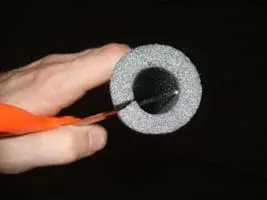 Figure 1. End view of cutting a tube of insulation lengthwise.Copyright 2007 Engineering K-Ph.D. Program, Pratt School of Engineering, Duke University
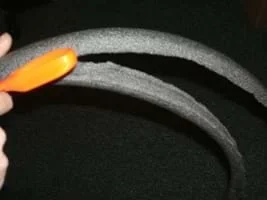 Figure 2. Side view of cutting a tube of insulation lengthwise.Copyright 2007 Engineering K-Ph.D. Program, Pratt School of Engineering, Duke University
- Review the Teach Engineering lesson, Time for Design, which outlines the steps of the engineering design process. Following these steps while building their roller coasters helps students learn exactly how roller coaster engineers solve problems.
With the Students
- Divide the class into engineering groups of three or four students each.
- Hand out the scoring rubrics for the class competition. The list of creativity points provides students with guidance as to the coaster features (height, turns, loops and corkscrews) that are desired in the design and the list of performance points provides a way to judge the safety of the coasters. Tell the students: In our roller coaster models, the glass marble simulates a normal car, the wooden marble represents an empty car, and a steel marble represents a full car. Your team will earn points for each type of marble (passenger load) that successfully completes your track and lands safely in the cup. A class competition will determine the most innovative and successful roller coasters.
- Have groups start designing their roller coasters, brainstorming and sharing ideas and agreeing on a design. Have students draw their roller coasters on paper, name them, and make signs. Allow up to 30 minutes for this. Look over their drawings to ensure that their proposed designs are physically possible. If not, point out those aspects of the roller coaster design that they may want to rethink. Give them time to iterate their designs.
- Give each group a foam tube track, masking tape and cup, and let them build their roller coasters using classroom materials. Expect students to be able to build their first design in 10 minutes or less. Use the cup to catch the marble at the track end.
- Give students marbles so they are able to test their roller coasters and make any necessary changes. This is the most time-consuming step and students may need up to 45 minutes to redesign their tracks.
- Hand out a stopwatch to each group and give them time to complete the worksheet, in which they determine certain specifications of their roller coasters.
- Start the class competition by telling the students: Similar to what you did today, engineers create small-scale models to help them test and analyze their structural designs. For example, the engineers who designed the Golden Gate Bridge in San Francisco were pioneering new suspension bridge design theory. They verified their complex calculations (all done without computers in the 1930s) of the forces it would need to withstand by performing tests on a steel tower model at 1:56 scale. That's 56 times smaller than one of the actual bridge towers. The tests confirmed that the tower calculations of the anticipated forces, including wind/earthquake deflections, were sound—and the bridge still stands today, more than 75 years later.
- Have each group present its roller coaster model to the class. Use the scoring rubric to evaluate the roller coaster model designs. Discuss the results as a class, as described in the Assessment section.
- force
- Any push or pull.
- gravity
- A force that draws any two objects toward one another.
- speed
- How fast an object moves and is equal to the distance that object travels divided by the time it takes.
- velocity
- A combination of speed and the direction in which an object travels.
- critical velocity
- The speed needed at the top of a loop for a car to make it through the loop without falling off the track.
- acceleration
- How quickly an object speeds up, slows down or changes direction. Is equal to change in velocity divided by time.
- friction
- A force caused by rubbing between two objects.
- potential energy
- The energy stored by an object ready to be used. (In this lesson, we use gravitational potential energy, which is directly related to the height of an object and its mass.)
- kinetic energy
- The energy of an object in motion, which is directly related to its velocity and its mass.
- gravitational constant
- The acceleration caused by the Earth's gravity at sea level. Is equal to 9.81 m/sec^2 (32.2 ft/sec^2).
- g-force
- Short for gravitational force. Is equal to the force exerted on an object by the Earth's gravity at sea level.
Activity Embedded Assessment
Applied Physics: Check that each group understands how and why its roller coaster works. If a roller coaster is not working, ask students what they think the problem is. See if they can identify physics constraints and explain problems such as "It's not high enough," or "The marbles rub too much" in physics terms such as "It doesn't have enough potential energy because it's not high enough," or "The friction between the marble and the track is too great."
Determining Velocity: Have students measure the length of their roller coaster (i.e., can measure the distance of the length of tubing) and the time it takes for the marble to complete the track. Ask students to calculate the velocity of the marble in m/s as well as in ft/s.
Graphing: During testing, graph the relationship between the height of the first hill (independent) and the average velocity of the marble (dependent); describe the relationship (e.g., as the height increases, the velocity increases),
Post-Activity Assessment
Worksheet: Have each student (or each group) complete the Roller Coaster Specifications Worksheet (PDF), which asks them to identify some critical points of the roller coaster as well as other specifications such as height and the number of loops and turns. Review students' answers to gauge their comprehension of the concepts.
Presentations: Have each group present its roller coaster model to the class. Use the Suggested Scoring Rubric (PDF) to evaluate the roller coasters for the class competition. Discuss the results as a class, asking students:
- Which roller coasters were most exciting? Which were safest?
- Which won for creativity? Which won for performance and safety?
- Which model best met the overall challenge for both thrilling design and safety? What were the trade-offs? (Point to make: Engineers call this optimization, balancing competing project requirements.)
- What did you learn from testing your model?
- If you were to redesign your roller coaster, what improvements would you make and why?
- What would happen if you/engineers ignored the fundamental laws of physics in your/their designs?
- How important is it to you that engineers test their designs (for appliances, cars, bridges, stairways, roller coasters, etc.) before they are built and people use them?
- What engineering design steps and techniques did we use today? (Answer: Brainstorming, modeling, simulation, testing, analyzing, redesign, optimization.)
- Make sure that students do not swallow or throw the marbles.
- Slipping on marbles on the floor could be dangerous. Have students immediately pick up any fallen marbles.
If students have difficulty getting their roller coasters to work, revisit the basic physics considerations:
- Make sure that the highest point of the roller coaster is at the beginning.
- Reduce friction by checking that the track is wide enough for the marbles to pass.
- Any track deformation occurring when marbles are rolled down the track results in a loss of energy, so make the roller coaster as stable as possible by taping it to supports (textbooks, walls, desks, chairs, shelves) at several points.
- For lower grade levels, eliminate much of the physics exploration behind the lesson content. Have students build their own roller coasters and discover for themselves many of the concepts that are discussed in detail at higher grade levels (such as energy conservation, friction and gravity), and they may also be capable of understanding some basic explanations of friction and gravity.
- For higher grades, introduce equations for potential and kinetic energy so students can calculate both forms of energy and verify the law of conservation of energy. Have students explore loops along with the concept of critical velocity. Have students find the starting height of a roller coaster necessary to complete a loop of a given height.
History of the Design and Construction of the Bridge: Engineering Design. Posted 2006-2012. Golden Gate Bridge Highway & Transportation District. Accessed November 20, 2013. http://goldengate.org/exhibits/exhibitarea4_2.php
- Physics of Roller Coasters
- Building Roller Coasters
Browse the NGSS Engineering-aligned Physics Curriculum hub for additional Physics and Physical Science curriculum featuring Engineering.
Contributors
Scott Liddle
Supporting Program
Engineering K-PhD Program, Pratt School of Engineering, Duke University
Acknowledgements
This content was developed by the MUSIC (Math Understanding through Science Integrated with Curriculum) Program in the Pratt School of Engineering at Duke University under National Science Foundation GK-12 grant no. DGE 0338262. However, these contents do not necessarily represent the policies of the NSF, and you should not assume endorsement by the federal government.
Copyright
2013 by Regents of the University of Colorado; original © 2007 Duke University