
Physics of Roller Coasters
Students explore the physics exploited by engineers in designing today's roller coasters, including potential and kinetic energy, friction and gravity. First, they learn that all true roller coasters are completely driven by the force of gravity and that the conversion between potential and kinetic energy is essential to all roller coasters. Second, they consider the role of friction in slowing down cars in roller coasters. Finally, they examine the acceleration of roller coaster cars as they travel around the track. During the associated activity, students design, build and analyze model roller coasters they make using foam tubing and marbles (as the cars).
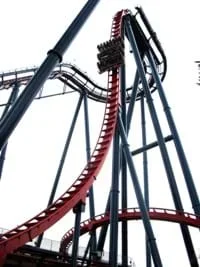 As the cars drop, potential energy provided by the chain lift on the left is converted to kinetic energy.Copyright Stock.XCHNG (free stock photo) http://www.SXC.hu
Students explore the most basic physical principles of roller coasters, which are crucial to the initial design process for engineers who create roller coasters. They learn about the possibilities and limitations of roller coasters within the context of energy conservation, frictional losses and other physical principles. After the lesson, students should be able to analyze the motion of any existing gravity-driven coaster and design the basics of their own model roller coasters.
After this activity, students should be able to:
- Explain why it is important for engineers to know how roller coasters work.
- Explain in physics terms how a roller coaster works.
- Discuss the effects of gravity and friction in the context of their roller coaster designs.
- Use the principle of conservation of energy to explain the layout of roller coasters.
- Identify points in a roller coaster track at which a car has maximum kinetic energy and maximum potential energy.
- Identify points in a roller coaster track where a car experiences more or less than 1 g-force.
- Identify points in a roller coaster track where a car accelerates and decelerates.
- Energy is the capacity to do work.
Grades 6-8
Do you agree with this alignment? - Energy can be used to do work, using many processes.
Grades 6-8
Do you agree with this alignment?
- MS-PS3-5 Construct, use, and present arguments to support the claim that when the kinetic energy of an object changes, energy is transferred to or from the object.
Grades 6-8
This resource focuses on the following Three Dimensional Learning aspects of NGSS:
Science & Engineering Practices- Science knowledge is based upon logical and conceptual connections between evidence and explanations.Do you agree with this alignment?
Disciplinary Core Ideas- When the motion energy of an object changes, there is inevitably some other change in energy at the same time.Do you agree with this alignment?
Crosscutting Concepts- Energy may take different forms (e.g. energy in fields, thermal energy, energy of motion).Do you agree with this alignment?
Do you agree with this alignment? - Science knowledge is based upon logical and conceptual connections between evidence and explanations.
- 6.P.3 Understand characteristics of energy transfer and interactions of matter and energy.
Grade 6
Do you agree with this alignment? - 7.P.2 Understand forms of energy, energy transfer and transformation and conservation in mechanical systems.
Grade 7
Do you agree with this alignment? - 7.P.2.1 Explain how kinetic and potential energy contribute to the mechanical energy of an object.
Grade 7
Do you agree with this alignment? - 7.P.2.2 Explain how energy can be transformed from one form to another (specifically potential energy and kinetic energy) using a model or diagram of a moving object (roller coaster, pendulum, or cars on ramps as examples).
Grade 7
Do you agree with this alignment?
An understanding of forces, particularly gravity and friction, as well as some familiarity with kinetic and potential energy. An understanding of Newton's second law of motion and basic motion concepts such as position, velocity and acceleration.
The underlying principle of all roller coasters is the law of conservation of energy, which describes how energy can neither be lost nor created; energy is only transferred from one form to another. In roller coasters, the two forms of energy that are most important are gravitational potential energy and kinetic energy. Gravitational potential energy is the energy that an object has because of its height and is equal to the object's mass multiplied by its height multiplied by the gravitational constant (PE = mgh). Gravitational potential energy is greatest at the highest point of a roller coaster and least at the lowest point. Kinetic energy is energy an object has because of its motion and is equal to one-half multiplied by the mass of an object multiplied by its velocity squared (KE = 1/2 mv2). Kinetic energy is greatest at the lowest point of a roller coaster and least at the highest point. Potential and kinetic energy can be exchanged for one another, so at certain points the cars of a roller coaster may have just potential energy (at the top of the first hill), just kinetic energy (at the lowest point) or some combination of kinetic and potential energy (at all other points).
The first hill of a roller coaster is always the highest point of the roller coaster because friction and drag immediately begin robbing the car of energy. At the top of the first hill, a car's energy is almost entirely gravitational potential energy (because its velocity is zero or almost zero). This is the maximum energy that the car will ever have during the ride. That energy can become kinetic energy (which it does at the bottom of this hill when the car is moving fast) or a combination of potential and kinetic energy (like at the tops of smaller hills), but the total energy of the car cannot be more than it was at the top of the first hill. If a taller hill were placed in the middle of the roller coaster, it would represent more gravitational potential energy than the first hill, so a car would not be able to ascend to the top of the taller hill.
Cars in roller coasters always move the fastest at the bottoms of hills. This is related to the first concept in that at the bottom of hills all of the potential energy has been converted to kinetic energy, which means more speed. Likewise, cars always move the slowest at their highest point, which is the top of the first hill.
A web-based simulation demonstrating the relationship between vertical position and the speed of a car in a roller coaster various shapes is provided at the MyPhysicsLab Roller Coaster Physics Simulation. This website provides numerical data for simulated roller coaster of various shapes.
Friction exists in all roller coasters, and it takes away from the useful energy provided by roller coaster. Friction is caused in roller coasters by the rubbing of the car wheels on the track and by the rubbing of air (and sometimes water!) against the cars. Friction turns the useful energy of the roller coaster (gravitational potential energy and kinetic energy) into heat energy, which serves no purpose associated with propelling cars along the track. Friction is the reason roller coasters cannot go on forever, so minimizing friction is one of the biggest challenges for roller coaster engineers. Friction is also the reason that roller coasters can never regain their maximum height after the initial hill unless a second chain lift is incorporated somewhere on the track.
Cars can only make it through loops if they have enough speed at the top of the loop. This minimum speed is referred to as the critical velocity, and is equal the square root of the radius of the loop multiplied by the gravitational constant (vc = (rg)1/2). While this calculation is too complex for the vast majority of seventh graders, they will intuitively understand that if a car is not moving fast enough at the top of a loop it will fall. For safety, most roller coasters have wheels on both sides of the track to prevent cars from falling.
Most roller coaster loops are not perfectly circular in shape, but have a teardrop shape called a clothoid. Roller coaster designers discovered that if a loop is circular, the rider experiences the greatest force at the bottom of the loop when the cars are moving fastest. After many riders sustained neck injuries, the looping roller coaster was abandoned in 1901 and revived only in 1976 when Revolution at Six Flags Magic Mountain became the first modern looping roller coaster using a clothoid shape. In a clothoid, the radius of curvature of the loop is widest at the bottom, reducing the force on the riders when the cars move fastest, and smallest at the top when the cars are moving relatively slowly. This allowed for a smoother, safer ride and the teardrop shape is now in use in roller coasters around the world.
Riders may experience weightlessness at the tops of hills (negative g-forces) and feel heavy at the bottoms of hills (positive g-forces). This feeling is caused by the change in direction of the roller coaster. At the top of a roller coaster, the car goes from moving upward to flat to moving downward. This change in direction is known as acceleration and the acceleration makes riders feel as if a force is acting on them, pulling them out of their seats. Similarly, at the bottom of hills, riders go from moving downward to flat to moving upward, and thus feel as if a force is pushing them down into their seats. These forces can be referred to in terms of gravity and are called gravitational forces, or g-forces. One "g" is the force applied by gravity while standing on Earth at sea level. The human body is used to existing in a 1 g environment. If the acceleration of a roller coaster at the bottom of a hill is equal to the acceleration of gravity (9.81 m/s2), another g-force is produced and, when added to the standard 1 g, we get 2gs. If the acceleration at the bottom of the hill is twice the acceleration of gravity, the overall force is 3 gs. If this acceleration acts instead at the top of a hill, it is subtracted from the standard 1 g. In this way, it can be less than 1 g, and it can even be negative. If the acceleration at the top of a hill were equal to the acceleration of gravity, the overall force would be zero gs. If the acceleration at the top of the hill were twice the acceleration of gravity, the resulting overall force would be negative 1 g. At zero gs, a rider feels completely weightless and at negative gs, they feel as though a force is lifting them out of the seat. This concept may be too advanced for students, but they should understand the basic principles and where g-forces greater than or less than 1 g can occur, even if they cannot fully relate them to the acceleration of the roller coaster.
Today's lesson is all about roller coasters and the science and engineering behind them. Before we start talking about physics, though, I'd like you to share some of your experiences with roller coasters. (Listen to a few students describe their favorite roller coasters. Point out some of the unique features of each coaster, such as hills and loops, that relate to the lesson.)
Does anyone know how roller coasters work? You might think that the roller coaster cars have engines inside them that push them along the track like automobiles. While that is true of a few roller coasters, most use gravity to move the cars along the track. Do any of you remember riding a roller coaster that started out with a big hill? If you looked closely at the roller coaster track (on which the cars move), you would see in the middle of the track on that first hill, a chain. You might have even have felt it "catch" to the cars. That chain hooks to the bottom of the cars and pulls them to the top of that first hill, which is always the highest point on a roller coaster. Once the cars are at the top of that hill, they are released from the chain and coast through the rest of the track, which is where the name roller coaster comes from.
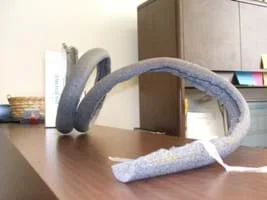 Figure 1. Example setup for quick lesson demo.Copyright 2007 Engineering K-PhD Program, Pratt School of Engineering, Duke University
What do you think would happen if a roller coaster had a hill in the middle of the track that was taller than the first hill of the roller coaster? Would the cars be able to make it up this bigger hill using just gravity? (Conduct a short demonstration to prove the point. Take a piece of foam pipe insulation cut in half lengthwise and shape it into a roller coaster by taping it to classroom objects such as a desktop and a textbook, as shown in Figure 1. Then, using marbles to represent the cars, show students that the first hill of a roller coaster must be the tallest point or the cars will not reach the end of the track. Refer to the Building Roller Coasters activity for additional instructions.)
(Next, play off other students' roller coaster experiences to move the lesson forward, covering the material provided in the Lesson Background and Vocabulary sections. For example, talk about the point in the roller coaster where you travel the fastest, how cars make it through loops and corkscrews, and what causes passengers to feel weightless or very heavy at certain points in the roller coaster. The order in which you teach these points, and possibly more, is not critical to the lesson. Also, it may be more engaging for the students to ask questions based on their experiences with roller coasters and let those questions lead the lesson from one point to the next. All of these points can be demonstrated using the foam tubing and marbles, so use them often to illustrate the lesson concepts.)
- force
- Any push or pull.
- gravity
- A force that draws any two objects toward one another.
- speed
- How fast an object moves. The distance that object travels divided by the time it takes.
- velocity
- A combination of speed and the direction in which an object travels.
- critical velocity
- The speed needed at the top of a loop for a car to make it through the loop without falling off the track.
- acceleration
- How quickly an object speeds up, slows down or changes direction. Is equal to change in velocity divided by time.
- friction
- A force caused by a rubbing motion between two objects.
- potential energy
- The energy stored by an object ready to be used. (In this lesson, we use gravitational potential energy, which is directly related to the height of an object and its mass.)
- kinetic energy
- The energy of an object in motion, which is directly related to its velocity and its mass.
- gravitational constant
- The acceleration caused by Earth's gravity at sea level. Is equal to 9.81 m/sec^2 (32.2 ft/sec^2).
- g-force
- Short for gravitational force. The force exerted on an object by the Earth's gravity at sea level.
Pre-Lesson Assessment
Before the lesson, make sure students have a firm handle on gravity, friction, potential and kinetic energy, and the basics of motion. This can be done in the form of a short quiz, a warm-up exercise or a brief discussion. Example questions:
- What causes gravity?
- What is friction?
- How do potential and kinetic energy differ?
- What is the difference between speed and velocity?
- How is acceleration related to velocity?
Lesson Summary Assessment
Show students a photograph of a roller coaster that includes a hill and a loop. Expect them to be able to identify:
- Points of maximum potential and kinetic energy.
- Points of maximum and minimum velocity.
- Points where g-forces greater or less than 1 are experienced.
Homework
Ask students to design their own roller coasters or find an existing roller coaster on the Internet and identify its characteristics in terms of the physics concepts learned in the lesson. This assignment also serves as an introduction to the associated activity, Building a Roller Coaster.
Bennett, David. Roller Coaster. Aurum Ltd., 1999.
Roller Coaster Database. Copyright 1996-2007. Duane Marden. Accessed 5/3/2007. http://www.rcdb.com/
Funderstanding Roller Coaster. Copyright 1998. Funderstanding. Accessed 5/3/2007. http://www.funderstanding.com/k12/coaster/
Loop (Roller Coaster). Last modified April 9, 2007. Wikipedia. Accessed 5/3/2007. http://en.wikipedia.org/wiki/Loop_%28roller_coaster)
Pescovitz, David. Roller Coaster Physics. Copyright 1998-1999. Encyclopedia Britannica, Inc. Accessed 5/3/2007. http://search.eb.com/coasters/ride.html
Neumann, Erik. Roller Coaster Physics Simulation. Copyright 2004. MyPhysicsLab. Accessed 5/3/2007. http://www.myphysicslab.com/RollerSimple.html
- Physics of Roller Coasters
Browse the NGSS Engineering-aligned Physics Curriculum hub for additional Physics and Physical Science curriculum featuring Engineering.
Contributors
Scott Liddle
Supporting Program
Engineering K-PhD Program, Pratt School of Engineering, Duke University
Acknowledgements
This content was developed by the MUSIC (Math Understanding through Science Integrated with Curriculum) Program in the Pratt School of Engineering at Duke University under National Science Foundation GK-12 grant no. DGE 0338262. However, these contents do not necessarily represent the policies of the NSF, and you should not assume endorsement by the federal government.
Copyright
2013 by Regents of the University of Colorado; original © 2007 Duke University