
Tracking a Virus
Students simulate the spread of a virus such as HIV through a population by "sharing" (but not drinking) the water in a plastic cup with several classmates. Although invisible, the water in a few of the cups has already be tainted with the "virus" (sodium carbonate). After all the students have shared their liquids, the contents of the cups are tested for the virus with phenolphthalein, a chemical that causes a striking color change in the presence of sodium carbonate. Students then set about trying to determine which of their classmates were the ones originally infected with the virus.
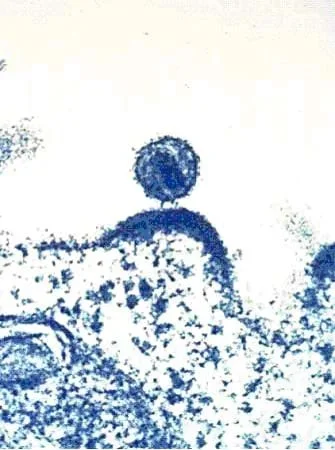 A newly made HIV virus is shown in this photomicrograph, immediately after being released from the infected immune cell just below it.Copyright NIH
Biomedical engineers and pharmacologists continue to work on developing a cure for AIDS. An understanding of the biological mechanisms behind the disease are crucial to develop a vaccine.
After students complete this activity, they will be able to:
- Describe the type of work that epidemiologists do.
- Describe what a virus is.
- Explain how a virus replicates itself once it attaches to a host cell.
- Describe how the immune system responds to a viral invasion.
- Explain why the HIV virus is unique and not readily eliminated by the immune system.
- CCSS.Math.Content.6.RP.A.3c Find a percent of a quantity as a rate per 100 (e.g., 30% of a quantity means 30/100 times the quantity); solve problems involving finding the whole, given a part and the percent.
Grade 6
Do you agree with this alignment?
- Advances and innovations in medical technologies are used to improve healthcare.
Grades 6-8
Do you agree with this alignment? - STEL-2Z Use management processes in planning, organizing, and controlling work.
Grades 9-12
Do you agree with this alignment? - STEL-3F Apply a product, system, or process developed for one setting to another setting.
Grades 6-8
Do you agree with this alignment?
- MS-LS1-3 Use argument supported by evidence for how the body is a system of interacting subsystems composed of groups of cells.
Grades 6-8
This resource focuses on the following Three Dimensional Learning aspects of NGSS:
Science & Engineering Practices- Use an oral and written argument supported by evidence to support or refute an explanation or a model for a phenomenon.Do you agree with this alignment?
Disciplinary Core Ideas- In multicellular organisms, the body is a system of multiple interacting subsystems. These subsystems are groups of cells that work together to form tissues and organs that are specialized for particular body functions.Do you agree with this alignment?
Crosscutting Concepts- Systems may interact with other systems; they may have sub-systems and be a part of larger complex systems.Do you agree with this alignment?
- Scientists and engineers are guided by habits of mind such as intellectual honesty, tolerance of ambiguity, skepticism, and openness to new ideas.Do you agree with this alignment?
Do you agree with this alignment? - Use an oral and written argument supported by evidence to support or refute an explanation or a model for a phenomenon.
- 8.L.1 Understand the hazards caused by agents of diseases that effect living organisms.
Grade 8
Do you agree with this alignment? - 8.L.1.1 Summarize the basic characteristics of viruses, bacteria, fungi and parasites relating to the spread, treatment and prevention of disease.
Grade 8
Do you agree with this alignment? - 8.L.1.2 Explain the difference between epidemic and pandemic as it relates to the spread, treatment and prevention of disease.
Grade 8
Do you agree with this alignment?
- 24-32 clear plastic drink cups, 4 to 9 ounce size
- water, preferably distilled, about 1 liter
- phenolphthalein solution, about 5 ml
- sodium carbonate (aka washing soda), 1 scant teaspoon
- disposable pipette or eye-dropper
- 24-32 small test tubes
- test tube rack
- beaker, flask, or cup
- permanent marker
- 24-32 index cards
- Tracking a Virus Worksheet (PDF) (1 per student)
- AIDS Knowledge Survey (PDF) (optional)
The associated lesson gives extensive background for this activity. Students in middle school often are aware of AIDS and HIV, but not how they are related and transmitted from person to person. AIDS can be transmitted sexually as well as through blood contact. Many students may know someone affected by AIDS or HIV, but not how viruses in general or HIV in particular work.
HIV (human immunodeficiency virus) is the virus that causes AIDS (acquired immunodeficiency syndrome) and it affects around 38 million people around the world.
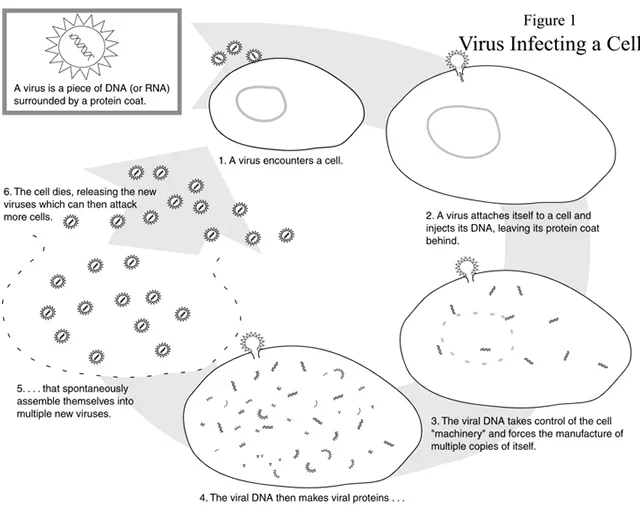
A virus is a piece of DNA/RNA surrounded by a protein coat and when infects a cell, it goes through a series of steps shown in Figure 1.
The human immune system reacts quickly when a virus invades the body, shown in Figure 2 below.
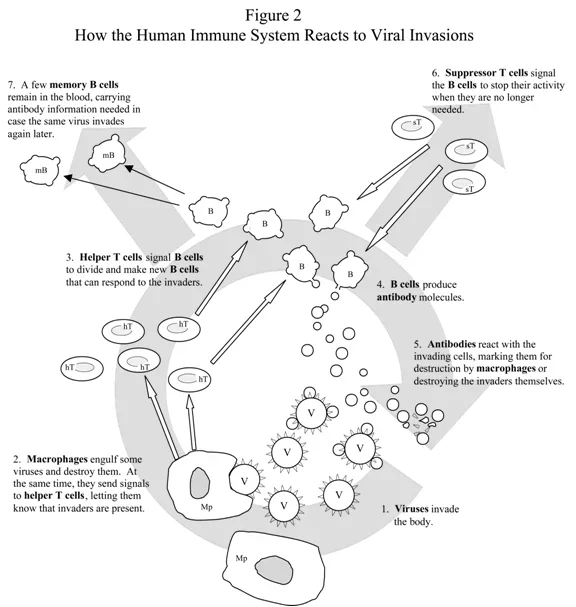
Refer to the background section in the associated lesson for more detail. Biomedical engineers and epidemiologists must understand how a virus infects the cells in our bodies and how our immune system reacts to the invasion in order to create vaccinations, protective devices, and procedures to keep us safe.
Now that you have a better understanding of how a virus infects a cell and how our immune systems work, you will swap "bodily fluids" with people in your class to simulate how a virus like HIV spreads!
Set Up
- Set the cups out on a table and place the test tubes in the rack. Using a permanent marker, number the cups 1 to 24, 28, or 32, depending on class size. Please read the information about class size in step 3 of the Conducting the Simulation section (below) before you start! Number the test tubes in the same way. It is important that the total number of cups and test tubes used is a multiple of four.
- Put about a cup of water into the beaker, and stir in the sodium carbonate (a.k.a. washing soda) until it is all dissolved and the water is clear. Choosing three of the numbered cups at random, pour this solution into them so that each cup is about one-quarter full. Pour some of the remaining solution into three of the test tubes whose numbers correspond with the cups, so that each test tube holds about an inch of solution.
- Fill the other cups about one-quarter full with water. Fill the remaining test tubes with about one inch of water. Put the test tubes somewhere out of sight.
Before the Activity
- With the students, review the different proteins in our bodies that are produced by cells:
- Hemoglobin is manufactured in developing red blood cells within our bone marrow. Hemoglobin contains iron, which gives it a great affinity for oxygen. This means that as red blood cells pass through capillaries very near to the lungs, oxygen from inhaled air passes through thin membranes and into the capillaries where it is very easily taken up by the hemoglobin molecules in the red blood cells. The oxygen is moved around the body through the circulatory system and delivered to tissues where it is needed. Hemoglobin also stores oxygen so we have a reserve of it.
- Collagen is another important protein and is the main structural protein found in animal tissue, including human, tissues. It gives our skin elasticity and is an important component of ligaments and tendons, helping to keep joints strong but flexible; it is even found in our eyes, intestines and in other parts of the body. Collagen is manufactured in different cells and places within the body but fibroblasts are the most common collagen-creating cells in the human body.
- Immunoglobulins are proteins that are often referred to as antibodies and are used by the immune system. These proteins are made by B-cells and they attach to and destroy invading cells as part of our immune system defenses.
- Have the students fill out the Tracking a Virus Worksheet (PDF).
Conducting the Simulation
- Give each student an index card on which to write his or her name. Have each student obtain a prepared cup, and then write the number that appears on the cup next to his or name on the index card.
- Explain to students that they will each "exchange bodily fluids" with three other students, one at a time, following a certain procedure:
- After choosing a classmate to "share" liquids with, one member of the pair pours all of the water from his or her cup into the partner's cup. Then the partner will pour half of the combined liquids back into the first member's cup. This way the students have mixed their two liquids, but in the end, each has the same amount they started with. Both students should record the number of the cup belonging to the person they just exchanged liquids with. (Demonstrate this exchange process with two extra cups containing tap water, emphasizing the need to record the numbers of the cups.)
- Each student should then find a different classmate to exchange liquids with, and record the cup number corresponding to this second exchange.
- Each student should then find a third student to exchange fluids with, and record the cup number corresponding to the third exchange. When all students are finished, each student should have shared liquids with exactly three other students.
- Note: This number three is important for the problem solving aspect of the exercise that follows. Thus, it is also important that the total number of participants is a multiple of 4, so classes of 24, 28 or 32 will work perfectly. If you don't have quite enough students to make a multiple of four, it is best if you recruit extra students or adults (including yourself) rather than leave any students out. Any recruits need only be present for the few minutes it takes to do the liquid exchanges. If you have 20 or fewer students, use only two "infected" cups (and test tubes) for the simulation, instead of three.
- Have students return to their seats with their index cards and cups of water. Tell the class that, unfortunately, a few of the cups contained "bodily fluids" that were infected with the AIDS virus, HIV, at the start of the simulation. By exchanging bodily fluids with their friends, it is likely that several more students are now "infected with HIV." Then walk around the room, placing a drop or two of phenolphthalein in each cup. Those cups with water that turns bright pink contain the "virus", so each student whose water is pink is now "infected" -- and contagious. Typically, at least two-thirds of the class will have become infected during the exchange process.
Tracking the Virus
- Give the students a chance to comment on the results of their "experiment." Probably they will ask who the original "infected" people were, so you should return the question to them, asking, "How can we find out?" Point out that epidemiologists are scientists and medical doctors who try to solve puzzles such as this, and epidemiology is a branch of medicine that is concerned with the causes, spread, and control of diseases in populations.
- Expect students to soon realize they need to start by eliminating those students who were not infected at the end of the experiment, and then try to work backwards from there. Treat this as a puzzle for them to solve -- try to keep out of things as much as possible. Give them time to realize that they will need to get organized and devise a systematic way to look at the data they have. They will probably realize they need one or two students at the board to lead the discussion and record information as they go along. Once they get going, it may be easy at first to eliminate students who could not have been the initially infected ones, but it will then become more difficult. They may not be able to deduce the original three infected persons, but they should be able to eliminate all but 4-6 students.
- At this point you can tell them that, fortunately, you took a "blood sample" from everyone before they started trading their "bodily fluids." Produce the rack of test tubes, and show how they are numbered to correspond to the cups that were used. Then explain that you can test for the presence of the virus using the same chemical indicator as before. Have a student volunteer put a drop of phenolphthalein in each test tube, and students will then be able to see how close they got to determining the original sources of the virus.
- epidemiology
- A branch of medicine that is concerned with the causes, spread and control of diseases in populations.
Pre-Activity Assessment
Survey: Have students complete the AIDS Knowledge Survey (PDF) to gauge their level of understanding on the topic. If they completed this during the lesson, you can skip this.
Activity Embedded Assessment
Worksheet: Observe students as they complete the activity worksheet. (PDF) Is each student engaged? Are they able to demonstrate a thorough understanding of how a virus gets into the human body and how the immune system fights off a virus? Can they describe the difference and relationship between HIV and AIDS? Review their answers to gauge their mastery of the subject.
Post-Activity Assessment
Explanations: Have students explain how the activity was a good example of how a virus spreads and how their investigative work is similar to what an epidemiologist does. Have students explain their approach to determining who the original infected persons were. Ask students to use what they learned to describe how the body is a system of interacting subsystems composed of groups of cells. Ensure they use evidence to support their argument.
Phenolphthalein, even in small doses, can act as a laxative. Caution students against drinking any of the liquids used in this activity, and have them wash their hands at the end of the activity. Clean any spills thoroughly.
- It is best to let students choose their own cups of "bodily fluids" at the beginning of the simulation, rather than handing them out. If students choose their own cups, the teacher cannot be accused of intentionally giving a student an "infected" cup. To make distribution of the cups easier, have only three or four students select their cups at a time.
- When all students have their cups and are ready to begin exchanging fluids, make sure they are on their feet, and encourage them to walk around the room and not just exchange with those right next to them. You can facilitate this by having students who are close friends situated apart from each other in different parts of the room at the onset of the activity. If students only exchange with those in close proximity, or only with their close friends in a clique, the "infection" is more likely to stay in one clump of students and not get distributed throughout the class.
Students may be interested in reading about other epidemiology case studies and how epidemiologists go about their work. Here are two possible extensions to this activity:
The CDC has several articles on COVID-19 Epidemiology, including how they determined the outbreak location, case data, and more about the disease. Students can dive into the pandemic of 2020 and relate the information learned in this activity to how COVID-19 spread so quickly.
"Disease Detectives," a National Geographic (June 1991) article that describes physician John Snow's classic work in London to discover the source of a cholera outbreak in the mid-1800s. The article also tells the story of a more contemporary outbreak in west Africa, which is particularly interesting because of the role prevailing cultural practices can play in the transmission of a disease.
- Viral Hijackers
- Tracking a Virus
Contributors
Mary R. Hebrank
Supporting Program
Engineering K-PhD Program, Pratt School of Engineering, Duke University
Acknowledgements
This content was developed by the MUSIC (Math Understanding through Science Integrated with Curriculum) Program in the Pratt School of Engineering at Duke University under National Science Foundation GK-12 grant no. DGE 0338262. However, these contents do not necessarily represent the policies of the NSF, and you should not assume endorsement by the federal government.
This activity of this curricular unit was originally published, in slightly modified form, by Duke University's Center for Inquiry Based Learning (CIBL). Please visit http://www.biology.duke.edu/cibl/ for information about CIBL and other resources for K-12 science and math teachers.
Copyright
2013 by Regents of the University of Colorado; original © 2004 Duke University