
Viral Hijackers
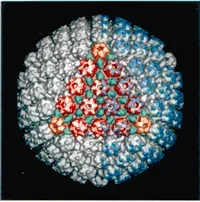 This computer-generated 3D model depicts a type of herpes virus that causes cold sores in humans.
Students learn how viruses invade host cells and hijack their cell-reproduction mechanisms in order to make new viruses, which can in turn attack additional host cells. Students also learn how the immune system responds to viral invasions, eventually defeating the viruses—if all goes well. Finally, they consider the special case of HIV, in which the virus' host cell is a key component of the immune system itself, thereby severely crippling the immune system and ultimately leading to AIDS. Note the recommended order to conduct this lesson/activitiy set: After presenting the lesson's Introduction/Motivation content, conduct the associated activity—a dramatic hands-on simulation that illustrates how quickly a virus can spread through a population, and then challenges students to determine who the initial bearers of the virus were. Then return to the lesson, with students ready to learn more about viruses.
Biomedical engineers and pharmacologists are currently trying to develop a cure for AIDS. An understanding of the mechanisms behind the disease are crucial to develop vaccine. Three-dimensional shapes of viruses are important to their interactions with their host cells.
After this lesson, students should be able to:
- Describe what a virus is.
- Give examples of diseases caused by viruses.
- Explain how a virus replicates itself once it attaches to a host cell.
- Describe how the immune system responds to a viral invasion.
- Explain why the HIV virus is unique and not readily eliminated by the immune system.
- Advances and innovations in medical technologies are used to improve healthcare.
Grades 6-8
Do you agree with this alignment? - The vaccines developed for use in immunization require specialized technologies to support environments in which a sufficient amount of vaccines is produced.
Grades 6-8
Do you agree with this alignment?
- MS-LS1-3 Use argument supported by evidence for how the body is a system of interacting subsystems composed of groups of cells.
Grades 6-8
This resource focuses on the following Three Dimensional Learning aspects of NGSS:
Science & Engineering Practices- Use an oral and written argument supported by evidence to support or refute an explanation or a model for a phenomenon.Do you agree with this alignment?
Disciplinary Core Ideas- In multicellular organisms, the body is a system of multiple interacting subsystems. These subsystems are groups of cells that work together to form tissues and organs that are specialized for particular body functions.Do you agree with this alignment?
Crosscutting Concepts- Systems may interact with other systems; they may have sub-systems and be a part of larger complex systems.Do you agree with this alignment?
- Scientists and engineers are guided by habits of mind such as intellectual honesty, tolerance of ambiguity, skepticism, and openness to new ideas.Do you agree with this alignment?
Do you agree with this alignment? - Use an oral and written argument supported by evidence to support or refute an explanation or a model for a phenomenon.
- 8.L.1 Understand the hazards caused by agents of diseases that effect living organisms.
Grade 8
Do you agree with this alignment? - 8.L.1.1 Summarize the basic characteristics of viruses, bacteria, fungi and parasites relating to the spread, treatment and prevention of disease.
Grade 8
Do you agree with this alignment? - 8.L.1.2 Explain the difference between epidemic and pandemic as it relates to the spread, treatment and prevention of disease.
Grade 8
Do you agree with this alignment?
Students should have prior knowledge of the basic structure and functions of cells. In particular, they will be better able to understand how viruses work if already familiar with how cells reproduce and make proteins, and are comfortable with terms such as genes and DNA.
One of the most important functions of many of the cells in our bodies is to produce proteins.
Hemoglobin is a special protein that is manufactured in developing red blood cells within our bone marrow. Ask: "Does anyone know what role hemoglobin plays in the human circulatory and respiratory systems?" (Answer: Hemoglobin contains iron, which gives it a great affinity for oxygen. This means that as red blood cells pass through capillaries very near to the lungs, oxygen from inhaled air passes through thin membranes and into the capillaries where it is very easily taken up by the hemoglobin molecules in the red blood cells. Our blood can carry about 70 times more oxygen because of the presence of hemoglobin than it could if we did not have hemoglobin. The oxygen is moved around the body through the circulatory system and delivered to tissues where it is needed. Hemoglobin also stores oxygen so we have a reserve of it.)
Collagen is another important protein. Ask: "Does anyone know what role collagen plays in the human body?" (Answer: Collagen is the main structural protein found in animal tissue, including human, tissues. It gives our skin elasticity and is an important component of ligaments and tendons, helping to keep joints strong but flexible; it is even found in our eyes, intestines and in other parts of the body. Collagen is manufactured in different cells and places within the body but fibroblasts are the most common collagen-creating cells in the human body.
Immunoglobulins are important proteins used by the immune system. Another name for this important type of proteins is antibodies. Soon we will learn that these proteins are made by B-cells and that they attach to and destroy invading cells as part of our immune system defenses.
So the fact that our cells contain special machinery that can make proteins is very important for our health, but viruses take advantage of this ability and use our own cells to make copies of themselves and replicate, as we will learn now.
Viruses are little more than a bunch of either DNA or RNA wrapped up in a protective coat made of protein. Since they are so small, they can only be seen through an electron microscope, and since they lack the machinery to do the things cells normally do, such as metabolize and reproduce, it is debatable whether they should even be considered living organisms.
To survive and reproduce, a virus attaches itself to a host cell and injects its DNA or RNA into the host (see Figure 1). The first thing the viral genetic material does is shut down the host cell's normal activity. Then the virus DNA or RNA hijacks the cell's protein-making machinery and instructs it to make new viruses instead. Soon the cell becomes so full of viruses that it bursts open, releasing them to attack host cells of their own. The entire process takes place quickly for common viruses such as the cold virus. Some viruses require less than a minute to shut down the host cell's normal activity, and in less than an hour a single virus can be replicated 100 times.
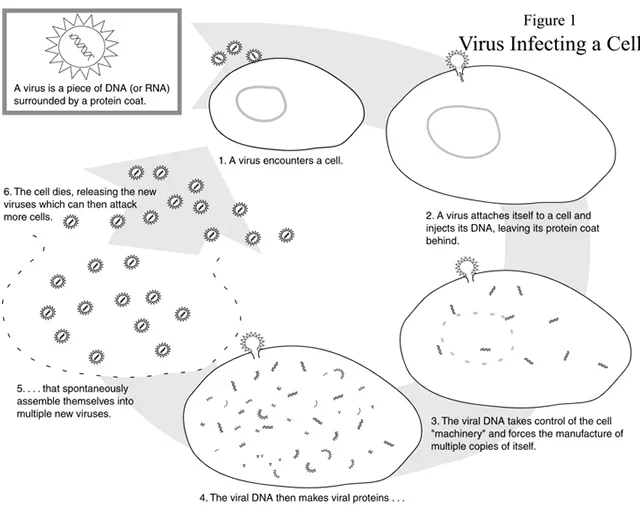 Copyright 2000 Mary Hebrank, Duke Center for Inquiry-Based Learning http://www.biology.duke.edu/cibl/exercises/virus_tracker.htm
Different types of viruses target different types of host cells. Cold viruses generally attack the mucosal cells lining the upper respiratory tract, while influenza viruses can also attack further down as far as the lungs. The herpes viruses that cause chicken pox and cold sores attack nerve cells in the skin, while hepatitis B is caused by a virus that attacks liver cells. Rotaviruses, which cause diarrhea, attack cells lining the gastrointestinal tract. The human immunodeficiency virus (HIV), the virus that causes AIDS, is especially deadly because it attacks some of the most important cells of the immune system, the helper T cells (also known as T4 cells or CD4 positive T cells). Because the immune system itself is attacked, the body is unable to rid itself of the virus.
Humans are not the only creatures plagued by viruses; other mammals can get rabies, for example, and monkeys and chimpanzees can get simian immunodeficiency virus (SIV), which is very similar to HIV. Flu outbreaks are not uncommon in hogs and chickens, because these domestic animals are usually kept in very close quarters. Some viruses seem not to affect insects, but the insects can carry them to humans when they bite. The viruses that cause encephalitis and yellow fever are examples. Also, more than 400 known viruses attack plants (one of the most studied is the tobacco mosaic virus), and even more viruses attack bacteria. The latter are known as bacteriophages.
When the host cells burst we start to feel sick. By this point, the immune system has been alerted, and the inflammatory response that results further contributes to our malaise. If it is a cold virus that has infected us, each time we sneeze or cough we release hundreds of newly made viruses into the environment as tiny airborne droplets. These can be inhaled directly by someone close by. Or, when we take a drink of water, we leave viruses behind on the rim of the cup. We were all taught to cover our mouths when we sneeze or cough, but in doing so our hands, if we don't use a handkerchief or elbow, are sprayed with viruses. If we pick up a pencil and use it, and then put it down, the pencil now has viruses on its surface. Someone else can use the same pencil, transferring some of the viruses to his fingers. If that someone then puts a finger in his mouth or nose, or eats a sandwich without washing his hands first, the viruses have easy access to the mucosal cells they target. Thus, frequent hand washing is one of the most effective ways to prevent colds, and not sharing a drinking cup is another.
HIV is transmitted via either semen or blood. Since its host cells are the helper T cells, their ability to summon the B cells (see Lesson Closure section) is compromised and the production of antibodies against the virus is limited. The initial symptoms of HIV are flu-like, last a week or so, and generally occur about a month after infection. Although many helper T cells are destroyed by the virus, the body begins to respond by stepping up production of new helper T cells. For most otherwise healthy adults, this situation can be maintained for years, with the virus and the immune system at a stalemate. Eventually, though, the immune system is sufficiently weakened, the number of helper T cells declines to less than a fifth of its normal level, and the body becomes susceptible to a variety of infections. At this point, the patient is said to have AIDS, as opposed to merely being HIV-positive.
AIDS is a "syndrome," a collection of maladies, rather than one specific disease. Several infections tend to be characteristic in AIDS patients, and one form of pneumonia is particularly common. This form is due to a fungus that is normally found in the bodies of healthy people but is controlled by their healthy immune systems. With AIDS, though, the immune system cannot keep it under control and the lungs provide the warm, moist conditions in which the fungus can thrive. Another common AIDS ailment, particularly in men, is Kaposi's sarcoma. This is a form of skin cancer characterized by bruise-like, but generally painless, lesions. Kaposi's sarcoma rarely affects women, but women with AIDS have higher rates of cervical cancer than normal. Tuberculosis, a bacterial infection, is also common in AIDS victims, particularly in less developed nations. The chief cause of death among AIDS patients in undeveloped nations, however, is malnutrition and weight loss due the diarrhea that can originate from any of a number of bacterial, viral or parasitic agents endemic in such areas. While these agents may be present in most of the surrounding population, like the fungus that causes pneumonia, these are normally kept under control by the immune system. Only when the number of helper T cell becomes low do these disease agents begin to thrive, cause serious illness, and eventually, lead to death.
By the time students are in middle school, most are aware of the devastating disease known as AIDS. Many of them know that it can be transmitted sexually, and some may know that it can also be transmitted through blood contact. Many may be aware that it is related to something called HIV, and some may have even lost family members or family friends to AIDS. While they all know that AIDS is a disease to be avoided, few know what the letters AIDS or HIV stand for, and it is unlikely that any know how viruses in general or HIV in particular work.
At the same time, students this age know it is an important topic, and because it has the potential to affect them personally, they are eager to learn about it. A good way to introduce the topic is with an informal pre-test such as the AIDS Knowledge Survey (PDF). Give students about 10 minutes to answer the questions. Some might be embarrassed by how little they know, but reassure them that they are not expected to know it already. Explain that the survey simply gives the teacher an idea of how much they already know so you know where to start in helping them build their knowledge of this important topic. Also, point out that very soon they will be able to answer all the questions on the survey.
Collect the completed surveys, scan them and set them aside. (After students have learned more, return them to students and ask them to rewrite their answers.) Next, explain that AIDS is caused by the virus known as HIV, and that they will soon learn more about both AIDS and HIV. In the meantime, however, all they need to know is that HIV is transmitted from one person to another through two types of bodily fluids, semen and blood. Then tell students that they will do a simulation to see how effectively a virus such as HIV can spread through the class when "bodily fluids" are exchanged.
At this point, expect students to be sufficiently curious and motivated to begin the associated activity, Tracking a Virus. After conducting the activity, return to the lesson to present students with the content in the Background section.
After conducting the associated activity simulation and the original carriers of the virus have been revealed, ask the class how pouring water between cups can represent a virus spreading through a group of people. Some viruses can be spread by drinking out of common glasses or bottles, and some can be spread by contaminated water, but the water can also represent those viruses that are spread through bodily fluids. HIV and hepatitis B are both transmitted through sexual or blood-to-blood contact. Students may dismiss the idea that they will contract a virus through sexual intercourse, but the idea that they might come to the aid of a bleeding friend could be far more plausible to a middle school student. For those that can think ahead a few years, it is not unusual for young adults to have at least three sexual partners by the time they marry, or even leave adolescence. This is the same number of classmates they "exchanged bodily fluids" with in the simulation.
Expect students to be curious about why the water with the "virus" turned bright pink when phenolphthalein was added. The sodium carbonate in the water made it sufficiently alkaline for the phenolphthalein, which is an indicator for solutions with a pH of 8 or higher, to turn its characteristic pink color.
Middle school students can gain an understanding of how the immune system works, despite its sometimes confusing vocabulary. When a virus somehow gets into the body, very large white blood cells known as macrophages encounter them, probably by chance, and recognize them as things that do not belong in the body. Macrophages respond by doing two things. Being large amoeboid sorts of cells, the macrophages wrap around the viruses, completely engulfing and digesting them. They also secrete a chemical messenger out into the blood, which acts as a signal to the helper T cells (see Figure 2).
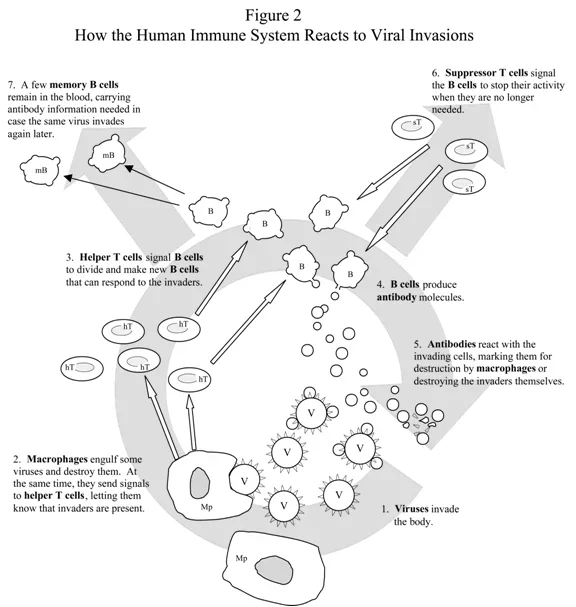 Copyright 2000 Mary Hebrank, Duke Center for Inquiry-Based Learning http://www.biology.duke.edu/cibl/exercises/virus_tracker.htm
When the helper T cells encounter the chemical messenger, they in turn signal the B cells. The B cells promptly begin to divide and make new B cells, each of which produces many antibody molecules. The antibodies are tailor made, based on information about the shape of the virus from the chemical messengers, to attach themselves to the surfaces of the viral invaders. Once attached, they have the effect of disintegrating the virus.
Meanwhile, other immune system cells are at work. The killer T cells ooze along seeking host cells that are infected with viruses. When they contact them, they produce a chemical that causes holes to form in the infected cell membranes. With their membranes shot full of holes, the host cells can no longer manufacture new viruses and their dying remains are disposed of by miscellaneous phagocytes.
It takes some time, but eventually the B cells and killer T cells manage to eliminate all the viruses. When that happens, the suppresser T cells are activated. Like the helper T cells, these also send chemical messages to the B cells, but this time the B cells are told to stop dividing and stop making antibodies against the virus, since they are no longer needed. However, some B cells, known as memory B cells, remain within the blood stream for years. If a virus identical to the one just defeated invades the body, these B cells can start producing antibodies immediately. They thereby defeat the new invaders before they even have a chance to make us sick.
Because of the presence of memory B cells, once a person has been sick with a particular virus such as measles or mumps, he or she is considered immune to it. The problem is that many viruses can subtly change their shapes through mutations, making them no longer recognizable by the memory B cells. Cold and flu viruses mutate easily, so people typically have dozens of colds and several bouts of flu during their lifetimes, each caused by similar but unique viruses. Other viruses, such as those causing smallpox, polio, mumps, and measles, do not readily mutate. Instead, vaccines containing dead viruses or virus components can be given; these stimulate the immune system enough to make antibodies and memory cells without actually making us sick.
Act It Out Class Exercise: Have students learn the basics of how the immune system works by acting it out. Assign or let them choose their roles: several host cells and viruses, and one or two macrophages and killer T cells. You also need several helper T cells, antibody-making B cells, suppresser T cells, and memory B cells. It is more fun if you let students think up and collect simple costumes and props. For example, viruses can wear black shirts and black eye-masks while they stalk the host cells. When they reach one, they can use rubber knives to attack. Meanwhile, the host cells might wear yellow smiley-face masks that they turn over to become frowny-faces once they are infected by a virus. Macrophages can drape themselves in white sheets and carry old telephones, which they use to signal the helper T cells, who also carry telephones. The B cells can pull Koosh™ balls out of their pockets to throw at the viruses, or toy hand grenades can represent antibodies. Killer T cells can carry large water guns (empty, of course!) and walk around infected host cells shooting holes in them. Suppresser T cells can carry stop signs and held them up in front of the B cells when the time comes, and memory B cells can use cameras to take pictures of the dead viruses sprawled on the floor. Let students be creative: they may get so carried away with their dramatizations that they will want to set them to music and perform them for their parents and other classes.
- bacteriophage
- A virus that attacks bacteria cells.
- encephalitis
- Inflammation of the brain.
- hiv
- Acronym for human immunodeficiency virus, the virus that causes AIDS (acquired immunodeficiency syndrome).
- Pre-Survey: Before starting the lesson, administer the AIDS Knowledge Survey (PDF) to determine students' base knowledge of the topic of AIDS.
- Post-Survey: After completing the lesson, administer the AIDS Knowledge Survey (PDF) again, or return students' pre-tests to them to make revisions. Compare pre/post answers to gauge students' knowledge gains.
- Paper/Verbal Post-Quiz: In paper or discussion format, quiz students by asking them to match the components of the immune system (macrophages, helper T cells, killer T cells, etc.) with brief descriptions of their roles; define the HIV and AIDS acronyms; and describe how viruses cause illness.
Assign students to conduct library or internet research to find out more about AIDS and how it affects the body. Similarly, have students also seek information about vaccines and how they work. News magazines such as Time and Newsweek occasionally devote issues to recent advances in medicine, and these are good resources.
HIV Infection and AIDS: An Overview. National Institutes of Health. Accessed October 11, 2004. http://www.niaid.nih.gov/factsheets/hivinf.htm
- Viral Hijackers
Contributors
Mary R. Hebrank
Supporting Program
Engineering K-PhD Program, Pratt School of Engineering, Duke University
Acknowledgements
This content was developed by the MUSIC (Math Understanding through Science Integrated with Curriculum) Program in the Pratt School of Engineering at Duke University under National Science Foundation GK-12 grant no. DGE 0338262. However, these contents do not necessarily represent the policies of the NSF, and you should not assume endorsement by the federal government.
This lesson was originally published, in slightly modified form, by Duke University's Center for Inquiry Based Learning (CIBL). Please visit http://ciblearning.org/ for information about CIBL and other resources for K-12 science and math teachers.
Copyright
2013 by Regents of the University of Colorado; original © 2004 Duke University