
Counting Atoms: How Not to Break the Law of Conservation of Matter
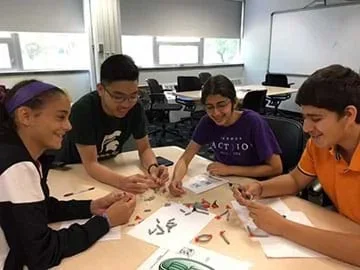 How can we demonstrate the law of conservation of matter is true using molecular models?Copyright 2017 Tuyen C. Duddles, Michigan State University RET
Students explore the science of microbial fuel cells (MFCs) by using a molecular modeling set to model the processes of photosynthesis and cellular respiration—building on the concept of MFCs that they learned in the associated lesson, “Photosynthesis and Cellular Respiration at the Atomic Level.” Students demonstrate the law of conservation of matter by counting atoms in the molecular modeling set. They also re-engineer a new molecular model from which to further gain an understanding of these concepts.
To design MFC-based sensors, engineers must understand the chemical mechanisms of photosynthesis and cellular respiration that occur within organisms such as yeasts, algae or bacteria. Engineers must understand how electron transport pathways are generated via photosynthesis and cellular respiration if they wish to harvest electrons for electrical power generation. However, one limitation to understanding these concepts is the small scale at which these chemical interactions take place. Therefore, engineers often model scientific phenomena and practice manipulating atomic variables in order to better understand what is happening within these processes.
After this activity, students should be able to:
- Describe the processes of photosynthesis and cellular respiration.
- Write the balanced chemical equations for the processes of photosynthesis and cellular respiration.
- Explain the relationship between cellular respiration and photosynthesis and their connection to the cycling of matter and energy in Earth’s ecosystem.
- Prove that the law of conservation of matter holds true by balancing the chemical equations for the processes of photosynthesis and cellular respiration and counting the atoms present on the reactant sides and the product sides of the equations.
- Engineer a better teaching model than existing molecular models to better understand the processes.
- Students will develop an understanding of the attributes of design.
Grades K-12
Do you agree with this alignment? - Students will develop an understanding of the relationships among technologies and the connections between technology and other fields of study.
Grades K-12
Do you agree with this alignment?
- MS-LS1-6 Construct a scientific explanation based on evidence for the role of photosynthesis in the cycling of matter and flow of energy into and out of organisms.
Grades 6-8
Do you agree with this alignment? - MS-PS1-1 Develop models to describe the atomic composition of simple molecules and extended structures.
Grades 6-8
Do you agree with this alignment? - MS-PS1-5 Develop and use a model to describe how the total number of atoms does not change in a chemical reaction and thus mass is conserved.
Grades 6-8
Do you agree with this alignment?
- MS-LS1-6 Construct a scientific explanation based on evidence for the role of photosynthesis in the cycling of matter and flow of energy into and out of organisms.
Grades 6-8
This resource focuses on the following Three Dimensional Learning aspects of NGSS:
Science & Engineering Practices- Construct a scientific explanation based on valid and reliable evidence obtained from sources (including the students' own experiments) and the assumption that theories and laws that describe the natural world operate today as they did in the past and will continue to do so in the future.Do you agree with this alignment?
- Science knowledge is based upon logical connections between evidence and explanations.Do you agree with this alignment?
Disciplinary Core Ideas- Plants, algae (including phytoplankton), and many microorganisms use the energy from light to make sugars (food) from carbon dioxide from the atmosphere and water through the process of photosynthesis, which also releases oxygen. These sugars can be used immediately or stored for growth or later use.Do you agree with this alignment?
- The chemical reaction by which plants produce complex food molecules (sugars) requires an energy input (i.e., from sunlight) to occur. In this reaction, carbon dioxide and water combine to form carbon-based organic molecules and release oxygen.Do you agree with this alignment?
Crosscutting Concepts- Within a natural system, the transfer of energy drives the motion and/or cycling of matter.Do you agree with this alignment?
Do you agree with this alignment? - Construct a scientific explanation based on valid and reliable evidence obtained from sources (including the students' own experiments) and the assumption that theories and laws that describe the natural world operate today as they did in the past and will continue to do so in the future.
- MS-PS1-1 Develop models to describe the atomic composition of simple molecules and extended structures.
Grades 6-8
This resource focuses on the following Three Dimensional Learning aspects of NGSS:
Science & Engineering Practices- Develop a model to predict and/or describe phenomena.Do you agree with this alignment?
Disciplinary Core Ideas- Substances are made from different types of atoms, which combine with one another in various ways. Atoms form molecules that range in size from two to thousands of atoms.Do you agree with this alignment?
- Solids may be formed from molecules, or they may be extended structures with repeating subunitsDo you agree with this alignment?
Crosscutting Concepts- Time, space, and energy phenomena can be observed at various scales using models to study systems that are too large or too small.Do you agree with this alignment?
Do you agree with this alignment? - Develop a model to predict and/or describe phenomena.
- MS-PS1-5 Develop and use a model to describe how the total number of atoms does not change in a chemical reaction and thus mass is conserved.
Grades 6-8
This resource focuses on the following Three Dimensional Learning aspects of NGSS:
Science & Engineering Practices- Develop a model to describe unobservable mechanisms.Do you agree with this alignment?
- Laws are regularities or mathematical descriptions of natural phenomena.Do you agree with this alignment?
Disciplinary Core Ideas- Substances react chemically in characteristic ways. In a chemical process, the atoms that make up the original substances are regrouped into different molecules, and these new substances have different properties from those of the reactants.Do you agree with this alignment?
- The total number of each type of atom is conserved, and thus the mass does not change.Do you agree with this alignment?
Crosscutting Concepts- Matter is conserved because atoms are conserved in physical and chemical processes.Do you agree with this alignment?
Do you agree with this alignment? - Develop a model to describe unobservable mechanisms.
Each group needs:
- Design a Better Model Assignment Handout (PDF)
- 12” x 18” construction paper sheets
- glue
- crayons
- colored pencils
- access to computers or laptops to aid in creation of advertising posters for student-created molecular model sets
- Photosynthesis and Cellular Respiration Molecular Model Set, for $20 at Amazon
OR
- a lab group set from one of the 12 group sets in Photosynthesis, Plants, and Food Kit #31 by Lab-Aids for $74.85
For the entire class to share:
- digital balance
- assorted low-cost and/or recycled materials, such as plastic bottle caps, pipe cleaners, aluminum foil, cotton balls, plastic straws, felt pieces, etc.
- capability to show students an online video
- Activity Worksheet (docx)
- Activity Worksheet (pdf)
- Activity Worksheet Answer Key (docx)
- Activity Worksheet Answer Key (pdf)
- Design A Better Model Project Assignment Handout (docx)
- Design A Better Model Project Assignment Handout (pdf)
- Design a Better Model Project Rubric (docx)
- Design a Better Model Project Rubric (pdf)
- Design A Better Model Project Student Sample Work (docx)
- Design A Better Model Project Student Sample Work (pdf)
Students and teachers should have a basic understanding of atoms, molecules, photosynthesis, cellular respiration, chemical reactions, and models. It is recommended that the associated lesson be conducted prior to this activity.
In the associated lesson, we discussed how, in about 20 years from now, you might be able to power your car with fuel cells that harness energy derived from microorganisms. The exciting potential of electromicrobiology—the science that may make the mass-production of microbial fuel cells a reality—is something young scientists and engineers like yourselves can help develop! But before we can develop these exciting new technologies, we have to dive deeper into the life science, physical science, and chemistry that forms the foundation of this research. This includes understanding a fundamental law of matter that we must follow in order to move our scientific research forward.
We will start off with a short video called: “The simple story of photosynthesis and food.” The video shows relationship between photosynthesis and cellular respiration. It also introduces the concepts of atoms and molecules involved in the two cellular processes.
From the video and the three diagrams that you drew previously (drawings made in the associated lesson), we are going to look even closer at the connection between photosynthesis and cellular respiration. This time at the molecular level.
Question: Has anyone heard of the law of conservation of matter? (Wait for students to respond. Write their answers on the board.)
Answer: The law of conservation of matter states that in any given system that is closed to the transfer of matter, the amount of matter in the system stays constant. The law of conservation of matter says that in chemical reactions, the total mass of the products must equal the total mass of the reactants.
Question: What do you think this means for the processes of photosynthesis and cellular respiration? (Wait for students to respond. Write their answers on the board.)
Answer: Since cellular respiration and photosynthesis are direct opposite reactions; then the same number of atoms that go into each reaction must come out of each reaction.
Background
The following links contain additional resources and information on photosynthesis, cellular respiration, and microbial fuel cells (MFC).
The following contains basic, essential information on photosynthesis and cellular respiration and their connection from CK-12.
Cellular respiration and photosynthesis are direct opposite reactions; the products of one reaction are the reactants of the other.
In words,
photosynthesis: carbon dioxide + water + light energy → glucose + oxygen
cellular respiration: glucose + oxygen → carbon dioxide + water + ATP
As balanced chemical reactions,
photosynthesis: 6 CO2 + 6 H2O → C6H12O6+ 6 O2
cellular respiration: C6H12O6 + 6 O2 → 6 CO2 + 6 H2O
To balance the chemical reactions, ensure that the same number of atoms are present on each side of the reaction. For example, the number of carbon atoms in the reactants equals number of carbon atoms in the products.)
For more in-depth and advanced information on energy conversion in the mitochondria and chloroplasts for teachers, read Chapter 14: “Energy Conversion: Mitochondria and Chloroplasts” of the book, Molecular Biology of the Cell. 4th edition.
Preview the TED-Ed video “The simple story of photosynthesis and food.” The video highlights the unique interconnection between human and plants. It demonstrates how plants utilize the CO2 we exhale along with water, and energy from sunlight to form glucose during photosynthesis. We eat carbohydrates from plants, like fiber from broccoli or starch from potatoes. We break down the carbohydrates into sugars and form ATP, which provides energy for our cells.
Before the Activity
- Present the related lesson, Photosynthesis and Cellular Respiration at the Atomic Level.
- Have students watch the TED-Ed video.
- Distribute copies of the Activity Worksheet (PDF) and the Design A Better Model Project Assignment Handout (PDF).
- Divide the class into lab groups of four students each.
With the Students
Part 1. Use a Molecule Modeling Set to Demonstrate the Law of Conservation of Matter
- After presenting the lesson and the Introduction/Motivation portion of the activity, distribute the handout and some sketching paper to each group.
- Distribute one Photosynthesis and Cellular Respiration Molecular Model set to each student group. Direct students to make 3D molecular models of the processes of photosynthesis and cellular respiration by using the word equation. For example, students should build a water molecule and a carbon dioxide molecule for the reactant side of photosynthesis. For the product side of photosynthesis, they would build a glucose molecule and an oxygen molecule. Likewise, they would do the reverse for cellular respiration. You may need to show the students how to build the molecule models or have the students follow the directions from the model set, if available.
- Ask students to sketch and label each molecule model they build on a sheet of paper.
- For each reaction (photosynthesis and cellular respiration), have the students count the atoms on the reactant side and then on the product side. Next have the students use the balance to find the mass of the reactant side and the mass of the product side. Have students record their data as the initial atom count and mass in the worksheet.
- Students will find that the total numbers of each type of atom as well as the total number of atoms overall will not match. When they compare the masses, they will find that the masses will not balance. Ask them how is this possible? Did they just break the law of conservation of matter? Ask the students, what can they do to follow the law of conservation of matter?
- At this point, introduce the balanced chemical equations for photosynthesis and cellular respiration. (You may choose to do a quick on-the-spot refresher lesson on balancing equations.) Explain that in chemical reactions like photosynthesis, atoms are rearranged to form different molecules and that only atoms present in the reactants can participate in the reaction to become part of the products. Atoms, which are the smallest unit of matter, cannot appear out of nowhere just like larger pieces of matter cannot appear out of nowhere.
- Have students build the molecular models for both processes based on the balanced chemical equations.
- Have the students to tally the number of each type of atom on each side of the equation. Students should then measure the mass of the reactants and the mass of the products. Have students record their data as the final atom count and mass in the worksheet.
- Ask each student to write a brief explanation about how the activity demonstrates the law of conservation of matter. Collect this and the student sketches of the 3D models for assessment.
Example explanation: Before balancing the chemical equations, the initial masses of the reactants did not equal the initial masses of the products. The masses of the products were greater than the masses of the reactants. Also, there were more atoms in the products than there were atoms in the reactants, which would mean that atoms or matter was created in the reaction which breaks the law of conservation of matter.
After balancing the chemical equation and building the molecules according to the balanced chemical equation, the mass of the reactants equals the mass of the products. Also, the number of atoms in the reactants equals the number of atoms in the products. This shows that matter was not created in the reaction just that the atoms are rearranged to form different molecules.
Part 2. Engineer a Better Model
- Distribute the handout.
- Direct the groups to assess the utility and limitations of the molecular modeling set they used to model photosynthesis and cellular respiration. Ask students to consider the ways where the molecule set helped them to understand the processes of photosynthesis and cellular respiration, the relationship between the two processes, and the law of conservation of matter. How did the molecule set help them to understand each concept? What was challenging about using the molecule set? What skills or capabilities did they need in order to be able to use the molecule set effectively?
- Challenge the students to design a better model than the existing molecular modeling set to teach the concepts that they just learned. How could they improve the existing molecular modeling set? What would they change about the modeling set? What features would they change and why? Design criteria include: using recycled materials or low cost materials and designing for students with physical impairments such as low vision or color-blindness.
- Next, have student groups make a drawing or sketch of their design. They should label the parts, including the materials used to make the model set, the cost of the materials, the dimensions (measurements) of the model parts, etc.
- Student groups will then build the same photosynthesis and cellular respiration molecules out of the materials of their new design.
- After building the molecules out of their new model set materials, students should determine if any changes need to be made to their new model set (i.e., different materials, different sizes, etc.) Students should write down any modifications or changes on their design sheet, redesigning their initial attempt.
- Students should build new molecules out of their modified model design. (Have students reiterate their design as many times as time allows.)
- Have student groups create a poster advertisement to sell their model set, design, or idea to teachers. Refer to the handout for project instructions and reflection. Use the Design a Better Model Project Rubric (PDF) to assess student work.
- Teachers may choose to have student groups present their molecule model designs and posters to the class, as time permits.
- Have students complete the project reflection questions in the handout.
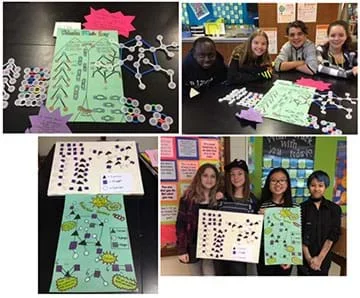 Students use a variety of tools to help explain photosynthetic and cellular respiration processes!Copyright 2017 Tuyen C. Duddles, Michigan State University RET
- adenosine triphosphate
- A complex organic chemical that provides energy to living cells. Abbreviated as ATP.
- algae
- A simple photosynthetic organism that varies in size; can be single-celled or multi-celled.
- anode
- An electrode where current enters.
- atom
- The smallest component of an element.
- autotroph
- An organism capable of nourishing itself by using inorganic material.
- cathode
- An electrode where current leaves or exits.
- cellular respiration
- The process where cells use oxygen to break down food into usable energy units commonly called ATP. Carbon dioxide and water are released as waste and byproduct of this reaction. Cellular respiration takes place in cell structures called mitochondria.
- chemical reaction
- One or more substances that are converted into another or other substance(s).
- chloroplast
- A cell structure found in plant cells that contain a green pigment called chlorophyll; the pigment captures light energy to jumpstart the process of photosynthesis.
- electromicrobiology
- A sub discipline of microbiology that examines the potential of electron transport pathways; in engineering, the potential for energy production at the molecular level.
- electron transport chain
- Electrons passing from one chain of molecules to another that drives the synthesis of ATP.
- heterotroph
- Organism capable of only using organic material as a food source.
- law of conservation of matter
- States that matter is conserved and cannot be created or destroyed.
- microorganism
- A life form that is so small, it can only be seen with a microscope.
- model
- (noun) A representation of something for imitation, comparison or analysis, sometimes on a different scale. (verb) To make something to help learn about something else that cannot be directly observed or experimented upon.
Activity Embedded Assessment
Worksheet: Have students complete the Activity Worksheet (PDF). Review their answers to gauge their depth of comprehension.
Post-Activity Assessment
Reflection: Have students answer the project reflection questions at the end of the Design A Better Model Project Assignment Handout (PDF).
Grading Rubric: Use the Design a Better Model Project Rubric (PDF) to assess student work.
“The simple story of photosynthesis and food.” YouTube video, TED-Ed. https://www.youtube.com/watch?v=eo5XndJaz-Y
Alberts, Bruce. "Energy Conversion: Mitochondria and Chloroplasts." Chapter 14. Molecular Biology of the Cell. 4th edition. U.S. National Library of Medicine. Accessed July 10, 2017.
Collins, Cindy. "Creating a Microbial Fuel Cell." Published October 8, 2015. YouTube. Accessed July 10, 2017. https://www.youtube.com/watch?v=-cPvp3_WYPg
Dockrill, Peter. "Scientists Have Developed a Power Cell That Harnesses Electricity from Algae." ScienceAlert. Accessed July 10, 2017.
Harwood, Jessica, Douglas Wilkin, Doris Kraus, Niamh Gray-Wilson, Jean Brainard, Sarah Johnson, Jane Willan and Corliss Karasov. "Connecting Cellular Respiration and Photosynthesis." CK-12 Foundation. Accessed July 11, 2017.
Ooten, Amanda. “The simple story of photosynthesis and food.” Published March 5, 2013. TED-Ed, YouTube. Accessed July 11, 2017. https://www.youtube.com/watch?v=eo5XndJaz-Y
- Photosynthesis and Cellular Respiration at the Atomic Level
- Counting Atoms: How Not to Break the Law of Conservation of Matter
Contributors
Tuyen Duddles; Kamryn Jenkins; Weiyang Yang; Wen Li
Supporting Program
Smart Sensors and Sensing Systems RET, College of Engineering, Michigan State University
Acknowledgements
This curriculum was developed through the Smart Sensors and Sensing Systems research experience for teachers under National Science Foundation RET grant no. CNS 1609339. However, these contents do not necessarily represent the policies of the NSF, and you should not assume endorsement by the federal government.
Copyright
2018 by Regents of the University of Colorado; original © 2017 Michigan State University