
Photosynthesis and Cellular Respiration at the Atomic Level
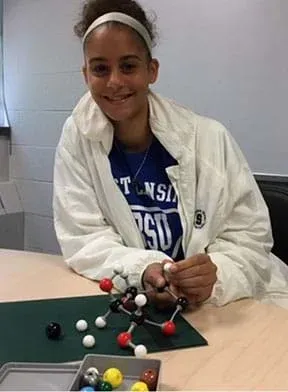 How can we demonstrate the law of conservation of matter is true using molecular models?Copyright 2017 Tuyen C. Duddles, Michigan State University RET
Students learn about the basic principles of electromicrobiology—the study of microorganisms’ electrical properties—and the potential that these microorganisms may have as a next-generation source of sustainable energy. They are introduced to one such promising source: microbial fuel cells (MFCs). Using the metabolisms of microbes to generate electrical current, MFCs can harvest bioelectricity, or energy, from the processes of photosynthesis and cellular respiration. Students learn about the basics of MFCs and how they function as well as the chemical processes of photosynthesis and cellular respiration
To design microbial fuel cells (MFCs), engineers must understand the chemical mechanisms of photosynthesis and cellular respiration that occur within organisms like yeasts, algae or bacteria. Engineers must also understand electron transport pathways—a complex series of interactions between electrons—that play a key role in generating photosynthesis and cellular respiration processes; particularly if they wish to harvest electrons for electrical power generation.
After this lesson, students should be able to:
- Describe the processes of photosynthesis and cellular respiration.
- Explain the relationship between cellular respiration and photosynthesis and their connection to the cycling of matter and energy.
- Explain how engineers apply scientific knowledge to make technology that can solve societal problems.
- Students will develop an understanding of the relationships among technologies and the connections between technology and other fields of study.
Grades K-12
Do you agree with this alignment?
- MS-LS1-6 Construct a scientific explanation based on evidence for the role of photosynthesis in the cycling of matter and flow of energy into and out of organisms.
Grades 6-8
Do you agree with this alignment? - MS-PS1-5 Develop and use a model to describe how the total number of atoms does not change in a chemical reaction and thus mass is conserved.
Grades 6-8
Do you agree with this alignment?
- MS-LS1-6 Construct a scientific explanation based on evidence for the role of photosynthesis in the cycling of matter and flow of energy into and out of organisms.
Grades 6-8
This resource focuses on the following Three Dimensional Learning aspects of NGSS:
Science & Engineering Practices- Construct a scientific explanation based on valid and reliable evidence obtained from sources (including the students' own experiments) and the assumption that theories and laws that describe the natural world operate today as they did in the past and will continue to do so in the future.Do you agree with this alignment?
- Science knowledge is based upon logical connections between evidence and explanations.Do you agree with this alignment?
Disciplinary Core Ideas- Plants, algae (including phytoplankton), and many microorganisms use the energy from light to make sugars (food) from carbon dioxide from the atmosphere and water through the process of photosynthesis, which also releases oxygen. These sugars can be used immediately or stored for growth or later use.Do you agree with this alignment?
- The chemical reaction by which plants produce complex food molecules (sugars) requires an energy input (i.e., from sunlight) to occur. In this reaction, carbon dioxide and water combine to form carbon-based organic molecules and release oxygen.Do you agree with this alignment?
Crosscutting Concepts- Within a natural system, the transfer of energy drives the motion and/or cycling of matter.Do you agree with this alignment?
Do you agree with this alignment? - Construct a scientific explanation based on valid and reliable evidence obtained from sources (including the students' own experiments) and the assumption that theories and laws that describe the natural world operate today as they did in the past and will continue to do so in the future.
- MS-PS1-1 Develop models to describe the atomic composition of simple molecules and extended structures.
Grades 6-8
This resource focuses on the following Three Dimensional Learning aspects of NGSS:
Science & Engineering Practices- Develop a model to predict and/or describe phenomena.Do you agree with this alignment?
Disciplinary Core Ideas- Substances are made from different types of atoms, which combine with one another in various ways. Atoms form molecules that range in size from two to thousands of atoms.Do you agree with this alignment?
- Solids may be formed from molecules, or they may be extended structures with repeating subunitsDo you agree with this alignment?
Crosscutting Concepts- Time, space, and energy phenomena can be observed at various scales using models to study systems that are too large or too small.Do you agree with this alignment?
Do you agree with this alignment? - Develop a model to predict and/or describe phenomena.
- MS-PS1-5 Develop and use a model to describe how the total number of atoms does not change in a chemical reaction and thus mass is conserved.
Grades 6-8
This resource focuses on the following Three Dimensional Learning aspects of NGSS:
Science & Engineering Practices- Develop a model to describe unobservable mechanisms.Do you agree with this alignment?
- Laws are regularities or mathematical descriptions of natural phenomena.Do you agree with this alignment?
Disciplinary Core Ideas- Substances react chemically in characteristic ways. In a chemical process, the atoms that make up the original substances are regrouped into different molecules, and these new substances have different properties from those of the reactants.Do you agree with this alignment?
- The total number of each type of atom is conserved, and thus the mass does not change.Do you agree with this alignment?
Crosscutting Concepts- Matter is conserved because atoms are conserved in physical and chemical processes.Do you agree with this alignment?
Do you agree with this alignment? - Develop a model to describe unobservable mechanisms.
Students should know the word equations for photosynthesis and cellular respiration.
photosynthesis: carbon dioxide + water + light energy → glucose + oxygen
cellular respiration: glucose + oxygen → carbon dioxide + water + adenosine triphosphate (ATP)
The aim of this lesson is for students to understand the basic mechanisms of photosynthesis and cellular respiration and how these two processes are connected. Expect students to learn how these processes are part of the flow of matter and energy within ecosystems and recognize that they follow the law of conservation of matter. By studying microorganisms’ electrical properties, known as electromicrobiology, and how electromicrobiology can be used to make energy, students gain an understanding of engineering and hardware design along with microbiology, molecular biology, and chemistry.
MFCs capture electrons from molecules during photosynthesis and cellular respiration. The processes of photosynthesis and cellular respiration, which take place in plant cells and microorganisms, involve electron transport chains. By collecting the electrons released by microorganisms during photosynthesis and respiration, scientists can capture the resulting electrical energy.
A typical MFC consists of an anode, cathode, and proton exchange membrane as shown in Figure 4. The microorganisms are placed in the anode chamber. As they undergo photosynthesis or cellular respiration, they release electrons onto the electrode’s surface. With electrical component attached to the cell, it is possible to extract the electrons and produce electrical power from the device.
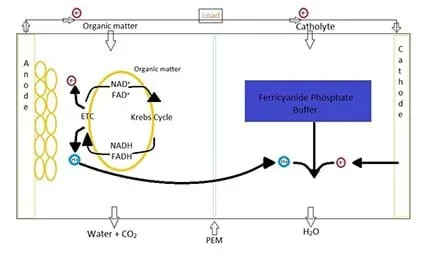 Figure 4. An example of an amicrobial fuel cell design.Copyright 2017 Tuyen C. Duddles, Michigan State University RET
To design MFC-based biosensors, engineers must understand the chemical mechanisms of photosynthesis and cellular respiration happening within organisms such as yeasts, algae or bacteria as shown in Figure 5. Engineers must also understand electron transport pathways and how they generate photosynthetic and cellular respiration processes, especially if they wish to harvest the electrons for electrical power generation.
In the associated activity (Counting Atoms: How Not to Break the Law of Conservation of Matter), students demonstrate their understanding of the law of conservation of matter. By using atom model kits, they construct the chemical processes of photosynthesis and cellular respiration. Students also assess the design and limitations of the molecular model and create a better teaching model that addresses or resolves the design limitations of the current model.
Teachers should review essential information regarding photosynthesis and cellular respiration such as:
- The reactants and products of both processes
- The word equation for both processes
- How to balance a chemical equation
- The balanced chemical equations for both processes
- The concept of reactants and products in chemical reactions
- The relationship between photosynthesis and cellular respiration
- The law of conservation of matter
- Where the reactions happen within the cells and the pathway of both processes
- The type of organisms that can photosynthesize
- The type of organisms that must perform cellular respiration
- The carbon cycle
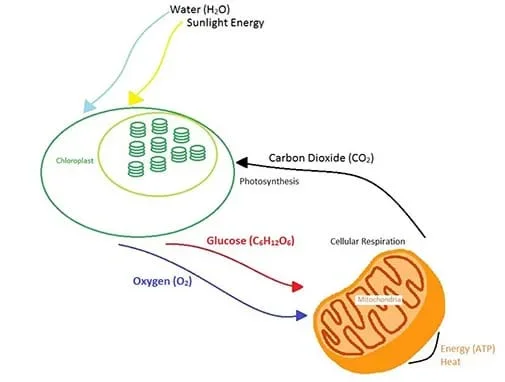 Figure 5. Diagram of the direct connection between photosynthesis and cellular respiration.Copyright 2017 Tuyen C. Duddles, Michigan State University RET
The following links contain additional resources and information on photosynthesis, cellular respiration, and MFCs:
- CK-12 article "Connecting Cellular Respiration and Photosynthesis."
- For more in-depth and advanced information on energy conversion in the mitochondria and chloroplasts, teachers should read Chapter 14 “Energy Conversion: Mitochondria and Chloroplasts” of the book Molecular Biology of the Cell. 4th edition.
Twenty years from now you’re driving your car along an interstate highway, when the computer softly announces that you need to replace your fuel cells within the next 50 miles. You ease your car onto the next exit, pull over to a rest station, open a panel on the back of your car and pull out several pale green tubes. You make a payment at a kiosk and out shoot several dark green tubes. You place these tubes back into your car, turn on the power, and cruise back on to the interstate. The green tubes are fuel cells for your next generation electrical vehicle, and the source of that power is supercharged electrical energy from one of the simplest lifeforms on the planet: green algae!
The fuel cells you inserted into your vehicle might very well someday be an exciting form of next-generation, sustainable energy— not driven by wind, geothermal, or solar power but within the tiny organisms found all around us. Imagine harvesting electrical energy from bacteria found in blue-green algae or even from the E. coli bacterium itself! Microorganisms that are both aerobic (requiring an oxygen-rich environment) and anaerobic (requiring an oxygen-free environment) generate electrical power as a byproduct when they consume organic matter. This electrical power can be captured and used in what is called a microbial fuel cell, or MFC. Engineers are investigating the potential for MFCs in microorganisms that are either photosynthetic (able to harvest food from the sun, such as plants) or heterotrophic (rely on the intake of nutrition from primarily plant or animal matter). Engineers may eventually harness MFCs and use them in health screening and disease detection devices—a self-powered biosensor for the human body. Another way engineers are studying MFCs is in waste clean-up. Heterotrophic microbes could be put to work consuming waste. As a byproduct, these MFC-powered organisms would produce their own “waste” which to us is useful in the form of electricity or hydrogen.
(Play the “Creating a Microbial Fuel Cell” video to provide background for the lesson’s introductory question below):
Question: How did the mud produce 0.4V of energy? What is generating this energy?
What basic scientific concept is at work here?
Answer: The cellular respiration of microorganisms in the mud is generating this energy.
Now, let’s watch the following videos to see more examples of how microorganisms are being harnessed to create energy:
“MudWatt Microbial Fuel Cell - How It Works”
“Plant-e: living plants generate electricity”
These videos show students that the basic mechanism powering the MFC is the transport of electrons by molecules—in mitochondria for cellular respiration, and in the green pigment chlorophyll in chloroplasts for photosynthesis.
Note: Ask students to help you write the word equations for the two processes, or introduce the word equations for both processes for students who may not know them at all. Use the information from the CK-12 article “Connecting Cellular Respiration and Photosynthesis” to help you frame the lecture.
photosynthesis: carbon dioxide + water + light energy → glucose + oxygen
cellular respiration: glucose + oxygen → carbon dioxide + water + ATP
Direct student groups to draw two separate diagrams to illustrate the processes of photosynthesis and cellular respiration. Their work may look something like Figures 1 and 2. Give students 15 - 20 minutes to complete both diagrams.
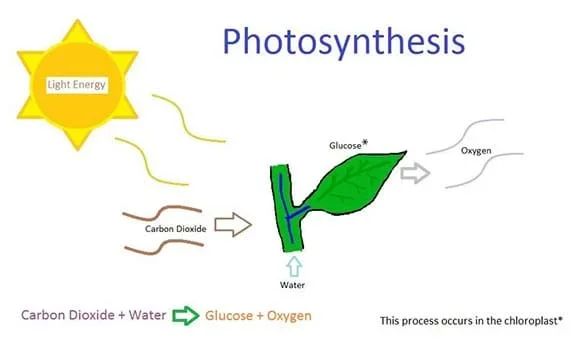 Figure 1. Hand-drawn example of the process of photosynthesis.Copyright 2017 Tuyen C. Duddles, Michigan State University RET
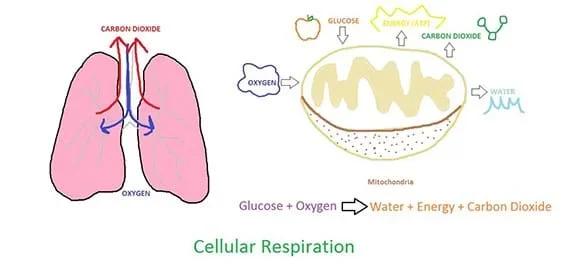 Figure 2. Hand-drawn diagram of cellular respiration.Copyright 2017 Tuyen C. Duddles, Michigan State University RET
Ask the students to examine the diagrams they just created and direct them to create a third diagram to show a link between the two processes. Use the information from the CK-12 article “Connecting Cellular Respiration and Photosynthesis” to help you frame the discussion. For example, you may ask or say to the students:
How do trees help you breathe?
Answer: Trees release oxygen into the atmosphere; oxygen is a product of photosynthesis.
What do you notice about the word equations for photosynthesis and cellular respiration?
Answer: They use the same molecules like carbon dioxide, oxygen, and water. They also involve some kind of energy.
How are the reactions of photosynthesis and cellular respiration related?
Answer: They are the opposite of each other. The products of photosynthesis are the reactants of cellular respiration and vice versa.
Give students 15 to 20 minutes to work within their lab group to create a third diagram. The students may create a diagram similar to the one shown in Figure 3:
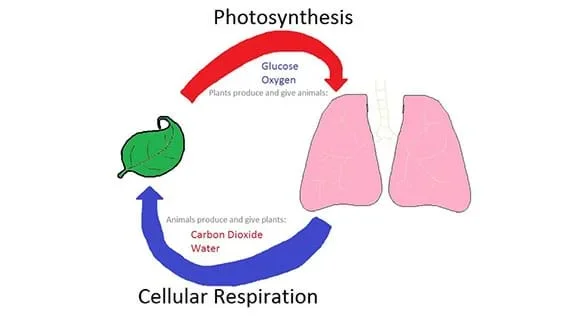 Figure 3. Hand-drawn diagram of how photosynthesis and cellular respiration are connected.Copyright 2017 Tuyen C. Duddles, Michigan State University RET
- adenosine triphosphate
- (ATP) A complex organic chemical that provides energy to living cells.
- algae
- A simple photosynthetic organism that varies in size; can be single-celled or multi-celled.
- anode
- An electrode where current enters.
- atom
- The smallest component of an element.
- autotroph
- An organism capable of nourishing itself by using inorganic material.
- cathode
- An electrode where current leaves or exits.
- cellular respiration
- The process where cells use oxygen to break down food into usable energy units commonly called ATP. Carbon dioxide and water are released as waste and byproduct of this reaction. Cellular respiration takes place in cell structures called mitochondria.
- chemical reaction
- One or more substances that are converted into another or other substance(s).
- chloroplast
- A cell structure found in plant cells that contain a green pigment called chlorophyll; the pigment captures light energy to jumpstart the process of photosynthesis.
- electromicrobiology
- A sub discipline of microbiology that examines the potential of electron transport pathways; in engineering, the potential for energy production at the molecular level
- electron transport chain
- Electrons passing from one chain of molecules to another that drives the synthesis of ATP.
- heterotroph
- Organism capable of only using organic material as a food source.
- law of conservation of matter
- States that matter is conserved and cannot be created or destroyed.
- microorganism
- A life form that is so small, it can only be seen with a microscope.
- mitochondria
- The part of a cell that produces energy for the cell by respiration.
- molecule
- A structure or substance produced when atoms combine chemically.
- photosynthesis
- The process by which green plants and some microorganisms like cyanobacteria make glucose from carbon dioxide and water, using energy captured from sunlight by chlorophyll, and releasing excess oxygen as a byproduct. In plants and algae, photosynthesis takes place in cell structures called chloroplasts.
- product
- The resultant of a chemical change in a substance.
- proton exchange membrane
- Carries hydrogen ions from anode to cathode without passing electrons that were removed.
- reactant
- The starting material in a chemical reaction.
- yeast
- Single cell fungi that digest food for growth.
Pre-Lesson Assessment
Opening Discussion: Ask students the following questions:
- What one thing did you use today that requires a battery or an energy source to work?
Answer: cellphones, laptops, calculator, car, etc.
- Where did this energy come from?
Answer: battery, gasoline, sunlight, electricity, etc.
Post-Introduction Assessment
Check Understanding: Ask students the following questions to gauge their understanding:
- What is photosynthesis?
Answer: The process in which plant cells convert water, carbon dioxide, and light energy into glucose and oxygen.
- What is cellular respiration?
Answer: The process in which cells convert food like glucose into energy for growth and reproduction.
- What is the relationship between the processes of photosynthesis and cellular respiration?
Answer: They are the direct opposite reactions. The products of photosynthesis are the reactants of cellular respiration.
- What type of food source does a cell need for cellular respiration?
Answer: Sugars like glucose from photosynthesis.
- How do MFCs work?
Answer: MFCs capture electrons from the photosynthetic and cellular respiration activities of microorganisms.
Lesson Summary Assessment
See Associated Activity: Using the molecular model set, students construct the processes of photosynthesis and cellular respiration. In the process of manipulating the reactant and product molecules, students should recognize these processes are the opposite chemical reactions. Students demonstrate their understanding of the law of conservation of matter by balancing the chemical equations of both processes and counting the number of atoms on the reactant side of the equation and the number of atoms on the product side of the equation. Students will also engineer a better design to model atoms and molecules for the purposes of teaching about chemical reactions such as photosynthesis and the law of conservation of matter.
Alberts, Bruce. "Energy Conversion: Mitochondria and Chloroplasts." Molecular Biology of the Cell. 4th edition. U.S. National Library of Medicine. Accessed 10 July 2017.
Collins, Cindy. "Creating a Microbial Fuel Cell." YouTube. Accessed 10 July 2017. https://www.youtube.com/watch?v=-cPvp3_WYPg
Dockrill, Peter. "Scientists Have Developed a Power Cell That Harnesses Electricity From Algae." ScienceAlert. Accessed 10 July 2017.
Harwood, Jessica, Ph.D. Douglas Wilkin, Ph.D. Doris Kraus, Niamh Gray-Wilson, Ph.D. Jean Brainard, Sarah Johnson, Jane Willan, and Corliss Karasov. "Connecting Cellular Respiration and Photosynthesis." CK-12 Foundation. Accessed 11 July 2017.
KeegoTech. "MudWatt Microbial Fuel Cell - How It Works." YouTube. Accessed 01 Aug. 2017. https://www.youtube.com/watch?v=RdIV_UZFK9A
Plant-e BV. "Plant-e animation [EN]." YouTube. Accessed 01 Aug. 2017. https://www.youtube.com/watch?v=XESK2DleVro
Plant-e BV. “Plant-e: living plants generate electricity.” YouTube. Accessed 01 Aug. 2017. https://www.youtube.com/watch?v=Ku1-_MOzkTE
- Photosynthesis and Cellular Respiration at the Atomic Level
To learn more about MFCs, or to learn how to make an MFC, students and teachers can investigate the following lessons and activities found on Teach Engineering. Some of these lessons and activities are great connections to this lesson while others would provide more background information for teachers. Summaries of the lessons and activities are listed including links to the lessons and activities on the website:
- Students are exposed to examples of how microbes play many roles in various systems to recycle organic materials and also learn how the carbon cycle can be used to make or release energy in the Biorecycling: Using Nature to Make Resources from Waste lesson
- Students can learn how to build a bioreactor which is an iteration of a microbial fuel cell on the macroscale in the The Great Algae Race activity
- Students and teachers can learn about how engineers use the biological processes of organisms to put them to work treating wastewater in the Biological Processes: Putting Microbes to Work lesson
- Students design systems that use microbes to break down a water pollutant (in this case, sugar) in the Microbes Know How to Work! activity
- Students learn about the basics of cellular respiration. They also learn about the application of cellular respiration to engineering and bioremediation in the Cellular Respiration and Bioremediation lesson
- Students use a simple pH indicator to measure how much CO2 is produced during respiration, at rest and after exercising in the Breathing Cells activity
Contributors
Tuyen Duddles; Kamryn Jenkins; Weiyang Yang; Wen Li
Supporting Program
Smart Sensors and Sensing Systems RET, College of Engineering, Michigan State University
Acknowledgements
This curriculum was developed through the Smart Sensors and Sensing Systems Research Experience for Teachers (RET) under National Science Foundation RET grant no. CNS 1609339. However, these contents do not necessarily represent the policies of the NSF, and you should not assume endorsement by the federal government.
Copyright
2018 by Regents of the University of Colorado; original © 2017 Michigan State University