
The Great Algae Race
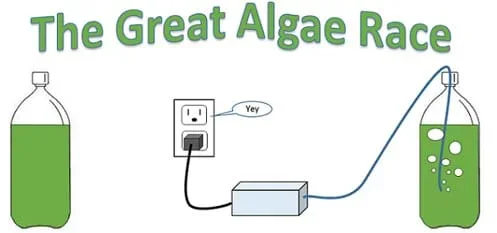 Figure 1. Experimental setup for "The Great Algae Race."Copyright 2013 Robert Bair, University of South Florida
In a multi-week experiment, student groups gather data from the photobioreactors that they build to investigate growth conditions that make algae thrive best. Using plastic soda bottles, pond water and fish tank aerators, they vary the amount of carbon dioxide (or nutrients or sunlight, as an extension) available to the microalgae. They compare growth in aerated vs. non-aerated conditions. They measure growth by comparing the color of their algae cultures in the bottles to a color indicator scale. Then they graph and analyze the collected data to see which had the fastest growth. Students learn how plants biorecycle carbon dioxide into organic carbon (part of the carbon cycle) and how engineers apply their understanding of this process to maximize biofuel production.
Environmental engineers grow algae in photobioreactors for biofuel and fertilizers, or to treat wastewater. To grow successfully, algae need adequate carbon dioxide, which is one of the conditions students test in this activity. Algae sequester carbon dioxide during photosynthesis, making biofuel production a potentially closed loop system. Thus, for engineers, this process serves as a way to biorecycle excess carbon dioxide in the atmosphere or generated from industrial processes such as electricity production, into organic carbon and biofuel.
After this activity, students should be able to:
- Explain how algae use carbon dioxide to grow during photosynthesis and how its availability affects their growth rates.
- Describe a photobioreactor and explain its purpose.
- Demonstrate how to record, analyze and interpret data.
- Describe the difference between renewable and nonrenewable energy.
- Describe how biofuels fit into the carbon cycle and how they biorecycle carbon dioxide into energy.
- CCSS.Math.Content.7.RP.A.2 Recognize and represent proportional relationships between quantities.
Grade 7
Do you agree with this alignment? - CCSS.Math.Content.8.SP.A.1 Construct and interpret scatter plots for bivariate measurement data to investigate patterns of association between two quantities. Describe patterns such as clustering, outliers, positive or negative association, linear association, and nonlinear association.
Grade 8
Do you agree with this alignment? - CCSS.Math.Practice.MP2 Reason abstractly and quantitatively.
Grades K-12
Do you agree with this alignment? - CCSS.Math.Practice.MP4 Model with mathematics.
Grades K-12
Do you agree with this alignment?
- MAFS.8.SP.1.1 Construct and interpret scatter plots for bivariate measurement data to investigate patterns of association between two quantities. Describe patterns such as clustering, outliers, positive or negative association, linear association, and nonlinear association.
Grade 8
Do you agree with this alignment? - MAFS.K12.MP.2.1 Reason abstractly and quantitatively.
Grades K-12
Do you agree with this alignment? - MAFS.K12.MP.4.1 Model with mathematics.
Grades K-12
Do you agree with this alignment?
- SC.8.L.18.1 Describe and investigate the process of photosynthesis, such as the roles of light, carbon dioxide, water and chlorophyll; production of food; release of oxygen.
Grade 8
Do you agree with this alignment? - SC.8.L.18.3 Construct a scientific model of the carbon cycle to show how matter and energy are continuously transferred within and between organisms and their physical environment.
Grade 8
Do you agree with this alignment?
- STEL-2P Create a closed-loop system that has a feedback path and requires no human intervention.
Grades 6-8
Do you agree with this alignment? - STEL-2R Compare how different technologies involve different sets of processes.
Grades 6-8
Do you agree with this alignment?
- MS-ESS2-1 Develop a model to describe the cycling of Earth's materials and the flow of energy that drives this process.
Grades 6-8
This resource focuses on the following Three Dimensional Learning aspects of NGSS:
Science & Engineering Practices- Develop and use a model to describe phenomena.Do you agree with this alignment?
- Analyze and interpret data to determine similarities and differences in findings.Do you agree with this alignment?
- Use mathematical representations to describe and/or support scientific conclusions and design solutions.Do you agree with this alignment?
Disciplinary Core Ideas- All Earth processes are the result of energy flowing and matter cycling within and among the planet's systems. This energy is derived from the sun and Earth's hot interior. The energy that flows and matter that cycles produce chemical and physical changes in Earth's materials and living organisms.Do you agree with this alignment?
Crosscutting Concepts- Models can be used to represent systems and their interactions.Do you agree with this alignment?
Do you agree with this alignment? - Develop and use a model to describe phenomena.
- MS-LS2-3 Develop a model to describe the cycling of matter and flow of energy among living and nonliving parts of an ecosystem.
Grades 6-8
This resource focuses on the following Three Dimensional Learning aspects of NGSS:
Science & Engineering Practices- Develop a model to describe phenomena.Do you agree with this alignment?
Disciplinary Core Ideas- Food webs are models that demonstrate how matter and energy is transferred between producers, consumers, and decomposers as the three groups interact within an ecosystem. Transfers of matter into and out of the physical environment occur at every level. Decomposers recycle nutrients from dead plant or animal matter back to the soil in terrestrial environments or to the water in aquatic environments. The atoms that make up the organisms in an ecosystem are cycled repeatedly between the living and nonliving parts of the ecosystem.Do you agree with this alignment?
Crosscutting Concepts- The transfer of energy can be tracked as energy flows through a natural system.Do you agree with this alignment?
- Science assumes that objects and events in natural systems occur in consistent patterns that are understandable through measurement and observation.Do you agree with this alignment?
Do you agree with this alignment? - Develop a model to describe phenomena.
Each group needs:
- 3 500-ml clear water bottles
- 0.5 meters of thin tubing, such as fish tank aeration tubing, which is reusable and can be used for a number of other activities; such as aquarium airline tubing with 0.165-inch inner diameter and 0.225-inch outer diameter, available in various lengths from https://www.petmountain.com/product/lees-airline-tubing-for-aquariums
- 1 aeration pump for an aquarium, such as the Tetra Whisper Air Pump for $6-$20 each at https://www.petmountain.com/product/tetra-whisper-aquarium-air-pump-non-ul
- 1 aeration stone, such as Penn Plax Aqua Mist Airstone Cylinders, 7/16-inch cylinder, 4-pack for $3 at https://www.petmountain.com/product/penn-plax-aqua-mist-airstone-cylinder
- Energy from Algae?! Worksheet (PDF), one per student
- 1 color scale; cut from the color-printed Algae Color Identification Scale (PDF) (nine scales per sheet)
- The Great Algae Race Data Sheet (PDF), one per group
To share with the entire class:
- (optional) computer with Internet access and projector to show students a short online video
- pond water, collected from a local pond, lake or river
- large bottle(s) for collecting pond water; enough for 200 ml per group
- bucket of tap water that has been left sitting out at room temperature for 24 hours (to help the chlorine dissipate); need at least 1.27 liters per group
- graduated cylinder
- coffee filter, to filter the pond water
- large Mason jar(s) or other soda or water bottles, to hold the filtered pond water
- liquid plant fertilizer, any type
- spoon
- permanent markers, for marking plastic bottles
- graph paper, colored pencils/markers, for plotting graphs
- bleach, a small amount to add to the photobioreactor bottle contents (algae) before disposal
- Energy from Algae?! Worksheet (docx)
- Energy from Algae?! Worksheet (pdf)
- Energy from Algae?! Worksheet Answer Key (docx)
- Energy from Algae?! Worksheet Answer Key (pdf)
- Algae Color Identification Scale (docx)
- Algae Color Identification Scale (pdf)
- The Great Algae Race Data Sheet (docx)
- The Great Algae Race Data Sheet (pdf)
Students should be familiar with photosynthesis and the fundamental requirements for plant growth. An understanding of renewable versus nonrenewable energy is helpful.
(Hand out the worksheets. [optional] Show students a 2:33-minute video, Energy 101: Algae-to-Fuels," at https://www.energy.gov/eere/videos/energy-101-algae-fuel.)
In today's challenge, you are an engineer looking to grow microalgae for biofuel. The people who run the local power plant are hoping that you will be able to use its carbon dioxide waste gas for your microalgae farm.
You're not sure if it will help your algae grow, and piping the waste gas to your site may be expensive. In this experiment, you will compare algae growth with and without the addition of carbon dioxide to see if adding this waste gas helps biofuel production.
Background
Biofuels come from plant-based crops, such as corn, sugarcane and microalgae. These biofuels are renewable, unlike petroleum products that currently dominate the energy market. In the case of corn, parts of the crop are fermented, distilled and turned into ethanol, which can be added to or used in place of gasoline.
Many algae species produce oil naturally as they grow, and this oil can be used to make fuels, even jet fuel. Not only are biomass fuels renewable, they also form a closed loop system because the crops sequester carbon dioxide released when the fuels are burned. However, because plant-based fuels rely on photosynthesis, biofuel crops need carbon dioxide, sunlight and nutrients to grow. In order to maximize biofuel production, engineers must thoroughly understand this biological process and how plants biorecycle carbon dioxide into organic carbon (part of the carbon cycle).
Before the Activity
- Gather materials and lab supplies. Note: An aeration stone (or air stone or aquarium bubbler) is a manufactured porous rock with a nozzle on the end that you attach to the airline tube of an aquarium aeration pump. Air goes down the tube and through the stone and bubbles come out to aerate the water.
- From a local pond, lake or river, collect water in a large bottle(s). Filter the pond water through a coffee filter into a Mason jar(s) or soda or water bottles. Store the pond water in a refrigerator until the activity is ready to start, but do not leave it in the refrigerator for more than a week.
- Make copies of the Algae Color Identification Scale (PDF), which has nine green color scales per sheet that need to be cut apart (see Figure 2). Print as many as needed so that each group has one scale.
- Make copies of the Energy from Algae?! Worksheet (PDF), one per student, and the The Great Algae Race Data Sheet (PDF), one per group.
- Leave the experimental water supply (tap water) sitting out overnight to rid it of chlorine.
- (optional) Prepare equipment to show the class a short online video as part of introducing the activity.
- Divide the class into groups of four students each.
With the Students
- Introduce the topic and activity by showing a short online video (optional, but good), presenting the Introduction/Motivation content and having students individually complete the worksheets for grading.
- Then prepare students for the activity by asking them the questions provided in the Assessment section.
- Have students form into groups and provide them with the activity materials (three water bottles, tubing, aeration pump and other supplies) and guide them as they set up their experiments.
- Have students fill two of the 500-ml bottles with 100 ml of filtered pond water. Make sure students know that the pond water is the source of the microalgae.
- Add 10 ml of liquid fertilizer to the each of those two bottles.
- Fill those two bottles each with 390 ml of tap water that has been left sitting out overnight.
- Fill the third bottle with 490 ml of overnight tap water and 10 ml of liquid fertilizer. This bottle has no algae and serves as the blank (control). Label this bottle "Control."
- Cap and shake the three bottles.
- Place the containers on a window sill or near some artificial lights.
- Leave one bottle capped and label this bottle "Capped."
- Take the cap off the second bottle, place an aeration tube into the uncapped bottle, and aerate using a fish tank pump. Doing this helps more CO2 reach the algae in this bottle. Refer to Figure 1 for the final experimental setup. Label this bottle "Aerated."
- Provide each group with an algae color identification scale and a data sheet.
- Over the course of 1-2 weeks, observe how the bottles change over time. Hold groups accountable to monitor, measure and record data for their experiments. Make daily observations of how well the bottles are doing. Each day, have students compare the color of their algae cultures in the bottles to the color indicator (Figure 2) and record the color numbers that most closely match the algae color on their data sheets.
 Figure 2. Use the algae color identification scale to assign value to the bottle colors so you can identify which bottle has the best growth.Copyright 2013 Robert Bair, University of South Florida
 - The activity can take up to two weeks to run its course. Once the color of the bottles starts turning brown, end the activity by bleaching the contents and dumping them down the drain. Feel free to end the experiment after one week one if enough growth data is collected.
- Once the experiment is concluded, have students plot and analyze their data to see which bottle had the fastest growth, as described in the Assessment section.
- Lead a class discussion to share results and guide students in the interpretation of their data. See the Assessment section for suggested questions.
- biofuel
- Renewable plant-based fuel made from biomass, such as corn, sugarcane or microalgae.
- microalgae
- Microscopic, often single-celled, photosynthetic organisms that sequester carbon dioxide. Microalgae can be used as a biofuel.
- photobioreactor
- A photobioreactor is a controlled, artificial environment in which algae are grown.
Pre-Activity Assessment
Worksheet: Have students fill out the Energy from Algae?! Worksheet (PDF) as you introduce the activity's topic. The worksheet provides information about algae, biofuel and photobioreactors, and it asks students questions about those topics. Review their answers to assess their comprehension of the new material.
Prep Questions: Once students have completed the worksheets, ask them the following questions to prepare them for the activity:
- Why do you think we add plant fertilizer? (Answer: The fertilizer contains essential nutrients that the algae need to grow.)
- What is your hypothesis? Which bottles do you expect to do better? Why? (Answer: We expect the aerated bottle to do better because it is receiving more carbon dioxide.)
Activity Embedded Assessment
Data Sheet: Every day, have students record algae growth on the The Great Algae Race Data Sheet (PDF). Throughout the activity, ask students the following questions:
- What is in the water collected from the stream or lake? Why are we taking that water sample and putting it in the photobioreactor tank? (Answer: The water sample contains all sorts of organisms naturally present in water bodies. Usually, these organisms are kept in check due to limitations in nutrients and food sources. Of these organisms we are hoping to select for some algae species.)
- Why is the water turning green? (Answer: As algae begin to thrive, they multiply and cause the water to turn green.)
- (Near the end of the experiment) Why is the green color vanishing from the photobioreactor? (Answer: The nutrients in the tank have been used up by the algae. Now the algae are dying or being eaten by other microbes.)
Post-Activity Assessment
Data Graphing: Have students plot their collected data (the numbers from the color chart reporting the color of their algae cultures over time) and analyze what it means. Direct students to each create one graph to compare growth rates in their group's three photobioreactor bottles, putting days on the x-axis and the color scale number on the y-axis. Plot the data using different colored pencils/markers for each data set (capped, aerated, control). As a class, guide students to interpret their data. Ask them:
- Which of your photobioreactor bottles had the fastest growth? (Listen to student answers.)
- Are the trends what were expected? (Answer: Expect the algae that had been aerated to grow best.)
- Why did they grow best? (Answer: Because they had access to more carbon dioxide, which is necessary for photosynthesis.)
If the initial growth is anything other than green, end the experiment; it is possible that bacteria other than algae have colonized the bottles.
To increase the likelihood of getting algae in your water, use water from a retention pond or drainage ditch that already looks green. Alternatively, algae may be acquired online for a moderate price.
Expand the activity by also varying the amount of nutrient fertilizer added to the bottles or wrapping some bottles in aluminum foil to hinder sunlight exposure.
- For lower grades, simplify the experiment by using light and dark as the variables to avoid the need for the fish tank aerators. Discuss how plants need sunlight to grow (and algae are plants!).
- For higher grades, add more variables, such as the amount of added fertilizer or light availability.
Show students the U.S. Department of Energy's "Energy 101: Algae-to-Fuels" video (2:33 minutes) to introduce the topic and activity: https://www.energy.gov/eere/videos/energy-101-algae-fuel
Newman, Stefani. How Algae Biodiesel Works. Posted June 18, 2008. HowStuffWorks.com. Accessed February 20, 2014. http://science.howstuffworks.com/environmental/green-science/algae-biodiesel.htm
Contributors
Robert Bair; Ivy Drexler; Jorge Calabria; George Dick; Onur Ozcan; Matthew Woodham; Caryssa Joustra; Herby Jean; Emanuel Burch; Stephanie Quintero; Lyudmila Haralampieva; Daniel Yeh
Supporting Program
Membrane Biotechnology Laboratory, College of Engineering, University of South Florida, Tampa
Acknowledgements
This curriculum was developed under National Science Foundation grant numbers 1236746, 1200682, 0965743 and 1243510, which includes the Water Awareness Research and Education (WARE) - Research Experience for Teachers (RET). However, the contents do not necessarily represent the policies of the National Science Foundation or the U.S. Department of Education, and should not be assumed an endorsement by the federal government.
The authors gratefully acknowledge funding from the Department of Education Graduate Assistants in Areas of National Need (GAANN) Fellowship, and the Bill and Melinda Gates Foundation, as well as classroom support from Learning Gate Community School (Lutz, FL), the Science and Technology Education and Innovation Center (St. Petersburg, FL), and Erin Morrison.
Copyright
2014 by Regents of the University of Colorado; original © 2013 University of South Florida