
Biorecycling: Using Nature to Make Resources from Waste
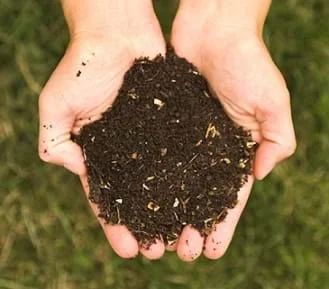 Students learn how carbon becomes biorecycledCopyright 2006 Kessner Photography, Wikimedia Commons http://commons.wikimedia.org/wiki/File:Real_Compost.jpg
By studying key processes in the carbon cycle, such as photosynthesis, composting and anaerobic digestion, students learn how nature and engineers "biorecycle" carbon. Students are exposed to examples, through the hands-on associated activities, of how microbes play many roles in various systems to recycle organic materials and also learn how the carbon cycle can be used to make or release energy.
Environmental engineers mimic the natural carbon cycle in many processes, often designing systems that process carbon faster than would occur in nature. Anaerobic digestion (which turns human or food waste into methane gas) and biofuel production (such as fuels from corn, sugarcane and algae) are excellent examples of using the carbon cycle to generate energy from waste.
After this lesson, students should be able to:
- Explain how engineers use microbes to manage carbon.
- Identify at least three biological processes that cycle elements and energy.
- Describe roles that microbes play in carbon management.
- Define photosynthesis, anaerobic digestion and composting.
- Describe how waste can be used as resources.
- SC.8.L.18.1 Describe and investigate the process of photosynthesis, such as the roles of light, carbon dioxide, water and chlorophyll; production of food; release of oxygen.
Grade 8
Do you agree with this alignment? - SC.8.L.18.3 Construct a scientific model of the carbon cycle to show how matter and energy are continuously transferred within and between organisms and their physical environment.
Grade 8
Do you agree with this alignment?
- STEL-1J Develop innovative products and systems that solve problems and extend capabilities based on individual or collective needs and wants.
Grades 6-8
Do you agree with this alignment? - STEL-2M Differentiate between inputs, processes, outputs, and feedback in technological systems.
Grades 6-8
Do you agree with this alignment? - STEL-2R Compare how different technologies involve different sets of processes.
Grades 6-8
Do you agree with this alignment?
- MS-ESS2-1 Develop a model to describe the cycling of Earth's materials and the flow of energy that drives this process.
Grades 6-8
This resource focuses on the following Three Dimensional Learning aspects of NGSS:
Science & Engineering Practices- Develop and use a model to describe phenomena.Do you agree with this alignment?
Disciplinary Core Ideas- All Earth processes are the result of energy flowing and matter cycling within and among the planet's systems. This energy is derived from the sun and Earth's hot interior. The energy that flows and matter that cycles produce chemical and physical changes in Earth's materials and living organisms.Do you agree with this alignment?
Crosscutting Concepts- Explanations of stability and change in natural or designed systems can be constructed by examining the changes over time and processes at different scales, including the atomic scale.Do you agree with this alignment?
Do you agree with this alignment? - Develop and use a model to describe phenomena.
- MS-LS2-3 Develop a model to describe the cycling of matter and flow of energy among living and nonliving parts of an ecosystem.
Grades 6-8
This resource focuses on the following Three Dimensional Learning aspects of NGSS:
Science & Engineering Practices- Develop a model to describe phenomena.Do you agree with this alignment?
Disciplinary Core Ideas- Food webs are models that demonstrate how matter and energy is transferred between producers, consumers, and decomposers as the three groups interact within an ecosystem. Transfers of matter into and out of the physical environment occur at every level. Decomposers recycle nutrients from dead plant or animal matter back to the soil in terrestrial environments or to the water in aquatic environments. The atoms that make up the organisms in an ecosystem are cycled repeatedly between the living and nonliving parts of the ecosystem.Do you agree with this alignment?
Crosscutting Concepts- The transfer of energy can be tracked as energy flows through a natural system.Do you agree with this alignment?
- Science assumes that objects and events in natural systems occur in consistent patterns that are understandable through measurement and observation.Do you agree with this alignment?
Do you agree with this alignment? - Develop a model to describe phenomena.
Biorecycling
Most of us know something about recycling. It is the process in which we break down used and discarded materials and make new products out of them. We typically associate recycling with glass, paper, metal and plastic, which are materials that humans have manufactured. But what about organic materials such as food waste, lawn trimmings, oils and fats? What about reusing the carbon that has been dumped into the atmosphere in the form of carbon dioxide? Biorecycling is a natural process in which organisms convert materials into new, useful materials. The "bio-" part of the word refers to the fact that biological organisms do all the hard work in these processes. In some cases, organisms are building up molecules, such as in photosynthesis when plants use sunlight and carbon dioxide to build complex materials like sugars and plant fibers. In other cases, organisms break down complex molecules to free up materials for use in other processes, such as when mushrooms break down dead tree trunks on the forest floor. Taken together, these processes help keep carbon, nutrients and energy cycling from one form to another.
Although biorecycling happens naturally, environmental engineers often design controlled systems, such as anaerobic digesters and composting facilities, which enable biorecycling to occur faster and more efficiently. To exploit these systems for waste management, or in other words, to turn these "wastes" (such as food waste) into useful things (such as methane gas or biofuel), environmental engineers must understand the basic principles behind the biorecycling processes.
Humans and the Carbon Cycle
The carbon cycle is typically presented to students from the perspective of natural systems, and thus the human influence on the carbon cycle is minimized or ignored. Yet, due to advancements in technology and consumptive habits, humanity has an enormous influence on the carbon cycle. Modern societies require large amounts of energy to accomplish daily tasks. Most of this energy comes from fossil fuels, such as coal, natural gas and petroleum, which are carbon-based fuels. Cars burn gasoline, a petroleum product, which produces carbon dioxide. Buildings use electricity, which is most often produced by coal- or natural gas-burning power plants that release carbon dioxide as a by-product. If only a few people drove and used electricity, the amount of carbon dioxide being pumped into the atmosphere would not be a big problem; plants and algae could easily take up the carbon dioxide during photosynthesis. However, we have billions of people on Earth burning fossil fuels and releasing carbon dioxide, causing an imbalance of atmospheric carbon.
The amount of carbon dioxide emitted has exceeded the capacity of the natural carbon cycle to sequester, or use, the carbon dioxide in processes such as photosynthesis or storing it in the ocean. Since the industrial revolution, humans have steadily increased the concentration of carbon dioxide in the Earth's atmosphere by burning fossil fuels and deforesting large land areas, which had previously sequestered, or stored, large amounts of carbon. Although the consequences of increased carbon dioxide in the atmosphere are not completely understood, it is generally agreed that it has negative effects on biological systems and coastal regions.
Although engineers have proposed many ways to sequester atmospheric carbon, this lesson focuses on biofuel production. Currently, the most well-known biofuel is corn-based ethanol, but other plants, such as sugar cane, switchgrass and algae, can be turned into liquid and gas fuels. Biofuel is different from fossil fuel because its production is a closed loop system, which means its outputs can also be inputs. For example, although biofuels still produce carbon dioxide when they are burned, they also sequester carbon dioxide during photosynthesis when they grow, thereby making biofuel production a carbon neutral process. Burning fossil fuels, on the other hand, is an open loop system, because the carbon dioxide never becomes fossil fuel again (or does so extremely slowly).
Waste Management
Think about how much goes into creating organic materials: energy from the sun, nutrients from the soil, carbon from the atmosphere, and water. They all combine via photosynthesis to create a wide variety of materials and products. Everything from apples to lumber is created in this way. The problem is that these same materials find themselves in the waste that cities produce. All of the lawn clippings, food waste and wood that a people throw out end up in landfills or incinerators where the nutrients and energy in the organic materials are discarded. This is problematic because the nutrients required for creating new plant materials are becoming scarcer. Yet, nature is a good example of how no such thing as waste exists. In nature, everything is recycled. Waste from one organism is used as food for another. We see a continual cycling of nutrients, energy and carbon. Inspired by nature, engineers use composting and anaerobic digestion to free up the nutrients and energy in these materials. Let's look at these individual processes.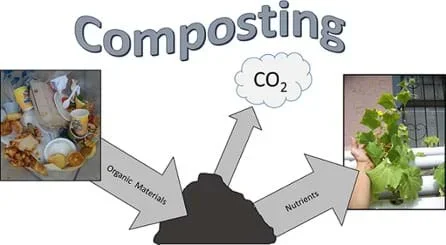 Inputs and outputs to a compost pile.Copyright 2013 Robert Bair, University of South Florida
Composting
Composting is a process during which microorganisms break down complex organic matter into its basic elements. The microbes that do this work need oxygen, thus they require aerobic conditions. In its simplest form, composting happens when you leave a banana in the kitchen for too long. Eventually, the microbes that are present on the peel break down the banana, leaving a liquid in its place. What's not apparent, however, is that oxygen is consumed and carbon dioxide and heat are released by the microbes. Through the process, the carbon in the carbon dioxide, once locked up in the organic matter as sugars or more complex molecules, is made available to plants for photosynthesis. This is the same process that takes place in nature when decomposers, such as fungi and bacteria, break down leaf litter or dead branches on a forest floor. Students can investigate this process with a long-term and hands-on experiment found in the Composting Competition activity.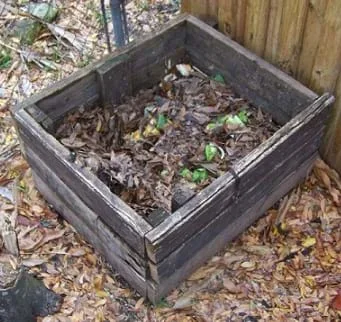 Example household-sized compost pile.Copyright 2013 Robert Bair, University of South Florida
As you can imagine, letting food waste rot in your kitchen is not the most efficient way of dealing with organic waste. Many households start compost piles as a way to efficiently recycle their organic trash. These piles of food and yard waste, provide the ideal environment for decomposers to thrive and rapidly break down the waste. In these small piles, the heat generated by microbial activity can be observed and even measured. How can well tell if the microbes are happy? The hotter a pile is, the happier the microbes are with their environment. When people "turn" their compost piles, they are aerating, or adding fresh oxygen, to their piles. When the materials are done degrading, the resulting nutrient-rich compost is ready to add to garden soil to assist new organic material in being produced.
Engineers design large-scale composting facilities that take in the waste from farms, neighborhoods and even entire cities. These facilities are created with careful consideration for the needs of the microbes. The piles are controlled for temperature, moisture, nutrient levels and oxygen content. When these parameters are maintained to the microbes' liking, composting can happen very quickly and serve as a good way of dealing with a city's waste. Instead of taking up space in a community's landfill, food waste can be biorecycled via composting to produce nutrient-rich fertilizer. Even the heat produced in the piles can be used for energy!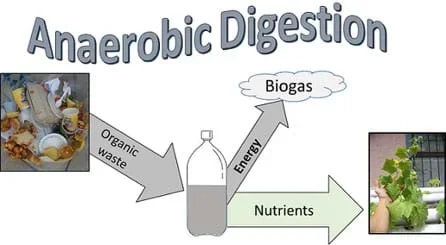 Inputs and outputs of anaerobic digestion.Copyright 2013 Robert Bair, University of South Florida
Anaerobic Digestion
Anaerobic digestion is similar to composting, but it occurs in environments without oxygen. We call these anaerobic environments. In nature, anaerobic environments occur in swamps and deep lakes, among other places. Refer to the Digest Your Food! activity to give students a hands-on opportunity to explore anaerobic digestion as a way to recycle food waste. As leaves, fish and other organic materials sink to the bottom of lakes and swamps, the organic material is broken down by anaerobic microbes, organisms that do not require oxygen to live. As the nutrients from these materials are released, plants in the lakes use them to grow. Anaerobic digestion also occurs in cow stomachs. Microbes in the stomach break apart grasses and plant fibers, releasing nutrients that are absorbed by the cow intestines. Anaerobic microbes also produce methane and carbon dioxide, which is what makes cows fart!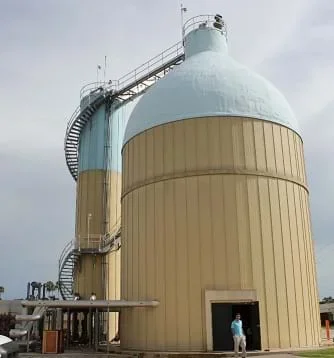 A large-scale anaerobic digester in Lakeland, FL, that treats human waste.Copyright 2013 Robert Bair, University of South Florida
Anaerobic digestion breaks apart complex carbon molecules, releases nutrients and creates biogas, which is a combination of carbon dioxide and methane gas. If the biogas is collected, it can be used as an energy source. In most natural settings, this biogas is simply released to the atmosphere where it becomes a potent greenhouse gas. In engineered systems, which we call anaerobic digesters, this collected biogas can be burned to generate electricity or heat. In this way, engineers create a renewable energy source from waste organic matter. In some cities, engineers have created large anaerobic digesters that take all of the organic materials and break them down into valuable fertilizers and biogas. The types of waste that can be fed to an anaerobic digester include human, food and yard waste.
Photosynthesis and Biofuels
Photosynthesis is the biological process in which organisms convert light energy into chemical energy by building organic matter from carbon dioxide. Although we typically associate photosynthesis with forests and large plants, crops also sequester carbon dioxide using photosynthesis. Some crops are grown specifically to make biofuel, or renewable plant-based fuel made from biomass. For example, corn can be turned into ethanol, which can be added to or used in place of petroleum-based liquid fuels. Many kinds of algae naturally produce oil, which can also be used to make liquid fuels. These microalgae are tiny, microscopic green organisms; the same type of organisms that may turn a swimming pool green! The reason engineers are investigating microalgae is because it grows much faster than other biofuel crops such as corn or sugarcane, and thus has the potential to sequester more carbon dioxide while making renewable fuel.
Engineers build photobioreactors, or controlled artificial environments, to grow specific types of algae. Photobioreactors are usually clear so that sunlight can penetrate, and the water temperature, nutrient content and carbon dioxide levels are kept at just the right conditions. Some engineers have designed photobioreactors that are connected to large power plants so that the microalgae have access to directly recycle the carbon dioxide by-product being produced. Students can prototype and observe their own photobioreactor in the two-week long activity The Great Algae Race. Algae can biorecycle carbon dioxide from power plants or the atmosphere to be made again into fuel or other products, such as fertilizer or animal feed.
We know that we can recycle glass, paper, aluminum and some plastic, but what about food waste and tree waste? What about carbon dioxide that remains in the atmosphere from combustion? What happens to all that stuff and why should we care?
Imagine if every scrap of food that you ever threw away never decomposed. What if every leaf that fell from a tree just sat on your lawn untouched for years? As you can imagine, our world would be a very different place if the carbon and nutrients in organic matter never broke down.
For one, things would just pile up! If it went on long enough, all of the world's nutrients and carbon would be locked up in piles of waste. There wouldn't be enough new nutrients to produce more food! All plants would die if they no longer had access to carbon dioxide, which they need to grow!
The carbon cycle describes how carbon moves from one form to another via chemical or biological processes. This lesson focuses on the biological processes and how engineers use them to "biorecycle" waste into useful carbon, energy and nutrients. In particular, we will look at three processes that engineers use to keep carbon cycling: photosynthesis, anaerobic digestion and composting.
(Continue by delivering the content in the Lesson Background section.)
Engineers use the biological processes of photosynthesis, composting and anaerobic digestion to help manage and cycle nutrients, carbon and energy from one form to another. These processes biorecycle wastes (such as food waste and power plant exhaust) into resources (such as energy and nutrients). While these same processes are found throughout nature, engineers make them happen faster in artificial environments such as anaerobic digesters, photobioreactors and compost piles. Waste is only waste if you waste it!
- aerate
- Adding oxygen.
- aerobic
- A condition, environment or process in which oxygen is available.
- anaerobic
- A condition, environment or process in which oxygen is not present.
- anaerobic digester
- A bioreactor or container that is designed to prevent oxygen from entering and in which anaerobic digestion occurs.
- biofuel
- Renewable plant-based fuel made from biomass, such as corn, sugarcane or microalgae.
- biogas
- A gas mixture produced during anaerobic digestion that contains methane and carbon dioxide. Biogas can be burned as an energy source.
- bioreactor
- A container or "work place" for microbes that provides the ideal conditions for microbial growth.
- biorecycling
- A process in which organisms take "waste" materials, break them down and make new materials from them, using biological processes such as anaerobic digestion or photosynthesis.
- closed loop system
- A system in which process outputs, or "wastes," are used as a system input, or "resource." An example is algae biofuel production, in which carbon dioxide that is produced in combusting the fuel is used again in photosynthesis.
- decomposers
- Organisms, such as fungi or bacteria, that break down complex organic materials into their basic components.
- fossil fuels
- Carbon-based fuels, such as coal, oil and natural gas, which have taken millions of years to form from decaying organic material. Fossil fuels are extracted and combusted, releasing carbon dioxide into the atmosphere.
- methane
- A simple gas that can be used as a fuel source when combusted, but is also a potent greenhouse gas.
- microalgae
- Microscopic, often single-celled, photosynthetic organisms that sequester carbon dioxide. Microalgae can be used as a biofuel.
- nutrients
- A molecule that serves as a fertilizer, such as ammonia, nitrate, phosphate or potassium.
- open loop system
- A system in which outputs, or "wastes," are not brought back into the process as input, or "resources." For example, burning fossil fuels releases carbon dioxide into the atmosphere, but the carbon dioxide is not biorecycled back to organic carbon in this process.
- organic matter
- All living or once-living things or items produced by living things. These carbon-based items include food waste, yard scraps, plant material, sugar, animals and people. Also just called "organics."
- photosynthesis
- The process by which plants use the sun's energy to turn atmospheric carbon dioxide into organic carbon through a series of biochemical reactions.
- sequester
- To lock up or store. To sequester carbon dioxide means to lock it up in a solid or liquid form, such as in a plant or the ocean, where it is no longer in the atmosphere.
Pre-Lesson Assessment
Recycle to Biorecycling Discussion Questions: Solicit, integrate and summarize student responses.
- We know we can recycle glass, paper, aluminum and some plastics, but what about our food waste? Can the carbon cycle help us? (Listen to student suggestions. Answer: Yes we can biorecycle food waste and other organic material through anaerobic digestion and another biorecycling process called composting.)
- We've learned about fossil fuels (or we know we burn gasoline in our cars), but what other forms of renewable energy do we know about? Do any fit in the carbon cycle? (Answer: Expect students to mention renewable energy sources such as solar, wind, water and geothermal. However, less common renewable energy sources include biofuels and anaerobic digestion. Biofuels fit into the carbon cycle because of their photosynthesis component. Anaerobic digestion fits in because of the breaking down and combustion of organic material.)
Post-Introduction Assessment
Make a Loop! Challenge students to draw one of the biorecycling systems discussed. Have them think of where they may get "inputs" for the system (for example, cafeterias for food waste, power plant flue gas for carbon dioxide, dairy farms for cow manure for anaerobic digestion, etc.).
Lesson Summary Assessment
Knowledge Check: At lesson end, have students complete the BioRecycling/BioEnergy Knowledge Check (PDF). This 20-question multiple-choice quiz reviews information presented in the lesson. Answers are provided on the BioRecycling/BioEnergy Knowledge Check Answer Key (PDF). Review students' answers to gauge their comprehension of the subject matter and readiness for the associated activities.
As necessary, show students a visual aid of the carbon cycle at http://earthobservatory.nasa.gov/Features/CarbonCycle/
Food Waste Management Tools and Resources, Resource Conservation. Last updated August 2, 2013. U.S. Environmental Protection Agency. Accessed February 20, 2014. http://www.epa.gov/foodrecovery/fd-tools_rescrs.htm
Newman, Stefani. How Algae Biodiesel Works. Posted June 18, 2008. HowStuffWorks.com. Accessed February 20, 2014. http://science.howstuffworks.com/environmental/green-science/algae-biodiesel.htm
Teachers: Composting & Recycling, Wastes—Educational Materials. Last updated June 14, 2013. U.S. Environmental Protection Agency. Accessed February 20, 2014. http://www.epa.gov/osw/education/teach_comp.htm
- Biorecycling: Using Nature to Make Resources from Waste
Contributors
Robert Bair; Ivy Drexler; Jorge Calabria; George Dick; Onur Ozcan; Matthew Woodham; Caryssa Joustra; Herby Jean; Emanuel Burch; Stephanie Quintero; Lyudmila Haralampieva; Daniel Yeh
Supporting Program
Membrane Biotechnology Laboratory, College of Engineering, University of South Florida, Tampa
Acknowledgements
This curriculum was developed under National Science Foundation grant numbers 1236746, 1200682, 0965743 and 1243510, which includes the Water Awareness Research and Education (WARE) - Research Experience for Teachers (RET). However, the contents do not necessarily represent the policies of the National Science Foundation or the U.S. Department of Education, and should not be assumed an endorsement by the federal government.
The authors gratefully acknowledge funding from the Department of Education Graduate Assistants in Areas of National Need (GAANN) Fellowship, and the Bill and Melinda Gates Foundation, as well as classroom support from Learning Gate Community School (Lutz, FL), the Science and Technology Education and Innovation Center (St. Petersburg, FL), and Erin Morrison.
Copyright
2014 by Regents of the University of Colorado; original © 2013 University of South Florida