
Composting Competition
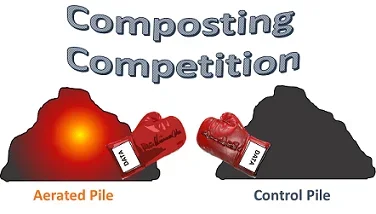 Who will win this heated race?Copyright 2013 Robert Bair, University of South Florida
In a multi-week experiment, students monitor the core temperatures of two compost piles, one control and one tended, to see how air and water affect microbial activity. They daily aerate and wet the "treated" pile and collect 4-6 weeks' worth of daily temperature readings. Once the experiment is concluded, students plot and analyze their data to compare the behavior of the two piles. They find that the treated pile becomes hotter, an indication that more microbes are active and releasing heat. Through this activity, students see that microbes play a role in composting and how composting can be used as a carbon management process.
Engineers use composting in many applications, such as large-scale municipal yard waste management, agricultural applications and at zoos to handle animal, yard and food waste. Composting is unique in that it is a natural process that can be applied in situations as simple as a backyard compost pile for household waste or as complex as an engineered solution to a city's waste problem.
After this activity, students should be able to:
- Present examples of microbes breaking down organic matter.
- Describe how heat is generated when microbes break down organic matter.
- Explain that to speed up the breakdown of organic materials microbes need air.
- Explain how composting fits in the carbon cycle.
- Identify instances when composting happens in nature.
- Describe how the process of composting biorecycles complex organic carbon matter into simpler carbon-based organic matter and nutrients.
- CCSS.Math.Content.7.RP.A.2 Recognize and represent proportional relationships between quantities.
Grade 7
Do you agree with this alignment? - CCSS.Math.Content.8.SP.A.1 Construct and interpret scatter plots for bivariate measurement data to investigate patterns of association between two quantities. Describe patterns such as clustering, outliers, positive or negative association, linear association, and nonlinear association.
Grade 8
Do you agree with this alignment? - CCSS.Math.Practice.MP2 Reason abstractly and quantitatively.
Grades K-12
Do you agree with this alignment? - CCSS.Math.Practice.MP4 Model with mathematics.
Grades K-12
Do you agree with this alignment?
- MAFS.8.SP.1.1 Construct and interpret scatter plots for bivariate measurement data to investigate patterns of association between two quantities. Describe patterns such as clustering, outliers, positive or negative association, linear association, and nonlinear association.
Grade 8
Do you agree with this alignment? - MAFS.K12.MP.2.1 Reason abstractly and quantitatively.
Grades K-12
Do you agree with this alignment? - MAFS.K12.MP.4.1 Model with mathematics.
Grades K-12
Do you agree with this alignment?
- SC.8.L.18.3 Construct a scientific model of the carbon cycle to show how matter and energy are continuously transferred within and between organisms and their physical environment.
Grade 8
Do you agree with this alignment?
- STEL-2R Compare how different technologies involve different sets of processes.
Grades 6-8
Do you agree with this alignment? - STEL-3F Apply a product, system, or process developed for one setting to another setting.
Grades 6-8
Do you agree with this alignment?
- MS-ESS2-1 Develop a model to describe the cycling of Earth's materials and the flow of energy that drives this process.
Grades 6-8
This resource focuses on the following Three Dimensional Learning aspects of NGSS:
Science & Engineering Practices- Develop and use a model to describe phenomena.Do you agree with this alignment?
- Analyze and interpret data to determine similarities and differences in findings.Do you agree with this alignment?
- Use mathematical representations to describe and/or support scientific conclusions and design solutions.Do you agree with this alignment?
Disciplinary Core Ideas- All Earth processes are the result of energy flowing and matter cycling within and among the planet's systems. This energy is derived from the sun and Earth's hot interior. The energy that flows and matter that cycles produce chemical and physical changes in Earth's materials and living organisms.Do you agree with this alignment?
Crosscutting Concepts- Models can be used to represent systems and their interactions.Do you agree with this alignment?
Do you agree with this alignment? - Develop and use a model to describe phenomena.
- MS-LS2-3 Develop a model to describe the cycling of matter and flow of energy among living and nonliving parts of an ecosystem.
Grades 6-8
This resource focuses on the following Three Dimensional Learning aspects of NGSS:
Science & Engineering Practices- Develop a model to describe phenomena.Do you agree with this alignment?
Disciplinary Core Ideas- Food webs are models that demonstrate how matter and energy is transferred between producers, consumers, and decomposers as the three groups interact within an ecosystem. Transfers of matter into and out of the physical environment occur at every level. Decomposers recycle nutrients from dead plant or animal matter back to the soil in terrestrial environments or to the water in aquatic environments. The atoms that make up the organisms in an ecosystem are cycled repeatedly between the living and nonliving parts of the ecosystem.Do you agree with this alignment?
Crosscutting Concepts- The transfer of energy can be tracked as energy flows through a natural system.Do you agree with this alignment?
- Science assumes that objects and events in natural systems occur in consistent patterns that are understandable through measurement and observation.Do you agree with this alignment?
Do you agree with this alignment? - Develop a model to describe phenomena.
Each student needs:
To share with the entire class:
- outside location to place two compost piles for a month or more, a minimum of 1 m2 (10.76 ft2)
- 1 truckload (1.14 m3 or 40.5 cubic feet) of yard trimmings/chipped branches and trees that are not completely degraded; tree trimming and landscaping companies often provide this service for free; alternative: search the neighborhood for bags of lawn clippings
- hand air mattress inflator pump; costs $11 (look for a used one)
- PVC pipe, 0.5 meter-long segment of 1.27 cm (half-inch) diameter
- new pump action sprayer; for student safety, it is important that the sprayer has not previously contained pesticides; costs ~$20
- 2 landscaping flags, or other way to mark the centers of the piles for daily temperature readings
- compost pile thermometer, available at hardware stores and gardening centers, costs $12 or more
- hacksaw
- lighter or hairdryer, for heating PVC pipe
- electrical tape
- graph paper, colored pencils/markers, for plotting graphs
- Composting Data Sheet (docx)
- Composting Data Sheet (pdf)
- Composting: Putting Microbes to Work (Again!) Worksheet (docx)
- Composting: Putting Microbes to Work (Again!) Worksheet (pdf)
- Composting: Putting Microbes to Work (Again!) Worksheet Answer Key (docx)
- Composting: Putting Microbes to Work (Again!) Worksheet Answer Key (pdf)
Students should understand that decomposers and bacteria break down complex organic material to make its components available to other organisms.
Have you ever wanted to do something more meaningful with your leftover food, rather than just throw it in the trash? How about biorecycling it using microbes that live in a compost pile?!
Like us, microbes like to eat, and they need oxygen and water, too. In this experiment, you will determine what conditions make microbes the happiest. When microbes are happy, they break down leftover food, turning it into fertilizer for your garden, so you can grow more food.
Background
This activity is designed to help students understand how organic materials, such as leaves, food waste and bark, can be broken down and returned to the carbon cycle. Although composting can be a slow process, it can be accelerated by providing the microbes with what they need to thrive. For example, microbes, require oxygen and water (like us!) to break down organic materials. As microbes break things down, they release energy in the form of heat. One way to gauge how "happy" microbes are is to check the compost pile temperature. The temperature of a healthy compost pile is between 48.8 °C (120 °F) to 65.40 °C (150 °F).
Before the Activity
- Gather materials and make copies of the Composting Data Sheet (PDF) and the Composting: Putting Microbes to Work (Again!) Worksheet (PDF), one each per student.
- Find a suitable location outside to set up and conduct the activity for four to six weeks.
- Decide whether or not to include students in the preparation of the aeration and water pumps, and the compost piles, depending on their ages and abilities.
Prepare the Aeration and Water Pumps
- To create an aeration pump, start by using a hacksaw to cut one end of the half-inch PVC pipe at a 45° angle.
- While outdoors, gently heat the other end of the PVC pipe with a lighter or hairdryer, being very careful not to burn the plastic.
- While still hot, force the heated end of the pipe onto the end of the air mattress pump hose (see Figure 1). When cooled, the pipe should form a tight fit around the pump hose. To finalize the seal, wrap the connection between the PVC pipe and pump hose with electrical tape.
- To prepare the water pump, use the hacksaw to cut the tip of the pesticide sprayer at a 45°angle to (see Figure 1).
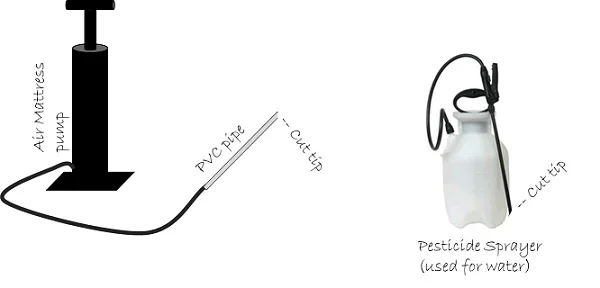 Figure 1. Modify the tools for the composting experiment.Copyright 2013 Robert Bair, University of South Florida
Prepare the Compost Piles
- Evenly divide the truckload of compost into two piles and place them directly on the soil outside, in a minimum footprint of 1 m2. One pile will be left alone as a control; the other will be watered and aerated as the "treated" pile.
- Visually estimate the centers of the piles and mark them with landscaping flags to indicate where to take the temperature readings.
- With some kind of weatherproof signs, identify one pile as the control pile and the other as the aerated and watered—"treated"—pile.
With the Students
- Begin by introducing the composting competition activity and asking students to hypothesize about what they expect to happen, as described in the Assessment section.
- On the first day, measure the temperature of both piles by placing the thermometer vertically in the center of the pile. Have students record these initial values on their data sheets.
- Daily aeration: Every day, have students visit the treated pile and stab it with the PVC pipe, going in as far as possible. While the pipe is in, pump the inflator five times. Repeat these steps at different locations throughout the pile at least 8 times daily. Set up a schedule to share the responsibility for this chore.
- Daily wetting: Then stab the pesticide sprayer pump into the treated pile 8 times while injecting water into the pile the entire time. Set up a schedule to share the responsibility for this chore.
- Once the aeration and wetting process is complete, have students take temperature readings at the flag locations for both the treated and control piles, recording the measured temperatures on their data sheets. Expect the temperature of the well-tended pile to increase more than the control pile.
- After 4-5 weeks, expect the aerated pile to begin to cool because the composting process has come to an end. Once this happens, the pile is ready to be added to garden soil.
- Assign students to individually complete the worksheet. Review the answers as a class.
- Once the experiment is concluded, have students plot and analyze their data to compare the behavior of the two piles, as described in the Assessment section.
- Lead a class discussion to share results and guide students in the interpretation of their data, including the pros/cons of assisting in the composting process. See the Assessment section for suggested questions.
- aerate
- Adding oxygen.
- microbe
- A general name given to an organism that is too tiny to see with the unaided eye.
- organic matter
- All living or once-living things or items produced by living things. These carbon-based items include food waste, yard scraps, plant material, sugar, animals and people. Also just called "organics."
Pre-Activity Assessment
Hypothesize: Ask students the following question and give them time to write responses. Then have students share their answers with the class and lead a discussion to develop one hypothesis for the class. Question: Do you expect any difference between the two piles and why? (Expect a variety of responses. Answer: The piles should be very different. In many cases, compost piles lack sufficient oxygen to enable the microbes to thrive. By aerating the pile, the microbes are able to break down the organic matter much faster.)
Activity Embedded Assessment
Questions: Throughout the course of the activity, as students take measurements and record temperature readings on their Composting Data Sheets (PDF), ask students the following questions:
- Why are we aerating one pile? (Answer: We are trying to ensure that the microbes get enough oxygen so they can do their work.)
- Where is the heat coming from? (Answer: Organic materials have lots of energy in them. If you don't believe it, try burning a log! As microbes break apart these organic materials, energy is released in the form of heat.)
- Why is it important to biorecycle carbon in organic waste? (Answer: It makes simple carbon available for other organisms as food. It releases carbon dioxide that can be used in photosynthesis (or used to grow biofuels!). It also releases nutrients that can be used to fertilize other plants.)
Post-Activity Assessment
Worksheet: Have students fill out the Composting: Putting Microbes to Work (Again!) Worksheet (PDF). Review the answers as a class to make sure students understand the concepts.
Data Graphing: Have students plot their many weeks' worth of collected temperature data and analyze what it means. Direct students to each create one graph with time on the x-axis and temperature on the y-axis. Plot the data from the two piles on the same graph using different colored pencils/markers for each data set, so as to compare the behavior of the two piles (control vs. treated). As a class, guide students to interpret their data. Ask them:
- Do the data support the hypothesis (that the aerated pile becomes hotter)? (Listen to student answers. Expect the data to support the hypothesis.)
- Which compost pile heated up more? (Answer: Expect the data and graphs to show that the treated pile heated up more.)
- Why did it get hotter? (Answer: Microbes breaking down organic material release heat; more microbes working results in more heat released.)
- How does composting fit into the carbon cycle? (Answer: Composting biorecycles complex organic carbon matter into simpler carbon-based organic matter and nutrients.)
- How do engineers apply this composting process to other situations? (Possible answers: To keep a city's large-scale human and yard/tree/leaves waste from filling landfills, to find a way to dispose of agricultural crop waste, and to handle the animal, yard and food waste at zoos, with the benefit of creating nutrient-filled compost that can be used to enrich the soil.)
- What are the advantages and disadvantages of "treating" a compost pile? (Example answers: Advantages include faster waste degradation, more fertilizer and nutrients produced, smaller footprint, heat produced byproduct available for some purpose. Disadvantages include cost of aeration tools, time spent to routinely aerate.)
- Make sure the pesticide sprayer is new and has never had chemicals in it so that students are not exposed to pesticides.
- Because the nozzle edges are sharp, warn students to be careful with the aeration and water pumps.
Prevent the PVC air and water injector pipes from clogging with soil/compost by pumping the pipes while they are inserted into the piles. If they become clogged, knock the pipes against a hard object a few times to unclog them.
Make sure that the two piles have almost identical conditions other than aeration and watering. For example, make sure that the piles are not being heated by the sun at different rates. Also, if students suggest that the heat is coming from the sun, have them measure and track two different temperatures: surface and center-of-the-pile.
A dry compost pile won't degrade very fast, that's why adding water helps the process move along. But too much water, from the sprayer and/or rain, will make it soggy, smell of ammonia and slow down the process because all the water is depriving the microorganisms of oxygen ("drowning" them!). So keep an eye on the wetness and the weather, and adjust accordingly. Ideally, a handful of compost should be the consistency of a wrung-out sponge.
- For more advanced students, start with three piles (instead of two) so that you can also test a pile that is only watered, but not aerated, in order to further separate the impact of the two factors (watered and aerated) applied in the "treated" pile.
- For higher grades, have students look at compost samples under the microscope during the course of the experiment. Are microbes visible? Identify the microbes.
Hundley, Lars. Compost Bin Moisture Level. Composting Instructions: How to Compost at Home, A Guide to Making Your Own Compost. Accessed February 28, 2014. http://www.compostinstructions.com/compost-bin-moisture-level/
Teachers: Composting & Recycling, Wastes—Educational Materials. Last updated June 14, 2013. U.S. Environmental Protection Agency. Accessed February 20, 2014. http://www.epa.gov/osw/education/teach_comp.htm
Contributors
Robert Bair; Ivy Drexler; Jorge Calabria; George Dick; Onur Ozcan; Matthew Woodham; Caryssa Joustra; Herby Jean; Emanuel Burch; Stephanie Quintero; Lyudmila Haralampieva; Daniel Yeh
Supporting Program
Membrane Biotechnology Laboratory, College of Engineering, University of South Florida, Tampa
Acknowledgements
This curriculum was developed under National Science Foundation grant numbers 1236746, 1200682, 0965743 and 1243510, which includes the Water Awareness Research and Education (WARE) - Research Experience for Teachers (RET). However, the contents do not necessarily represent the policies of the National Science Foundation or the U.S. Department of Education, and should not be assumed an endorsement by the federal government.
The authors gratefully acknowledge funding from the Department of Education Graduate Assistants in Areas of National Need (GAANN) Fellowship, and the Bill and Melinda Gates Foundation, as well as classroom support from Learning Gate Community School (Lutz, FL), the Science and Technology Education and Innovation Center (St. Petersburg, FL), and Erin Morrison.
Copyright
2014 by Regents of the University of Colorado; original © 2013 University of South Florida