
Exploiting Polarization: Designing More Effective Sunglasses
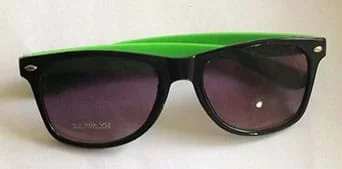 Students design prototype sunglasses to meet technical design objectives.Copyright 2014 Yinan Chen, Wikimedia Commons (public domain) https://commons.wikimedia.org/wiki/File:Gfp-sunglasses.jpg
Students apply what they know about light polarization and attenuation (learned in the associated lesson) to design, build, test, refine and then advertise their prototypes for more effective sunglasses. Presented as a hypothetical design scenario, students act as engineers who are challenged to create improved sunglasses that reduce glare and lower light intensity while increasing eye protection from UVA and UVB radiation compared to an existing model of sunglasses—and make them as inexpensive as possible. They use a light meter to measure and compare light intensities through the commercial sunglasses and their prototype lenses. They consider the project requirements and constraints in their designs. They brainstorm and evaluate possible design ideas. They keep track of materials costs. They create and present advertisements to the class that promote the sunglasses benefits, using collected data to justify their claims. A grading rubric and reflection handout are provided.
Engineers are often challenged to create more effective and efficient versions of existing products and concepts, for instance the wireless network. Due to the demand from so many users and bandwidth-hungry applications, data sharing networks have increased from 3G to 4G LTE, and now a 5G data service is in development. This next-generation network aims to use 28 GHz to 64 GHz frequencies with shorter cellular coverage radii that tends to attenuate completely through humans and walls. In order to provide faster data sharing rates at an acceptable cost, engineers are researching ways to redirect the beams nearly instantaneously via antenna arrays on the end system and packet switches (routers). Engineers often use the engineering design process to conduct experiments to collect data as part of refining prototype designs and preparing them for release.
After this activity, students should be able to:
- Apply their knowledge about light polarization and attenuation to design and create improved sunglasses that reduce glare and light intensity, while providing protection from UVA and UVB radiation.
- Apply engineering design principles to evaluate the effectiveness of designs.
- Understand the basic steps of the engineering design process.
- CCSS.Math.Content.HSS-ID.B Summarize, represent, and interpret data on two categorical and quantitative variables
Grades 9-12
Do you agree with this alignment? - CCSS.Math.Practice.MP4 Model with mathematics.
Grades K-12
Do you agree with this alignment? - CCSS.Math.Practice.MP5 Use appropriate tools strategically.
Grades K-12
Do you agree with this alignment?
- Students will develop an understanding of the attributes of design.
Grades K-12
Do you agree with this alignment? - Students will develop an understanding of engineering design.
Grades K-12
Do you agree with this alignment? - Students will develop an understanding of the role of troubleshooting, research and development, invention and innovation, and experimentation in problem solving.
Grades K-12
Do you agree with this alignment? - Students will develop abilities to apply the design process.
Grades K-12
Do you agree with this alignment? - Students will develop abilities to assess the impact of products and systems.
Grades K-12
Do you agree with this alignment? - Students will develop an understanding of the relationships among technologies and the connections between technology and other fields of study.
Grades K-12
Do you agree with this alignment?
- CCSS.Math.Content.HSS-ID.B Summarize, represent, and interpret data on two categorical and quantitative variables
Grades 9-12
Do you agree with this alignment? - CCSS.Math.Practice.MP4 Model with mathematics.
Grades K-12
Do you agree with this alignment? - CCSS.Math.Practice.MP5 Use appropriate tools strategically.
Grades K-12
Do you agree with this alignment?
- HS-ETS1-2 Design a solution to a complex real-world problem by breaking it down into smaller, more manageable problems that can be solved through engineering.
Grades 9-12
Do you agree with this alignment? - HS-ETS1-3 Evaluate a solution to a complex real-world problem based on prioritized criteria and trade-offs that account for a range of constraints, including cost, safety, reliability, and aesthetics, as well as possible social, cultural, and environmental impacts.
Grades 9-12
Do you agree with this alignment?
- HS-ETS1-2 Design a solution to a complex real-world problem by breaking it down into smaller, more manageable problems that can be solved through engineering.
Grades 9-12
This resource focuses on the following Three Dimensional Learning aspects of NGSS:
Science & Engineering Practices- Design a solution to a complex real-world problem, based on scientific knowledge, student-generated sources of evidence, prioritized criteria, and tradeoff considerations.Do you agree with this alignment?
Disciplinary Core Ideas- Criteria may need to be broken down into simpler ones that can be approached systematically, and decisions about the priority of certain criteria over others (trade-offs) may be needed.Do you agree with this alignment?
Do you agree with this alignment? - Design a solution to a complex real-world problem, based on scientific knowledge, student-generated sources of evidence, prioritized criteria, and tradeoff considerations.
- HS-ETS1-3 Evaluate a solution to a complex real-world problem based on prioritized criteria and trade-offs that account for a range of constraints, including cost, safety, reliability, and aesthetics, as well as possible social, cultural, and environmental impacts.
Grades 9-12
This resource focuses on the following Three Dimensional Learning aspects of NGSS:
Science & Engineering Practices- Evaluate a solution to a complex real-world problem, based on scientific knowledge, student-generated sources of evidence, prioritized criteria, and tradeoff considerations.Do you agree with this alignment?
Disciplinary Core Ideas- When evaluating solutions it is important to take into account a range of constraints including cost, safety, reliability and aesthetics and to consider social, cultural and environmental impacts.Do you agree with this alignment?
Crosscutting Concepts- New technologies can have deep impacts on society and the environment, including some that were not anticipated. Analysis of costs and benefits is a critical aspect of decisions about technology.Do you agree with this alignment?
Do you agree with this alignment? - Evaluate a solution to a complex real-world problem, based on scientific knowledge, student-generated sources of evidence, prioritized criteria, and tradeoff considerations.
Each group needs:
- 1 pair of inexpensive, unpolarized sunglasses; such as 12 for $9 at Amazon
- paper and pencils
- 2 plastic Petri dishes, 5-10 cm in diameter size
- 1 6 x 6-inch polarizing filter per group, such for $10.50 each at Educational Innovations
- light sensor, such as the GoDirect® Light and Color Sensor for $79 by Vernier; alternatively, share one sensor with the entire class
- computer/tablet/cell phone, Bluetooth and free Graphical Analysis 4 software, downloaded from https://www.vernier.com/products/software/graphical-analysis/; to use the Vernier light sensor
- hot glue gun and hot glue sticks
- scissors
- (optional) pieces of thick cardboard (or other material) to protect tabletops from hot glue
- Sunglasses Design Grading Rubric (PDF), one per student
- Project Reflection Handout (PDF), one per student
To share with the entire class:
- An understanding of light polarization and ways to polarize light.
- Familiarity with the differences between opaque, transparent and translucent mediums.
- An understanding that different materials completely block specific frequencies from transmitting through them.
- (optional but helpful) An understanding of how to operate a light sensor and analyze its data.
Welcome! You are newly hired engineers at the Sunny Vision Company that specializes in the development of sunglasses. You and your group have on the counter in front of you the company’s current model that needs to be updated to meet changing customer needs. Our customers want the light intensity and glare to be further reduced as well as increased attenuation of UVA and UVB radiation. At the end of this challenge, you will present your sunglasses in the form of an advertisement to sell your product.
How do we begin this project? What should we do first?
Well, what do you know about the product? Do you use sunglasses? Why do you use them? Why are they important to you to use? What types do you use? What makes one type of sunglasses different from another? (Use prompts like these to start a brief discussion among students about the product—sunglasses. Then transition the discussion to focus more on the assignment—the engineering design challenge.)
Step 1 of the Engineering Design Process: Ask to identify the project requirements and constraints?
- Your final sunglasses design will be evaluated on how much it reduces the light intensity, glare and ultraviolet (UVA/UVB) radiation compared to the original model.
- It will also be judged on its design aesthetic—that’s how stylish or visually pleasing it is.
- You may only use the provided materials. (Do not identify the materials yet.)
- The Sunny Vision Company believes in creating stylish sunglasses for an affordable price. Each material has an associated cost that you must keep in mind as you create your design. Your materials costs figure into the total price of your sunglasses, which you must include in your advertisement.
For your engineering assignment, you need to use a light meter to measure the intensities of the various wavelengths of the current model sunglasses, and then use the same light meter to measure the properties of your newly designed sunglasses. In a minute, I’ll show you how to use the light meter.
Let’s quickly review the basic steps of the engineering design process. You have already completed some of these steps.
- Ask: Identify the need, requirements and constraints.
- Research the problem: What would be helpful to know for this challenge? Such as the baseline light intensity measurements of the current model sunglasses.
- Imagine Possible Solutions: In your team, brainstorm and think of possible solutions.
- Plan by Selecting a Promising Idea: Evaluate your best solutions and select one to proceed with. Then decide on details and materials, and make sketches.
- Create a prototype(s). Often engineers create and test many different prototype versions.
- Test and evaluate the prototype(s) to make improvements and make sure you meet the requirements and constraints.
- Improve and Redesign as Needed: Engineers often redesign their prototype based off of the testing results.
(Hand out to each group a grading rubric.) Notice on this grading rubric the expectations in six categories—technique and concepts, habits of mind and effort, reflection and understanding, meeting design requirements and constraints, craftsmanship, and communication of design (that’s the concluding advertisement). Make sure you read through this rubric before you dig into the project.
Any questions at this stage? (Answer any questions.) Then let the designing begin!
In this activity, students design, build and test model sunglasses with the goal to develop prototypes that reduce light intensity and glare, and provide ultraviolet radiation eye protection—and that are as inexpensive as possible to make.
Cost Constraint—To design their sunglasses, teams choose from the teacher-provided materials, keeping in mind their costs. Set the materials costs as you like; the costs are not for students to actually purchase, but to tally up to determine their total cost of materials. In general, take the approach that the higher the price of a material, the more you charge per unit or per square inch. As students fabricate their prototype sunglasses, they need to consider the cost of each material item used. Below are examples of suggested costs to communicate to the teams:
- Petri dishes to serve as base lenses = free
- Hot glue = free
- UV blocking film = $1.25 per square inch
- Polarizing filters = $1.75 per square inch
- Black garbage bag plastic = 75¢ per square inch
- Pipe cleaners = 25¢ per stem
Light Sensor Use—When the prototype sunglasses are complete, students go outside and use the light sensor to measure the intensity of visible sunlight and UVA/UVB radiation through the prototype lenses, creating and analyzing graphs of the intensity of these electromagnetic frequencies. They compare this data to the baseline measurements for the original model sunglasses. See the Procedure section for more detailed instructions on how to collect data with the light sensor.
Redesign and Improvement—If students wish to further improve their new designs (and if time permits), have them continue to refine their ideas until they achieve the desired performance levels. The ultimate goal is to reduce the light intensity and provide more ultraviolet radiation protection than the original model.
Marketing—When a final prototype is achieved, students create advertisements for their group’s sunglasses that describe how the new model sunglasses compare to the original model by using graphics to illustrate the differences and promote the benefits.
Before the Activity
- Gather materials and make copies of the Sunglasses Design Grading Rubric (PDF) and Project Reflection Handout (PDF), one each per student.
- Remove any plastic coatings on the polarizing filters—or have students do that as part of the activity.
- As necessary, refresh your understanding of how to use the light sensors. Refer to the detailed instructions in step 4, below. The Vernier Go Direct sensors connect to phones, tablets and computers via Bluetooth and the free Graphical Analysis 4 software that is available for Chrome, Windows, macOS, iOS and Android. Download from your phone’s application store or directly to a computer from the Vernier website. See Vernier’s sensor user manual (downloadable PDF) at https://www.vernier.com/manuals/gdx-lc/.
- Before students arrive, place all materials in a central location for easy student access and place an inexpensive pair of sunglasses at each group workspace.
- Have ready to distribute to each team the grading rubric and two Petri dishes.
- Schedule the activity on a sunny day so that you can perform testing outdoors.
With the Students
- As students enter the classroom, have them do the bell work brainstorming, as described in the Assessment section.
- Divide the class into groups of three students each and organize them at separate workspaces, each with a pair of sunglasses.
- Then present to the class the Introduction/Motivation content, handing out the rubric at the end.
- Next, in as much detail as necessary, model how to use the light sensor. Once connected, show how to collect data, change settings and analyze graphs. The main steps:
- Using a computer/tablet/phone, connect the Vernier light sensor via Bluetooth and open up the Graphical Analysis 4 application.
- The application automatically recognizes which Vernier sensor is connected via the unique code listed on the sensor, which is helpful if you have multiple sensors that are each connected to different devices. (Once connected, it works similar to the Logger Pro computer program that is typically associated with Vernier sensors.)
- Place the sensor behind the sunglasses lens and hold up both to the sun. Then collect data by pressing the “collect” button on the sensor device.
- Then the app creates a graph—either intensity vs. time OR intensity vs. wavelength—depending on the settings you put in (see next two bullets). The resulting graph can be exported to various formats for further analysis. Do this by using the “export” button at the top right of the screen.
- To measure light intensity, first set the sensor device setting for light intensity vs. time (this is usually the default setting).
- To measure ultraviolet radiation, first change the sensor device setting to intensity vs. wavelength. In the resulting graph, look at the electromagnetic data in the 320–375 nm range (UVA/UVB radiation). Then find the peak intensities in that range, and record those measurements.
- Tell students: Use the sensors to measure the current light intensity and UVA/UVB reduction of the original model sunglasses at your table. Your objective is to establish the baseline numbers. As you analyze the graphs, look at the relative intensity of the wavelength. Light intensity is found in the default setting. You must change the setting on your device so that the sensor collects electromagnetic data in the 320–375 nm (UVA/UVB radiation). Then find and record the peak intensities of these wavelengths.
- Show students where to find all the provided materials and give each group two Petri dishes. Explain that the Petri dishes serve as the base clear plastic lenses for their prototype sunglasses.
- Next, students brainstorm ideas in their groups about how they wish to design their lenses, meaning placement of polaroids, style, etc. If desired, this could include identifying a target customer and making a unique style of sunglasses that would appeal to that population of people. Suggest that students first individually brainstorm to come up with ideas (further developing their bell work brainstorming ideas) and then share, discuss and evolve the ideas as a group. This includes evaluating the pros and cons of the ideas and selecting the best design or combination of ideas.
- Once a final design is decided upon, require students to create material lists and sketches that include the lens and the placement order of the materials on top of the lens.
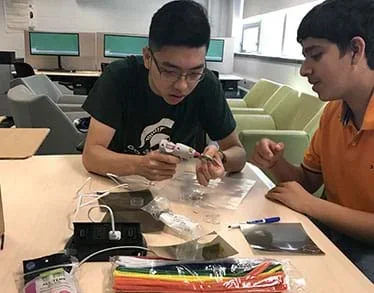 Figure 1. Students working together on prototype construction.Copyright 2017 Adam Alster, Michigan State University RET
- Move on to the prototype fabrication phase when students use the materials to coat the plastic lenses (see Figure 1). They use scissors to cut the polaroids to fit on the Petri dish-lenses and hot glue to affix the materials to the lenses. Hot glue is easy to remove and keeps the materials well-affixed.
- If time and materials permit, it is useful for groups to create more than one prototype for testing (the next step). By doing this, they can obtain multiple datasets to compare and analyze—gaining helpful information towards determining the final best design.
- When students are confident in their lens prototype and ready for testing, have them go outside and use the light sensor connected via Bluetooth to their devices to graphically analyze the visible light and UVA/UVB intensity coming through the fabricated lens, using the sun as the light source. To make the measurements, repeat the steps that were modeled for students earlier (see step 4, above). Remember to first set the settings for either light intensity or ultraviolet radiation.
- Once teams complete their lens prototypes, including any redesign improvements, have them use pipe cleaners to make frames for the lenses. One approach is to twist together a few pipe cleaners to make strong and stylish sunglasses. See a few examples in Figure 2. This is a good place to personalize the sunglasses lens shape and frames to appeal to a target population.
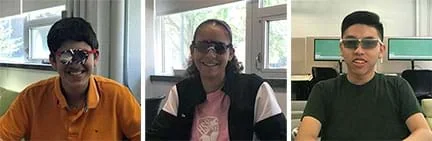 Figure 2. Students show off their creative prototype sunglasses.Copyright 2017 Adam Alster, Michigan State University RET
- Next, students create advertisements for their sunglasses, as described in the Assessment section.
- To conclude, assign students to individually complete the reflection handout, as described in the Assessment section.
- attenuation
- The reduction of amplitude of a signal, electric current or other oscillation.
- light intensity
- Essentially, the brightness of light. Intensity is directly related to the energy of light. The rate at which light is received at the surface.
- polaroid
- An optical filter that permits light waves of a specific polarization to pass through while blocking other polarizations. Polaroids can convert beams of light of mixed polarization into well-defined polarizations.
- ultraviolet radiation
- Electromagnetic waves with wavelengths from 10-400 nm. This radiation carries enough energy when oxidized with melanin to brown human skin. Too much exposure to this radiation can damage skin tissue.
Pre-Activity Assessment
Bell Work Brainstorming: To get students’ creative juices flowing, ask students to brainstorm a list of materials they imagine they would need in order to create sunglasses that reduce light intensity, glare and UVA/UVB intensity. Then have them sketch how they would use the materials to make sunglasses. Students will build off these ideas later in the activity.
Activity Embedded Assessment
Questions to Guide Thinking: As students work on designing and fabricating their sunglasses, circulate the room, asking students how the work is progressing. Look at student data and provide feedback as necessary. In general, ask questions to facilitate a discussion within each group (and without the teacher). Do not wait for a response, ask the question and leave the team to discuss. Example prompting questions:
- Based on your data, how much did you reduce the intensity of visible light and UVA/UVB radiation? How do you think you can improve upon that?
- Why are you using (name a material)? What do you hope to accomplish with this material?
- Are you keeping track of costs?
Post-Activity Assessment
Sunglasses Advertisement: For the activity summative assessment, ask teams to each create a catchy advertisement to promote their sunglasses. Suggest that they refer to the Sunglasses Design Grading Rubric (PDF) to clarify expectations. Give students a few days between the assignment and its due date to give them time to analyze the data and create a well-thought-out advertisement. If desired, have teams present their advertisements to the rest of the class. Suggested guidelines and requirements:
- Decide on a format, such as a newspaper, magazine or web ad, or a television commercial
- Include details on the key characteristics and benefits of the sunglasses and how much the light intensity and ultraviolet light frequency intensities are reduced.
- Incorporate collected sensor data and graphs to justify and describe the improved performance of the new sunglasses compared to the original model and to support marketing claims made to sell the sunglasses.
- Include a suggested retail price that covers the total materials cost to make the sunglasses.
- If you have identified a target customer, make the ad appeal to that population of people.
Project Reflection: Assign students to individually reflect on the sunglasses design project by providing short answers to four open-ended questions in the Project Reflection Handout (PDF). The questions ask them to share what they learned about what engineers do, what was most challenging, what was most successful, and what further improvements they might make to their prototype sunglasses.
Making Sense: Have students reflect about the science phenomena they explored and/or the science and engineering skills they used by completing the Making Sense Assessment (PDF).
- Protect the tabletop(s) where students use the hot glue guns, such as with a layer of thick cardboard, in order to keep students from burning themselves and the counter.
- Suggest to students a routine for collecting the materials to enable them to efficiently move about the classroom.
- To troubleshoot the Vernier light sensor, go to www.vernier.com and search for “Go Direct Light and Color Sensor.”
- Be sure students remove the protective coating from the polaroids and UV film.
- Make sure students place glue on the sides of the Petri dish so it does not interfere with their results.
- If students begin to see a rainbow, that is because they are placing the polaroids on each side of the plastic Petri dish-lenses, which creates thin-film interference. To resolve, place the polaroids on top of each other with nothing in between.
- Be sure to align the UVA/UVB and visible light sensors accurately through the sunglasses when analyzing relative intensities.
Related to the attenuation of electromagnetic radiation, specifically ultraviolet radiation, have students investigate sunscreens with various SPFs to graphically analyze the relative intensity of UVA/UVB radiation versus the SPFs to determine which is most effective and whether higher SPF sunscreens are worth their higher costs. See the How Effective Is Your Sunscreen? activity.
Have students design their own sunscreens using a variety of chemicals, with the objective to permit only a very small UVA/UVB intensity to pass through the sunscreen matter. For inspiration, see Flinn Scientific’s Making UV-Sensitive Paper—Student Laboratory Kit at https://www.flinnsci.com/making-uv-sensitive-paper---student-laboratory-kit/ap6155/.
- For lower grades, have students design and make sunglasses that reduce the light intensity that gets through following the same activity procedure with the exception of the ultraviolet film. Have them construct a lens that the instructor analyzes for its light intensity using the light sensor. Evaluate the success of their prototype sunglasses in terms of reducing light intensity and aesthetics.
- For even lower grades, entirely eliminate use of a light sensor and just demonstrate how light varies in intensity through a variety of materials. Have students hold polaroids up to any light source and observe what happens to the light. Have them add another polaroid to the first, rotating it to observe what happens when the polarizing filters are perpendicular to each other. After a quick discussion on polarization, have students look at various light sources—fluorescent lights, the sun (carefully!), phones, tablets, TV screens, computer monitors—to see if the light is polarized.
- For higher grades, instead providing students with ultraviolet blocking film, challenge them to create their own film using different mixtures of ferric nitrate solution, potassium ferricyanide solution and oxalic acid. Using a different combination of these materials enables more or less UVA/UVB radiation to pass through, resulting in greater or lower intensity measurements
Refer to Vernier’s light sensor user manual (downloadable PDF) at https://www.vernier.com/manuals/gdx-lc/.
“The Electromagnetic and Visible Spectra.” Light Waves and Color – Lesson 2 – Color and Vision, The Physics Classroom. Accessed July 19, 2017. http://www.physicsclassroom.com/class/light/Lesson-2/The-Electromagnetic-and-Visible-Spectra
“Polarization.” Light Waves and Color – Lesson 1 – How Do We Know Light Is a Wave? The Physics Classroom. Accessed July 19, 2017. http://www.physicsclassroom.com/class/light/Lesson-1/Polarization
Rappaport, Theodore S. (2013) NYU WIRELESS. Publication Library, Tandon School of Engineering, NYU. http://wireless.engineering.nyu.edu/
Rappaport, Theodore S. “Millimeter Wave Mobile Communications for 5G Cellular: It Will Work!” (PowerPoint® slide presentation) NYU Wireless and IEEE. http://pimrc2014.ieee-pimrc.org/IEEE%20PIMRC%20Keynote%20Sept%205%202014%20Final%20Ted.pdf
Rappaport, Theodore S., Shu Sun and Rimma Mayzus. “Millimeter Wave Mobile Communications for 5G Cellular: It Will Work!” IEEE Access, Vol. 1, No. 1, pp. 335–349, May 10, 2013. (includes five-minute YouTube video) http://ieeexplore.ieee.org/document/6515173/
- Electromagnetic Waves: How Do Sunglasses Work?
- Exploiting Polarization: Designing More Effective Sunglasses
Contributors
Adam Alster; Quan Tran; Drew Kim
Supporting Program
Smart Sensors and Sensing Systems RET, College of Engineering, Michigan State University
Acknowledgements
This curriculum was developed through the Smart Sensors and Sensing Systems research experience for teachers under National Science Foundation RET grant no. CNS 1609339. However, these contents do not necessarily represent the policies of the NSF, and you should not assume endorsement by the federal government.
Copyright
2018 by Regents of the University of Colorado; original © 2017 Michigan State University