
Who's Hitchhiking in Your Food?
How can you tell if harmful bacteria are growing in your food? Students learn to culture bacteria in order to examine ground meat and bagged salad samples, looking for common foodborne bacteria such as E. coli or salmonella. After 2-7 days of incubation, they observe and identify the resulting bacteria. Based on their first-hand experiences conducting this conventional biological culturing process, they consider its suitability in meeting society's need for ongoing detection of harmful bacteria in its food supply, leading them to see the need for bioengineering inventions for rapid response bio-detection systems.
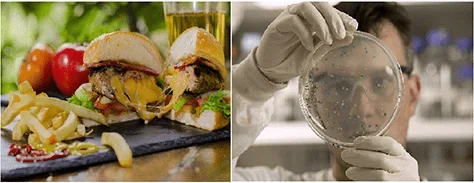 How can you tell if harmful bacteria are growing in your food?Copyright (left) Pixabay https://pixabay.com/en/burger-fast-food-food-restaurant-1976187/ (right) 2006 David McClenaghan, CSIRO CC BY-SA 3.0 https://commons.wikimedia.org/wiki/File:CSIRO_ScienceImage_3567_Examining_an_agar_dish_for_bacterial_colonies_as_part_of_the_bioremediation_project.jpg
Engineers use the problem solving process to design new ways to meet human needs and challenges. Using conventional biological processes to detect harmful bacteria in food is slow, complicated and unreliable. Thus, a need exists for new advanced testing technologies to address the problem of pathogen detection in the medical, military, food and environmental industries. Bioengineers are finalizing the technology for portable, rapid, accurate detection of pathogens using handheld nano-scale biosensors that have the potential to save lives, reduce outbreaks and increase public confidence in the food supply.
After this activity, students should be able to:
- Perform experiments on common food items such as ground meat, milk, vegetables or water to test for the presence of specific bacteria such as E. coli, including growing a culture of the bacteria.
- Evaluate the usefulness of the culturing process to meeting society's need for food screening.
- Explain why engineering new designs for rapid response bio-detection systems are desirable solutions to protect human health.
- The development of refrigeration, freezing, dehydration, preservation, and irradiation provide long-term storage of food and reduce the health risks caused by tainted food.
Grades 6-8
Do you agree with this alignment? - Biotechnology has applications in such areas as agriculture, pharmaceuticals, food and beverages, medicine, energy, the environment, and genetic engineering.
Grades 9-12
Do you agree with this alignment? - STEL-1J Develop innovative products and systems that solve problems and extend capabilities based on individual or collective needs and wants.
Grades 6-8
Do you agree with this alignment?
- B1.1A Generate new questions that can be investigated in the laboratory or field.
Grades 9-12
Do you agree with this alignment? - B1.1B Evaluate the uncertainties or validity of scientific conclusions using an understanding of sources of measurement error, the challenges of controlling variables, accuracy of data analysis, logic of argument, logic of experimental design, and/or the dependence on underlying assumptions.
Grades 9-12
Do you agree with this alignment? - B1.1C Conduct scientific investigations using appropriate tools and techniques (e.g., selecting an instrument that measures the desired quantity-length, volume, weight, time interval, temperature-with the appropriate level of precision).
Grades 9-12
Do you agree with this alignment? - B2.2g Propose how moving an organism to a new environment may influence its ability to survive and predict the possible impact of this type of transfer.
Grades 9-12
Do you agree with this alignment? - B2.3B Describe how the maintenance of a relatively stable internal environment is required for the continuation of life.
Grades 9-12
Do you agree with this alignment? - S.IP.07.13 Use tools and equipment (spring scales, stop watches, meter sticks and tapes, models, hand lens, thermometer, models, sieves, microscopes, hot plates, pH meters) appropriate to scientific investigations.
Grade 7
Do you agree with this alignment? - S.IP.M.1 Inquiry involves generating questions, conducting investigations, and developing solutions to problems through reasoning and observation.
Grades 5-7
Do you agree with this alignment? - K-7 Standard S.IP: Develop an understanding that scientific inquiry and reasoning involves observing, questioning, investigating, recording, and developing solutions to problems
Grades K-7
Do you agree with this alignment?
- MS-LS1-5 Construct a scientific explanation based on evidence for how environmental and genetic factors influence the growth of organisms.
Grades 6-8
This resource focuses on the following Three Dimensional Learning aspects of NGSS:
Science & Engineering Practices- Construct a scientific explanation based on valid and reliable evidence obtained from sources (including the students' own experiments) and the assumption that theories and laws that describe the natural world operate today as they did in the past and will continue to do so in the future.Do you agree with this alignment?
Disciplinary Core Ideas- Genetic factors as well as local conditions affect the growth of the adult plant.Do you agree with this alignment?
Crosscutting Concepts- Phenomena may have more than one cause, and some cause and effect relationships in systems can only be described using probability.Do you agree with this alignment?
Do you agree with this alignment? - Construct a scientific explanation based on valid and reliable evidence obtained from sources (including the students' own experiments) and the assumption that theories and laws that describe the natural world operate today as they did in the past and will continue to do so in the future.
Each group needs:
- 4 Petri dishes, 4-inch size
- microwave safe container (bowl), quart-size
- hot and cold tap water
- agar nutrient, 5 grams (for 4 Petri dishes)
- weighing boat
- stirrer, for boiling agar and water
- 2 samples raw hamburger, ~1/16 pound each (purchase one pound of raw hamburger for a class of eight groups; prepare by leaving one-half unrefrigerated overnight and one-half refrigerated; groups each get a sample from each half)
- 2 samples uncooked salad mix from a bag, ~ 1 cup each (purchase 2 bags salad mix; prepare by leaving one unrefrigerated overnight and one refrigerated; groups each get a sample from each bag)
- sterile water, ~ 8 ounces, available at pharmacies and medical supply stores
- wash bottle
- 4 cotton swabs
- 4 zip-lock plastic bags, size that can accommodate a Petri dish
- permanent marker or tape and pen, to label Petri dishes
- graduated cylinder, for measuring amounts of water
- polypropylene beaker
- lab tray or lab bench
- lab coat or apron, one per student
- purple nitrile gloves, one pair per student
- safety glasses, one pair per student
- Lab Results Sheet (PDF), one per person
- How to Culture Bacteria Steps (PDF), one per group
- Identifying Cultured Bacteria Handout (PDF), one per group
- (optional) second zip-lock bag that can hold four bagged Petri dishes (if needed for disposal method)
To share with the entire class:
- one-half teaspoon measuring spoon, for agar
- incubator, oven or other warm dark place to grow the cultures (not too warm, up to ~ 98 °F [37 °C])
- microwave, for boiling water
- digital balance
- access to a refrigerator, for chilling half the sample food
- biohazard disposal container (or your school's suggested disposal method)
- (optional) thermal gloves, bleach wipes, hand sanitizer, parafilm, bleach, standard trash bag
- An understanding of life requirements for organisms, especially bacteria.
- An understanding of cells and cell division.
- An understanding of the role of DNA in identifying an organism's characteristics (optional for sixth grade).
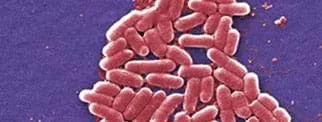 Most strains of E. coli are harmless, others can make you sick.Copyright Centers for Disease Control and Prevention http://www.cdc.gov/features/ecoliinfection/
It's a simple fact of life—everyone eats! But sometimes the things we eat can make us sick. Have you ever heard people say they had the stomach flu? Or maybe food poisoning? Chances are that they ate food that was contaminated with common foodborne bacteria such as E. coli 0157:H7, Salmonella or campylobacter jejuni. If the illness included nausea, vomiting, diarrhea, chills or fever, then it was probably due to bacteria present in consumed food or beverages.
Why would people eat food that would make them feel sick? Most of us would never eat food that looked moldy or spoiled. The problem is that these common and harmful bacteria are microorganisms—so tiny that they can only be seen under extreme magnification, like a microscope. So we cannot see the bacteria in our food and do not know that it is there! But it does not take many bacteria to cause illness in humans. The bacteria love to reproduce in our guts because it is warm, moist and has lots of food already there. While you may only eat a few bacteria in your food, chances are, they will soon have plenty of relatives living in there with them!
If a lot of people start becoming sick with the same symptoms after eating the same foods or foods from the same restaurants or grocery stores, scientists perform tests on samples of those foods to determine if bacteria are present, and what kind of bacteria they are. After that, it is a race in time to find out where the original contamination happened so that the outbreak can be stopped. This is why it is important to have quick methods for detecting the presence of bacteria.
Bacteria are living organisms that use the process of binary fission (splitting in half) to reproduce rapidly. Usually, the original bacteria are present only in small quantities, spread out amongst a huge amount of ground beef, milk or bean sprouts. To try to find the original bacteria, you cannot look at, say, four thousand pounds of hamburger under a microscope—it would take forever! So scientists take small samples of a food product, and try to grow additional bacteria from the few organisms that may be in each sample. This process is called culturing and it has been done for many years for a variety of purposes. Although this process has been done for a long time, it is also very slow. New engineering solutions, such as technologies that are quick and also accurate are needed.
Have you ever had your throat swabbed to see if you had strep? That's an example of a culture. Humans have a long history of brewers and bakers culturing their own strains of yeast from which delicious beverages and bread are made, and penicillin was originally discovered because certain kinds of mold seemed to have antibiotic properties. People tried to grow stable forms of mold to use as antibiotics for hundreds of years, until Alexander Fleming was successful in 1928.
To perform a culture test, bacteria are added to a dish that has nutrients in it, which is then kept warm to encourage rapid reproduction of the bacteria. After enough bacteria reproduce themselves, a colony becomes visible in the dish. If no living bacteria were in the sample, then no colonies are seen. This process takes two to seven days and requires sterile laboratory practices in order to be confident in the results, so we can say we have conclusive evidence.
In this activity, we are going to take samples from ground beef and bagged mixed salad greens and culture them to determine if any bacteria are present. This activity has two purposes. First, it gives you the opportunity to practice your laboratory techniques to culture microorganisms, and second, it gives you first-hand experience from which to decide whether this is an efficient and effective way to look for foodborne pathogens or if better methods should be developed. From this activity, you will gain an understanding of the importance of bioengineering inventions.
Background
During Part 1 of this activity, students observe the difference in bacterial count between cultures from beef and lettuce that were left out at room temperature and beef and lettuce that were kept refrigerated. Expect it to take two to seven days for incubation of the cultures. The lab reinforces the concept that fresh food must be kept adequately chilled in order for it to remain safe to eat. Chilling is an effective short-term method for controlling microbial growth. But, chilling does not kill microorganisms, so it is still important to correctly handle meat when defrosting and cooking it.
During Part 2 of the activity, students reflect upon the results of the culturing experiments, consider the pros and cons of the conventional biological culturing process meeting the need for detection of pathogen contamination in our food supply, and see how emerging biosensor technologies are needed to provide solutions to this challenge. What would important design requirements for new technologies be? What should engineers take into consideration?
Before the Activity
- Gather materials and make copies of the Lab Results Sheet (PDF), How to Culture Bacteria Steps (PDF) and Identifying Cultured Bacteria Handout (PDF). Print the latter handout in full color.
- The day before the lab, buy the beef and salad, leaving half of the food unrefrigerated overnight.
- Organize lab supplies for each group on lab trays or at lab benches.
With the Students: Part 1—Lab Introduction
- Present to students the information in the Introduction/Motivation section.
- Distribute the Lab Results Sheets.
- Introduce the lab by presenting to students the following suggested scenario. Alternatively, ask students to come up with a scenario of when food might be unintentionally left out of the refrigerator for too long.
Last night, Mrs. Cooper bought two packages of hamburger and two bags of mixed salad greens that she planned to prepare for dinner. She put one package of each in the refrigerator. She forgot to get the other grocery bag from the back seat of her car to put in the refrigerator. So it sat in her car in the garage all night long. She found the bag the next morning when she got in the car to go to work. She put the food in the refrigerator, but wondered if the unrefrigerated hamburger was safe to eat. She wasn't worried at all about the salad since it was just mixed lettuces and other vegetables.
- Ask the class: Would you eat the unrefrigerated hamburger? The unrefrigerated salad? Why or why not? Let's test both packages of hamburgers and salad to look for any differences between them. We can use a culturing technique to try to grow bacteria from the four samples (write this on the classroom board):
- Sample 1: Refrigerated ground beef
- Sample 2: Unrefrigerated ground beef
- Sample 3: Refrigerated bagged salad mix
- Sample 4: Unrefrigerated bagged salad mix
- Divide the class into teams of four students each. Have them each assemble around a lab tray or bench.
- Assign groups to form hypotheses about the refrigerated food vs. the food that was left out overnight. Have students record their hypotheses on the lab sheets.
- Then ask students: How would you test your hypotheses? Have them record their answers on the lab sheets.
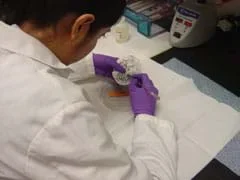 Lab safety precautions must be used when handling contaminated materials.Copyright 2012 Lisa Wininger, Michigan State University
With the Students: Part 1—Lab Procedure
Hand out the How to Culture Bacteria Steps and have students put on their protective lab gear. Then review the following experimental design for the lab (also on the handout).
- On your lab tray or bench, get a clean, microwave-safe container (quart-sized bowl) to mix and heat the agar with water. The following mixing proportions make enough nutrient agar to prepare two halves of the Petri dish. Mix ½ teaspoon agar (about 1.2 grams) with ¼ cup (60 ml) hot water and stir. Bring this mixture to a boil for one minute to completely dissolve the agar. CAUTION: Adult supervision is required to boil water. Especially if you use a microwave oven to boil the mixture, be careful not to let the solution boil over. The final mixture should be clear with no particles floating around in the solution. Let the mixture cool for 3 to 5 minutes before moving on to the next step.
- Separate the Petri dish into two pieces, a top and a bottom. Carefully fill the bottom half with warm agar nutrient solution. Use the top half to loosely cover the bottom portion; place the lid ajar so moisture can escape. Let the solution cool and harden for at least 1 hour.
- It is time to collect some bacteria on the end of a cotton swab. You are testing ground meat and bagged mixed salad. Since the bacteria are attached to these surfaces, mix some sterile water with a sample of the meat or the salad, and then drag your cotton swab through the liquid. Remember to use a clean cotton swab for each sample.
- Lift the top off the Petri dish and LIGHTLY draw a squiggly line in the agar with the end of the cotton swab. Cover the Petri dish with the top half and use a permanent marker (or tape and pen) to label the dish with the sample number and description of the item being tested. For your protection, place the sealed Petri dish inside a zip-lock bag and zip it closed. For safety reasons, do not ever open the zip-lock bag. View the growing bacteria through the clear plastic.
- Repeat the above procedure for each sample culture.
- Place the Petri dishes in an incubator, oven or other warm dark place to grow— not too warm, but up to ~ 98 °F (37 °C) is good. Over the next few days, expect to see an amazing variety of bacteria, molds and fungi appear, growing to more and larger colonies. Remember: Do NOT open the media plates once things begin to grow; you may be culturing a pathogen.
- Safety note: Remember—do not open the zip-lock bag—ever! Most bacteria collected in the environment are not harmful. However, once they multiply into millions of colonies in a Petri dish, they become more of a hazard. Be sure to protect open cuts with rubber gloves and never ingest or breathe in growing bacteria. Keep your Petri dishes sealed in the zip-lock bags for the entire experiment.
- After a few days, you are likely to have a huge variety of colors and shapes in the tiny Petri dish worlds. Getting bacteria to grow can be a little tricky, so do not get discouraged if you have to make more than one attempt. Count the number of colonies on each Petri dish. Draw and describe the differences in colors, shapes and other properties. Allow enough time for them to grow, too. It may take 2-7 days for all of the bacteria to consume the nutrient and stop growing. You need millions of them in one place just to see them at all. They are really tiny! In a lab, a scientist would use an inoculating loop to pick up a bit of the bacteria in order to create a slide for further study under a microscope.
- Safety note: Later, when you are finished observing and analyzing your cultured bacteria, correctly dispose of them. As an extra precaution, place the Petri dish bags into a larger zip-lock bag along with a few drops of bleach. Then seal up the larger bag and dispose of it as hazardous waste.
With the Students: Part 1—Data Collection and Analysis
- After several days, when bacterial growth is observable, have students take a careful look. Direct them to make written observations and sketches on the lab sheets. Expect to see a variety of colors and shapes in the microscopic bacterial world. Count the numbers of colonies.
- Is it possible to tell which types of bacteria were cultured in the dishes by looking at their colors and shapes? Have groups refer to the Identifying Cultured Bacteria Handout to learn about identifying characteristics. The handout provides key information on identifying bacteria by shape (form), elevation (side view height), margin (edges), surface (texture), opacity (transparency) and pigmentation (color). It includes drawings that illustrate common forms, elevations and margins, as well as color photographs of specific bacteria, yeasts, molds and other fungi.
- Lead a class discussion to compare results and conclusions. Ask the students:
- In relation to your hypotheses, were there any surprises? (Answers will vary.)
- Which bacteria were you able to identify? (Answers will vary.)
- Did the cold kill the bacteria in the refrigerated samples? (Expected results: Some bacterial growth was observed, which is feasible since cold does not kill bacteria.)
- What did you observe in the unrefrigerated samples? (Expected results: More bacteria grew from the unrefrigerated food samples than from the refrigerated food samples. This is feasible since we know the unrefrigerated food was in the "danger zone" for several hours.)
- What can you conclude about what went wrong along the farm-to-table continuum in respect to our test foods? (Example answer: The food may have been contaminated with bacteria before Mrs. Cooper purchased it. However, she compounded the problem by her unsafe handling of the food after she brought it home. She did not follow the "chill" rule of the 4Cs of Food Safety. She violated the two-hour rule by not placing the food in the refrigerator immediately.)
- Who has the final responsibility for the safety of this food? (Answer: Each of us. It is our responsibility to make sure that our food stays safe after we purchase it.)
- Could I just cook the unrefrigerated hamburger thoroughly and make it safe to eat? (No. If food is left unrefrigerated, bacteria cells will grow and more heat is required to kill the additional cells. Also, leaving the meat unrefrigerated invites the possibility of cross-contaminating surfaces, hands, etc. Researchers advise us to practice safe food-handling habits, so always handle your food defensively. If the hamburger was left in room temperature conditions for more than two hours, discard it.)
With the Students: Part 2—Reflection and Nano-Scale Biosensors
- Reflect upon the results of your culturing experiments. Since our objective is to determine whether harmful bacteria exist in our food, what are the benefits of performing this procedure—the conventional biological culturing process? What are the possible problems or disadvantages with using this procedure to test the food supply? Record your ideas on your lab sheets (question 4 on the second page). Have students hand in their lab sheets for grading.
- Lead a wrap-up class discussion in which everyone shares their ideas on the benefits and problems of culturing food samples (like we did in this activity) as an ongoing way to test our food supply for the presence of harmful bacteria.
- What are some benefits of this conventional biological culturing process to detect harmful bacteria in food? (Example answers: You learn whether or not contaminants are present in the sampled food. You have the tools and experts to conclusively identify the cultured bacteria, to determine if they are harmful to humans. You can see how different food samples compare by testing in the same culturing conditions.
- What are some possible problems or disadvantages of using this culturing procedure to test our food supply? (Example answers: It takes many days to wait for results, during which time more people may be exposed to the pathogens in the food. It must be done in a clean laboratory with skilled technicians, expensive equipment and strict procedures. Even if certain harmful bacteria are cultured and identified, you still do not know for sure at what stage of handling the contaminant[s] were introduced. It is always possible that contaminants were introduced during the culturing process.)
- Since this laboratory-based culturing procedure is time-consuming, technical to conduct and sometimes inaccurate, what should we do? How can we engineer better solutions to the challenge of safeguarding our food supply? What would the constraints and criteria of a new design for detecting contaminants be? (Possible answer: We need to design new ways to test food that are quicker, easier, can be done outside of labs, and are more reliable.)
- What might be a good solution? How would this solution benefit society? (Provide the following information to students: Bacteria can be detected using biosensors, which are devices that measure and communicate data about physiological changes or the presence of chemical or biological materials. Imagine field-based, rapid, accurate detection of pathogens using handheld biosensors to save lives, reduce outbreaks, and increase public confidence in the food supply. Bioengineers are working on solutions to the problems associated with the testing and identification of foodborne bacteria, aiming to reduce the incubation period and eliminate the need for culturing bacteria in laboratories. They are developing new types of biosensors that are small, relatively inexpensive, easy for non-scientists to operate, rapid and accurate. They are designing biosensors in many shapes and sizes, usually with some kind of a probe that is used to examine biological specimens and electronics that generate measurements and signals. Biosensors, some of them working at the nano-scale, are intended to also address the need for pathogen detection in the medical, military and environmental industries. See the Background section of the associated lesson for more information on some example biosensors.)
- bacteria
- Unicellular organisms lacking organelles or an organized nucleus. Some may cause disease.
- bio-detection
- Using a device, such a biosensor, to find, identify or quantify a biological entity, such as a virus or bacterium
- bioengineering
- The application of concepts and methods of biology and physics, mathematics or computer science to solve real-world life sciences problems.
- biosensor
- A device that detects, measures and communicates information about physiological changes or the presence of specific chemical or biological materials. Usually composed of a probe for sensing and electronics for processing and signaling.
- cell
- In biology, the basic unit of which all living things are composed.
- contamination
- The unintended presence of harmful substances or microorganisms in food.
- cross-contamination
- The transfer of bacteria from foods, hands, utensils or food preparation surfaces to a food. For example, when liquids from raw meat, poultry and seafood transmit harmful bacteria to previously uncontaminated foods or surfaces.
- culture
- To maintain (tissue cells, bacteria, etc.) in conditions suitable for growth.
- electrode
- An electrical conductor used to make contact with a nonmetallic part of a circuit
- food supply
- Amount of a type of food item available for consumption.
- food supply chain
- A series of links and interdependencies that enable food to be produced, processed, transported and consumed.
- foodborne illness
- Infection or intoxication caused by the transfer of microbial or chemical contaminants (substances that spoil or infect) from food or drinking water to humans. In most cases, the contaminants are bacteria, parasites or viruses.
- infection
- Attachment and growth of pathogenic micro-organisms, including bacteria, protozoans, viruses and parasites, on or within the body of a human or animal.
- microorganism
- A microscopic life form that cannot be seen with the naked eye. Types of microorganisms include: bacteria, viruses, protozoa, fungi, yeasts and some parasites and algae.
- nano scale
- Measurements at a scale of one-billionth of a meter.
- nutrient
- A chemical that an organism needs to live or grow.
- pathogen
- Any microorganism that is infectious or toxigenic and causes disease. Pathogens include parasites, viruses and some fungi/yeast and bacteria.
- sample
- A specimen taken from food and tested for the purpose of identifying a foodborne pathogen or various kinds of chemical contaminants.
- species
- A group of organisms that are genetically related. The second word in the binomial name of a bacterium is called the species name.
- spore
- A reproductive structure, some of which are adapted for dispersal and surviving for extended periods of time in unfavorable conditions.
- sterile
- Any process that eliminates or kills all form of life from an item or field.
- strain
- A variant of a species of bacteria. Some may be pathogenic and some may be benign. For example, most E. coli are neutral or helpful to people, but E. coli O157:H7 is a strain of E. coli that is harmful to people.
- toxin
- A poison that is produced by microorganisms, carried by fish or released by plants.
Lab Reports: During the lab, have students use the Lab Results Sheet (PDF) to record their hypotheses, experimental test plans, written observations and sketches of the cultured bacteria results, as well as reflections on the benefits and problems of using this lab procedure as a way to test the safety of our food supply. Review their data and answers to gauge their comprehension of the subject matter.
Results & Analysis Discussion: After the lab, lead a class discussion to compare groups' lab experiment results and conclusions. See the questions/answers in the Procedure section.
Wrap-Up Discussion: Conclude the activity by leading a class discussion in which everyone shares their ideas on the benefits and disadvantages of culturing food samples (as was done in the lab activity) as an ongoing way to test our food supply for the presence of harmful bacteria. See the questions/answers in the Procedure section. Conclude by providing information on the potential of biosensors as a solution to this challenge.
- Provide adult supervision for boiling water.
- It is extremely important that students do not handle food with their bare hands!
- All cultures must remain sealed within zip-lock bags to prevent any possibility of students coming into contact with cultured bacteria.
- Make sure to dispose of all cultures in a marked hazardous waste container and follow your school's procedures for disposal, in accordance with state and national requirements.
When preparing the ground beef and lettuce samples, be careful not to cross-contaminate between the refrigerated and unrefrigerated portions with utensils, containers and hands.
- For lower grades, conduct the lab as a teacher demonstration, and make sure to direct the discussions in a way that does not cause alarm or fear about food contamination.
Dr. X and the Quest for Food Safety video/DVD Module 4 - Retail and Home (4 minutes, starting at minute 27), at http://www.fda.gov/Food/FoodScienceResearch/ToolsMaterials/ucm182117.htm
Food Safety A to Z Reference Guide – Good reference for the following terms: bacteria, cross-contamination, danger zone, foodborne illness, food code, food safety, four steps to food safety, freezing, germ, handwashing, pathogen, and refrigeration. See http://www.fda.gov/Food/FoodScienceResearch/ToolsMaterials/ucm216150.htm
- Biosensors for Food Safety
- Who's Hitchhiking in Your Food?
Contributors
Lisa Wininger; Evangelyn Alocilja; Hannah Miller
Supporting Program
Bio-Inspired Technology and Systems (BITS) RET, College of Engineering, Michigan State University
Acknowledgements
The contents of this digital library curriculum were developed through the Bio-Inspired Technology and Systems (BITS) RET program under National Science Foundation RET grant no EEG 0908810. However, these contents do not necessarily represent the policies of the NSF and you should not assume endorsement by the federal government.
Copyright
2013 by Regents of the University of Colorado; original © 2012 Michigan State University