
Biosensors for Food Safety
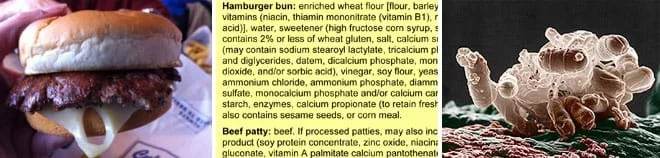 Thoroughly cooked meat minimizes contamination worries, especially with the presence of so many ingredients in the industrial food supply.Copyright 2012 Lisa Wininger, Michigan State University (left and middle); U.S. Department of Agriculture (right) http://www.ars.usda.gov/is/ar/archive/mar04/pigs0304.htm
How can you tell if harmful bacteria are in your food or water that might make you sick? What you eat or drink can be contaminated with bacteria, viruses, parasites and toxins—pathogens that can be harmful or even fatal. Students learn which contaminants have the greatest health risks and how they enter the food supply. Students can conduct their own experiment to investigate bacteria growth using the associated activity. While food supply contaminants can be identified from cultures grown in labs, bioengineers are creating technologies to make the detection of contaminated food quicker, easier and more effective.
Using biological lab tests to detect harmful bacteria in food is time consuming, technically complex and sometimes inaccurate. New testing technology is needed to better safeguard our food supply. Engineers are currently developing and testing nano-scale biosensors to address the serious problem of pathogen detection in the medical, military, food and environmental industries. Field-based, rapid and accurate detection of pathogens using hand-held nano-scale biosensors has the potential to save lives, reduce outbreaks and increase public confidence in the food supply.
After this lesson, students should be able to:
- Identify common foodborne bacteria that cause human illness.
- Describe how people can protect themselves from contaminated food.
- Identify locations where bacteria may be introduced in the food supply chain, and the method of introduction.
- Explain how the engineering design process is used to create new ways to solve human problems.
- The development of refrigeration, freezing, dehydration, preservation, and irradiation provide long-term storage of food and reduce the health risks caused by tainted food.
Grades 6-8
Do you agree with this alignment? - Biotechnology has applications in such areas as agriculture, pharmaceuticals, food and beverages, medicine, energy, the environment, and genetic engineering.
Grades 9-12
Do you agree with this alignment? - STEL-1J Develop innovative products and systems that solve problems and extend capabilities based on individual or collective needs and wants.
Grades 6-8
Do you agree with this alignment? - STEL-5F Analyze how an invention or innovation was influenced by its historical context.
Grades 6-8
Do you agree with this alignment?
- B1.2C Develop an understanding of a scientific concept by accessing information from multiple sources. Evaluate the scientific accuracy and significance of the information.
Grades 9-12
Do you agree with this alignment? - S.IA.07.12 Evaluate data, claims, and personal knowledge through collaborative science discourse.
Grade 7
Do you agree with this alignment? - S.IP.M.1 Inquiry involves generating questions, conducting investigations, and developing solutions to problems through reasoning and observation.
Grades 5-7
Do you agree with this alignment?
- MS-LS1-5 Construct a scientific explanation based on evidence for how environmental and genetic factors influence the growth of organisms.
Grades 6-8
This resource focuses on the following Three Dimensional Learning aspects of NGSS:
Science & Engineering Practices- Construct a scientific explanation based on valid and reliable evidence obtained from sources (including the students' own experiments) and the assumption that theories and laws that describe the natural world operate today as they did in the past and will continue to do so in the future.Do you agree with this alignment?
Disciplinary Core Ideas- Genetic factors as well as local conditions affect the growth of the adult plant.Do you agree with this alignment?
Crosscutting Concepts- Phenomena may have more than one cause, and some cause and effect relationships in systems can only be described using probability.Do you agree with this alignment?
Do you agree with this alignment? - Construct a scientific explanation based on valid and reliable evidence obtained from sources (including the students' own experiments) and the assumption that theories and laws that describe the natural world operate today as they did in the past and will continue to do so in the future.
- Example Ingredients Lists Visual Aid (docx)
- Example Ingredients Lists Visual Aid (pdf)
- The 12 Most Unwanted Bacteria Poster Project Handout (docx)
- The 12 Most Unwanted Bacteria Poster Project Handout (pdf)
- The Most Common Harmful Foodborne Bacteria (docx)
- The Most Common Harmful Foodborne Bacteria (pdf)
- Introduction to the Dr. X Food Safety Film Reading (doc)
- Introduction to the Dr. X Food Safety Film Reading (pdf)
- Film Companion Question Sheet (docx)
- Film Companion Question Sheet (pdf)
- Film Companion Question Sheet Example Answers (docx)
- Film Companion Question Sheet Example Answers (pdf)
- Post-Film Quiz (docx)
- Post-Film Quiz (pdf)
- Post-Film Quiz Example Answers (docx)
- Post-Film Quiz Example Answers (pdf)
- Engineering Practices Worksheet (docx)
- Engineering Practices Worksheet (pdf)
- An understanding of life requirements for organisms, especially bacteria.
- An understanding of cells and cell division.
- An understanding the role of DNA in identifying an organisms characteristics (optional for sixth grade).
Suggested Lesson Sequence
- Introduce the topic of bacteria by showing students Module 1 of the FDA's "Dr. X and the Quest for Food Safety" film (16 minutes). Direct student to take three-column notes during the film, as described in the Assessment section. The film is freely available at: https://www.fda.gov/Food/FoodScienceResearch/ToolsMaterials/ucm182117.htm
- After showing students giant microbes or microscopic images of bacteria, pass out The 12 Most Unwanted Bacteria Poster Handout (PDF). For this research project, students investigate the most common bacteria that cause foodborne illness, prompted by the questions at the bottom of the poster sheet. Assign student pairs pathogens 1 through 12 (so all organisms are researched). Have groups report their findings to the class.
- Make the connection to real-life by assigning students to prepare case studies of how our food gets contaminated. Direct student groups to conduct Internet searches using the term "food contamination outbreak" to find recent examples. Require students to document what foods were contaminated, geographical locations of the outbreaks, pathogen identities, and how human health was affected. Ask students to determine where in the food supply chain the contaminations were introduced. Have groups report their findings to the class. Then have students follow-up by conducting their own hands-on experiment with the Who's Hitchhiking in Your Food? activity by sampling common food items to detect the presence of bacteria.
- Continue study of the food supply chain by showing students Modules 2-3-4 of the FDA's "Dr. X and the Quest for Food Safety" film (12 minutes). As the movie is being viewed, have students use the Film Companion Question Sheet (PDF) and stop between each segment to review questions and clarify concepts. Follow up by administering the Post-Film Quiz (PDF).
- How can we engineer better solutions to problems? Have students read and discuss the Engineering Practices Handout (PDF), and complete the writing and reflection tasks associated with each principle.
Common Foodborne Pathogens
With increasing globalization of the food supply, "food miles" (the distance food travels to get to the table) are increasing. With that increase comes more opportunities for pathogens to be introduced to food supplies and cause foodborne illnesses.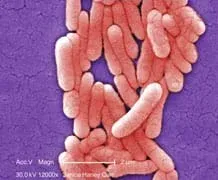 The Salmonella bacteria is sometimes found in raw eggs, meat, dairy and produce.Copyright PHIL, Centers for Disease Control and Prevention http://www.health.wyo.gov/phsd/epiid/salmonella.html
Some of the most common harmful foodborne bacteria are listed below. Refer to The Most Common Harmful Foodborne Bacteria (PDF) for an expanded description of these pathogens, including their preferred environmental conditions, typical sources, resulting illnesses and symptoms, vulnerable populations, incubation periods and durations.
- Escheria coli 0157:H7 (E. coli 0157:H7)
- Campylobacter jejuni
- Salmonella Enteritidis and Typhimurium (2 strains)
- Vibrio cholorae
- Vibrio vulnificus
- Shigella
- Yersinia enterocolitica
- Staphylococcus aureus
- Listeria monocytogenes
- Clostridium perfringens
- Clostridium botulinum
Required Bacterial Growth Conditions
Conditions required for bacterial growth are warm temperatures (if above 40 °F can multiply rapidly to create toxins), nutrient availability (they like high-protein foods), pH above 4.6 (they do not like acidic foods such as vinegar and lemons), and moisture (rarely grow on dry foods, but can grow in a moist intestinal tract). Bacteria can multiply quickly—in fact, one cell can double within 20 to 30 minutes. And, it takes less than 10 E. coli bacteria to make you sick.
The 4Cs of Food Safety remind us of the most effective ways to control bacteria and prevent foodborne illnesses:
- Cooking (heat kills bacteria)
- Chilling (cold slows bacterial growth)
- Cleaning (removes bacteria from surfaces and hands)
- Combating cross contamination (prevents spread of bacteria from one place to another)
Timely Identification of Bacteria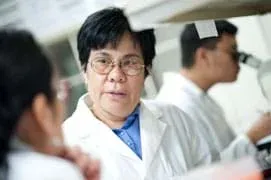 Michigan State University's Dr. Evangelyn Alocilja discusses lab procedures involved in biosensing food contaminants.Copyright 2012 Kurt Stepnitz, Michigan State University http://msutoday.msu.edu/news/2012/msu-spin-out-company-to-market-portable-biohazard-detection/
Many bacteria strains are useful and either help or do not harm humans. Scientists use DNA (genetic) analysis to determine if bacteria found in foods or on surfaces are from harmful groups or strains. The usual method of identifying a bacterial strain is to take a sample from a suspected contaminated food source and grow, or culture, it in a sterilized glass Petri dish with nutrient medium. In two to seven days, the bacterial strain grows to a size at which it can be conclusively identified through DNA analysis. However, this procedure requires a laboratory setting, skilled technicians and expensive equipment. In addition, the time (up to seven days) it takes to get a conclusive result with this process can further compromise human health and increase infection rates.
Bioengineers are researching solutions to the problems associated with the testing and identification of foodborne bacteria, aiming to reduce the incubation period to less than a day and eliminate the need for culturing bacteria in a laboratory. They are developing new types of biosensors that are small, relatively inexpensive, easy for non-scientists to operate, rapid and accurate.
As engineers work to find solutions to this challenge, they follow the engineering design process. The basic steps of the engineering design process are: understand the need, brainstorm different ideas, select the best design to fit the circumstances and constraints, plan, create and improve. This is a cyclical process that requires engineers to test and redesign prototype devices as often as it takes so they end up with reliable finished products.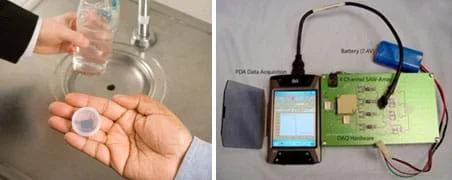 Example biosensors. (left) The "lab-on-a-chip" device is a nanotechnology-based biosensor that tests for waterborne illnesses and infectious diseases. (right) The portable and battery-powered acoustic wave biosensor identifies a wide range of pathogens in minutes.Copyright (left) NASA, (right) Sandia Labs http://www.nasa.gov/centers/ames/multimedia/images/2008/biosensor.html http://www.sandia.gov/mstc/awards-R&D-100.html#nogo
Examples of successfully engineered biosensors are the blood glucose monitoring devices used by diabetic people, in which a test strip contains chemicals that react with blood glucose. A person puts a drop of blood on a treated test strip, which is fed into a small device called a monitor or meter. Some meters measure the amount of electricity that passes through the test strip. Others measure how much light reflects from it. The device gives a numeric reading of the person's blood glucose level. This device enables diabetics to monitor their blood glucose levels by themselves, quickly, accurately and as often as necessary, leading to fewer negative reactions and better overall health.
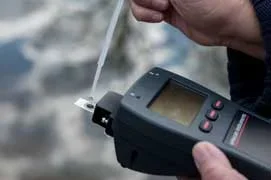 Prototype nano-scale biosensor for quickly identifying and measuring the presence of foodborne bacteria outside of a laboratory.Copyright 2013 Evangelyn Alocilja, Michigan State University
One example of a biosensor for food safety that is currently being developed by engineers is a nano-scale biosensor. Magnetic particles such as iron oxide coated with gold particles at a nanometer scale (one billionth of a meter) are treated with an antibody or DNA designed to bind with a specific pathogen such as E. coli or salmonella. The particles are added to food samples and the mixture sits for 30 minutes or longer to allow binding to occur between the antibody and the bacteria before the particles are placed in a test tube for washing. Washing concentrates the sample to a smaller and smaller volume and extracts food particles to create the maximum opportunity to detect the pathogen.
Next, an electrode is used to apply an electrical charge to see if an electrical response is detected. A response indicates that the bacteria are creating electrical resistance, which means that the bacteria are present even in very low concentrations. The electrical response is recorded and analyzed by a computer program, charted and graphed. A specific pattern on the graph shows that bacteria are present. This process takes no more than a few hours.
This type of biosensor is intended for commercial applications for use on farms, in meatpacking facilities, bottling and packaging plants, markets, institutional settings, and even homes. It has the potential to speed the detection of foodborne pathogens, reduce outbreaks of illness and improve overall food safety.
For additional information, read the Introduction to Dr. X and the Quest for Food Safety Film Reading (PDF).
See the Additional Multimedia Section for recommended additional background resources.
When was the last time you ate a hamburger or chicken nuggets? Had a glass of milk or a mixed salad? (Display a hamburger and chicken nuggets clearly made at home, not from a restaurant—or an image of them.)
How many ingredients do you think are in this hamburger, including the bun and condiments? How many ingredients are in this chicken nugget? What are the ingredients in these food items? (Have small groups of students estimate the number of ingredients and list their names.)
(Then show students the Example Ingredients Lists Visual Aid (PDF).)
Every ingredient in your burger or nugget comes from somewhere in the food supply chain. The average grocery store food item in the U.S. travels about 1,500 miles to get to your plate. Harmful food bacteria like E. coli, salmonella or listeria can be introduced to food anywhere along its route, from the farm, to the production, packaging or manufacturing plant, in shipping, handling, in the grocery store or in your home! Harmful microorganisms called pathogens can make people extremely sick and cause some people to die, especially those who are very young, very old or already ill.
(Show students some images of these pathogens, such as the giant stuffed models of microorganisms found at https://www.giantmicrobes.com/.) Here are some examples of what these pathogens look like when they are magnified large enough to be seen by the human eye without a microscope. What do you think of how these organisms look?
Over the next few days, we are going to work on solving this food safety challenge by investigating:
- What are the most common pathogens in our food?
- How do pathogens enter our food, and how do they harm us?
- What biological tests can be used to find out if pathogens exist in our food?
- What process do engineers use to try to solve problems like those associated with the detection of food contaminants?
What have we learned in this lesson? (Listen to student responses. As necessary, provide prompts and the following summaries.) We learned:
- Our food supply is vulnerable to unwanted bacteria that can cause illness when consumed.
- About the most common types of harmful bacteria, how they get into our food, and the 4Cs of protecting our food.
- Engineers use a problem solving process to design nano-scale biosensors to detect bacteria faster, easier and more accurately than biological tests alone.
- additive
- Any substance added to food that affects the food's characteristics.
- bacteria
- Unicellular organisms lacking organelles or an organized nucleus. Some may cause disease.
- bind
- To fix two or more substances together.
- bio-detection
- Using a device, such a biosensor, to find, identify or quantify a biological entity, such as a virus or bacterium
- bioengineering
- The application of concepts and methods of biology and physics, mathematics or computer science to solve real-world life sciences problems.
- biosensor
- A device that detects, measures and communicates information about physiological changes or the presence of specific chemical or biological materials. Usually composed of a probe for sensing and electronics for processing and signaling.
- cell
- In biology, the basic unit of which all living things are composed.
- contamination
- The unintended presence of harmful substances or microorganisms in food.
- cross-contamination
- The transfer of bacteria from foods, hands, utensils or food preparation surfaces to a food. For example, when liquids from raw meat, poultry and seafood transmit harmful bacteria to previously uncontaminated foods or surfaces.
- culture
- To maintain (tissue cells, bacteria, etc.) in conditions suitable for growth.
- dna
- Acronym for deoxyribonucleic acid. A molecule that forms a double helix composed of units called nucleotides. Each nucleotide is composed of a sugar (deoxyribose) connected to one of four nitrogenous bases by a phosphate molecule. DNA encodes genetic information in all living cells and in many viruses
- electrode
- An electrical conductor used to make contact with a nonmetallic part of a circuit
- food miles
- The distance food is transported from the time of its production until it reaches the consumer.
- food supply
- Amount of a type of food item available for consumption.
- food supply chain
- A series of links and interdependencies that enable food to be produced, processed, transported and consumed.
- foodborne illness
- Infection or intoxication caused by the transfer of microbial or chemical contaminants (substances that spoil or infect) from food or drinking water to humans. In most cases, the contaminants are bacteria, parasites or viruses.
- globalization
- The process of international integration, required due to the increasing connectivity and interdependence of the world's markets and businesses.
- glucose
- A simple sugar that is an important carbohydrate in biologic functions.
- infection
- Attachment and growth of pathogenic micro-organisms, including bacteria, protozoans, viruses and parasites, on or within the body of a human or animal.
- microorganism
- A microscopic life form that cannot be seen with the naked eye. Types of microorganisms include: bacteria, viruses, protozoa, fungi, yeasts and some parasites and algae.
- nano scale
- Measurements at a scale of one-billionth of a meter.
- nutrient
- A chemical that an organism needs to live or grow.
- pathogen
- Any microorganism that is infectious or toxigenic and causes disease. Pathogens include parasites, viruses and some fungi/yeast and bacteria.
- sample
- A specimen taken from food and tested for the purpose of identifying a foodborne pathogen or various kinds of chemical contaminants.
- species
- A group of organisms that are genetically related. The second word in the binomial name of a bacterium is called the species name.
- spore
- A reproductive structure, some of which are adapted for dispersal and surviving for extended periods of time in unfavorable conditions.
- sterile
- Any process that eliminates or kills all form of life from an item or field.
- strain
- A variant of a species of bacteria. Some may be pathogenic and some may be benign. For example, most E. coli are neutral or helpful to people, but E. coli O157:H7 is a strain of E. coli that is harmful to people.
- toxin
- A poison that is produced by microorganisms, carried by fish or released by plants.
- virus
- A non-cellular particle that consists minimally of protein or nucleic acid (DNA or RNA). In order to survive, it must replicate inside another cell, such as a bacterium or a plant and animal cell.
During Film Note-Taking: While watching Module 1 of the Dr. X film, direct students to take notes using the three-column method: 1) ideas they already know, 2) new ideas they learned, and 3) further questions that they have. Review their notes to evaluate their engagement and comprehension.
Organisms Research Findings: In response to the prompts provided on the bottom of the 12 Most Unwanted Bacteria Poster Handout (PDF), have student pairs report to the class their findings from researching specific organisms. Gauge their mastery of the topic by the quality and comprehension of the material presented to the class, and how well they responded to poster questions.
Case Studies Research Findings: Have student groups report to the class their findings from researching real-world "food contamination outbreaks." Assess their mastery of the topic by the quality and comprehension of the material presented to the class. Require reporting on what foods were contaminated, geographical locations of the outbreaks, pathogen identities, how human health was affected, and at what steps in the food supply chain the contaminations were introduced.
Film Companion Qs/As: As students watch Modules 2-3-4 of the Dr. X film, have them use the Film Companion Question Sheet (PDF) and stop between each segment to review questions and clarify concepts. Their answers reveal how much they are paying attention and their depth of comprehension.
Post-Film Quiz: After students have viewed the Dr. X film, administer the Post-Film Quiz (PDF). Review their answers to gauge their mastery of the topic.
Engineering Practices: How can we engineer better solutions to problems? Have students read and discuss the eight practices defined and described on the Engineering Practices Handout (PDF). As homework, assign them to complete the writing and reflection tasks associated with each principle.
Have students explore hand washing as an important way to minimize the spread of disease-causing bacteria, as presented by the Utah Education Network's Glo Germ and Handwashing activity for high school students. In the activity, students learn the importance of correct hand washing, practice washing hands for the correct amount of time, and visualize bacteria. See http://www.uen.org/Lessonplan/preview.cgi?LPid=22559
Dr. X and the Quest for Food Safety online video (46 minutes total) at https://www.fda.gov/Food/FoodScienceResearch/ToolsMaterials/ucm182117.htm
Module 1: Understanding Bacteria
Module 2: Farm (starts at 16 minutes)
Module 3: Processing and Transportation (starts at 20 minutes)
Module 4: Retail and Home (starts at 27 minutes)
Module 5: Outbreak and Future Technology (starts at 31 minutes)
An 18-minute video lesson from the Khan Academy is a good source of general background information about bacteria: www.khanacademy.org/science/biology/v/bacteria
Download the FDA's free "Bad Bug Book" (PDF) for detailed descriptions of food contamination organisms and toxins, and a good reference of all food safety hazards: http://www.fda.gov/food/foodsafety/foodborneillness/foodborneillnessfoodbornepathogensnaturaltoxins/badbugbook/default.htm
The 12 Most Unwanted Bacteria. 2007 Edition. Last updated November 16, 2009. Science and Our Food Supply - Middle School Guide: U.S. Food and Drug Administration, U.S. Department of Health and Human Services. Accessed April 10, 2013. http://www.fda.gov/Food/FoodScienceResearch/ToolsMaterials/ucm182419.htm
Science and Our Food Supply - Middle School Guide. 2007 Edition. Last updated May 21, 2010. U.S. Food and Drug Administration, U.S. Department of Health and Human Services. Accessed April 10, 2013. http://www.fda.gov/Food/FoodScienceResearch/ToolsMaterials/ucm176480.htm
- Biosensors for Food Safety
Contributors
Lisa Wininger; Evangelyn Alocilja; Hannah Miller
Supporting Program
Bio-Inspired Technology and Systems (BITS) RET, College of Engineering, Michigan State University
Acknowledgements
The contents of this digital library curriculum were developed through the Bio-Inspired Technology and Systems (BITS) RET program under National Science Foundation RET grant no EEG 0908810. However, these contents do not necessarily represent the policies of the NSF and you should not assume endorsement by the federal government.
Copyright
2013 by Regents of the University of Colorado; original © 2012 Michigan State University