
The Stress That You Apply: Footprint Area, Weight & Load
 Students examine contact stressCopyright 2012 City of Grimes, IA http://www.grimesiowa.gov/
Students learn about contact stress and its applications in engineering. They are introduced to the concept of heavy loads, such as buildings, elephants, people and traffic, and learn how those heavy loads apply contact stress. Through the analysis of their own footprints, students determine their contact stress.
Civil engineering projects often incorporate the concepts of force, area and contact stress in their designs. For example, bridges, buildings and houses carry heavy loads that are transferred to the soil beneath, thus these concepts are important in determining the best design for such structures. Several additional factors, such as load size, contact area, load transfer system and soil resistance, affect how contact stresses are handled in construction designs. For these reasons, civil engineers must be aware of all the variables that might affect a structure so that they can design and construct safe buildings, bridges, roadways, homes, furniture, vehicles and many other items.
After this activity, students should be able to:
- Describe the concept of contact stress and provide real-world civil engineering examples.
- Describe load and provide examples.
- Explain how contact stress changes when either the contact area or load is adjusted.
- Calculate how much stress their bodies apply to the floor and create a visual representation.
- CCSS.Math.Content.3.MD.B Represent and interpret data.
Grade 3
Do you agree with this alignment? - CCSS.Math.Content.3.OA.A.3 Use multiplication and division within 100 to solve word problems in situations involving equal groups, arrays, and measurement quantities, e.g., by using drawings and equations with a symbol for the unknown number to represent the problem.
Grade 3
Do you agree with this alignment? - CCSS.Math.Content.3.OA.D Solve problems involving the four operations, and identify and explain patterns in arithmetic.
Grade 3
Do you agree with this alignment?
- STEL-7C Explain that design is a response to wants and needs.
Grades -1-2
Do you agree with this alignment? - STEL-7D Discuss that all designs have different characteristics that can be described.
Grades -1-2
Do you agree with this alignment? - STEL-7H Illustrate that there are multiple approaches to design.
Grades 3-5
Do you agree with this alignment?
- 3.OA.3 Use multiplication and division within 100 to solve word problems in situations involving equal groups, arrays, and measurement quantities, e.g., by using drawings and equations with a symbol for the unknown number to represent the problem.
Grade 3
Do you agree with this alignment? - Solve problems involving the four operations, and identify and explain patterns in arithmetic.
Grade 3
Do you agree with this alignment? - Represent and interpret data.
Grade 3
Do you agree with this alignment?
- MS-ETS1-4 Develop a model to generate data for iterative testing and modification of a proposed object, tool, or process such that an optimal design can be achieved.
Grades 6-8
Do you agree with this alignment?
- MS-ETS1-4 Develop a model to generate data for iterative testing and modification of a proposed object, tool, or process such that an optimal design can be achieved.
Grades 6-8
This resource focuses on the following Three Dimensional Learning aspects of NGSS:
Science & Engineering Practices- Develop a model to generate data to test ideas about designed systems, including those representing inputs and outputs.Do you agree with this alignment?
Disciplinary Core Ideas- Models of all kinds are important for testing solutions.Do you agree with this alignment?
- The iterative process of testing the most promising solutions and modifying what is proposed on the basis of the test results leads to greater refinement and ultimately to an optimal solution.Do you agree with this alignment?
Do you agree with this alignment? - Develop a model to generate data to test ideas about designed systems, including those representing inputs and outputs.
Each group needs:
- 2 sheets of 1-inch x 1-inch graph paper (use attached Contact Stress Worksheet (PDF))
- 2-3 crayons
- ~60 pennies
For groups to share:
- weight scale
Have you ever heard the term contact stress? What if I told you that you apply contact stress? I'm sure you are wondering what this means. Well, today we learn all about contact stress, our own contact stress, and how contact stress affects engineering. (Show the class the Contact Stress in Civil Engineering Presentation (PPT).)
At the end of the activity, you will be able to explain why civil engineers design large structures with foundation systems, show how load (or weight) applies equally distributed contact stress on a given area, compare a human body to large structures in terms of their contact stress, and calculate how much stress you apply to the floor when standing.
Let's begin with a few questions to kick off brainstorming about contact stress. What keeps homes and huge buildings and hotels upright and stable? (Give students time to discuss among themselves. Answer: Engineers design a special structure, called a foundation, to hold heavy loads. In order to do that, they need to know the amount of load, or weight, the structure is expected to hold.) What is underneath these special structures? (Expected answers: Soil, rock, clay, groundwater.) Believe it or not, one branch of civil engineering focuses especially on understanding all the Earth's materials, including soil, rock and groundwater. This specific field is called geotechnical engineering.
During the design process of building a new structure, civil engineers calculate the load, or weight, that the structure will be expected to hold. For example, consider if you put a cracker on a bed of sand and lay a penny on the cracker. Slowly add more pennies, one by one, increasing the load that the cracker is holding. The total weight, before the cracker breaks, is what an engineer thinks about during the design phase. When the load, or weight, acts on a surface area (in our case, the bed of sand), we call it a contact stress. Contact stress is a specific force concentrated on a small area (the area underneath the cracker). As another example, think about using your hand as a hammer. If you smack your hand down on your desk, you are experiencing contact stress. The bigger the impact by your hand (for instance, the harder you throw your hand down), the greater the contact stress. Figure 1. The contact stress that a structure applies depends on its load as well as the surface area with which it comes in contact. Wide and low structures (top) apply a very different contact stress to the ground compared to tall, narrow buildings such as skyscrapers (bottom row).Copyright 2012 U.S. Department of Commerce http://www.commerce.gov/blog/category/1764 (top); 2010 U.S. Senator, Idaho, Mike Crapo http://www.crapo.senate.gov/services/MonumentsMemorials.cfm (bottom left); 2009 U.S. Department of Energy http://apps1.eere.energy.gov/news/news_detail.cfm/news_id=12387 (bottom center); {ND} Lawrence Berkeley National Laboratory http://www.lbl.gov/LBL-Programs/global_solutions/ (bottom right)
Usually, engineered structures are supported by the ground itself, so geotechnical engineers usually work on projects with other civil engineers of varying expertises. This is true on construction projects for most structures, such as bridges, tunnels, dams and large buildings. Two of the most important factors for determining contact stress are the size and shape of the structure's load. For instance, imagine the load (weight) of a skyscraper compared with that of a small house. Which would most likely have the largest load, the skyscraper or the house? (Give students time to discuss among themselves. Answer: Skyscraper.) The size and shape of each load on a structure results in different contact stress. Now, let's talk about how to figure out the contact stress if we know the shape and size of the load.
Contact stress is calculated by distributing or dividing the load evenly among the area in contact with the structure. For example, if 100 pounds of pennies evenly rested on one square foot of area (imagine a square plate), every single point on the plate (the area) would feel a contact stress of 100 pounds per cubic foot, 100 pcf. For many engineering designs, engineers deal with contact stress between the structure and the soil beneath. Foundation systems, which support the structure, are designed differently depending on the size and shape of a structure's load, the eventual size of contact stress applied, and the quality of the soil beneath the structure.
Next, we experiment with the concepts of weight and area to help you understand that contact stress is basically the distribution of weight over a unit area. Then, you will trace the outline of your foot (foot print area) to determine the distribution of your weight, represented by pennies. Finally, you compare the contact stress applied when you stand on one foot versus two feet to identify how the stress force changes based on the size of the contact area.
Background
During the hands-on portion of this activity, students determine the contact stress they apply on the ground. They also create visual representations of their contact stress using a quantity of pennies proportional to their weight, evenly distributed in an area created by tracing their own feet.
The teacher should have a knowledge of mass and weight, gravity, area and stress force. The following activities provide basic knowledge on weight, load and force and are recommended for review:
Before the Activity
- Gather materials and make copies of the Contact Stress Worksheet (PDF), one per student.
- Talk to students about different sizes and shapes of loads. Provide examples that compare and contrast big and small loads, such as the Empire State Building in New York or the Sears Tower in Chicago compared to a moderately-sized family house or your school building. Compare the load of an elephant to that of a mouse, a car to bike, a watermelon to an orange, etc.
- Review with students the concepts of area, mass, weight and gravity (refer to recommended activities or the Vocabulary section.)
With the Students
- Ask students to quietly pick a student partner. If an uneven number of students, permit a group of three students.
- Hand out the worksheets and give each group ~60 pennies.
- Direct one student of each group to place his/her worksheet on the floor (hard floor is better than carpeted floor), and gently place his/her foot in the center of the graph paper. Direct the partner student to trace the outline of the foot onto the paper. (Note: Students do not need to trace the outline of each toe.)
- Have students reverse roles so that each student has an outline of his or her feet traced onto a worksheet.
- Have each student work individually to calculate his or her own contact stress with the following instructions:
- Count all squares that are partially included in the footprint outline.
- Multiply this total by ½ (0.5), or divide by 2.
- Round to the nearest whole number (if necessary).
- Record the result in the space on the right edge of the worksheet labeled Partial Squares area. (Note: Provide assistance If students are not capable of multiplying by ½ or dividing by 2.)
- Count each square fully included within the outline.
- Record this total in the space labeled Full Squares area.
- Add Partial Squares area and Full Squares area to find Total area; record on the worksheet as Total area in square inches (because the squares are one inch on each side, the Total area is given in units of square inches).
- When step #5 is complete, have students, one at a time, use the weight scale to determine their weights. Record the weight in the Body weight space on the worksheet.
- Ask students to multiply this total by ½ (0.5), or divide by 2 to find their weight applied to each foot. Write the number in the space marked Body weight per foot. If students are unsure about dividing their weight, provide assistance.
- Using a crayon or marker, have student color each full square a dark color, and each partial square a light color.
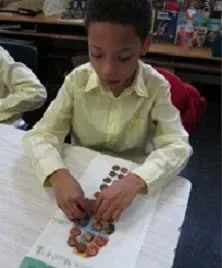 Figure 2. Using his traced footprint and his body weight calculation, a student determines his own contact stress on the ground.Copyright 2013 Eduardo Suescun, Polytechnic Institute of NYU
 - Pennies are used to simulate load (their weight), with each penny representing one pound. Have sudents count out an appropriate number of pennies, based on their weight applied to each foot. For example, a 60-pound student counts out 30 pennies (60 pounds x 0.5). Direct students to write on their worksheets the Total number of pennies they need to use for the activity. (Note: This number should be the same as one-half their body weights, per foot.)
- Direct students to evenly place the number of pennies representing their weight on top of each colored square (see Figure 2). Begin by filling each dark-colored (full) square with one penny. Once every full square is filled with a penny, add a second penny to each full square and one penny to each light-colored (partial) square. Repeat this process until all pennies are evenly distributed across the foot outline.
- At this point, the number of pennies stacked on one full square is considered to be the contact stress. In most cases, students may stack some full squares with one more penny than the other full squares (due to the number of pennies versus the number of squares). For example, some full squares may have three pennies, while the rest of the full squares have four pennies. If this is the case, have students average the two quantities together by adding the two numbers and dividing by two. Provide assistance to students having difficulty with this calculation. Remind students that this number has units of pounds per square inch. (Note: If the weight scale used kilograms instead of pounds, the units would be kilograms per square inch.) The final result provides a visual representation of the division operation and illustrates the concept of contact stress as load divided by area.
- Once finished, combine paired-groups together or form small groups of 4-6 students. Ask students to share and compare their results.
- area
- The two-dimensional space on a surface measured by the number of equal unit squares that fit in the space.
- beam
- A rigid, long, slender, horizontally-oriented construction and support material.
- civil engineer
- An person who applies science and mathematical concepts to design and construct projects such as highways, bridges, buildings and other structures for the benefit of a community.
- column
- A long, rigid, vertically-oriented construction and support material.
- load
- A mass or weight supported or carried by an object.
- mass
- The measure of how much matter is in an object.
- unit square
- A square whose sides have length 1; for example, a 1-inch by 1-inch square, the unit is 1-inch squared.
- weight
- The downward force caused by gravity and the mass of an object. For a given object, the mass of the object times gravity is defined as the object's weight.
Pre-Activity Assessment
Double Think Pair Share: Students team up in groups of four to discuss the following questions:
- What is contact stress? (Answers will vary depending on students' knowledge.)
- What do civil engineers need to know to design and construct a building or other structures? (Possible answers: They need to understand weight, soil, loads, contact areas and contact stress related to the structure and ground below; they need to know on what surface they are going to build.)
- Do you think that increasing the size of a building will increase or decrease the weight of the building? (Answer: Increase.) Why? (Answer: It will weigh more because a bigger building means more materials to build it, which means more overall weight.)
Activity Embedded Assessment
Observation: As students work on determining their contact stresses, circulate the classroom and observe each groups' progress. Ask students the following questions individually or in pairs to assess their understanding of the concept of contact stress:
- How many pennies are in each full square? (Answers will vary.) What does this quantity, or number, mean? (Expected variation of answer: The average of these numbers is the contact weight in pounds per square inch.)
- Does every full square have the same amount of pennies? (Since most students will have an uneven distribution of pennies, a typical answer would be: some squares have three, others four; no, the squares have different amounts.) If the pennies are not the same, how do we find the contact stress? (Answer: To calculate the contact stress, the two numbers are averaged together.)
- What would happen to the number of pennies in each square if your foot was double the size it is now? (Answer: There would be fewer pennies in each square. In fact, there would be half as many pennies in each square.) What does this mean in terms of your contact stress? (Answer: This would mean the contact stress would be half as much as it is now.)
- What would happen to the number of pennies in each square if your foot was half the size it is now? (Answer: There would be more pennies in each square. In fact, there would be twice as many pennies in each square.) What does this mean in terms of your contact stress? (Answer: This would mean the contact stress would be half as much as it is now.)
Post-Activity Assessment
Tippy Toe Trace: Working in the same paired groups, have students, one at a time, flip over their graph papers to the blank sides and stand on the middle of the papers on their tippy toes, holding onto a desk chair for balance. Then the partner student traces the part of the foot in contact with the ground. Once finished, have students reverse roles. Ask students to repeat steps #8-10 of the activity to determine their contact stress on the ground while standing on tippy toes in pounds per square inch. Once students have determined the contact stress acting on this smaller contact area, ask students the following questions:
- What is contact stress? (Answer: Contact stress is a force caused by the load of an object that acts on the area in contact with the object.)
- Do you think that a smaller contact area, such as in the case of standing on tippy toes, causes your contact stress on the ground to be increased or decreased? (Answer: From this example, we can see that reducing the contact area results in more pennies being stacked in each square. This means that given the same load, a smaller contact area results in an increased contact stress acting on the ground.)
If a student's footprint is larger than the sheet of graph paper, tape two sheets of paper together to create a larger grid. Have extra sheets available to do this.
Adjust the amount of technical vocabulary to suit the students' abilities.
Contributors
Eduardo Suescun; Janet Yowell
Supporting Program
AMPS GK-12 Program, Polytechnic Institute of New York University
Acknowledgements
This activity was developed by the Applying Mechatronics to Promote Science (AMPS) Program funded by National Science Foundation GK-12 grant no. 0741714. However, these contents do not necessarily represent the policies of the NSF, and you should not assume endorsement by the federal government.
Copyright
2013 by Regents of the University of Colorado; original © 2013 Polytechnic Institute of New York University