
Naked Egg Drop
Student pairs experience the iterative engineering design process as they design, build, test and improve catching devices to prevent a "naked" egg from breaking when dropped from increasing heights. To support their design work, they learn about materials properties, energy types and conservation of energy. Acting as engineering teams, during the activity and competition they are responsible for design and construction planning within project constraints, including making engineering modifications for improvement. They carefully consider material choices to balance potentially competing requirements (such as impact-absorbing and low-cost) in the design of their prototypes. They also experience a real-world transfer of energy as the elevated egg's gravitational potential energy turns into kinetic energy as it falls and further dissipates into other forms upon impact. Pre- and post-activity assessments and a scoring rubric are provided. The activity scales up to district or regional egg drop competition scale. As an alternative to a ladder, detailed instructions are provided for creating a 10-foot-tall egg dropper rig.
 Figure 1. Students pose with their egg catcher.Copyright 2015 Denise Jabusch, University of California Davis
Engineers must understand well the concepts of energy transfer, conservation of energy, and energy dissipation in order to design uncountable real-world projects. They also need to understand the properties of materials in order to design complex systems. Materials can dissipate energy through various means, such as heat, light, and vibration. For example, engineers design skyscraper foundations using concrete and steel so that any given foundation can withstand the huge force of the building it supports as well as the dynamic forces it may experience during earthquakes. Engineers who design computer keyboards want to select a material that can be repeatedly tapped, can be easily and permanently be printed on for the letters, feels good under finger tips, is inexpensive and environmentally benign, and is cleanable. Identifying the materials that help to meet project constraints is an important aspect of the design process.
After this activity, students should be able to:
- Explain the transfer of potential to kinetic energy of a dropped egg and explain where the energy goes after it hits the egg catcher.
- Explain why some materials are better than others for absorbing the kinetic energy of a falling egg.
- Describe the relationship between height and the kinetic energy of a dropped egg.
- Explain design modifications made during the design process, weighing factors such as height and materials.
- Models are used to communicate and test design ideas and processes.
Grades 3-5
Do you agree with this alignment? - STEL-7I Apply the technology and engineering design process.
Grades 3-5
Do you agree with this alignment? - STEL-7P Illustrate the benefits and opportunities associated with different approaches to design.
Grades 6-8
Do you agree with this alignment?
- 3-5-ETS1-1 Define a simple design problem reflecting a need or a want that includes specified criteria for success and constraints on materials, time, or cost.
Grades 3-5
This resource focuses on the following Three Dimensional Learning aspects of NGSS:
Science & Engineering Practices- Define a simple design problem that can be solved through the development of an object, tool, process, or system and includes several criteria for success and constraints on materials, time, or cost.Do you agree with this alignment?
Disciplinary Core Ideas- Possible solutions to a problem are limited by available materials and resources (constraints). The success of a designed solution is determined by considering the desired features of a solution (criteria). Different proposals for solutions can be compared on the basis of how well each one meets the specified criteria for success or how well each takes the constraints into account.Do you agree with this alignment?
Crosscutting Concepts- People's needs and wants change over time, as do their demands for new and improved technologies.Do you agree with this alignment?
Do you agree with this alignment? - Define a simple design problem that can be solved through the development of an object, tool, process, or system and includes several criteria for success and constraints on materials, time, or cost.
- 3-5-ETS1-2 Generate and compare multiple possible solutions to a problem based on how well each is likely to meet the criteria and constraints of the problem.
Grades 3-5
This resource focuses on the following Three Dimensional Learning aspects of NGSS:
Science & Engineering Practices- Generate and compare multiple solutions to a problem based on how well they meet the criteria and constraints of the design problem.Do you agree with this alignment?
Disciplinary Core Ideas- Research on a problem should be carried out before beginning to design a solution. Testing a solution involves investigating how well it performs under a range of likely conditions.Do you agree with this alignment?
- At whatever stage, communicating with peers about proposed solutions is an important part of the design process, and shared ideas can lead to improved designs.Do you agree with this alignment?
Crosscutting Concepts- Engineers improve existing technologies or develop new ones to increase their benefits, to decrease known risks, and to meet societal demands.Do you agree with this alignment?
Do you agree with this alignment? - Generate and compare multiple solutions to a problem based on how well they meet the criteria and constraints of the design problem.
- 3-5-ETS1-3 Plan and carry out fair tests in which variables are controlled and failure points are considered to identify aspects of a model or prototype that can be improved.
Grades 3-5
This resource focuses on the following Three Dimensional Learning aspects of NGSS:
Science & Engineering Practices- Plan and conduct an investigation collaboratively to produce data to serve as the basis for evidence, using fair tests in which variables are controlled and the number of trials considered.Do you agree with this alignment?
Disciplinary Core Ideas- Tests are often designed to identify failure points or difficulties, which suggest the elements of the design that need to be improved.Do you agree with this alignment?
- Different solutions need to be tested in order to determine which of them best solves the problem, given the criteria and the constraints.Do you agree with this alignment?
Do you agree with this alignment? - Plan and conduct an investigation collaboratively to produce data to serve as the basis for evidence, using fair tests in which variables are controlled and the number of trials considered.
- 4-PS3-2 Make observations to provide evidence that energy can be transferred from place to place by sound, light, heat, and electric currents.
Grade 4
This resource focuses on the following Three Dimensional Learning aspects of NGSS:
Science & Engineering Practices- Make observations to produce data to serve as the basis for evidence for an explanation of a phenomenon or test a design solution.Do you agree with this alignment?
Disciplinary Core Ideas- Energy can be moved from place to place by moving objects or through sound, light, or electric currents.Do you agree with this alignment?
- Energy is present whenever there are moving objects, sound, light, or heat. When objects collide, energy can be transferred from one object to another, thereby changing their motion. In such collisions, some energy is typically also transferred to the surrounding air; as a result, the air gets heated and sound is produced.Do you agree with this alignment?
- Light also transfers energy from place to place.Do you agree with this alignment?
- Energy can also be transferred from place to place by electric currents, which can then be used locally to produce motion, sound, heat, or light. The currents may have been produced to begin with by transforming the energy of motion into electrical energy.Do you agree with this alignment?
Crosscutting Concepts- Energy can be transferred in various ways and between objects.Do you agree with this alignment?
Do you agree with this alignment? - Make observations to produce data to serve as the basis for evidence for an explanation of a phenomenon or test a design solution.
- 4-PS3-4 Apply scientific ideas to design, test, and refine a device that converts energy from one form to another.
Grade 4
This resource focuses on the following Three Dimensional Learning aspects of NGSS:
Science & Engineering Practices- Apply scientific ideas to solve design problems.Do you agree with this alignment?
Disciplinary Core Ideas- Possible solutions to a problem are limited by available materials and resources (constraints). The success of a designed solution is determined by considering the desired features of a solution (criteria). Different proposals for solutions can be compared on the basis of how well each one meets the specified criteria for success or how well each takes the constraints into account.Do you agree with this alignment?
- Energy can also be transferred from place to place by electric currents, which can then be used locally to produce motion, sound, heat, or light. The currents may have been produced to begin with by transforming the energy of motion into electrical energy.Do you agree with this alignment?
- The expression "produce energy" typically refers to the conversion of stored energy into a desired form for practical use.Do you agree with this alignment?
Crosscutting Concepts- Science affects everyday life.Do you agree with this alignment?
- Energy can be transferred in various ways and between objects.Do you agree with this alignment?
- Engineers improve existing technologies or develop new ones.Do you agree with this alignment?
- Most scientists and engineers work in teams.Do you agree with this alignment?
Do you agree with this alignment? - Apply scientific ideas to solve design problems.
Each group needs:
- 1 or more sheet(s) of paper, to sketch and plan egg catcher designs
- pencils
- scissors
- tape and/or glue; white glue for younger students; hot glue for adult helpers and older students
- at least 1 raw egg (depending on the number of testing trials planned per group)
- computer with Internet access, for the research phase of the engineering design process
- Novice Engineer Pre-Assessment (PDF), one per student
- Naked Egg Drop Rules and Score Sheet (PDF), one per group
- Expert Engineer Post-Assessment (PDF), one per student
To share with the entire class: materials for building egg catchers:
- Provide materials such as cardboard or paperboard, clean food containers, foam, tissue paper, fabric, rubber bands, packing peanuts, fiberfill, bubble wrap, cotton balls, grass and other soft and cushiony materials. Reduce the cost by salvaging these materials as much as possible and/or asking students to salvage and bring items from home.
- Do not provide the following materials because they are such excellent shock absorbers (it is nearly impossible to break the egg from amazing heights): food and food ingredients, powders (sand, flour, baby powder), and pastes and gels that stay wet.
Competition supplies to share with the entire class:
- 6 foot (or taller) ladder
- tape measure
- tarp, newspaper or butcher paper, to simplify clean up
- concrete or asphalt slab on which to hold the egg drop competition since grass absorbs a significant amount of shock
- (optional alternative to the ladder) To improve student safety and increase the wow factor, build an egg dropper rig using the materials list and building instructions provided in the Egg Dropper Construction and Use (PDF) (see Figure 2). Building the device is especially recommended if a district or regional competition is planned as part of the Elementary School Engineering Design Field Day unit, since its labor and material costs can be shared among many instructors/classrooms/schools. Estimated materials cost for the rig is ~$300.
- (optional) Especially helpful for large competition events, make a tool to enable quick measurements of egg catcher diameters and heights before the egg drop, as a way to easily enforce the design constraints. The homemade device in Figure 6 consists of a 25-cm diameter circle cut out of wood and an arm with a sliding ruler for measuring device height.
- (optional) For the testing/competition, it may be helpful to have a few other adults or older students on hand to serve as judges and helpers to perform material and dimension checks.
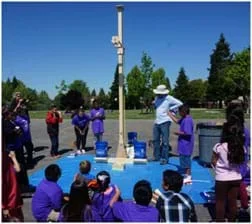 Figure 2. Students keep their eyes on the egg during the naked egg drop competition.Copyright 2015 Denise Jabusch, University of California Davis
- Novice Engineer Pre-Assessment (docx)
- Novice Engineer Pre-Assessment (pdf)
- Novice Engineer Pre-Assessment Answer Key (docx)
- Novice Engineer Pre-Assessment Answer Key (pdf)
- Egg Dropper Construction and Use (docx)
- Egg Dropper Construction and Use (pdf)
- Naked Egg Drop Rules and Score Sheet (docx)
- Naked Egg Drop Rules and Score Sheet (pdf)
- Expert Engineer Post-Assessment (docx)
- Expert Engineer Post-Assessment (pdf)
- Expert Engineer Post-Assessment Answer Key (docx)
- Expert Engineer Post-Assessment Answer Key (pdf)
Students should be familiar with types of energy, specifically gravitational potential, kinetic, thermal and elastic, and the engineering design process. At a minimum, younger students should understand that energy can be transferred and designs can be improved through evaluation and improvement.
Imagine that you are at the Olympics competing in the 10 meter (~30 feet) platform diving event. You've practiced your flawless dive countless hours and you are ready to win a gold medal. You bend your knees, your toes push against the rough surface of the platform, you take a deep breath, and you jump. You whiz through the air, moving faster and faster for what feels like forever. You twist and turn, doing flips as you watch the faces of your supporters. Suddenly, your fingers dip into the water with your arms, shoulders, torso falling from the sky into the depths of the pool. You make the smallest of splashes. Your powerful legs kick and you surface to see all 10.0s from the judges.
Think about what type of energy you had before your jump, during your jump, and right before you hit the water. What allowed you to jump from a great height safely and confidently? What type of energy did you have at the beginning of the jump? (Answer: Gravitational potential energy.) What type of energy did you gain during the jump? (Answer: Kinetic energy.) How could you tell?
Teacher Background
In classic engineering egg drop competitions, an egg gains potential energy the higher it is held above the landing surface. When the egg is released, this gravitational potential energy converts to kinetic energy, as gravity pulls the egg towards the Earth's surface. Once the egg hits the ground, all the kinetic energy (movement energy) needs to transfer somewhere. We know that energy must be transferred into different forms of energy because once the egg stops moving, it no longer has any kinetic energy.
We know by the reliable nature of our world—in this case defined as the law of conservation of energy—that energy is neither created nor destroyed, so in the case of the egg, it must be transferred to different forms of energy. Options for the egg's dissipation of energy as it hits the pavement are sound (the splat of an egg), heat (the egg heats up from the friction of hitting the ground), and/or the continuation of kinetic energy as seen by the breaking of the shell.
As an example of how energy can dissipate, watch what happens to a rubber ball as it hits a wall in the four-second Squash Ball Bounce video at https://www.youtube.com/watch?v=5IOvqCHTS7o. The ball is elastic so it is able to squish dramatically and then reform to its original shape.
But—eggs are not elastic (!) like the ball in the video, so dropped eggs will break without something to take the kinetic energy. The challenge of this activity is for students to design an egg catcher to absorb the kinetic energy and prevent a dropped egg from breaking.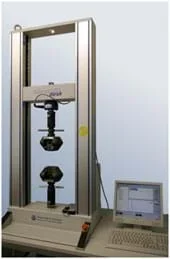 Figure 3. A universal testing machine that is used for tensile testing of materials to determine their elasticity.Copyright 2007 Smial, Wikimedia Commons https://commons.wikimedia.org/wiki/File:Inspekt_desk_50kN_IMGP8563.jpg
Engineers and material scientists use machines (like the one shown in Figure 3) to test materials' stretchiness or elasticity by crushing and releasing test materials between two sensors. An egg's shell is very brittle (not elastic) so elastic materials are the best choice to absorb a falling egg's kinetic energy. If the egg catcher is well designed and the egg does not break, then the material absorbed enough of the egg's energy so that the egg's kinetic energy is not transferred to sound, heat and/or a broken shell. Instead, the energy is transferred to the elastic catcher material, which might squish and then reform to its original shape, as is seen with the squash ball in the video clip.
Refer to the three What Are Newton's Laws? lessons (about Newton's first, second and third laws of motion) and the Solid, Liquid or Gas? activity (about materials) as background or information sources for teachers and students.
Teacher Design Considerations and Tips
Overall, to create a winning design, students must thoroughly understand the competition rules and scoring so that they know the constraints (requirements and limitations) of the problem well (refer to the Naked Egg Drop Rules and Score Sheet (PDF)). This means that like real-world engineers, students must balance competing factors to be successful in this activity. Like professional engineers, they pick appropriate materials, considering the ability to dissipate kinetic energy as well as cost, reused and repurposed materials, and environmental impact of materials used. For example, while plastic foams absorb a lot of kinetic energy, they do not biodegrade quickly.
The ingenious use of materials such as packing peanuts, tissue paper, fabric, rubber bands and grass can cushion and protect an egg from damage; see the Materials List for additional material ideas and refer to the rules and score sheet for prohibited materials (because they work too well!). As students follow the steps of the engineering design process (Figure 4), encourage them to try different materials, different amounts of materials, and/or combinations of different materials in their egg catcher devices. Expect the designs to incorporate their knowledge of materials and the properties of those materials.
Beyond the smart use of materials, another strategy is to design and build catchers that combine the concepts of a hammock and a trampoline. In this approach, the catcher curves around the egg to hold it similar to a hammock, and is also elastic like a trampoline. Students can modify these sorts of designs by changing the height of the suspended hammock and/or the "give" of the springs or spring-like structures.
For the egg catcher footprint, it is best to use the largest surface area possible for increasing the likelihood of catching the dropped egg. Then, working within the constraint that the catchers must be no more than 25 cm in any direction, direct student teams to decide what shape gives them the largest surface area for aiming the egg at, as well as complying with the 25 cm rule. (A circle footprint provides the biggest surface area within this constraint.) Once groups have mastered the catch from the highest possible height, have them iterate through the design process for size. Have students aim to reduce the surface area since the competition tie-breaker depends on minor diameter, which is defined with a sketch in the rules and score sheet.
If highly elastic materials are used, the egg may bounce off and crack on the ground. To prevent this from happening, students may build walls on the device. As part of the engineering design process, direct students to aim to minimize the catcher height while still preventing breakage or bouncing.
Before the Activity
- Decide whether to provide students with an assortment of building materials from which to use, or break the first hour into two parts, with time in between for the teacher and/or students to acquire building materials as specified from group designs. Then, for the building component of the activity, assemble scavenged or purchased materials and/or request that students bring scavenged or purchased materials from home. Take note of the banned list of materials—items that are too effective at being shock absorbers!
- Gather and assemble materials for students to plan and build egg catchers.
- Gather and assemble competition supplies and equipment. Arrange for extra helpers and judges if necessary.
- Make copies of the Novice Engineer Pre-Assessment (PDF), Naked Egg Drop Rules and Score Sheet (PDF) and Expert Engineer Post-Assessment (PDF).
With the Students
- Administer the pre-assessment, as described in the Assessment section.
- Present the Introduction/Motivation content to the class.
- Divide the class into groups of two students each. Hand out the supplies, including the rules and score sheet.
- Introduce the design challenge: To create a device to catch an egg dropped from a height without the egg breaking.
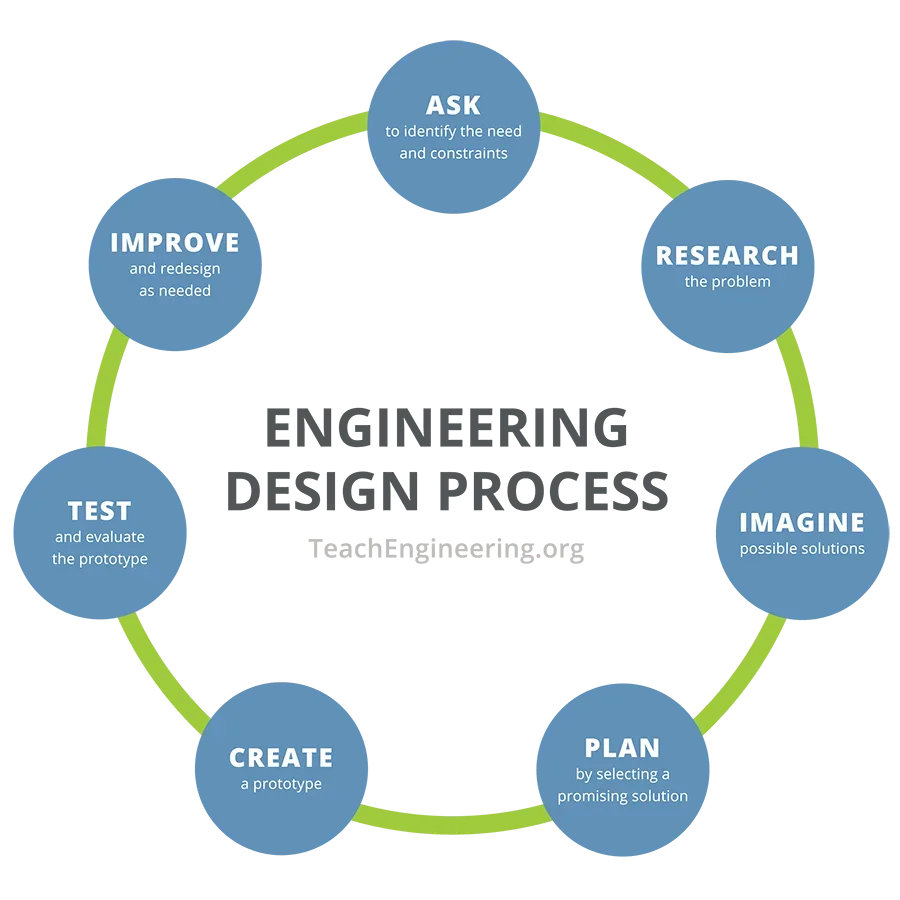 Figure 4. The steps of the engineering design process.Copyright 2014 TeachEngineering.org. All rights reserved.
 - Review the steps of the cyclical and iterative engineering design process (see Figure 4). Tell students that as student engineers, they might begin by asking questions to understand the problem, including its criteria and constraints, then researching to learn more, then imagining ideas before making plans for how to create the best solution they can think of. Next, teams each create a prototype, test it, and change and improve the design from what they learn through testing.
- Ask: Identify the need and constraints. Have students read the first page of the competition rules and score sheet. As mentioned earlier, the engineering "need" is to design a device to catch an egg dropped from a height without the egg breaking. Make sure teams are aware of the constraints (requirements and limitations). Remind students that the egg catchers must be made of approved materials (no gels, food, powders), have all materials secured, and be less than 25 cm in any direction.
- Research the Problem. Have student teams independently investigate materials science and energy of motion topics. Show the class the Squash Ball Bounce video and discuss the elasticity measuring device. Additional research might focus on inventions such as trampolines, catchers' mitts and rock climbing pads to learn about their design approaches and materials.
- Imagine: Develop possible solutions. Direct student teams to brainstorm together and then design and sketch on paper their ideas for egg catcher designs. Remind students to include dimensions and materials lists. Remind them to calculate the surface area available to catch the egg of their planned devices. Encourage students to salvage materials or use materials some people consider waste (what's in the recycling bin?). Engineers often try to incorporate underutilized materials like "waste" to decrease the cost and the environmental impact of their designs. Examples include saved and dried paper towels used as cushioning in the egg catcher or an empty cereal box to make the egg catcher exterior structure.
- Plan: Select a promising solution. After teams have developed a few design ideas, have them decide on a final design. Remind them to review the rules and scoring sheet to make sure the design addresses and considers all the constraints.
- Require the final plan to include a drawing of what the catcher will look like including labels that describe special features, and a list of materials and amounts, especially if the teacher is providing the materials.
- Create: Build a prototype. Next, student engineering teams each build an initial prototype. Figures 1 and 5 show examples of completed student-designed and -built egg catchers.
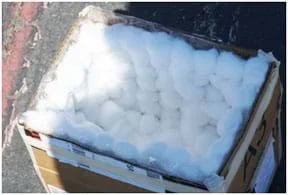 Figure 5. An example egg catcher made by an elementary school student.Copyright 2015 Denise Jabusch, University of California Davis
 - Test and evaluate prototype.
- Use the score sheet to record pre-competition material and dimension checks (see Figure 6) to verify that team prototypes meet all the constraints, balancing the conflicting factors of their devices. This includes a check for permitted vs. banned materials and a shake test, plus measurement of the catcher height and footprint area (all dimensions must be < 25 cm).
- Then test the catchers by dropping eggs either by hand from a ladder or by using an egg dropper device (like the one shown in Figure 2). The minimum drop height is 100 cm and the maximum height for the egg-dropping device is 365 cm. The maximum height using a ladder depends on ladder height and student safety limitations.
- During competition, give each group three drops; let them pick how much to increase the height between each successful drop.
- After the test, students calculate their drop height-to-catcher height ratios, which are indicators of effective design and used to determine the competition winner. The shorter the egg catcher and the taller the drop ratio indicates a team that has selected materials and amounts that can successfully dissipate much kinetic energy.
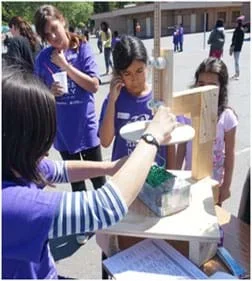 Figure 6. A teacher uses a device to quickly measure an egg catcher diameter and height before the competition.Copyright 2015 Denise Jabusch, University of California Davis
 - Improve: Redesign as needed. Expect students to learn a lot from their egg catcher tests and from observing other teams' tests, resulting in many ideas for design improvement and refinement.
- Regroup the teams or class to discuss what parts of their designs worked well and what needs to be changed during the re-design process. If an egg breaks due to bouncing, a revised design might raise the catcher walls. If an egg breaks due to inadequate cushioning, a team might change the material amount or type. Other issues might be the result of student error, such as poor aiming of the dropped egg or sloppy placement of the catcher on the ground below the egg.
- Then direct teams to restart the design process with their design changes in mind. Test again, as time and materials permit, declaring a winner at competition end.
- Administer the post-assessment, as described in the Assessment section.
- constraint
- A limitation or restriction. For engineers, constraints are the requirements and limitations that must be considered when designing a workable solution to a problem.
- engineering design process
- A series of steps used by engineering teams to guide them as they create, evaluate and improve a design solution. Typically, the steps include: identify the need and constraints, research the problem, develop possible solutions, select a promising solution, create a prototype, test and evaluate the prototype, redesign as needed.
- gravitational potential energy
- One type of potential energy due to the mass of Earth pulling objects towards its surface.
- kinetic energy
- The energy of an object's motion.
- potential energy
- The stored energy of an object.
- prototype
- A first attempt or early model of a new product or creation.
Pre-Activity Assessment
Pre-Assessment: Before starting the activity, administer the three-question Novice Engineer Pre-Assessment (PDF) to gauge students' base level of understanding about the egg drop challenge and the types of energy involved. Answering the questions also helps students begin to formulate solutions.
Activity Embedded Assessment
Rules and Score Sheet: Have students use the Naked Egg Drop Rules and Score Sheet (PDF) to prepare for the competition. Throughout the design process, observe and evaluate students' catchers to help them think through the constraints of the challenge.
Discussion Questions: Ask students questions to determine their depth of understanding, such as:
- What are ways you can get disqualified from the competition? (Answer: Using prohibited materials, building an egg catcher with any dimension greater than 25 cm, not securing materials to the structure of the egg catcher.)
- What egg catcher shape maximizes surface area under our constraints? (Answer: A circle.)
- What materials dissipated the kinetic energy from the falling egg? (Answer: Elastic materials.)
- Why might you need walls on the sides of an egg catcher? (Answer: To prevent the egg from bouncing out and breaking on the ground.)
- What are safety concerns with this activity? (Answer: Falling off the ladder.)
Post-Activity Assessment
Post-Assessment: After the activity, administer the six-question Expert Engineer Post-Assessment (PDF) to gauge student comprehension. This short-answer test gives students an opportunity to write about their successes and failures through experiencing the design process.
Discussion Questions: As a class, ask the following questions to reveal students' depth of comprehension:
- How did your design change from your initial sketch to your first-built catcher prototype to your last catcher? (Have each team share its story.)
- Why was it important to test your catcher before competition?
- What did you learn by doing a test? (Listen to examples from many teams.)
- Why do professional engineers build prototypes and models and test them?
- Why is it important to understand the properties of materials for your designs?
- What types of energy or energy transfer are present in the fall of the egg? (Answer: Prior to the drop, an elevated egg has a large amount of gravitational potential energy due to its height above the ground. When it is dropped, that the energy is transferred from potential to kinetic. Right before the egg hits the egg catcher, (nearly) all the potential energy has been converted to kinetic energy.)
Presentations: As an alternative post-activity assessment, require student groups to make brief summary class presentations of their egg catchers to the rest of the class, pointing out their features, lessons learned, improvements and final results.
If using a ladder to drop the eggs, do not permit any rough-housing around the ladder. Have one person dedicated to holding the ladder when a student is climbing it.
- For lower grades, relax the construction requirements to permit larger devices or more materials.
- For higher grades, increase the construction requirements to smaller egg catchers or increase the initial drop height.
- Have more advanced students do some area calculations to determine the shape that provides the biggest egg catcher design surface area within the 25 cm constraint. (A circle footprint.)
Show students an example of how energy can dissipate by watching what happens to a rubber ball as it hits a wall in the four-second Squash Ball Bounce video at https://www.youtube.com/watch?v=5IOvqCHTS7o.
Contributors
Lauren Jabusch
Supporting Program
RESOURCE GK-12 Program, College of Engineering, University of California Davis
Acknowledgements
The contents of this digital library curriculum were developed by the Renewable Energy Systems Opportunity for Unified Research Collaboration and Education (RESOURCE) project in the College of Engineering under National Science Foundation GK-12 grant no. DGE 0948021. However, these contents do not necessarily represent the policies of the National Science Foundation, and you should not assume endorsement by the federal government.
Heartfelt thanks to Travis Smith, for developing, building, testing and writing instructions for the egg dropper device (Figure 2). Travis also designed and made the device for quickly measuring the dropper (Figure 5). You can see from Figure 2, where Travis is pictured in the hat and blue shirt, that he is a wealth of knowledge on engineering, geekery and fashion.
Copyright
2015 by Regents of the University of Colorado; original © 2015 University of California Davis